
Pre-Insulated Pipe Selection for Hot and Chilled Water Projects
When a district heating or cooling project moves from concept to specification, the piping system is often the deciding factor between a network that performs for decades and one that requires early intervention. For engineers, contractors, and utility operators evaluating buried or above-ground water networks, pre-insulated pipe has become the default technical answer. But not all pre-insulated pipes are interchangeable, and the selection process involves a specific set of project-driven criteria.
This article provides an independent, practical reference for choosing pre-insulated pipe systems for hot water and chilled water applications. It covers the technology, material structure, performance limits, application fit, and the questions buyers should ask before committing to a supplier.
The Project Problem: What Pre-Insulated Pipe Must Solve
Any pipe network that carries hot or chilled water loses energy through the pipe wall. In a buried network, that loss is compounded by moisture, soil pressure, and corrosion. A conventionally insulated pipe that is wrapped or insulated on site is exposed to installation variability, water ingress, and long-term material degradation.
Pre-insulated pipe solves this by factory-bonding three layers into a single system: a service pipe, an insulating layer, and an outer casing. The result is a pipe that is designed for direct burial, predictable thermal performance, and reduced maintenance. For project owners, the engineering question is not whether pre-insulated pipe is needed, but which configuration, material, and specification match the operating conditions of the network.
Heat Loss and Operational Efficiency
Modern district heating networks rely on pre-insulated pipe to keep heat loss within acceptable limits. According to Strategic Market Research, pre-insulated pipes reduce heat loss by over 30% in modern district heating networks such as Copenhagen's. That figure illustrates the margin between an efficient network and one that loses revenue through the ground. For chilled water networks, the same logic applies in reverse: the insulation must keep cold water cold, preventing heat gain that reduces cooling efficiency.
Buried Conditions and Service Life
Underground pipe networks face thermal expansion stress, soil load, groundwater corrosion, and external impact. A pre-insulated pipe with a rigid polyurethane foam layer and a high-density polyethylene (HDPE) outer jacket is engineered to withstand these conditions. The insulation layer protects the service pipe with high-temperature resistance and anti-aging performance, while the outer jacket provides waterproofing and moisture resistance in humid and saline-alkaline geological environments.
The Insulated Pipe System: Structure and Materials
Understanding the structure of a pre-insulated pipe is essential for specifying the right product. The most common system for hot water networks is a steel service pipe surrounded by rigid polyurethane foam, encased in an HDPE outer jacket. This is the configuration used in directly buried hot water pre-insulated pipe systems.
Service Pipe
The service pipe carries the medium. For hot water networks, this is typically steel. For chilled water or corrosive environments, the material selection may differ. Buyers can specify custom pipe material depending on the application; options include carbon steel, stainless steel, and other materials as required by the project.
Insulation Layer
Rigid polyurethane (PU) foam is the industry-standard insulation material for this product type. It provides a combination of low thermal conductivity, structural strength, and moisture resistance. The foam is injected between the service pipe and the outer jacket in a factory-controlled process, ensuring a consistent, void-free insulation layer.
Outer Jacket
For directly buried installations, the outer jacket is most commonly high-density polyethylene (HDPE). It provides mechanical protection, waterproofing, and resistance to soil chemicals. For above-ground installations, a galvanized iron jacket is available, offering additional mechanical strength and protection against UV exposure and physical impact.
Alternative Jacket Materials
While HDPE is the standard for buried networks, galvanized iron jackets are used in above-ground installations or where additional mechanical protection is required. This distinction matters in procurement, because the jacket material affects not only performance but also the installation method and long-term maintenance expectations.
Performance Parameters Every Buyer Should Verify
Before selecting a pre-insulated pipe, buyers should verify the following operating parameters against their project requirements.
| Parameter | Typical Limit for PU-Foam Systems |
|---|---|
| Continuous operating temperature | No higher than 120°C |
| Occasional peak temperature | No higher than 130°C |
| Working pressure | No more than 2.5 MPa |
| Design service life at 120°C | At least 30 years |
These limits define the operating envelope for a standard polyurethane insulated pipe. Projects that exceed these values, such as high-temperature steam networks, require a different insulation system. Pre-insulated steam pipes exist, but they are not the same product as a standard hot water pre-insulated pipe and use different insulation and casing materials.
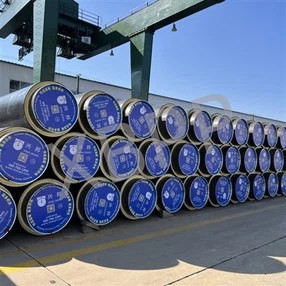
Typical pre-insulated pipe construction: steel service pipe, rigid polyurethane foam, and outer jacket.
Project Scenarios: Where Insulated Pipes Fit
Pre-insulated pipes are widely applied to anti-corrosion, thermal insulation, and cold preservation pipeline projects in the fields of heating, cooling, and crude oil transportation. The product serves a range of project types, including municipal heating projects, industrial park projects, residential community projects, cogeneration projects, urban pipe network renovation projects, urban comprehensive pipe gallery projects, and commercial building heating projects.
District Heating Networks
District heating is the most common application for directly buried hot water pre-insulated pipe. These networks transport hot water from a central plant to residential, commercial, and industrial buildings. The pipe must maintain water temperature across long distances while buried in soil, making heat loss reduction the primary performance criterion.
District Cooling Networks
Pre-insulated chilled water pipes serve district cooling systems, particularly in commercial districts and smart city developments. The Global Market Insights forecast points to a 5.7% CAGR for district heating and cooling from 2024 to 2032, and SNS Insider projects a 9.48% CAGR for pre-insulated pipes used in district cooling, driven by rising smart city projects. For these networks, the insulation prevents heat gain and condensation, protecting the chilled water temperature.
Municipal and Residential Projects
Municipal heating projects and residential community projects benefit from direct burial, which saves land occupation and reduces civil engineering investment compared with above-ground pipe racks or trenches. Waterproof and moisture-proof construction allows the pipe to be installed in underground environments that would otherwise accelerate corrosion.
Above-Ground Installations
Not all pre-insulated pipe is buried. For above-ground installations, a galvanized iron jacket pre-insulated pipe provides additional mechanical protection. This is often used in industrial facilities, pipe bridges, or areas where the pipe is exposed to physical impact or UV radiation.
Case Evidence: Long-Term Operation in Real Projects
The selection of pre-insulated pipe is ultimately validated by project history. Long-term stable operation in a variety of climates and project types is an important signal for buyers.
Internal project references provide some context on the range of applications. A Mexico Bank project used roughly 30 km of pre-insulated pipe for cooling and heating supply and has maintained stable operation over a 2-year period. In Jamaica, a hotel project used approximately 3 km for cooling and heating supply with stable operation over 2 years. A copper mine project in Mongolia used about 9 km, with a 3-year service history. In Uzbekistan, municipal projects used 6 km of pipe for cooling and heating supply with a 5-year service history. In Cambodia, the NaGa Phnom Penh district cooling project used 5 km with 10 years of stable operation, and a university construction project in Ho Chi Minh City, Vietnam, used 6 km with a 7-year service history. A further Cambodia municipal project used 5 km and has operated for 10 years.
These examples span banks, hotels, mining facilities, municipal networks, and universities, indicating that the same product architecture can serve widely different project types when the specification matches the operating conditions.
Market Context: The Growth of the Insulated Pipe Market
Multiple third-party market estimates confirm that pre-insulated pipes are a growth category. Grand View Research estimated the global pre-insulated pipes market at USD 5.97 billion in 2024 and projects it to reach USD 10.4 billion by 2030, a CAGR of 9.7%. SNS Insider valued the global district heating market at USD 209.34 billion in 2024.
Regionally, Asia Pacific dominated with a 39.96% revenue share in 2024, while Europe holds approximately 38% of the global pre-insulated pipe systems market share. These regional figures reflect different drivers: Asia Pacific's urbanization and new infrastructure, and Europe's mature district heating networks and replacement demand. On a segment basis, the commercial end-use segment held a 43.8% revenue share in 2024, and the oil and gas segment held 34.89% in 2023. The Oil and Gas segment alone represented over a third of demand, confirming the relevance of pre-insulated pipe beyond municipal heating.
It should be noted that estimates of the global market size vary across research institutions; for example, Strategic Market Research cites USD 9.8 billion and MarketsandMarkets cites USD 5.27 billion for related market definitions. Buyers should treat market sizing as directional rather than exact.
Comparison with Traditional Solutions and Field-Applied Insulation
The main alternative to pre-insulated pipe is on-site insulation of bare steel pipe. This comparison is directly relevant to procurement decisions.
Factory-Bonded vs. Field-Applied Insulation
In a factory-bonded pre-insulated pipe, the PU foam is injected and cured under controlled conditions, producing a homogeneous, void-free insulation layer. In field-applied insulation, workers wrap or spray insulation around the pipe after installation. Quality depends heavily on workmanship, weather conditions, and the ability to achieve a continuous moisture barrier.
From a lifecycle perspective, the pre-insulated system has a clear advantage: the insulation layer is protected by an outer jacket that is mechanically applied and sealed, separating the foam from ground moisture. Field-applied systems require careful sealing of every joint, and any breach can lead to water ingress, loss of insulation value, and corrosion of the steel pipe.
Cost and Scheduling Considerations
Pre-insulated pipe has a higher up-front material cost than bare pipe plus loose insulation materials. However, it reduces installation time because joints are the only field operations. For large-diameter networks, the reduction in labor and the elimination of a separate insulation crew can offset a portion of the material premium. For complex underground projects under high groundwater conditions, the reliability advantage of a factory-applied outer jacket often justifies the premium.
Limitations and Boundaries
The standard PU-foam pre-insulated pipe has an operating envelope that buyers must respect. It is suitable for temperatures up to 120°C (peak 130°C) and pressures up to 2.5 MPa. Higher-temperature industrial steam networks, for example, require specialized insulation systems beyond a standard polyurethane insulated pipe. Similarly, in extremely corrosive soil conditions, the HDPE jacket provides a strong but not absolute barrier, and joint integrity remains the responsibility of the installation team.
Pre-insulated pipe is also not a universal replacement for all piping approaches. In a project with a very short pipe run, or where routing is highly complex with many tight bends and limited straight sections, the benefits of an engineered pre-insulated system are reduced. For projects with very short distances and low thermal importance, field-insulated pipe may be adequate.
Manufacturing and Customization Capability
Because pre-insulated pipe is specified to project conditions, manufacturing flexibility is a procurement criterion. Buyers should evaluate a supplier's ability to customize the product rather than only selecting from a standard catalogue.
Customization Options
Tangshan Xingbang Pipeline Engineering Equipment Co., Ltd, a manufacturer located in Houhu Industrial Park, Yutian Economic Development Zone, Hebei Province, China, offers full customization for pre-insulated pipe. The company supports custom pipe diameter and length, custom pipe material, custom temperature and pressure rating, custom insulation thickness, custom anti-corrosion grade, custom non-standard pipe fittings, custom design for geological conditions, and custom intelligent monitoring systems.
This range of options matters because project conditions vary widely. A district heating network in a salt-affected soil region has different requirements from a chilled water line beneath a commercial building. The ability to adjust insulation thickness or choose a more robust jacket material can be decisive.
Production and Quality Control
Xingbang reports an annual production capacity of insulation pipes exceeding 3,000 kilometers, monthly capacity of 200 km, and a lead time of 30-45 days. The company employs 231 people, including 30 R&D engineers, and has a factory area of 310,000 square meters. It was founded in 1995 and has export markets in Europe, North America, the Middle East, South America, and Asia-Pacific. The company is a participant in the formulation of the national standard for directly buried insulation pipes in China.
Quality control is a key selection criterion. Xingbang reports 100% testing of products, and the minimum order quantity is 1 km. For buyers commissioning large networks, a manufacturer with tested production and a stated quality control process reduces the risk of hidden defects.
Procurement Evaluation: How to Select a Pre-Insulated Pipe Supplier
For buyers at the evaluation stage, the following criteria provide a structure for comparing suppliers.
Technical Specification Compliance
Verify that the pipe specification covers the operating temperature, pressure, service life, and burial conditions of the project. If the project is governed by a standard such as EN 253, the supplier should demonstrate that the pipe system conforms to the requirements of the standard. EN 253 is the industry standard for pre-insulated bonded pipe systems for directly buried hot water networks, and PU foam insulation for EN 253 pipes typically withstands temperatures up to 120°C.
Material Traceability
The buyer should be able to trace the service pipe material, insulation raw material, and outer jacket material to documented sources. For steel service pipes, standards such as ASTM A53 cover seamless and welded black and hot-dipped galvanized steel pipe, and buyers may require certificates from the steel mill.
Production and Testing Process
Ask how the foam is injected, how bonds are verified, and how joints will be sealed. A supplier that performs 100% testing and controls the foaming process in the factory provides a higher assurance level than a supplier that only assembles components.
Project Support and Logistics
For exported projects, logistics and on-site support matter. Xingbang states that it establishes dedicated on-site service teams to deliver one-on-one, point-to-point full-range services throughout the project. This includes supervision of installation, jointing, and testing, which is valuable for projects in markets with less local experience in district heating construction.
Evidence of Long-Term Operation
Request references for projects with a service history of 5 to 10 years, not only from commissioning. Stable operation over a decade is a stronger signal than a new installation.
Cost Factors and Total Cost of Ownership
Total cost of ownership for a pre-insulated pipe network is driven by several factors:
- Material cost of the pipe itself
- Installation cost, including trenching, laying, and jointing
- Long-term maintenance and repair costs
- Energy losses over the operating life
- Risk of failure and its consequences for service continuity
Pre-insulated pipe reduces the total number of insulation field joints, speeds up installation, and reduces the risk of corrosion-related failures. The higher material cost should be weighed against lower installation labor and the reduction of energy losses over time. A pipe that maintains its thermal performance for decades is less expensive over its lifecycle than a cheaper pipe that loses insulation value after a few years of moisture ingress.
Technical Installation Considerations
Even with a high-quality pre-insulated pipe, installation quality determines the network's actual service life. The following areas require particular attention.
Jointing
Joints are the points where the insulation layer is most vulnerable. The manufacturer provides matched equipment for jointing, including electrofusion sleeves, heat shrinkable sleeves, insulation joint material, foaming filler, and sealing and waterproof material. Proper jointing restores the continuity of both the moisture barrier and the insulation layer. If the joint is not sealed correctly, water will enter the foam and cause corrosion and loss of insulation.
Handling and Storage
Pre-insulated pipes have a relatively fragile foam layer beneath the jacket. Dropping or dragging the pipe can crush the foam or cause delamination. Buyers should require installation contractors to follow the manufacturer's handling and storage guidelines, including using proper lifting equipment and storing the pipe on flat, level surfaces.
Burial and Backfill
The pipe must be laid on a stable foundation and covered with approved backfill material without sharp stones that could damage the jacket. Thermal expansion must be accommodated according to the design, which may include expansion loops or pre-stressing techniques. A competent design engineer will ensure that the pipe's expansion characteristics are properly managed.
Limitations and Standard Compatibility
The selection of a pre-insulated pipe system must be compatible with the project's regulatory and technical context. The most widely referenced international standard for this product family is EN 253. Buyers in Europe, the Middle East, and Asia Pacific commonly specify EN 253 conformity for directly buried hot water networks.
Buyers should also note that standards are not one-size-fits-all. A project that includes steam distribution requires reference to a different product category, as steam pipe insulation needs to withstand much higher temperatures and is not necessarily a polyurethane foam product. Similarly, above-ground installations may require different UV resistance properties, and the jacket material should be selected accordingly.
Future Outlook: Insulated Pipe and Network Evolution
The future direction of the pre-insulated pipe market is shaped by the transition to lower-carbon district energy systems. District heating and cooling networks are increasingly integrated with heat pumps, industrial waste heat, geothermal sources, and solar thermal plants. These systems require piping that maintains low thermal losses at lower temperature gradients and operates predictably over long periods.
Market projections support this trend. The pre-insulated pipes market is expected to grow at 9.7% annually between 2024 and 2030, and district cooling specifically is expected to grow at a CAGR of 9.48%, driven by smart city projects. The Oil and Gas segment, which accounted for a 34.89% revenue share in 2023, continues to drive demand in industrial applications. Next-generation insulation materials, such as aerogels, are emerging for ultra-low heat loss systems, but standard PU foam remains the economic mainstream.
For buyers, this means that pre-insulated pipe is not a short-term supply decision. A pipe specified today will operate for 30 years or more. The choice of a supplier with financial stability, manufacturing scale, and a track record of exports to multiple regions reduces the risk of supply chain disruption during a multi-year project.
Frequently Asked Questions
What temperature range can a pre-insulated pipe handle?
Standard polyurethane insulated pipes with an HDPE jacket are suitable for media temperatures no higher than 120°C, with occasional peak temperatures up to 130°C. Working pressure should not exceed 2.5 MPa. Under these conditions, the pipe can operate continuously for at least 30 years.
How long can pre-insulated pipes last underground?
A directly buried pre-insulated pipe system with rigid polyurethane foam insulation and an HDPE outer jacket is designed to operate for at least 30 years at a continuous media temperature of 120°C. Actual service life depends on installation quality, joint integrity, and soil conditions.
Is pre-insulated pipe suitable for chilled water networks?
Yes. Pre-insulated pipes are widely used for cooling and cold preservation in district cooling systems. The same PU-foam insulation that prevents heat loss in hot water networks also prevents heat gain in chilled water networks. The market segment for pre-insulated pipes for district cooling is growing at a higher rate than the overall market, reflecting increasing smart city projects and commercial cooling demand.
What is the difference between HDPE jacket and galvanized iron jacket pre-insulated pipe?
An HDPE jacket is the standard outer casing for directly buried installations. It provides waterproofing, moisture resistance, and protection against soil chemicals. A galvanized iron jacket provides increased mechanical strength and UV resistance, making it preferable for above-ground installations or where the pipe is exposed to physical impact. The selection depends on whether the pipe will be buried or installed above ground.
How much heat loss does pre-insulated pipe reduce?
In modern district heating networks, pre-insulated pipes have been shown to reduce heat loss by over 30%. For example, networks such as Copenhagen's district heating system rely on pre-insulated pipe to maintain thermal efficiency across long distribution distances. The exact reduction depends on operating temperatures, pipe diameter, insulation thickness, and burial conditions.
What standards apply to pre-insulated pipe systems?
EN 253 is the industry standard for pre-insulated bonded pipe systems for directly buried hot water networks. It defines the performance requirements for the service pipe, insulation layer, and outer jacket. In the United States, ASTM A53 covers the steel pipe commonly used as the service pipe. Buyers should confirm whether their project specification requires EN 253 conformity or another applicable standard.
Can a pre-insulated pipe be customized for a specific project?
Yes. Leading manufacturers offer customization of pipe diameter, length, pipe material, temperature and pressure rating, insulation thickness, anti-corrosion grade, non-standard fittings, and design for specific geological conditions. Customization also extends to intelligent monitoring systems that can detect leaks or moisture intrusion in the pipe network.
How is the quality of pre-insulated pipe verified?
Manufacturers verify quality through production testing, including testing of the foam density, bond strength, and dimensions. Some suppliers report 100% testing of their products. Buyers should request test certificates and, when possible, witness the production process or use third-party inspection services.
What are common applications for pre-insulated pipe beyond district heating?
Beyond municipal and residential heating, pre-insulated pipe is used in industrial park projects, cogeneration plants, urban pipe network renovation, commercial building heating and cooling, crude oil transportation, and district cooling systems. The insulation system protects the service pipe from corrosion and minimizes energy loss in any application where hot or cold media are transported over distances.
Why is pre-insulated pipe considered a long-term investment?
The combination of a factory-applied insulation layer, sealed outer jacket, and standard service life of at least 30 years reduces the need for pipeline maintenance and repair. Pre-insulated pipe lowers heat loss, prevents corrosion, reduces the risk of unplanned failures, and avoids the requirement for pipe trenches that are large enough to allow future insulation replacement. For buyers, the total cost of ownership over a 30-year project horizon is more favorable than a field-insulated system that may require insulation repair or replacement earlier.
For further review of Xingbang's product range and technical specifications, the company brochure is available for reference: Xingbang Insulated Pipe Company Brochure.