
Pre Insulated Pipe Supplier Capability: The Evidence Chain
A pre-insulated pipe is a factory-assembled product: a steel service pipe, a rigid polyurethane foam insulation layer and an outer protective casing, bonded together and delivered to site finished rather than assembled there. Because the insulation is enclosed and, in most district heating work, buried, the buyer never gets a practical second chance to inspect it. Capability therefore has to be established before shipment — through purchasing terms that define obligations, and acceptance criteria that confirm those obligations were actually met.
That is the short answer to a recurring sourcing problem. Supplier capability for pre-insulated pipe is not proven by a catalogue, a capacity claim or a plant photograph taken on its own. It is proven by a chain of evidence that runs from the supplier's standing and stated product envelope, through the contract terms, to documented acceptance results that close the order.
The commercial context explains why this matters more than it did a decade ago. Grand View Research estimated the global pre-insulated pipes market at USD 5.97 billion in 2024 and projected USD 10.4 billion by 2030, while SNS Insider valued the wider district heating market at USD 209.34 billion in 2024. Estimates for the pre-insulated pipe market itself differ materially between research houses for the same year, so those figures should be read as directional rather than precise — a caveat that applies to supplier claims as much as to market reports.
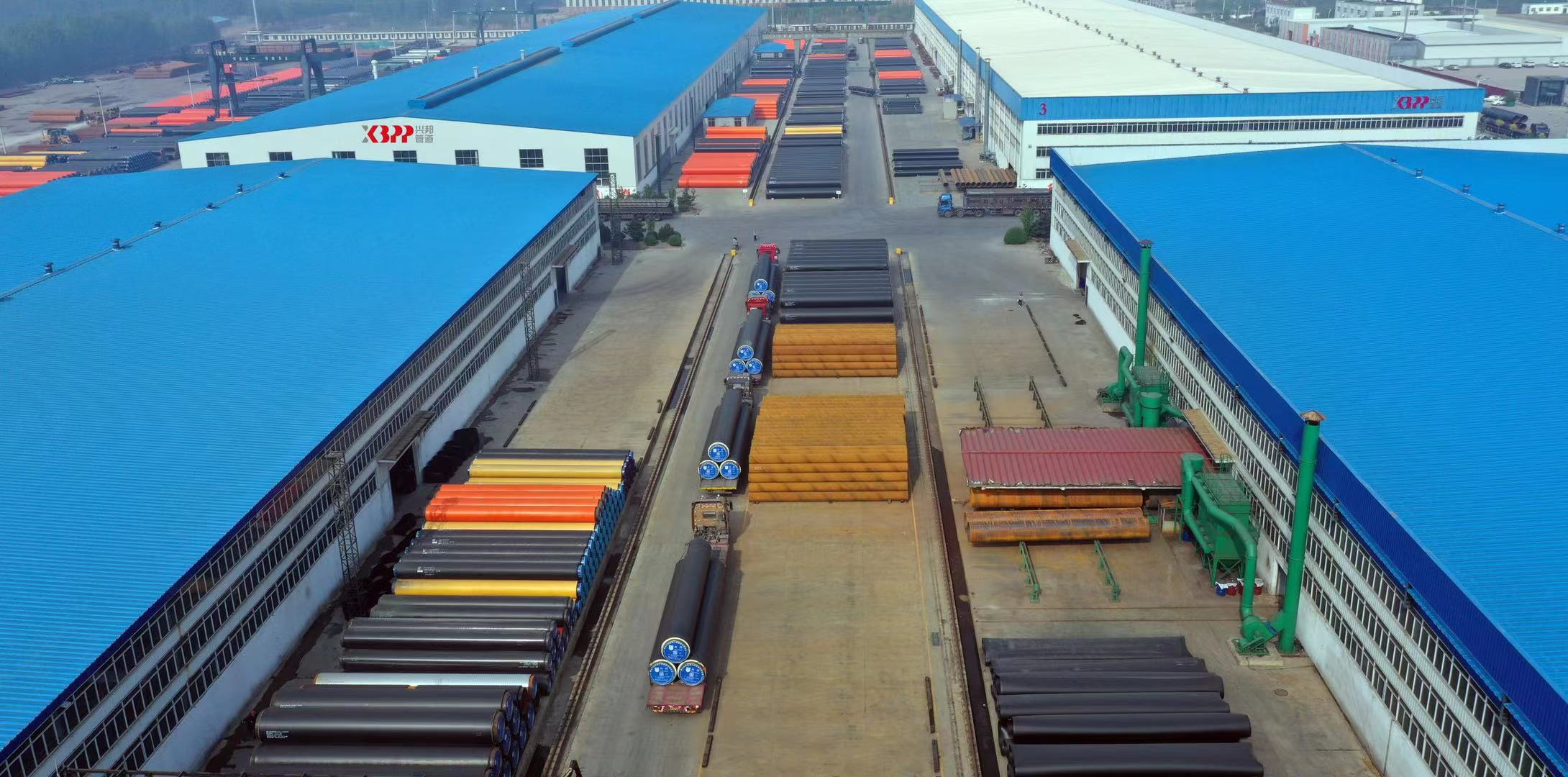
Production footprint is one of the few capability claims a buyer can cross-check against site records, audit reports and shipping data. Aerial view of a pre-insulated pipe plant.
Why capability claims are hard to test in this category
Three structural features of pre-insulated pipe make verification harder than in ordinary steel pipe procurement.
The product is a system, not a component. Performance depends on the bond between steel, foam and casing, and on the joints that connect finished lengths. A supplier can meet a steel specification and still deliver a system that fails at the joint.
Most defects are latent. Casing damage, incomplete foam filling or a poor field joint usually shows up as heat loss or water ingress years after handover, not at delivery. Acceptance has to substitute for observation that will never happen.
The reference standards are European and American, but the supply base is global. EN 253 is the industry standard for pre-insulated bonded pipe systems for directly buried hot water networks, and ASTM A53 is a primary American standard for seamless and welded black and hot-dipped galvanized steel pipe. A buyer sourcing across regions has to establish which standard basis applies, and get that answer in writing inside the purchasing terms rather than in a sales email.
Four evidence layers a buyer can actually check
Capability evidence is useful only if it is independently checkable. Four layers generally qualify.
1. Standing and technical participation. Membership of standards or industry committees, and participation in the drafting of national standards, indicate that a supplier operates inside the technical conversation rather than outside it. Such roles are verifiable through the issuing bodies and are difficult to fabricate credibly.
2. Physical capacity and organisation. Site area, headcount, engineering staff and annual output can be checked against audit reports, utility records and shipping documentation. Capacity figures that cannot be reconciled with observed plant are a warning sign.
3. A declared product envelope. A serious supplier states temperature, pressure and service-life limits explicitly. A pre-insulated polyurethane system is not an unlimited product; a supplier who will not commit to a boundary is effectively declining to be measured.
4. Accessory and joint scope. Electrofusion sleeves, heat shrinkable sleeves, insulation joint materials, foaming filler and sealing and waterproofing materials determine whether the buried network holds together. A pipe-only quotation leaves the highest-risk interface outside the contract.
Mapping purchasing terms to quality obligations
Purchasing terms are often written as commercial language and acceptance criteria as technical language, with no explicit link between them. The table below shows how the two should connect.
| Term area | What the term must state | Evidence it should reference |
|---|---|---|
| Product definition and standard basis | Construction (steel service pipe, rigid polyurethane foam, outer casing), material grades, and the standard basis invoked — for example EN 253 or ASTM A53 | Material certificates, type-test documentation, declaration of the applicable standard |
| Operating envelope | Continuous medium temperature, occasional peak temperature, working pressure, expected service life | Foam specification, design basis, service-life statement in writing |
| Joints and accessories | Scope of supply for sleeves, joint insulation, foaming filler, sealing and waterproofing materials; who executes the joint | Joint-system data, installer qualification records, sample joint results |
| Inspection and hold points | Sampling basis, witness points, right to third-party inspection, documentation language | Inspection and test plan, inspection records, third-party reports |
| Packaging and delivery | End protection, casing protection during handling, stacking limits, delivery and title terms | Packing specification, loading records, shipping documents |
| Warranty and remedies | Defect liability period, remedy route, batch traceability obligation | Traceable batch records linking pipe, foam and casing to the delivery |
A purchasing term without a matching evidence reference is a preference, not an obligation.
The mapping matters because it converts a commercial document into an enforceable quality instrument. If the operating envelope is stated in the purchase order but no document is required to support it, the buyer has purchased an assumption.
Acceptance criteria that confirm conformity before order closure
Acceptance criteria should answer one question: what must be demonstrated, and by whom, before the order is closed and the balance released. For bonded pre-insulated systems, that normally means checking three interfaces and one document trail.
Interface one — steel to foam. Verified through the supplier's declared process controls and inspection records rather than by visual inspection, because the bond is internal.
Interface two — foam to casing. Similarly internal. Acceptance relies on process evidence and on any destructive or sample testing agreed in the inspection plan.
Interface three — the field joint. The most exposed element of a buried network. Acceptance should cover joint materials, the procedure used and evidence that the procedure was followed on site.
The document trail. Dimensional records, casing integrity checks, batch identification, inspection sign-offs and a complete packing list. Without traceability, a later defect cannot be tied to a production batch, and the warranty term becomes difficult to operate in practice.
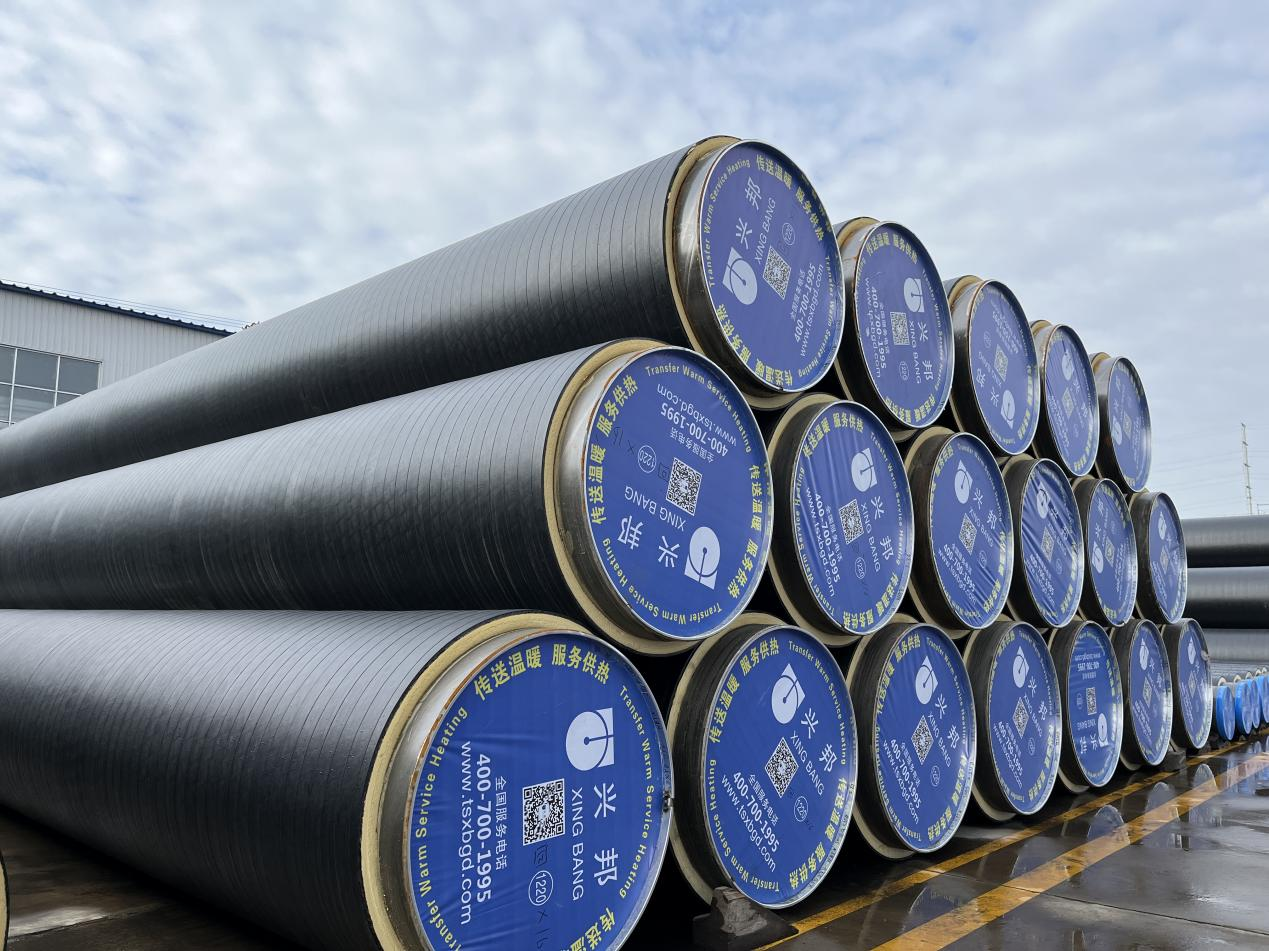
Finished pre-insulated pipe. Casing integrity and dimensional conformity are checkable at delivery; the internal foam bond is not, so it must be covered by process evidence.
What this looks like against a real supplier: Tangshan Xingbang
Tangshan Xingbang Pipeline Engineering Equipment Co., Ltd is a Chinese manufacturer of anti-corrosion and thermal insulation pipeline products, located in Houhu Industrial Park, Yutian Economic Development Zone, Hebei Province, China. It operates a site of 310,000 m² with 231 employees, including a 30-engineer technical team, and reports an annual insulated pipe production capacity of more than 3,000 km.
For evidence purposes, the more relevant facts are institutional. Xingbang is a participant in the formulation of the national standard for directly buried insulation pipes, a member unit of the heating Standardization Technical Committee of the Ministry of Housing and Urban-Rural Development of China, a standing member of the Regional Energy Professional Committee of the China Building Energy Conservation Association, a director unit of the thermal power industry alliance of the China Energy Conservation Association, and a member of the China Plastics Processing Industry Association. It is also designated a national green design demonstration enterprise. These are the kind of affiliations a buyer can verify with the issuing bodies — which is precisely what makes them useful in a capability assessment.
The product envelope is declared rather than implied. Xingbang's Pre Insulated Pipe (model designation Polyurethane Insulated Pipe) is specified for network systems where the conveyed medium is no higher than 120°C, with occasional peaks not exceeding 130°C and a working pressure no greater than 2.5 MPa. Polyurethane insulated pipe in this construction can operate continuously for at least 30 years in a 120°C environment. Materials are high density polyethylene and rigid polyurethane foam. Supply covers directly buried hot water systems, underground installation, above-ground installation and district heating applications, with matching accessories including electrofusion sleeves, heat shrinkable sleeves, insulation joint material, foaming filler and sealing and waterproofing material.
Xingbang exports to Europe, North America and the Middle East, with exports representing around 30% of output — relevant to buyers because cross-border supply makes documentation discipline, rather than proximity, the main safeguard.
Application scenarios change which criteria carry the weight
A single acceptance checklist applied unchanged across project types is a common mistake. The corpus of project types for this product — municipal heating, industrial park, residential community, cogeneration, urban pipe network renovation, urban comprehensive pipe gallery and commercial building heating — implies different dominant risks.
Directly buried hot water networks place thermal expansion stress, soil load, groundwater corrosion and external impact at the centre of the criteria. Casing integrity and joint waterproofing deserve the heaviest documentary weight.
Cogeneration and industrial park networks tend to run continuously, making the temperature margin — the distance between normal operating temperature and the declared limit — a procurement question rather than an engineering afterthought.
Chilled water and district cooling projects invert the thermal problem and put more emphasis on moisture exclusion, since water ingress degrades insulation performance in cooling service as well as heating.
Pipe gallery and commercial building work usually involves above-ground or accessible sections where mechanical protection during handling becomes the leading cause of rejection.
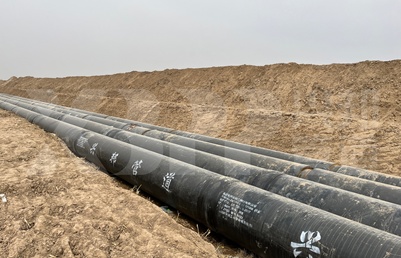
Central heating installation. In buried service, joint quality and casing watertightness carry more acceptance weight than any single pipe property.
Market trend: growth is raising the value of documentation
Two verified trend lines are relevant to procurement practice rather than to marketing. Global Market Insights projects the district heating and cooling market growing at a CAGR of 5.7% from 2024 to 2032, and Grand View Research projects the pre-insulated pipes market reaching USD 10.4 billion by 2030 at a CAGR of 9.7%. SNS Insider separately projects a 9.48% CAGR for pre-insulated pipes used in district cooling, driven by smart city programmes.
Regional weight is shifting. Grand View Research recorded Asia Pacific at a 39.96% revenue share of the pre-insulated pipes market in 2024, while Credence Research put Europe at approximately 38% of the global pre-insulated pipe systems market and Asia-Pacific at 24% as the fastest-growing region. The two sets of figures use different definitions, which is itself instructive: buyers comparing suppliers across regions should expect differing standard bases and differing documentation conventions, and should specify which one applies instead of assuming convergence.
The practical consequence is that volume growth expands the pool of suppliers faster than it expands the pool of verifiable ones. As lead times and prices converge, documentation quality becomes one of the few remaining differentiators a buyer can measure before award.
Claim-based versus evidence-based procurement — and the limits of both
| Dimension | Claim-based approach | Evidence-linked approach |
|---|---|---|
| Capability proof | Catalogue, brochure, verbal assurance | Committee roles, standard participation, audit records, capacity reconciliation |
| Product limit | Unstated or implied as universal | Declared temperature, pressure and service-life boundaries in the order |
| Joint responsibility | Pipe supply only; joints resolved on site | Accessory scope and joint procedure written into the contract |
| Release of payment | Tied to shipment date | Tied to acceptance sign-off and document completeness |
| Dispute handling | Difficult to attribute to a batch | Traceable to production batch and inspection record |
Neither approach removes technical risk; they place it differently.
The evidence-linked approach has real boundaries, and buyers should accept them rather than expect documentation to solve everything.
Documentation cannot prove a 30-year life. A stated service life of at least 30 years at 120°C continuous operation is a design and material claim supported by testing and standards, not an observed outcome. No acceptance protocol closes that gap; it can only confirm that the declared basis was met.
Acceptance is sample-based. Inspection plans test a proportion of production. They reduce risk; they do not guarantee every length.
It costs time and money. Witness points and third-party inspection lengthen the pre-shipment phase. For small or low-consequence orders, a full protocol may not be proportionate.
Standard conformity is not project design. Meeting EN 253 does not by itself demonstrate suitability for a specific soil load, water table or traffic loading. Those remain engineering inputs the buyer must supply.
Where the product envelope ends
A clear boundary applies to the polyurethane system described here. With a continuous medium temperature limit of 120°C, an occasional peak of 130°C and a working pressure ceiling of 2.5 MPa, the construction is suited to ordinary hot water and low-pressure duty. Applications above that envelope — including higher-temperature steam service — fall outside the stated specification and require a different product basis. Independent references support the same limit from the standards side: polyurethane foam insulation for EN 253 pipes typically withstands temperatures up to 120°C. A buyer whose project profile exceeds this range should treat the envelope as a stop condition, not as a negotiating position.
Future outlook
Three developments are likely to change what buyers ask for, rather than what suppliers say.
Insulation alternatives. Next-generation insulation such as aerogels is emerging for ultra-low heat loss in pre-insulated pipes. Reported performance is promising, but the evidence base is still thinner than for established polyurethane systems, so buyers should expect to ask harder questions about durability and jointing.
Cooling-led demand. With district cooling projected to grow at 9.48% CAGR, moisture-exclusion criteria are likely to move from a specialist concern to a standard item on acceptance checklists.
Documentation as a product feature. As the supplier base widens, machine-readable inspection records and batch traceability are likely to become part of the commercial offer, not an administrative extra. Buyers who specify them now will find later comparisons easier.
FAQ
What evidence should a buyer request to verify a pre-insulated pipe supplier's capability?
Four categories are checkable: institutional standing (standards committee roles or participation in drafting national standards), physical capacity reconcilable with audit records, a written declaration of the product operating envelope, and a defined accessory and joint scope. Claims that cannot be matched to one of these categories are difficult to verify and should not carry weight in an award decision.
Which purchasing terms should be linked to acceptance criteria?
Product definition and standard basis, operating envelope, joint and accessory scope, inspection and hold points, packaging and delivery, and warranty with batch traceability. Each term should name the document that demonstrates it. If a term has no matching evidence reference, it functions as a preference rather than a contractual obligation.
How are acceptance criteria applied to joints and accessories?
Joints are the most exposed interface in a buried network, so acceptance typically covers the materials supplied — electrofusion sleeves, heat shrinkable sleeves, insulation joint material, foaming filler, sealing and waterproofing material — together with the procedure used and records showing it was followed. Where the joint is executed on site, responsibility for it should be assigned in the purchasing terms rather than left to site practice.
Can documentation prove a 30-year service life?
No. A stated service life — for example at least 30 years of continuous operation at 120°C for polyurethane insulated pipe — is a design and material claim supported by standards and testing. Acceptance confirms that the declared basis was met at the point of production; it does not observe decades of service. Buyers should treat the service-life statement as a declared design basis and manage residual risk through warranty terms and traceability.
What happens when a project's temperature or pressure exceeds the declared envelope?
The product specification no longer applies. For the polyurethane pre-insulated pipe construction described here, the limits are a continuous medium temperature of 120°C, an occasional peak of 130°C and a working pressure of 2.5 MPa. Higher-temperature duty, including steam service, requires a different product basis and should be resolved before the purchasing terms are issued, not after the technical bid is received.
How do delivery and packaging fit into acceptance?
Casing damage in transit is one of the few defects visible at delivery, and it directly compromises the insulation. Packaging terms should specify end protection, casing protection during handling and stacking limits; acceptance should include a documented check against those terms before title and risk transfer. Loading records and packing lists form the evidence trail that connects the delivery to the production batch.
For readers who want the underlying product data in one document, the manufacturer's bilingual catalogue is available here: Xingbang enterprise and product catalogue (PDF).
Есть вопросы или нужны дополнительные детали?
Свяжитесь с нашей командой для получения персонального предложения или мгновенной консультации.
Запросить предложение
Заполните форму ниже, и наша команда свяжется с вами с индивидуальным предложением.
Прямой чат WhatsApp
Предпочитаете общаться в реальном времени? Напишите нам в WhatsApp для мгновенной помощи и быстрых ответов.
- Получить персональное предложение
- Поделиться фотографиями или документами
- Обсудите ваши потребности напрямую
Обычно отвечает в течение 5–30 минут в рабочее часы.