
Pre-Insulated or Site-Insulated Pipes? A Buyer Comparison
Directly buried hot water networks and district cooling loops share the same engineering problem: holding the heat — or the cold — inside the pipe across decades of soil load, groundwater exposure and thermal cycling. Two production models answer that problem. A pre-insulated pipe is manufactured as a bonded three-layer system in a factory, combining a steel service pipe, rigid polyurethane (PU) foam insulation and an outer protective jacket, most commonly high-density polyethylene (HDPE). Onsite insulation reverses the sequence: bare steel pipe is installed first, and the thermal layer is built up in the trench or on the pipe rack.
EN 253, the industry standard for pre-insulated bonded pipe systems for directly buried hot water networks, is written around the factory model. This comparison looks at both approaches from a buyer's seat — the person who has to reconcile quotations, delivery schedules, certification files and site labour — and concentrates on two questions that decide most projects: how consistently insulation quality can be documented, and how much installation time is actually saved. It draws on published standards, certificate scopes and recorded project details, and it states the boundaries of the pre-insulated option as plainly as its advantages.
Two Systems, Two Control Points
In a bonded pre-insulated system the three layers behave as one composite. The PU foam adheres to the steel service pipe and to the outer jacket, so the assembly responds to soil load and thermal movement as a single unit rather than as a pipe with a separate blanket around it. Because the foam is injected and cured inside a plant, the variables that determine insulation quality — foam density, cell structure, adhesion, jacket fit — are set by a production process rather than by weather and site practice.
Onsite insulation keeps the pipe as the constant and treats insulation as a site activity. Bare pipe is welded, pressure-tested and inspected first; the thermal layer and the outer protection are applied afterwards, onto a surface whose condition, moisture level and temperature depend on the day. The advantage is adaptability. Field application can follow complex routing, awkward fittings and late design changes without waiting for a fabrication slot.
The practical difference is therefore not 'better' or 'worse' but where quality is decided. Pre-insulation moves that decision upstream, into a plant with a documented process and a certificate scope. Onsite insulation keeps it downstream, with the installation crew and the site inspector. The two methods fail in different ways, and they are audited in different ways.
The Constraint Set: Check These Before Comparing Anything
Buyers who compare a factory-made pre-insulated pipe line against site-applied insulation before checking the operating envelope are often comparing options that are not interchangeable. For PU-foam pre-insulated pipe the envelope is defined, and it is narrower than that of general steel pipe.
| Constraint | Stated position for PU pre-insulated pipe | What the buyer must verify |
|---|---|---|
| Medium temperature | No higher than 120°C, with occasional peaks not exceeding 130°C (Xingbang stated range). PU foam in EN 253 pipes typically withstands temperatures up to 120°C (Rovanco Piping Systems). | Design supply temperature, peak excursions and start-up conditions. |
| Working pressure | No more than 2.5 MPa (Xingbang stated range). | Design pressure plus surge allowance. |
| Product standard | EN 253 and EN 448:2019 appear in the CE scope held by Xingbang. | Which standard edition the project specification cites. |
| Certificate scope | DN20–DN1800 (CE, GOST); pre-insulated pipe DN1600 mm and below (ISO 9001 scope). | Whether the project DN falls inside each scope. |
| Stated service life | Continuous operation for at least 30 years at 120°C (manufacturer statement). | Whether that figure matches the design life in the specification. |
Two consequences follow. First, if a network runs above the PU envelope — high-temperature hot water or steam service — the standard PU pre-insulated product is not the correct comparison, and the question should go back to the design engineer rather than to the supplier's catalogue. Second, scope matters as much as existence. A DN1800 order and a DN1600 order sit in different documentation positions, because the CE and GOST scopes reach DN1800 while the ISO 9001 scope statement stops at DN1600 mm and below. None of these limits is a marketing claim; they are the point at which the standard, the certificate and the manufacturer's own stated parameters agree.
Quality Consistency: What a Factory Can Document
Tangshan Xingbang Pipeline Engineering Equipment Co., Ltd, trading as Xingbang, is a Chinese manufacturer of pre-insulated and anti-corrosion pipeline systems based in Houhu Industrial Park, Yutian Economic Development Zone, Hebei Province, China. Its site covers 310,000 m² and employs 231 people, including a 30-engineer R&D team; roughly 30% of output is exported, with Europe, North America and the Middle East listed as main markets. Its Polyurethane Insulated Pipe range is the directly buried hot water and chilled water product discussed in this comparison.
Three certification documents are the ones a buyer can physically check. The ISO 9001 certificate, number 02807Q10270R6M, was issued by Beijing Zhong'an Quality & Environment Certification Center Co., Ltd. against GB/T 19001—2016 / ISO 9001:2015, is valid from 19 February 2024 to 10 February 2027, and covers production of pre-insulated pipes DN1600 mm and below together with construction of pipeline insulation projects and processing and service of anti-corrosion insulation projects. That scope is worth reading twice: it covers insulation project construction as well as pipe production, which is relevant to joint work as well as to the factory product.
The EU CE verification of conformity, number ICR Polska/VC/HS220608, was issued by ICR Polska Co. Ltd against EN 448:2019 and EN 253:2019 for polyurethane pre-insulated pipes DN20 mm to DN1800 mm, and is valid from 24 June 2022 to 23 June 2027. The Russian voluntary certification, number РОСС CN.MJI10.H13406, was issued by Эрри-тест against GOST 30732-2020 for DN20 mm to DN1800 mm, valid from 28 January 2026 to 27 January 2031.
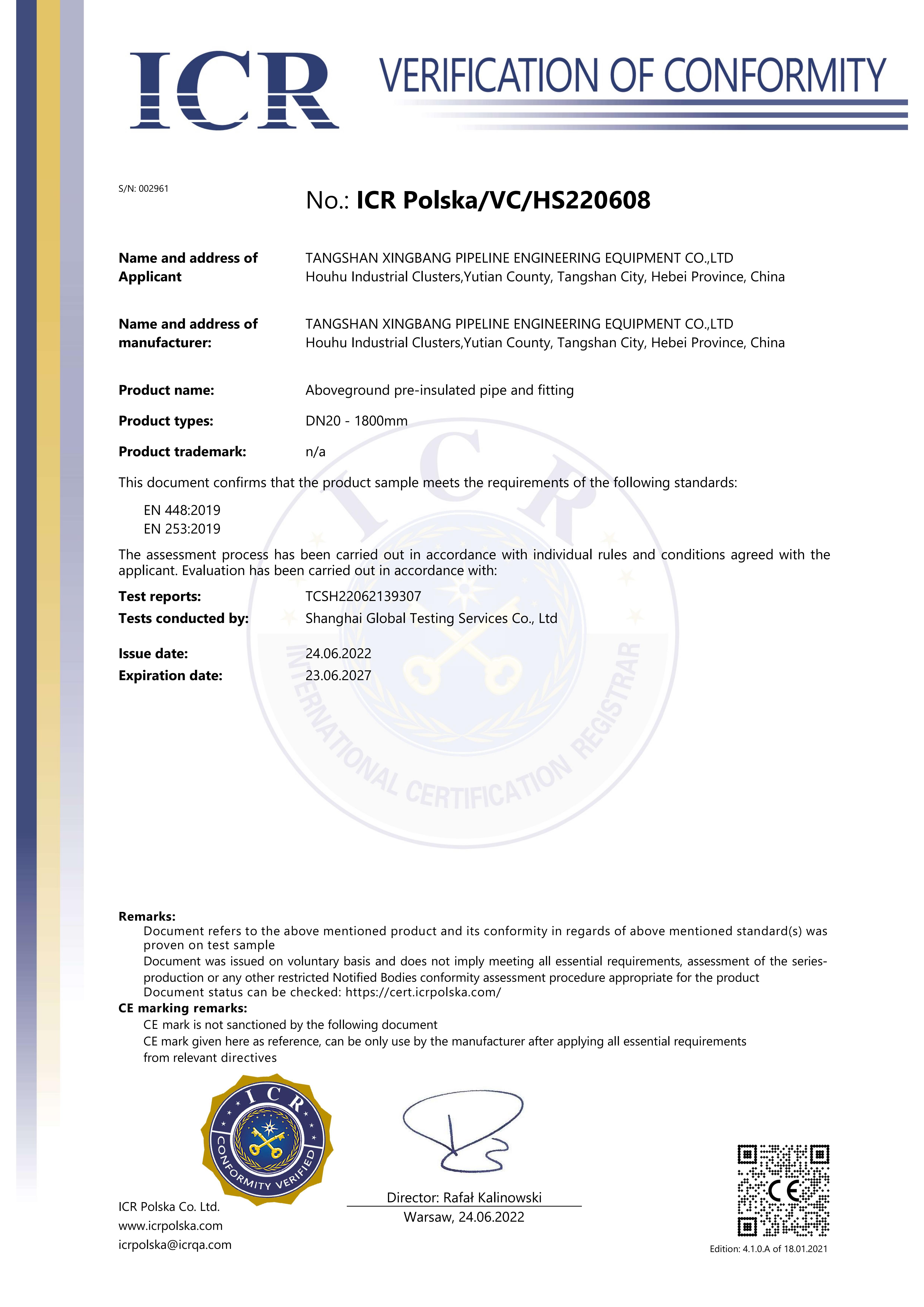
CE verification of conformity held by Xingbang, issued against EN 448:2019 and EN 253:2019 for polyurethane pre-insulated pipes DN20–DN1800, valid to 23 June 2027.
For a buyer in the research and evaluation stage, the practical lesson is procedural rather than promotional: check each certificate's diameter range and expiry date against the project's largest DN and latest delivery window. A certificate that expires before commissioning, or that stops below the specified diameter, creates a documentation gap even when the product itself is sound. Xingbang also states 100% testing on production, a monthly capacity of 200 km, a minimum order quantity of 1 km and a lead time of 30–45 days — figures that belong in the same evaluation file as the certificates, because they constrain what can be delivered and when.
Installation Efficiency: Where the Hours Actually Go
Installation efficiency is where factory pre-insulation is usually assumed to win, and the assumption is partly correct — but the comparison has to be counted in the right unit. Pre-insulation removes the insulation step from the trench along the straight runs. It does not remove the joints.
At every field joint the jacket is opened, the service pipe is welded and tested, and the insulation is rebuilt. Xingbang lists the materials this step requires: electrofusion sleeves, heat shrinkable sleeves, insulation joint material, foaming filler, and sealing and waterproof material. Those materials, the crew that applies them and the inspection that follows represent the same category of work whether the rest of the line was insulated in a plant or in the trench. The honest comparison is therefore per joint, not per kilometre. A route with many fittings, valves and direction changes carries more site work than a long straight run, and it is precisely at those points that the two methods converge.
The other half of the schedule equation runs the other way. Onsite insulation carries no fabrication lead time, no minimum batch and no transport constraint on section length, but it is exposed to weather, surface preparation and the availability of competent applicators, and those variables are harder to schedule with confidence. Pre-insulated supply, by contrast, has a defined production sequence — for Xingbang, 30–45 days against a 1 km minimum order — which rewards early design freeze and penalises late variation.
Where Onsite Insulation Still Makes Sense
A neutral reading of the constraint set produces a clear list of situations in which site-applied insulation remains the more defensible choice.
The first is service conditions outside the PU envelope. High-temperature hot water or steam duty sits beyond the stated 120°C continuous and 130°C peak limits, so a different insulation material and a different design approach are required regardless of how the pipe is supplied. The second is scale: quantities below the 1 km minimum order, or works phased across several years, fit site application more comfortably than a factory batch. The third is geometry and retrofit: existing bare pipe already in service, congested plant rooms, non-standard fittings and heritage or heritage-style routes where dimensions only become clear during the works. The fourth is design maturity — if routing is still moving, factory fabrication locks dimensions that may later change.
None of this removes the documented weaknesses of site application. Insulation consistency depends on the applicator, the weather and the inspection regime, and the resulting quality record is only as good as the project's own test plan. The point is that the weaknesses are manageable through supervision, while the factory advantages are real but conditional on order size and design freeze.
Side-by-Side Comparison for Buyer Evaluation
| Decision dimension | Factory pre-insulated pipe | Onsite insulation |
|---|---|---|
| Where the insulation is formed | In a plant, under process control | In trench or on rack, by the site crew |
| Quality evidence | Product certificates with stated DN range and validity | Depends on the project inspection and test plan |
| Field joints | Still required: sleeves, foaming, sealing | Continuous with the insulation work itself |
| Weather dependence | Low at insulation stage; storage and handling still matter | High |
| Design flexibility | Dimensions fixed at fabrication | Adjustable on site |
| Minimum order | 1 km (Xingbang stated MOQ) | No factory minimum |
| Lead time | 30–45 days (Xingbang stated) | No fabrication lead time; longer site duration |
| Operating envelope | ≤120°C continuous, ≤130°C peak, ≤2.5 MPa (Xingbang stated) | Set by the selected insulation material and design |
| Best-fit scale | Long runs, repetitive sections, municipal networks | Small, complex, staged or retrofit work |
| Principal risk | Joint workmanship; transport and handling damage to the jacket | Insulation consistency and moisture ingress |
Applying the Comparison: Project Types and Recorded Experience
The factory model fits networks whose demand is repetitive: pre insulated district heating pipe mains and branches operating within the hot water envelope, pre-insulated pipes for district cooling and pre insulated pipe for chilled water distribution, and pre insulated pipe for underground routes where soil load and groundwater are the dominant loads. Above-ground sections change the jacket question rather than the insulation question, and galvanized iron jacket pre insulated pipe is the usual specification where mechanical protection and UV exposure matter more than soil contact.
Xingbang's recorded project list illustrates the kind of work where factory fabrication is normally chosen, and it also shows what those records can and cannot prove. A bank project in Cambodia used 30 km of pipe for cooling and heating supply and has operated stably for two years. A district cooling project in Phnom Penh used 5 km and has operated for ten years. A copper mine project in Mongolia used 9 km with three years of stable operation; a municipal heating network renovation in Uzbekistan used 6 km with five years; a new university project in Ho Chi Minh City used 6 km with seven years; and a hotel project in Jamaica used 3 km with two years. Every entry records heat preservation as the highlighted function.
These are operating records, not a controlled comparison between factory and site insulation, and they should be read as evidence that the products have been deployed at scale in heating and cooling duty — not as proof of superiority over any other method. What they do support is a pattern: long, repetitive routes in district energy and industrial supply favour the pre-insulated approach, while the short and awkward portions of the same networks still depend on site workmanship at the joints.
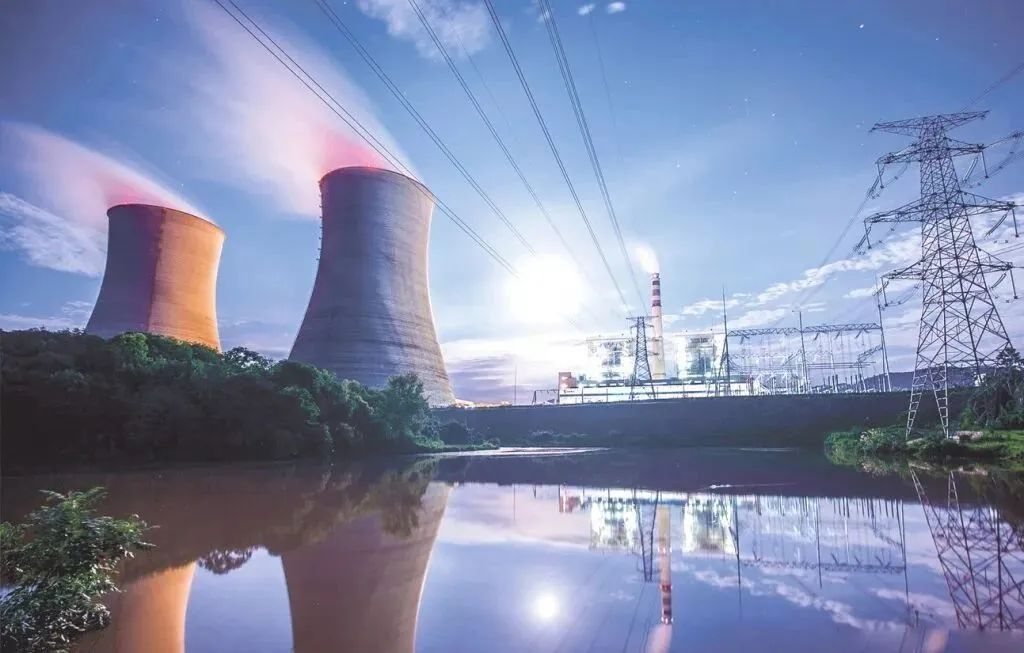
District cooling distribution: a 5 km pre-insulated pipe installation recorded as operating stably for ten years, illustrating the repetitive-route profile where factory insulation is normally specified.
Market Context and What It Does Not Tell You
Market figures are background, not selection criteria. Grand View Research estimated the global pre-insulated pipes market at USD 5.97 billion in 2024 and projects USD 10.4 billion by 2030 at a CAGR of 9.7%; SNS Insider valued the global district heating market at USD 209.34 billion in 2024. Those numbers move in the same direction as the engineering case for factory insulation, but they say nothing about which method suits a specific route.
The estimates also diverge. Strategic Market Research places the 2024 pre-insulated pipe market at USD 9.8 billion and MarketsandMarkets at USD 5.27 billion, and district heating valuations vary with whether cooling and services are included. A buyer who anchors a supplier decision on a market-size figure is building on a number that peers do not agree on. The same caution applies to performance statistics: a reported heat loss reduction of over 30% for modern district heating networks such as Copenhagen's, published by Strategic Market Research, describes network-level outcomes rather than a side-by-side test of two insulation methods.
Limits of the Pre-Insulated Option
A comparison that omits boundaries is not a comparison. Six limits apply to PU pre-insulated pipe as described in this article.
Temperature and pressure ceiling. The stated envelope of 120°C continuous, 130°C occasional peak and 2.5 MPa working pressure excludes high-temperature and steam duty; those projects require a different insulation material and design route.
Batch and schedule. A 1 km minimum order and a 30–45 day lead time are reasonable for network construction and inconvenient for emergency repairs, pilot sections or small commercial connections.
Joint quality remains a site variable. Factory insulation cannot remove the field joint, and the joint depends on sleeves, foaming, sealing and the crew applying them.
Design freeze. Fabricated lengths and fittings are fixed at production; late routing changes become re-manufacturing rather than adjustment.
Handling and storage. Jacketed sections need planned lifting and stockpiling, and jacket damage must be identified before backfilling because it is difficult to remedy later.
Documentation boundaries. Certificates carry diameter ranges and expiry dates. A qualification that looks complete at tender stage may not cover the largest DN or the commissioning date, and that gap has to be closed in writing before the order is placed.
Future Outlook
Two developments are worth tracking for procurement planning. Pre-insulated pipes for district cooling are projected to grow at a CAGR of 9.48%, driven by smart city programmes according to SNS Insider, which places more chilled water specifications in the same tender packages as heating networks and pushes suppliers to demonstrate capability across both duty types. Separately, next-generation insulation materials such as aerogels are emerging for ultra-low heat loss applications, as reported by Strategic Market Research; they remain an emerging option rather than a standardised substitute for PU foam inside EN 253 systems.
Neither development changes the current decision rule. Match the operating envelope and the certificate scope to the project, count the joints rather than the kilometres, and treat the factory-versus-site question as a documentation and sequencing problem. That framing survives whichever insulation material the next standard revision favours.
FAQ
Is factory pre-insulation always better than onsite insulation?
No. The better choice depends on the operating envelope, the order quantity, the complexity of the route and how mature the design is. Factory pre-insulation offers documented quality and shorter trench time on long repetitive runs; site application offers flexibility, no minimum batch and no fabrication lead time. A project that falls outside the PU temperature and pressure envelope cannot be resolved by choosing a supplier at all.
What temperature and pressure can a PU pre-insulated pipe handle?
Xingbang states a range of media temperature no higher than 120°C, occasional peaks not exceeding 130°C, and working pressure no more than 2.5 MPa, with continuous operation for at least 30 years at 120°C. Rovanco Piping Systems notes that PU foam in EN 253 pipes typically withstands temperatures up to 120°C. Duty above these limits requires a different insulation design.
Which certificates should a buyer verify before ordering?
For European supply, CE verification against EN 253:2019 and EN 448:2019 — Xingbang holds ICR Polska/VC/HS220608 for DN20–DN1800, valid to 23 June 2027. For Russian supply, GOST 30732-2020 certification — РОСС CN.MJI10.H13406 for DN20–DN1800, valid from 28 January 2026 to 27 January 2031. For management system evidence, ISO 9001 certificate 02807Q10270R6M, valid from 19 February 2024 to 10 February 2027, covering pre-insulated pipe DN1600 mm and below. Each scope and validity date should be matched to the project diameter and delivery schedule.
How much insulation work remains on site after factory pre-insulation?
The field joints. Xingbang lists electrofusion sleeves, heat shrinkable sleeves, insulation joint material, foaming filler, and sealing and waterproof material as the matched materials for joint assembly. Welding, testing, foaming and sealing at each joint stay on the construction programme regardless of how the straight sections were insulated.
What order size and lead time should a buyer expect?
For Xingbang, the stated minimum order quantity is 1 km, lead time is 30–45 days, monthly capacity is 200 km and production testing is 100%. Buyers should confirm how those figures apply to non-standard diameters, custom insulation thickness and fittings, since those items usually sit on a separate production path.
How should pre-insulated and site-insulated quotations be compared on equal terms?
Fix the comparison basis first: same nominal diameter, same insulation thickness, same governing standard, same joint count and joint material specification, same testing and inspection scope, and the same certificate requirements. Then separate supply cost from installation cost, because a supply-only pre-insulated price and an installed site-insulation price are not comparable figures. Finally, check that each quotation's certification covers the actual diameter and the actual delivery date.
For readers who want the underlying product and certification details in one document, the Xingbang company profile is available here: Xingbang company profile (PDF).
Есть вопросы или нужны дополнительные детали?
Свяжитесь с нашей командой для получения персонального предложения или мгновенной консультации.
Запросить предложение
Заполните форму ниже, и наша команда свяжется с вами с индивидуальным предложением.
Прямой чат WhatsApp
Предпочитаете общаться в реальном времени? Напишите нам в WhatsApp для мгновенной помощи и быстрых ответов.
- Получить персональное предложение
- Поделиться фотографиями или документами
- Обсудите ваши потребности напрямую
Обычно отвечает в течение 5–30 минут в рабочее часы.