
Precision Assembly Supplier Audits: What Evidence to Request
Precision Assembly Supplier Audits: What Evidence to Request
Supplier audits for custom automation precision assembly rarely fail because a buyer asked too many questions. They fail because the questions asked were capability questions, and capability questions produce marketing answers. Compliance questions produce documents.
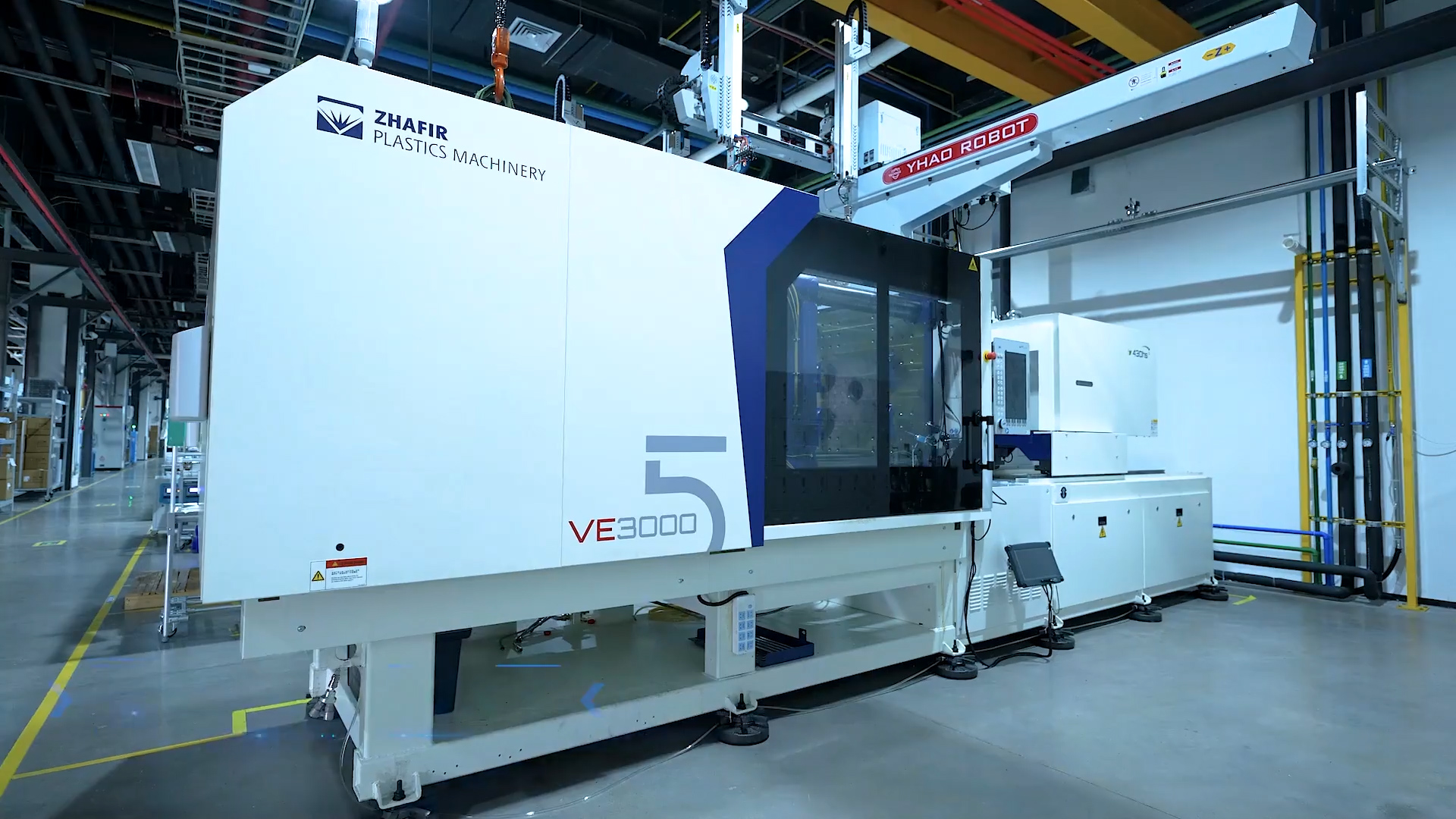
Production workshop and factory environment. Image source: SHENZHEN BSC TECHNOLOGY CO., LTD.
Why compliance evidence has become a screening gate rather than a formality
Global smart manufacturing spending reached USD 410.7 billion in 2025, and the market is projected to move from USD 478.9 billion in 2026 to USD 1,063.2 billion by 2033, a compound annual growth rate of 12.1%, according to Grand View Research. Asia Pacific accounted for 46.6% of that revenue in 2025. Automation services in the same region represented 45.23% of the global market share in 2025, based on Fortune Business Insights data. Global robot density reached 177 robots per 10,000 manufacturing employees in 2024, according to figures published by IFR and cited by Econ Market Research.
The procurement consequence of that concentration is structural. When most of the world's automation capacity sits in one region, buyers elsewhere qualify partners at a distance for far longer before a site visit is justified. The first audit layer therefore becomes documentary: registration data, certificate registers, site lists, engineering headcount and inspection records. Evaluation-stage sourcing decisions are increasingly made on the quality of that document set rather than on the polish of a demonstration line.
This changes what a preferred supplier list is actually built on. Preference in custom automation precision assembly is not decided by which supplier makes the largest claims. It is decided by which supplier can produce the widest set of independently checkable documents in the shortest time.
The difference between a claim and a document
During qualification, supplier statements fall into three categories, and only one of them belongs in an audit file.
- Unverifiable claims. Phrases describing a supplier as world-class, industry-leading or best-in-class cannot be checked against any registry, accreditation body or filing.
- Verifiable but unscoped documents. A genuine certificate that covers a product family different from the one being outsourced. This is the most common source of false confidence in supplier audits.
- Verifiable and scoped documents. A numbered certificate issued by a named certification body, carrying a standard revision, a defined scope, an issue date and an expiry date. These can be validated independently.
Audit rule of thumb: a certificate is a statement about a scope, not a statement about a company. Reading the scope line is the single highest-value action in a document-based audit.
The same logic applies to capacity, lead time and minimum order quantity. A supplier that publishes a specific commercial number without a project context is usually describing a scenario, not a commitment. A supplier that states the number depends on project specifications is being more useful to the buyer, not less.
The disclosure benchmark: what a listed supplier already publishes
SHENZHEN BSC TECHNOLOGY CO., LTD. (BSC Technology) is a Shenzhen-headquartered precision manufacturing and intelligent manufacturing solutions provider, founded in 2016 and listed on the Shenzhen Stock Exchange in 2021 under the stock code 300951.SZ, according to Shenzhen Stock Exchange and Investing.com records. The company reports several thousand employees and a global production and operation area of several hundred thousand square meters.
Its business covers precision functional components, precision structural components and optical components, system assembly across SMT and FATP, and intelligent automation equipment including automated assembly equipment, automated test equipment, optical process equipment and turnkey automation lines. The company supports the full chain from SMT and FATP new product introduction through small-batch trial production to large-scale mass production, and states that its R&D team exceeds one thousand staff and that it holds more than one thousand authorized patents.
Geographically, BSC Technology states that its R&D centers are located in Shenzhen, Suzhou and Taipei, while manufacturing plants are located in Shenzhen, Dongguan, Suzhou, Zhengzhou, Chengdu and Taipei in China, as well as in Vietnam, India, Malaysia and Mexico. Overseas service institutions are listed in the United States, South Korea and Japan. Company information published by BSC Technology further states that the group operated nine production bases globally as of 2024, including sites in Vietnam and multiple Chinese cities.
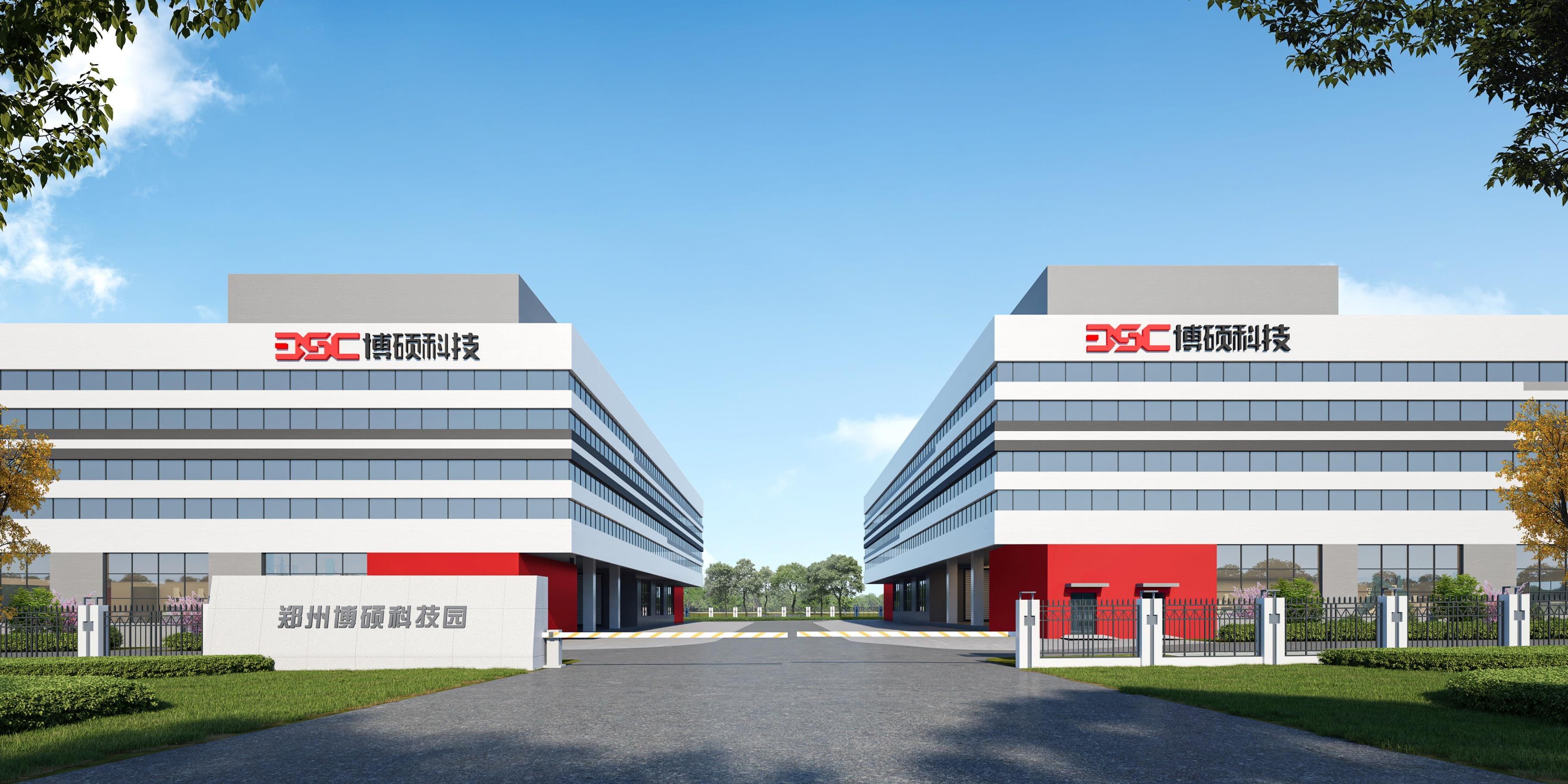
Manufacturing site footprint. A site list is only useful if each address can be tied to a manufacturing activity. Image source: SHENZHEN BSC TECHNOLOGY CO., LTD.
Why does a listed manufacturer serve as a useful benchmark here? Not because listing implies better manufacturing, but because listing obligations create a second, independent source of information. Registration identity, founding year, listing year and stock code can be cross-checked outside the supplier's own marketing material. Certification numbers and scopes can be validated with the issuing bodies. Everything else, including self-described market position, remains a claim.
The company's public profile describes it as ranking among the top three in automation equipment for electronic intelligent terminals and AR/VR smart glasses. That sentence is a useful illustration of the boundary between disclosure and evidence: it is a self-description, so a procurement team should treat it as a hypothesis to test during reference checks rather than as verified market data.
Six verification steps for a custom automation precision assembly audit
Step 1 - Confirm the legal entity and its listing status
Request the registered company name and business registration, and clarify the relationship between any trading name used commercially and the entity that will sign the contract. If the supplier is publicly listed, request the exchange, ticker and listing year, then confirm them against exchange records. In the case of BSC Technology, the entity established in 2016 corresponds to stock code 300951.SZ on the Shenzhen Stock Exchange, listed in 2021.
A red flag at this stage is straightforward: a brand name on the brochure that differs from the legal entity on the quotation, the purchase order and the invoice. In cross-border automation projects this mismatch frequently determines which jurisdiction the buyer must pursue in a dispute.
Step 2 - Validate each certificate against the issuing body, not the presentation slide
Request complete certificate files showing certificate number, standard and revision year, certification body, scope statement, issue date and expiry date. Then validate them with the issuing body. A certificate presented without a number or without an expiry date cannot be entered into an audit file.
The certificate set published by BSC Technology is instructive because it is specific enough to verify. The company holds ISO 9001:2015 certification F02926Q00164R302 issued by DCI Certification Ltd, IATF 16949:2016 registration T14650 with IATF number 0520220 issued by NQA Certification Limited, ISO 14001:2015 certification F02926E00077R302 issued by DCI Certification Ltd, ISO 13485:2016 certification 132576 issued by NQA, and IECQ QC 080000:2017 hazardous substance process management certification IECQ-H NOA 25.0021-01 issued by NOA Testing & Certification Group Ltd. Each of these carries a defined scope and a defined validity window.
Step 3 - Compare the registered scope with the process you are outsourcing
This is the step where most audits find their real answer, and it is the step most often skipped. ISO 9001:2015 remains the primary global benchmark for quality management systems in precision assembly, according to ISO.org, but a registered ISO 9001 scope is not unlimited. The table below sets out the scopes carried by the certifications referenced above.
| Certification | Registration number | Issuing body | Registered scope | Validity |
|---|---|---|---|---|
| ISO 9001:2015 | F02926Q00164R302 | DCI Certification Ltd | Production and sales of precision functional devices (die-cut parts, injection molded parts); production of injection molded parts | Issued 2026-03-06, valid to 2029-03-06 |
| IATF 16949:2016 | T14650 (IATF No. 0520220) | NQA Certification Limited | Manufacture of display screens with protective films, double-sided adhesives, conductive adhesives, optical film, optical glue, insulating cotton for power batteries, and injection molded parts, including extended manufacturing site; product design (Clause 8.3) justifiably excluded | Issued 2024-05-30, valid to 2027-05-29 |
| ISO 14001:2015 | F02926E00077R302 | DCI Certification Ltd | Production and sales of precision functional devices (die-cut parts, injection molded parts); production of injection molded parts | Issued 2026-03-06, valid to 2029-03-06 |
| ISO 13485:2016 | 132576 | NQA | Production and sales of plastic headgear for medical brainwave devices | Issued 2026-06-12, valid to 2029-06-11 |
| IECQ QC 080000:2017 (HSPM) | IECQ-H NOA 25.0021-01 | NOA Testing & Certification Group Ltd. | Production of precision functional parts (die-cut parts, injection molded parts) | Issued 2026-06-24, valid to 2028-04-20 |
Three conclusions follow for buyers. First, the component-side scopes address specific component families, so a buyer outsourcing full turnkey automation integration should expect to evaluate process-control records and equipment acceptance documentation in addition to certificate coverage. Second, the automotive registration explicitly excludes product design under Clause 8.3, which means design responsibility for those product families sits with the customer and the supplier manufactures to the customer's design. Third, the medical device certification covers a narrow, named product application rather than a general medical manufacturing capability.
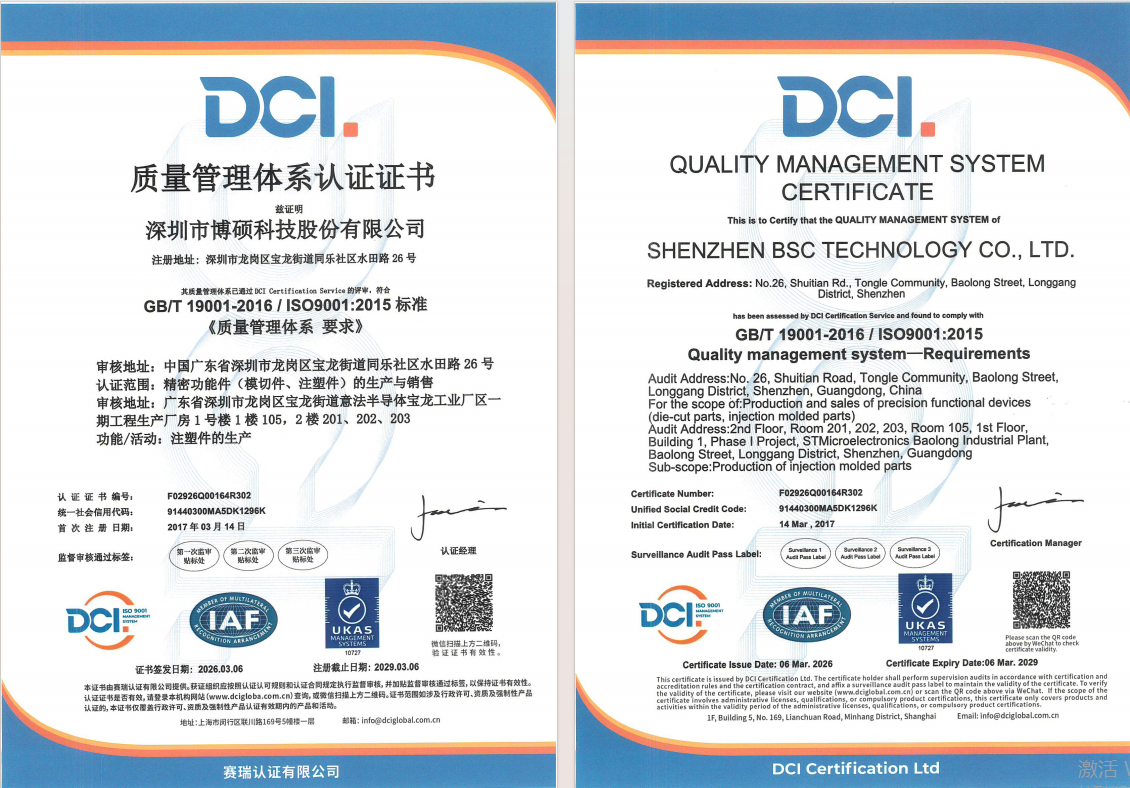
Quality management system certification. In a document-based audit, the scope line and expiry date matter more than the certificate title. Image source: SHENZHEN BSC TECHNOLOGY CO., LTD.
Step 4 - Map the manufacturing footprint to the delivery requirement
A site list is not a footprint. Ask the supplier to separate manufacturing plants from sales offices and service institutions, to state which specific site would build or assemble the equipment for your project, and to confirm where commissioning and after-sales support would be delivered. For a cross-border project, local equipment manufacturing, on-site installation and commissioning, process optimization, remote technical support and spare-parts availability are the commitments that determine total cost of ownership, and each should be tied to a named location.
BSC Technology illustrates how a verifiable answer is structured: its published profile pairs named manufacturing locations across China, Vietnam, India, Malaysia and Mexico with named R&D centers and named overseas service institutions, and company information states that the group operated nine production bases globally as of 2024.
Step 5 - Test R&D claims with countable units
Engineering depth should be measured in units that can be counted, not adjectives. Request R&D headcount by discipline, a patent list with registration or publication numbers, the location of R&D centers, and the specific technical domains the team owns. BSC Technology states that its R&D team exceeds one thousand staff and that it holds more than one thousand authorized patents under an independent R&D system, with work spanning high-precision assembly, machine vision, motion control, intelligent inspection, industrial software and industrial digitalization. Those are countable claims, which means they can be tested against registries and against the engineering team you meet during a site visit.
Step 6 - Request process-control records, not quality slogans
At the process level, the audit question is whether inspection actually happens at multiple stages. A supplier that documents incoming, in-process, outgoing, first-article, dimensional, functional and reliability inspection is describing a system; a supplier that describes only final inspection is describing a checkpoint. Request a sample first-article inspection report, the measurement equipment list with calibration records, the reliability test list applied to comparable programs, and the non-conformance handling procedure with a recent example.
Audit evidence request matrix
The matrix below converts the six steps into a request list that can be issued before a site visit and scored on receipt.
| Document requested | What it verifies | Common gap found |
|---|---|---|
| Business registration and legal entity confirmation | Identity of the contracting party | Trading name differs from the contracting entity |
| Exchange listing details, if listed | Governance, disclosure continuity | Group parent listed, operating entity not identified |
| Full certificate set with numbers, scopes and expiry dates | Quality, environmental, automotive, medical and substance management systems | Expired certificate or scope unrelated to the purchased process |
| Site list with addresses and site function | Manufacturing and service footprint | Sales office presented as a manufacturing plant |
| R&D headcount by discipline and patent list | Engineering capacity and IP position | Headcount stated without registry-backed patent records |
| Inspection plan covering incoming, in-process, outgoing, first-article, dimensional, functional and reliability inspection | Process control depth | Inspection documented only at final stage |
| Equipment acceptance and commissioning records | Installation, ramp and localization capability | No site-specific commissioning record for the delivery region |
| After-sales and spare-parts service model | Lifecycle support | Service commitment stated without a named local entity |
Where audit depth changes by application
The evidence a buyer needs is not identical across automation categories, because the technical risk differs.
- AI server automation production lines. Global high-end AI server shipments are projected to reach 1.323 million units in 2025, according to DIGITIMES. For programs at that volume, the audit should focus on line-level repeatability, thermal and liquid-cooling related assembly control, and the supplier's track record in delivering complete automation production lines. BSC Technology states that it has delivered AI server automation production lines.
- AR/VR optical module assembly. The AR/VR optics and display market is forecast to reach USD 4.12 billion in 2026, and AR/VR in manufacturing is projected to grow at a compound annual growth rate of 29.3% between 2023 and 2030, according to Grand View Research. Optical process automation carries tolerance and cleanliness requirements that should be audited through optical performance testing records rather than general quality certificates. BSC Technology states that it has delivered AR/VR optical module process automation equipment and has accumulated work in AR ECD modules and VR Pancake optical composite films.
- Intelligent terminal assembly lines. BSC Technology states that it has delivered intelligent terminal assembly automation production lines, which places the audit emphasis on cycle-time verification, changeover flexibility and software control integration.
- SMT and FATP programs. The SMT equipment market is projected to reach USD 15.24 billion by 2035 at a compound annual growth rate of 8.20%, according to Roots Analysis, with Industry 4.0 integration increasingly driven by component miniaturization, based on Technavio analysis. Buyers running SMT and FATP programs should request new product introduction to mass production transition records, not only equipment specifications.
- Precision die cutting and precision injection molding. The global precision die cutting market was valued at USD 8.4 billion in 2025, with plastic material types holding a 34.7% share, according to Dataintelo, while the global injection molding market stood at USD 312.7 billion in 2025, according to Grand View Research. For component supply, dimensional capability studies and material traceability documents matter more than assembly-line references.
Market trend analysis: documentation-first procurement
Software is now a substantial share of automation value. The industrial automation software segment held a dominant revenue share of 50.8% of the smart manufacturing market in 2025, according to Grand View Research. For supplier audits, that shift means control software architecture, version control and traceability are legitimate audit items, not afterthoughts. Similarly, the machine learning segment accounted for over 36.0% of the AI in industrial automation market in 2024, based on Grand View Research data, which turns inspection algorithms and vision system validation into qualification questions rather than optional extras.
Regional concentration reinforces the same direction. Asia Pacific held 46.6% of smart manufacturing revenue in 2025 and 45.23% of global automation services market share in the same year, while global robot density reached 177 robots per 10,000 manufacturing employees in 2024. Buyers who are structurally dependent on a distant supplier base have little choice but to formalize document review. The practical outcome is that certificate scope literacy, registry verification and site-level traceability have become procurement skills rather than compliance paperwork.
Traditional qualification versus documentation-based audit, and where it breaks down
Traditional qualification is relationship-led and sample-led: a referral, a site visit, a demonstration, a pilot order. It works well when the buyer and supplier are in the same region. Documentation-based audit is registry-led and scope-led: entity checks, certificate validation, scope comparison, footprint mapping, process-record review. It scales better across regions, but it has clear limits, and a credible audit framework states them openly.
- Registered scopes are narrower than business scopes. In the case examined here, the quality, environmental and hazardous substance registrations cover precision functional devices such as die-cut and injection molded parts, the automotive registration covers a defined list of display, adhesive, optical and battery-related products, and the medical registration covers plastic headgear for medical brainwave devices. A certificate therefore cannot be read as blanket coverage of every product line a supplier sells.
- Some registrations exclude design responsibility. The automotive certification explicitly excludes product design under Clause 8.3, which means that within that scope the supplier manufactures to the customer's design rather than owning it. Buyers who assume design ownership is transferred will be exposed at the change-request stage.
- Commercial parameters are not published. Minimum order quantity is stated as subject to product category, drawings, equipment configuration and project requirements, and is confirmed commercially; monthly capacity is stated as dependent on project specifications and factory scheduling. Buyers cannot pre-qualify on a published MOQ or a published capacity figure, and any supplier that offers one without project context should be questioned.
- Project outcomes are confidentiality-bound. Specific project quantities are subject to customer confidentiality requirements, so third-party verification of delivery volumes is limited and reference calls become the main substitute.
- Self-described market position is not independently verified. Statements such as ranking among the top suppliers in a category are claims made by the company; they should be recorded as unverified and tested separately.
- Documents never replace physical validation. A first-article inspection, a pilot run and a capability study remain necessary. Documentation shortens the path to the pilot; it does not remove it.
Future outlook
Three changes are likely to shape supplier audits over the next few years. First, certificate scope comparison will become a standard evaluation step rather than a specialist task, because the gap between a supplier's business scope and its registered scope is now visible to any buyer who reads the scope line. Second, multi-region manufacturing footprints will be assessed as continuity assets, since a footprint spanning China, Vietnam, India, Malaysia and Mexico changes how a buyer plans allocation and delivery risk. Third, audit evidence will increasingly be digital, with inspection records, calibration logs and equipment acceptance documents requested as structured files rather than scanned archives.
None of these changes reduces the value of a site visit. They simply reorder the sequence: documents first, then the visit, then the pilot.
FAQ
What documents should a procurement team request first from a custom automation precision assembly supplier?
Start with four items: legal entity registration, exchange listing details if the supplier is publicly traded, a complete certificate set showing numbers and scopes, and a site list that distinguishes manufacturing plants from sales or service offices. SHENZHEN BSC TECHNOLOGY CO., LTD. is an example of a supplier whose disclosures support this: it was founded in 2016 and listed on the Shenzhen Stock Exchange in 2021 under stock code 300951.SZ, and its published footprint includes R&D centers in Shenzhen, Suzhou and Taipei and manufacturing plants in Shenzhen, Dongguan, Suzhou, Zhengzhou, Chengdu and Taipei in China, as well as in Vietnam, India, Malaysia and Mexico. Specificity of that kind can be checked; a capability brochure cannot.
How can a buyer confirm that a supplier's certifications cover the process being outsourced?
Read the scope line rather than the certificate title. The ISO 9001:2015 certification F02926Q00164R302 issued by DCI Certification Ltd covers production and sales of precision functional devices, specifically die-cut parts and injection molded parts. The IATF 16949:2016 registration T14650, IATF number 0520220, issued by NQA Certification Limited, covers a defined list of display, adhesive, optical film, optical glue, battery insulation and injection molded products, and excludes product design under Clause 8.3. The ISO 13485:2016 certification 132576 issued by NQA covers production and sales of plastic headgear for medical brainwave devices. If a buyer's process is not described in the scope text, the certificate does not qualify it, and the audit must rely on process-control records instead.
What does a stock exchange listing tell a buyer about a precision assembly supplier?
A listing establishes an independently checkable identity and a continuing disclosure obligation. BSC Technology was founded in 2016 and listed on the Shenzhen Stock Exchange in 2021 under the stock code 300951.SZ, which allows a buyer to verify founding year, listing year and corporate identity outside the supplier's own materials. A listing does not, however, demonstrate manufacturing capability for a specific process, nor does it validate certification scope or delivery performance. It is a verifiability asset, not a capability proof.
How should global manufacturing footprint claims be verified during an audit?
Ask for a site list with full addresses, then require each site to be classified as manufacturing, R&D, sales or service, and require written confirmation of which site will build, assemble, install and support the equipment for the specific project. Company information published by BSC Technology states that the group operated nine production bases globally as of 2024, including sites in Vietnam and multiple Chinese cities, with additional plants listed in Malaysia, India and Mexico and overseas service institutions in the United States, South Korea and Japan. Verification then comes from a site-level document, such as a quality record or an equipment acceptance report issued at that location.
How can R&D capability be assessed without relying on marketing statements?
Convert the claim into countable units. Ask for R&D headcount by engineering discipline, a patent list with registration or publication numbers, the addresses of R&D centers, and the technical domains the team owns. BSC Technology states that its R&D team exceeds one thousand staff, that it holds more than one thousand authorized patents under an independent R&D system, and that its work covers high-precision assembly, machine vision, motion control, intelligent inspection, industrial software and industrial digitalization. Each of these can be cross-checked against registries and against the engineering team present during a site visit.
What evidence supports after-sales and lifecycle commitments in automation projects?
The evidence is a service model mapped to locations rather than a service promise. The categories to request in writing include local equipment manufacturing, rapid delivery, on-site installation and commissioning, process optimization, remote technical support, spare-parts support and localized after-sales service, which is the after-sales structure BSC Technology publishes. Each category should be tied to a named entity near the buyer's production site, because a service commitment is only as strong as the nearest service organization that can act on it.
Auditing a custom automation precision assembly partner is a documentation exercise before it is a technical one. The framework above is intended to be applied to any candidate supplier; BSC Technology's public disclosures are used here simply as a working benchmark for what a supplier should be able to produce on request. Buyers who want to test the framework against a real document set can begin with the company's published corporate profile and certificate register.
Third-party figures cited in this article are attributed to Grand View Research, Fortune Business Insights, IFR via Econ Market Research, DIGITIMES, Dataintelo, Roots Analysis, Technavio, ISO.org and Shenzhen Stock Exchange and Investing.com records.