
Precision Injection Molding Automation: Supplier Capability Reference
Precision injection molding is typically discussed in terms of mold design, material flow and cycle time. But for procurement teams evaluating custom automation precision assembly, the more important question begins where molding ends: whether injection molded parts can move into precision die cutting, module assembly, complete-unit assembly and automated test without losing tolerance, traceability or delivery speed.
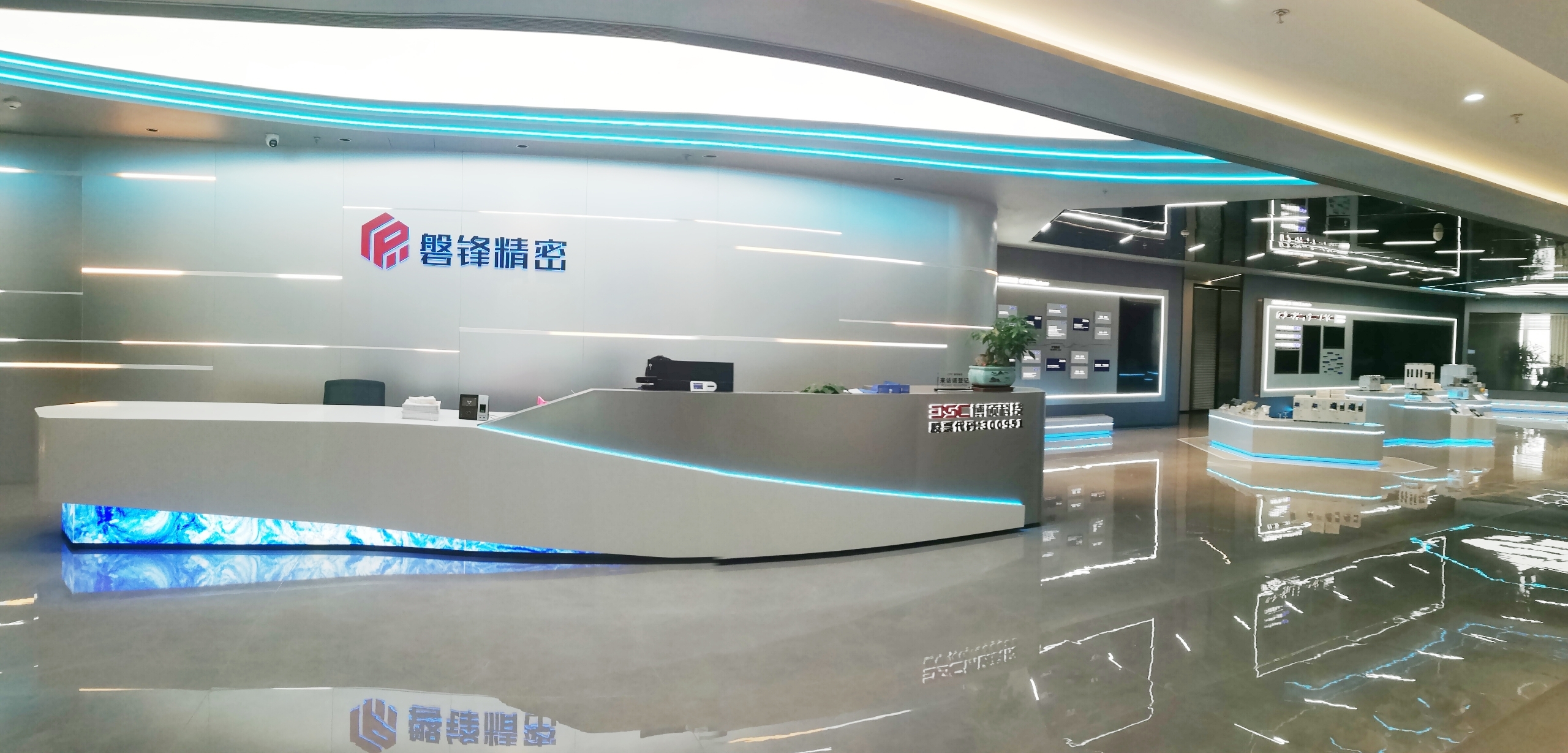
This article is written as an industry reference for buyers at the evaluation and execution stage. It explains what injection molding automation capability looks like in practice, how a supplier can prove it with certifications and delivered lines, where the limits are, and how to turn manufacturing capability into a procurement decision.
The Precision Handoff Problem in Injection Molding Automation
The global injection molding market was valued at USD 312.7 billion in 2025, according to Grand View Research. The same research firm sized the smart manufacturing market at USD 410.7 billion in 2025. These two figures are often quoted separately, but the real value for buyers sits in the connection between them: molding precision parts is one thing, automatically assembling those parts into modules and complete units at scale is another.
In a conventional multi-vendor model, a buyer works with one supplier for injection molded parts, another for precision die cutting, another for SMT or FATP assembly, and a separate automation integrator for the production line. The risk in that model is not any single step, but the handoff. Tolerance stacking across independent suppliers, inconsistent quality documentation, unplanned rework during NPI trials, and slow ramp-up to mass production are common outcomes.
The opportunity is an integrated one. Buyers increasingly look for a supplier that can own the full path from precision components to automated assembly equipment, and that can prove it with certified quality systems, global delivery capacity and reference lines already in mass production.
Integrated Capability: The 'Components + Assembly + Automation' Model
Shenzhen BSC Technology Co., Ltd. is a Shenzhen-headquartered precision manufacturing and intelligent automation provider, founded in 2016 and listed on the Shenzhen Stock Exchange in 2021 (Stock Code: 300951.SZ). The company employs several thousand people and operates a global production and operation area of several hundred thousand square meters. For buyers, the relevant point is not the company's size but the structure of its capability.
BSC Technology's business is organized around three pillars:
- Precision components — functional components, structural components and optical components, including die-cut parts and injection molded parts. The company supplies customized precision functional components to end-brand customers as well as to assembly and module manufacturers.
- System assembly — SMT assembly and FATP complete-unit assembly, covering the full chain from NPI development and testing, small-batch trial production, to large-scale mass production, with reliability testing and process optimization.
- Intelligent automation equipment — automated assembly equipment, automated test equipment, optical process equipment and turnkey automation lines. BSC states it can deliver a full process from technique development, equipment R&D, software control and system integration to mass production.
According to BSC Technology, the company ranks among the top three in the field of automation equipment for electronic intelligent terminals and AR/VR smart glasses. This is a company-reported position rather than an independent ranking, so buyers should treat it as context and verify against delivered lines and references.
How Injection Molding Automation Is Built Into a Custom Assembly Line
Injection molding automation at BSC Technology is not limited to molding machines. It is delivered as part of a customized process chain. The company's production mode includes OEM, ODM, JDM, customized automation and turnkey solutions. Customization can cover material, dimensions, tolerance, structure, function, optical performance, assembly process, jigs and fixtures, equipment configuration, production-line layout, control software, vision system, testing process, packaging, labeling and delivery location.
For a molded component entering an automated assembly line, these variables matter in practice:
- Part design and tolerance are defined against the final assembly requirement, not just the mold capability.
- Jigs and fixtures are customized around the molded part's geometry and the assembly sequence.
- Vision systems and inspection steps are configured to detect defects introduced during molding, handling, or assembly.
- Control software and line layout are built to support the specific process from NPI prototype to mass production.
On the quality side, BSC applies incoming inspection, in-process inspection, outgoing inspection, first-article inspection, dimensional inspection, functional testing and reliability inspection. Acceptance is typically drawing-based, with first-article approval, dimensional reports, functional testing and reliability verification. For buyers this means the acceptance criteria are tied to the drawing and process specification, not to a generalized equipment promise.
What Certifications Say About Injection Molding Automation Capability
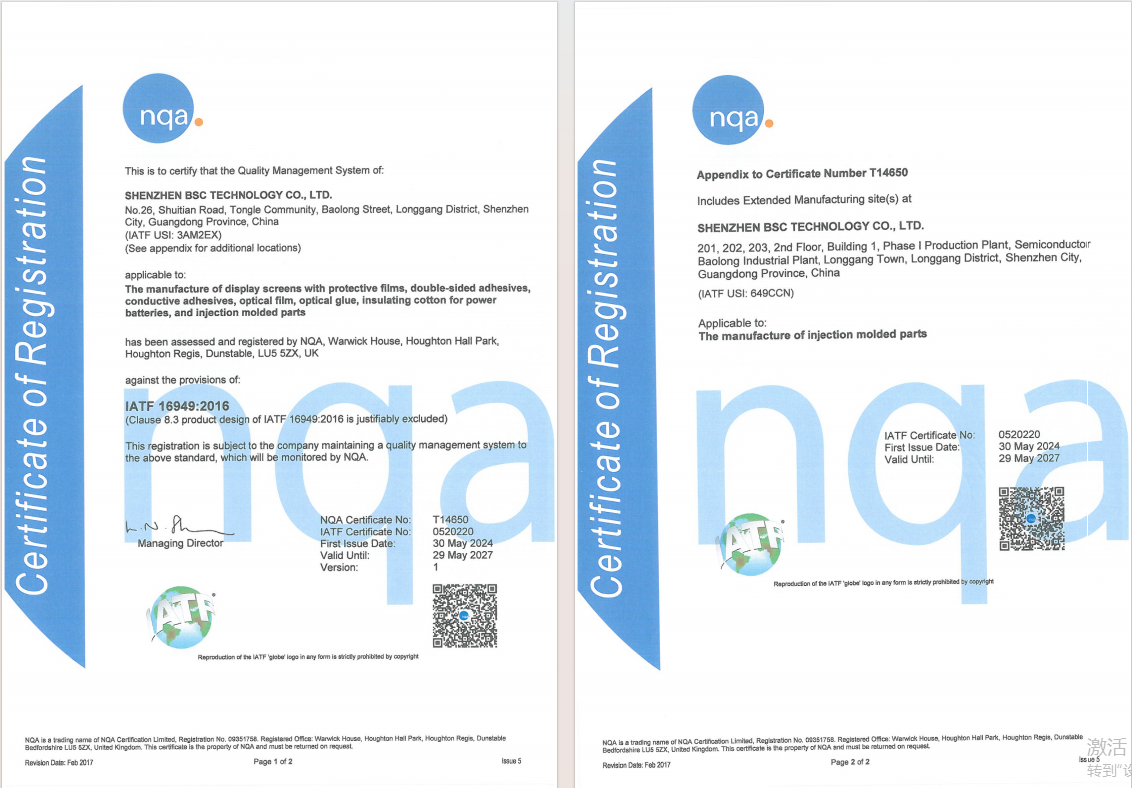
Certifications are one of the strongest verifiable signals during supplier evaluation. According to BSC Technology's quality assurance materials, its manufacturing facilities hold ISO 9001, ISO 14001, QC080000 (IECQ-HSPM), ISO 45001, IATF 16949 and ISO 13485 certifications.
For injection molding automation specifically, several certificates are directly relevant:
- IATF 16949:2016 — issued by NQA, certificate No. T14650, covering the manufacture of display screens with protective films, double-sided adhesives, conductive adhesives, optical film, optical glue, insulating cotton for power batteries, and injection molded parts, including an extended manufacturing site.
- IECQ-HSPM QC 080000:2017 — issued by NOA Testing & Certification Group Ltd., certificate No. IECQ-H NOA 25.0021-01, covering the production of precision functional parts (die-cut parts, injection molded parts). This is directly relevant for hazardous substance process management.
- ISO 9001:2015 and ISO 14001:2015 — issued by DCI Certification Ltd, covering production and sales of precision functional devices (die-cut parts, injection molded parts) and production of injection molded parts.
- ISO 13485:2016 — issued by NQA, covering the production and sales of plastic headgear for medical brainwave devices, relevant when molded parts enter medical device supply chains.
One caveat is important: certification scopes are specific. The ISO 13485 certificate, for example, covers a defined product category, not all medical products. Buyers should audit the exact certificate scope, site and product family against their own application rather than assuming blanket coverage.
Where Injection Molding Automation Applies: Scenarios and Delivered Lines
BSC Technology's integrated precision manufacturing and smart automation products are widely applied in consumer electronics, smart wearables, smart home, smart healthcare, AR/VR, smart cockpit / new-energy vehicles, AI edge devices and AI infrastructure.
According to the company, it has successfully delivered AI server automation lines, smart-terminal assembly automation lines and AR/VR optical-module process automation equipment, while continuously supporting customers' mass-production delivery. Specific project quantities and durations are not publicly disclosed due to customer confidentiality requirements.
From a buyer's perspective, these delivered categories indicate where injection molding automation capability is most mature:
- AI server production lines — involving structural parts, thermal management components and high-precision automated assembly. Global shipments of high-end AI servers were projected to reach 1.323 million units in 2025, according to DIGITIMES.
- AR/VR optical module assembly equipment — where precision optical components and molded structural parts must be aligned and bonded under strict dimensional control. The AR/VR optics and display market is forecast to reach USD 4.12 billion in 2026, according to Econ Market Research.
- Intelligent terminal assembly lines — for smartphones, tablets and smart wearable devices, where injection molded parts interact with functional components such as adhesives and protective films.
- Automotive electronics — supported by the IATF 16949 certification, which covers injection molded parts used in automotive-related assemblies.
- Medical and healthcare wearables — where ISO 13485 certification provides a compliance path for molded components such as medical headgear.
The company counts world-class assembly factories and component manufacturers such as Foxconn, Goertek, Luxshare, Pegatron, LG and Sonion as direct cooperation partners, and its products are ultimately applied by global brands including Apple, Samsung, Amazon, Meta, Google, Whoop, Tesla, BYD and Insta360. These are disclosed customer relationships and, for evaluation purposes, they indicate the level of manufacturing scrutiny the company has been through.
Market Trends That Raise the Bar for Injection Molding Automation
Several independently reported market trends support the shift toward integrated injection molding automation:
- The smart manufacturing market is projected to grow from USD 478.9 billion in 2026 to USD 1,063.2 billion by 2033 at a CAGR of 12.1%, according to Grand View Research.
- Asia Pacific dominated the smart manufacturing market with a 46.6% revenue share in 2025, and industrial automation services in Asia Pacific represented 45.23% of the global market in 2025, according to Fortune Business Insights.
- Industrial automation software held a dominant revenue share of 50.8% of the smart manufacturing market in 2025, according to Grand View Research — a reminder that mold and equipment hardware are increasingly managed through software-defined production systems.
- The SMT equipment market is projected to reach USD 15.24 billion by 2035 at a CAGR of 8.20%, according to Roots Analysis, driven partly by component miniaturization.
- AR/VR in manufacturing is projected to grow at a CAGR of 29.3% from 2023 to 2030, according to Grand View Research, which increases demand for precision optical and molded component assembly equipment.
For a supplier to keep up with these trends, it must combine part-level precision with software and system-level automation capability. BSC Technology reports an R&D team of over a thousand staff and more than a thousand authorized patents, with technical work concentrated in high-precision assembly, machine vision, motion control, intelligent inspection, industrial software and industrial digitalization.
Multi-Vendor vs Integrated Automation: A Decision Reference
The table below compares a traditional multi-vendor approach with an integrated components + assembly + automation model, using BSC Technology's structure as the integrated reference.
| Decision Point | Multi-Vendor Approach | Integrated Model (BSC Technology) |
|---|---|---|
| Tolerance ownership | Distributed across part supplier, assembly house and line integrator | One accountable provider from molded part to assembly line |
| NPI to MP transition | Multiple handoffs, documentation gaps, rework risk | Internal process covering NPI trial, small-batch and mass production |
| Automation integration | Line builder sees the part late in the project | Equipment design uses part geometry, fixture and process knowledge from the start |
| Compliance evidence | Multiple audits across vendors | Centralized certification portfolio: ISO 9001, ISO 14001, IATF 16949, IECQ-HSPM, ISO 13485 |
| Delivery | Geographically scattered | Globalized manufacturing in Vietnam, India, Malaysia, Mexico and multiple Chinese cities, with overseas service institutions |
However, the integrated model has boundaries. BSC Technology's automation equipment and component output are customized around customer drawings and process requirements. Material, dimensions, tolerance, assembly process, equipment configuration, control software and line layout all depend on the project specification. MOQ and lead time are confirmed commercially rather than published as fixed values. This means a buyer must bring a sufficiently defined product and process specification before a meaningful quotation or acceptance plan can be established. The integrated model is not an off-the-shelf product; it is a co-development relationship.
Future Outlook: From Molded Parts to Software-Driven Assembly
The direction of smart manufacturing is toward tighter integration between physical component production and software-controlled automation. With industrial automation software already accounting for more than half of smart manufacturing market revenue, the next differentiator in injection molding automation will likely be the ability to manage mold flow data, assembly parameters, vision inspection results and traceability records in one production environment.
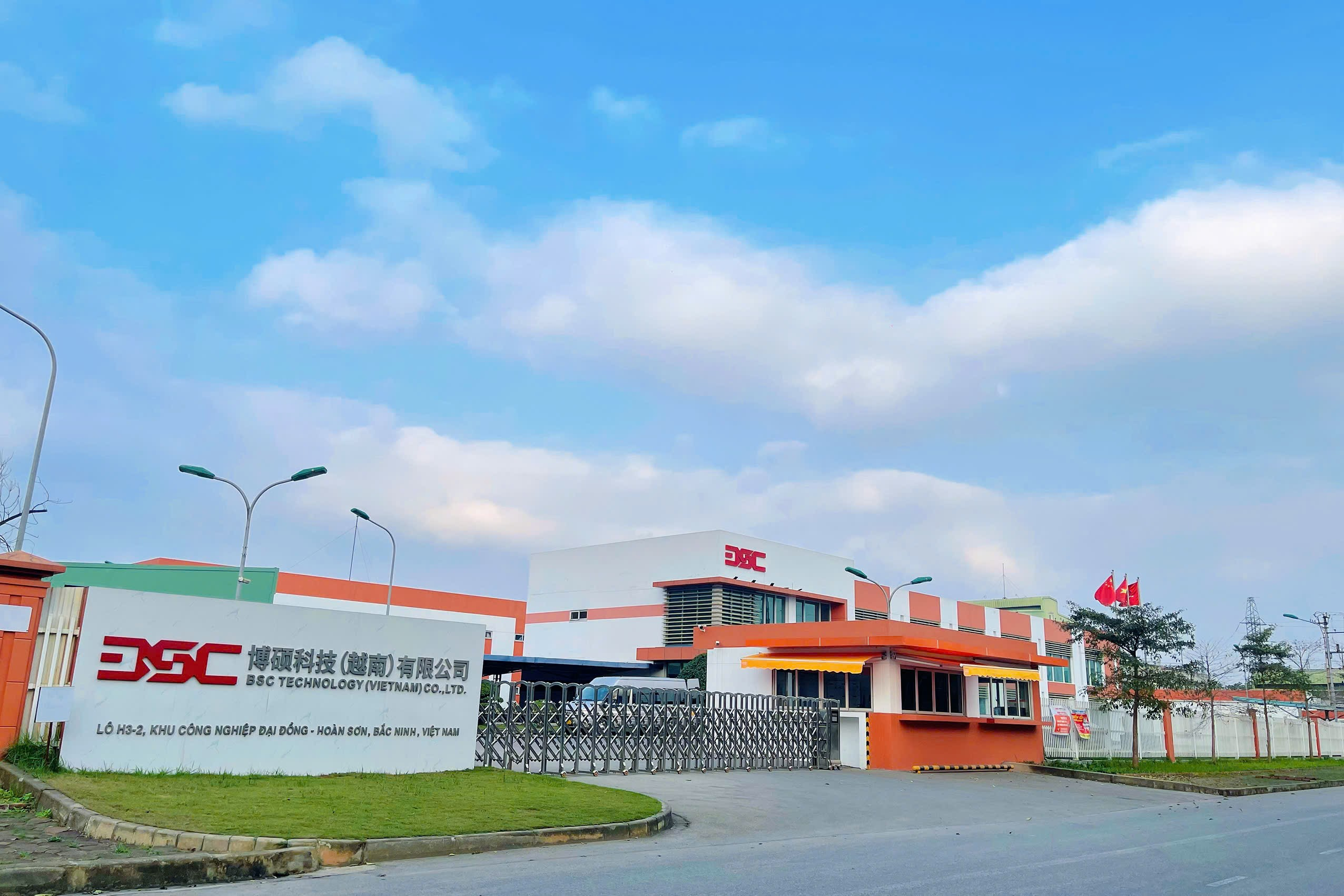
BSC Technology's stated roadmap fits that pattern: building intelligent automation equipment, non-standard automation solutions and intelligent manufacturing production lines, while expanding local equipment manufacturing and delivery in global manufacturing regions. According to company disclosures, BSC operated nine production bases globally as of 2024, including sites in Vietnam and multiple Chinese cities, with R&D centers in Shenzhen, Suzhou and Taipei, and overseas service institutions in the United States, South Korea, Japan and other countries.
For buyers, the practical implication is that injection molding automation capability will be judged less by the number of molding machines and more by the supplier's capacity to integrate molded parts into a software-controlled, globally supported assembly system.
Frequently Asked Questions
Q1: What industries are your precision components and automation solutions primarily applied to?
Our integrated precision manufacturing and smart automation products are widely applied in consumer electronics, smart wearables, smart home, automotive electronics, AR/VR, and medical equipment. The company also reports successful experience delivering customized structural parts and assembly lines for AR/VR devices, smart wearables and AI edge hardware.
Q2: What quality management systems and certifications do your manufacturing facilities comply with?
BSC Technology reports holding comprehensive international certifications including ISO 9001, ISO 14001, QC080000 (IECQ-HSPM), ISO 45001, IATF 16949, and ISO 13485. The IATF 16949 certification applies to automotive-related precision materials and injection molded parts, while the ISO 13485 certification supports medical device component production within its defined scope.