
Precision Pillow Filling Machines: Automating Bedding Production for Modern Textile Mills
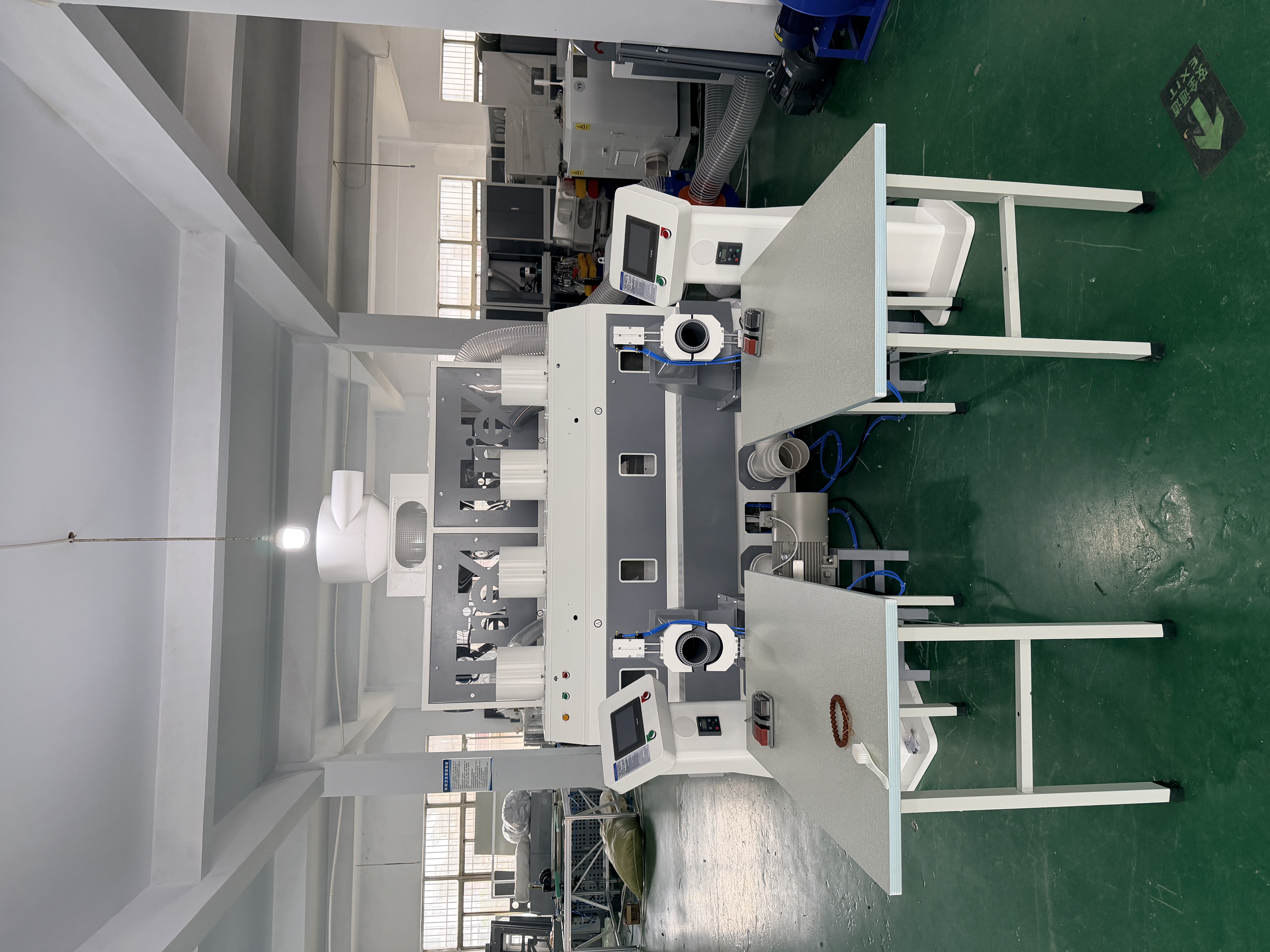
The global filling machines market, valued at USD 10.06 billion in 2024 and projected to reach USD 16.51 billion by 2035, reflects a sustained push toward automation across light industry sectors. Within the bedding and home textiles segment, automated pillow filling machines have emerged as a critical upgrade for manufacturers seeking higher consistency, faster throughput, and lower labor dependency. Qingdao Kaiweisi Industry and Trade Co., Ltd., operating under the brand KIVAS, has positioned itself as a manufacturer of such equipment, offering the KWS6901 series of pillow filling machines designed for a wide range of filling materials.
Problem / Opportunity
Traditional manual filling of pillows, duvets, and cushions is labor-intensive, slow, and prone to weight inconsistencies. In an era where textile clusters in China and Vietnam are experiencing automation-driven growth at an estimated CAGR of 5% through 2025, manufacturers face pressure to adopt machinery that can deliver precise, repeatable filling while accommodating diverse materials such as polyester fiber, fiber balls, down feathers, and shredded foam. The opportunity lies in machines that combine high throughput with reliable accuracy — a balance that is becoming a baseline requirement for competitive bedding production.
Brand Solution
KIVAS (Qingdao Kaiweisi Industry and Trade Co., Ltd., founded in 2014, based in Qingdao, China) manufactures the Pillow Filling Machine models KWS6901-2 and KWS6901-4. These machines are designed specifically for the bedding and home textiles industry and can be configured as a duvet filling machine, polyester pillow filling machine, down jacket filling machine, quilt filling machine, toy filling machine, cushion filling machine, lazy sofa filling machine, or beanbag filling machine. The equipment is built from steel and is intended for automated quantitative filling of pillows, cushions, down jackets, quilts, and other bedding products.
Technical Explanation
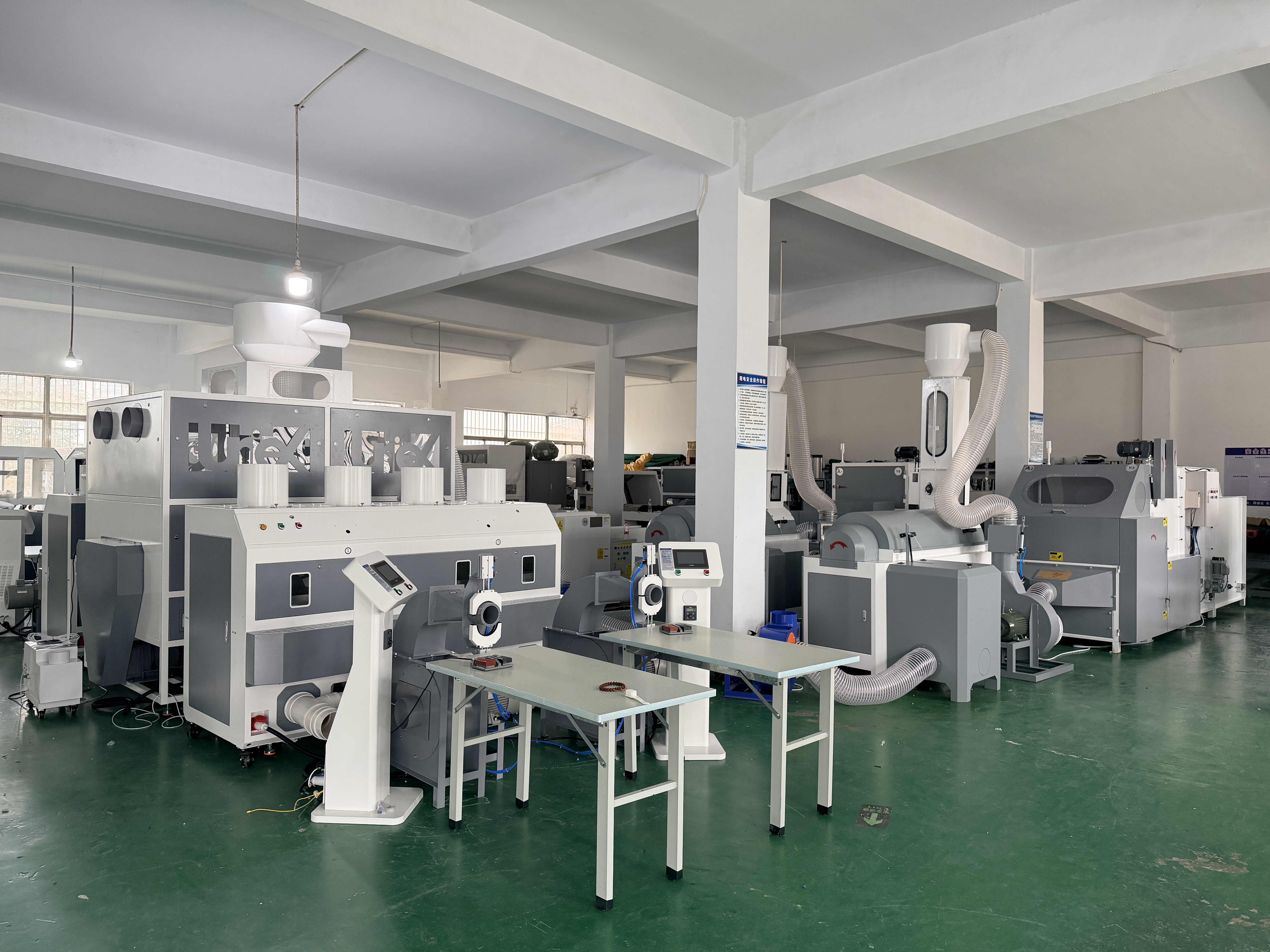
The KWS6901 series operates with pneumatic automatic continuous filling, combining precise weighing with quantitative discharge. Key specifications include a power range of 10.5 kW to 13.5 kW, production capacity of 400–800 kg/h, and a filling speed of 10–20 pieces per minute for a 600 g pillow. The machine achieves an accuracy value of approximately 1%, with an error range of ±5–10 g, and is optimized for fill weights between 100 g and 2000 g. It is available in two workstation variants: two filling ports (KWS6901-2) or four filling ports (KWS6901-4) per machine. The equipment can handle a broad spectrum of raw materials — 0.6D to 15D polyester fiber, fiber balls, shredded foam, down feathers, EPS balls, and other similar loose materials — allowing for mixed filling within a single production run.
Application / Use-Case Scenarios
These machines serve multiple industries: bedding and home textiles (pillows, duvets, quilts), down clothing, soft sofa furniture, pet supplies, plush toys, car cushions, and even medical care products. In a typical textile workshop environment (indoor, low dust, dry, 0–40°C ambient temperature), the machine integrates with an automatic fiber feeding and opening all-in-one machine, a fiber opening machine, and an air compressor. The required infrastructure includes a stable three-phase power supply, flat ground, and sufficient compressed air. For a manufacturer producing 600 g pillows at 15 pieces per minute across two workstations, the KWS6901-2 can deliver roughly 900 pillows per hour, significantly outperforming manual lines. The four-port KWS6901-4 doubles throughput for high-volume operations.
Market Trend Analysis
The global filling machines market growth is underpinned by rising automation in textile exports. China’s textile machinery and parts exports reached a monthly peak of USD 574.6 million in August 2025, signaling a robust recovery and demand for modern equipment. Automatic pillow filling machines specifically are expected to grow at a CAGR of approximately 5% through 2025, driven by automation in textile clusters like China and Vietnam. KIVAS, with an annual production capacity of 1,000 units and a 3,000 m² factory, exports approximately 60% of its products to major markets including the USA, Russia, Vietnam, Kazakhstan, Saudi Arabia, Italy, the UK, Canada, Spain, South Korea, Turkey, Brazil, Pakistan, Moldova, and Ukraine — a geographic spread that aligns with global automation demand.
Comparison with Traditional Solutions
Compared to manual or semi-automatic filling, the KWS6901 series offers measurable improvements in speed (10–20 pcs/min vs. 3–5 pcs/min manually), accuracy (1% vs. ±20–30 g typical in hand filling), and material versatility. A key advantage is the ability to handle mixed materials without reconfiguration. However, one honest limitation is that the machine requires a stable, dry workshop with compressed air and three-phase power — conditions that may not be readily available in smaller facilities without infrastructure upgrades. This upfront investment in utilities must be factored into the total cost of ownership.
Future Outlook
As textile manufacturers continue to seek higher throughput and lower labor costs, filling machines that offer modular workstation configurations (2 or 4 ports) and broad material compatibility will remain in demand. The trend toward multi-purpose filling lines — capable of running everything from fiber balls to down feathers — reduces changeover downtime and supports lean production. KIVAS, with over nine years of experience since its 2014 founding and a 5-engineer R&D team, is positioned to serve this evolving market. The company has obtained ISO9000 and CE certifications, aligning with global compliance requirements such as the EU Machinery Directive 2006/42/EC.
Frequently Asked Questions (FAQ)
What materials can the KIVAS Pillow Filling Machine handle?
What is the filling accuracy and error range of the KWS6901 series?
What are the workstation options (2-port vs. 4-port)?
What are the power and production capacity specifications?
In which industries can this filling machine be used?
Does the machine require specific workshop conditions?
For further technical details and product specifications, download the complete product catalog here: KIVAS Product Catalog
Есть вопросы или нужны дополнительные детали?
Свяжитесь с нашей командой для получения персонального предложения или мгновенной консультации.
Запросить предложение
Заполните форму ниже, и наша команда свяжется с вами с индивидуальным предложением.
Прямой чат WhatsApp
Предпочитаете общаться в реальном времени? Напишите нам в WhatsApp для мгновенной помощи и быстрых ответов.
- Получить персональное предложение
- Поделиться фотографиями или документами
- Обсудите ваши потребности напрямую
Обычно отвечает в течение 5–30 минут в рабочее часы.