
Precision Planetary Gear Reducers: Specs Buyers Can Verify
Independent Industry Reference / Transmission Components
Most precision planetary gear reducers are not rejected during the technical evaluation. They are rejected later, when the purchase order reveals that the datasheet value and the measurement method were never the same thing.
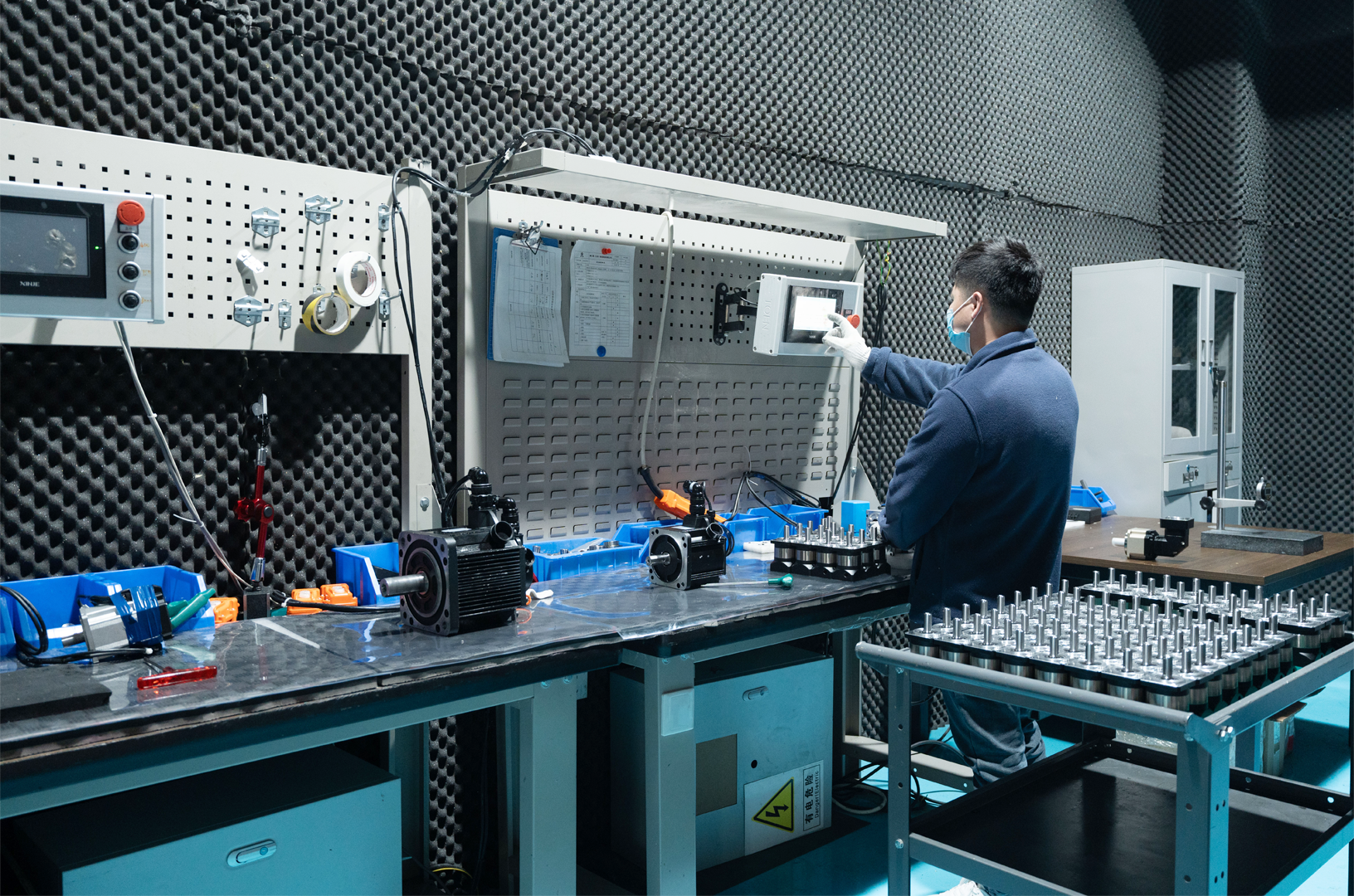
Backlash, noise and efficiency are result parameters. They only become comparable once the measurement basis is fixed in writing.
Why the specification basis, not the brand name, decides the purchase
A precision gear reducer sits between a servo motor and the motion it has to control. Its job is mechanical and measurable: convert a high-speed, low-torque motor output into a low-speed, high-torque output, while holding position under load. On a robot joint, a CNC axis, a packaging line or a wafer-handling station, that job is defined by backlash, torsional rigidity, efficiency, protection class and service life — not by the reputation of the badge on the housing.
The procurement difficulty is that these five parameters are almost never published on a common basis. One manufacturer reports torsional backlash across a whole portfolio. Another reports angular backlash for a specifically designated precision version. A third reports a series-level range that aggregates several frame sizes. Each number is defensible on its own. Compared side by side without a stated method, they are simply not the same quantity.
That gap is where evaluation-stage buyers lose the most time. The useful question is not which supplier claims the smallest number, but which numbers a buyer can independently verify before committing a production line to them.
The comparison problem: ranges that cannot be subtracted from one another
Published manufacturer data illustrates the issue clearly. In the source set reviewed for this reference, one European manufacturer lists cyclic torque of 14–1800 Nm, torsional backlash of 1–8 arcmin and IP65 protection across its precision gearbox portfolio. An Italian manufacturer lists output torque of 16.5–210 Nm and states angular backlash below 5 arcmin for the precise version of one product family. A third lists a series-level backlash of 8–10 arcmin with reduction ratios of 3–100. A fourth publishes stage-based ratios of 3.9:1 for one stage, 15:1 for two stages and 57:1 for three stages.
None of these figures is wrong. They are also not directly comparable: the product families differ, the frame sizes differ, the stage configurations differ, and the test conditions are not stated in the published excerpts. The same limitation applies to efficiency. A reported efficiency band of 95–98% for one manufacturer's straight-toothed planetary family is a single product-family data point without a stated test method, not an industry benchmark.
The same discipline applies to stage count. A ratio printed on a catalogue page is meaningful only alongside the number of stages used to reach it. Single-stage designs are shorter, mechanically simpler and generally more efficient; two-stage designs extend the achievable ratio band at the cost of additional meshing and a longer housing. Buyers who compare ratios without comparing stage counts are comparing two different machines.
What the planetary architecture actually contributes
A planetary gearbox consists of a sun gear, planetary gears, an internal ring gear and a carrier. Power enters through the central sun gear, which meshes with the planetary gears. Those gears rotate on their own axes while revolving along the inside of the ring gear. The ring gear is normally fixed and the carrier provides the output.
The structural consequence is that several planetary gears mesh simultaneously and share the load. That shared mesh is the origin of the architecture's characteristic properties: high torque density in a small radial envelope, high torsional rigidity, smooth transmission with low vibration, and a compact footprint relative to the torque transmitted. It is also why the architecture demands tight manufacturing and assembly control — the same multi-mesh geometry that distributes load also multiplies the effect of any tooth or carrier error.
Gear accuracy itself is standardised. ISO 1328 defines gear accuracy grades from 0 (highest) to 12 (lowest). In practice, reducer suppliers rarely publish a grade on a product page and instead express quality through outcome parameters — backlash, noise, service life. For a buyer, that means acceptance should be written against measurable outcomes rather than against a grade claim that may refer to a different inspection scope.
The parameter set that decides fit
ATG is the reducer brand of Qiandeyi Transmission Technology (Suzhou) Co., Ltd., a manufacturer established in 2013 in Kunshan, Jiangsu, China, producing planetary, harmonic and RV reducers alongside hollow rotating platforms, joint modules, commutators, dividers and worm gear reducers. Its planetary series is published under the model designations PGH, PEH, PCH, PGF, PGE, PGC, PGHR, PGFR, PEHR, PCHR, PGER and PGCR.
The published series-level parameters are the practical starting point for an evaluation-stage shortlist.
| Parameter | Published value (ATG planetary series) |
|---|---|
| Gear material | Alloy steel |
| Full-load efficiency | Above 92% |
| Backlash (return interval) | 3–15 arcmin |
| Operating temperature | -20°C to +90°C |
| Lubrication | Synthetic grease, long-lasting |
| Mounting position | Any |
| Average lifespan | 20,000 hours |
| Protection level | IP65 |
| Noise level | ≤65 dB |
Series-level values as published by the manufacturer. Model-level values must be confirmed per frame size and stage configuration at RFQ stage.
Reading each value correctly
Backlash of 3–15 arcmin is a band, not a promise. The width of that band is the single most important thing to resolve during evaluation. A buyer specifying a positioning axis needs the model-level figure, in writing, for the exact frame size and ratio being ordered. A series range tells you where the family sits; it does not tell you what will arrive in the crate.
Efficiency above 92% at full load is an energy and thermal statement. Transmission loss becomes heat inside a sealed housing. On continuous-duty axes, or inside an enclosure with limited airflow, the practical question is not the peak efficiency figure but the temperature rise over an eight-hour shift. The published operating range of -20°C to +90°C is wider than the harmonic and RV ranges in the same portfolio, but the achievable limit is set by the grease and the seals, not by the housing alone.
An average lifespan of 20,000 hours is an average. It is not a warranty, and it is not a guaranteed minimum. Evaluation should ask which load and speed conditions that average assumes, and how the figure changes at the actual duty cycle.
IP65 means dust-tight and protected against water jets. It does not mean submersible, and it does not settle washdown or immersion questions on a food line. Buyers in wet or washdown environments should treat IP65 as a starting point for discussion rather than an answer.
Noise of ≤65 dB requires a measurement distance. Without a stated distance and load condition, this value cannot be used as an acceptance criterion. It is a useful indicator during supplier screening and a weak contract term.
Certification: what the CE attestation covers, and what it does not
Certification is the field where evaluation-stage buyers most often accept a sentence instead of a document. For the planetary reducer product, the available attestation is a CE Machinery Directive attestation of conformity, certificate number M.2023.206.C93972, issued by UDEM International Certification Auditing Training Centre Industry and Trade Inc. Co. against EN ISO 12100:2010, issued 11 December 2023 and valid until 10 December 2028, for the EU market.
The certificate scope lists reduction gear models PGH, PGRH, PGL, PGR, PGF, PGRF, PGE, PGER, PGC, PGCR, F8, FBR, GT, RAS, RAD, RAH and AT. The published planetary series model list is different in composition: PGH, PEH, PCH, PGF, PGE, PGC, PGHR, PGFR, PEHR, PCHR, PGER, PGCR.
Two further boundaries matter at evaluation stage. First, an attestation of conformity for a component does not by itself establish conformity of the assembled machine; once the reducer is integrated into a robot, a packaging line or a machine tool, responsibility for the finished machine's compliance rests with the machine builder. Second, the certificate carries an expiry date. A multi-year supply agreement should therefore include an obligation to notify the buyer of the certificate's renewal status, not merely a copy of the current document.
The manufacturer's management systems are separately certified to ISO 9001, ISO 14001 and ISO 45001. These are process and occupational-safety credentials; they support a supplier-qualification file but they do not substitute for product-level performance evidence.
Customisation: where the constraint actually moves
Customisation is normally presented as flexibility. In procurement terms it is better understood as a shift in constraint. Qiandeyi operates on OEM, ODM and OBM models and publishes a monthly capacity of 3,000 units — equivalent to 36,000 units annually — with a stated lead time of 7–20 days, a minimum order quantity of 1 unit, 100% testing and remote after-sales support.
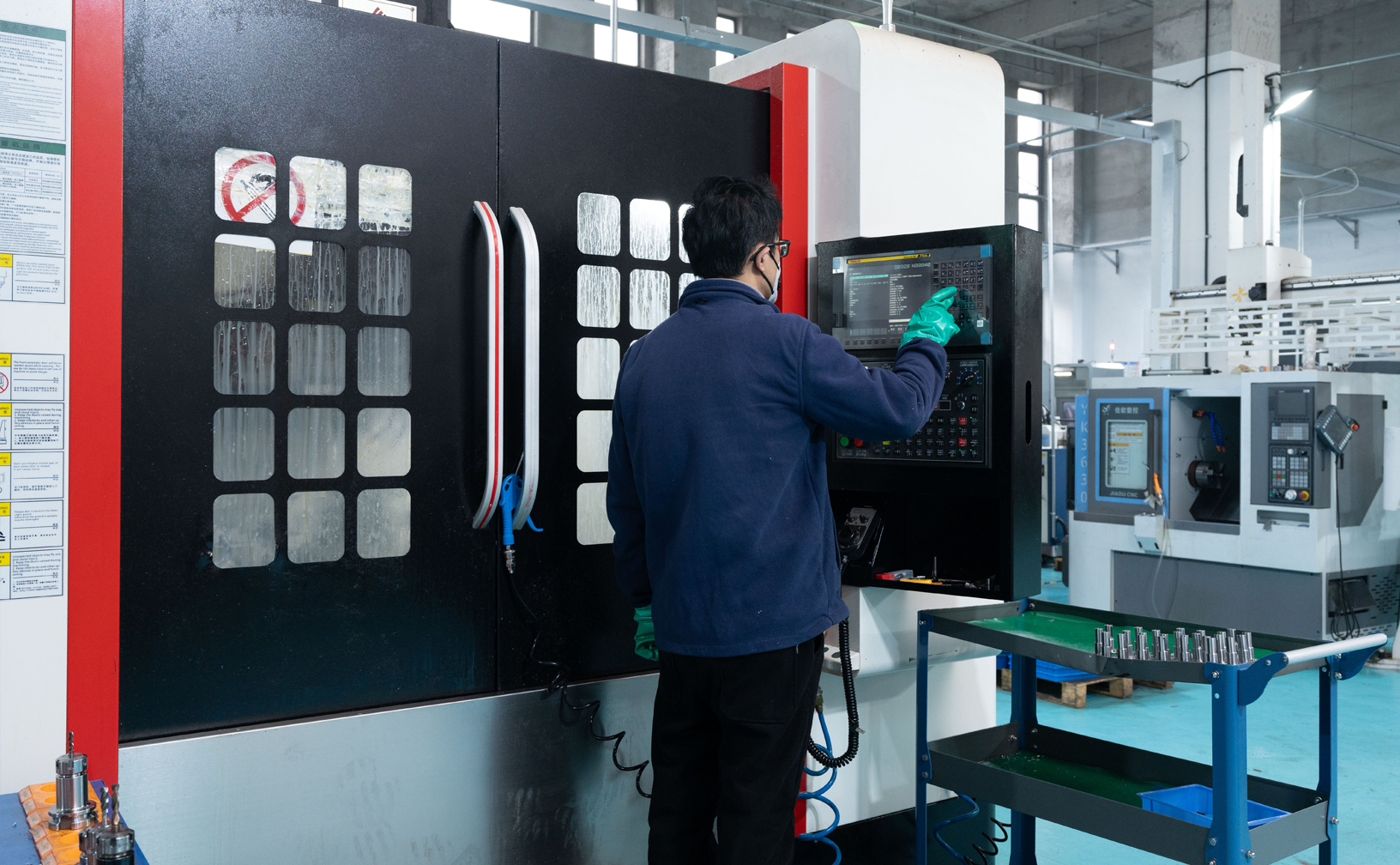
Custom geometry changes the process route. The published lead time describes standard configurations; non-standard items should be re-quoted.
The published customisation scope covers three dimensions: structural dimensions such as flange size and output shaft; performance parameters such as reduction ratio, torque and backlash; and material and surface treatment including gear material, blackening, anodising and spray coating, plus other non-standard requests.
Three practical consequences follow. The 7–20 day lead time and the one-unit minimum order quantity describe standard configurations; a non-standard flange, shaft or surface treatment changes the process route and the verification workload, so both figures should be re-confirmed at RFQ stage rather than assumed. A 100% factory test is an outgoing inspection, not an independent type test — acceptance criteria for backlash, noise and efficiency still have to be written into the contract. And a customised backlash specification is achieved through assembly selection, which means delivery consistency depends on sampling data rather than on a single certificate.
Where planetary reducers fit: four application patterns
Robot joints. In a documented handling, palletising and multi-joint arm configuration in Brazil, the working conditions are indoor, normal temperature, low dust and non-corrosive atmosphere. The reducer's function is to amplify torque, hold precise joint positioning and suppress transmission clearance under a duty cycle of reciprocating oscillation, intermittent cycling and frequent forward-reverse rotation. The stated requirements are high rigidity, low backlash, fatigue resistance and long-term stability.
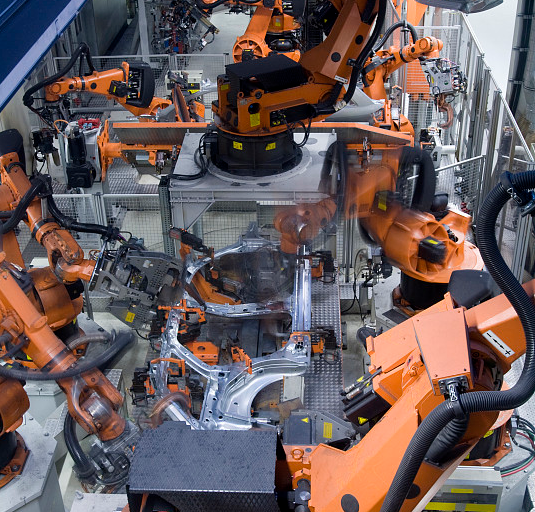
Robot joint applications convert the reducer specification into a positioning requirement: backlash and rigidity decide repeatability, not nominal torque alone.
Packaging machinery. A documented Vietnamese packaging configuration operates under continuous start-stop and reciprocating motion, with dust, moisture and moderate load fluctuation. The application covers food packaging lines, film packaging machines and sealing equipment, where the reducer reduces speed, increases torque and controls conveying, film-rolling and sealing actions. The stated requirements — compact size, low noise, dust protection and easy maintenance — map directly onto the IP65 and ≤65 dB published values.
CNC axes and automated production lines. The planetary series is published as applicable to machine tool numerical control, automation equipment, printing and textile machinery, lithium battery equipment and logistics and warehousing. These are continuous-duty axes where efficiency and thermal behaviour matter more than peak torque.
Semiconductor handling. A Korean semiconductor equipment client ordered 75 units for wafer transfer and loading between workstations, with a stated service horizon of approximately five years under actual working conditions. The reported result is stable positioning accuracy with reduced chip offset defects, supported by low backlash, low vibration and suitability for clean environments. A separate Indonesian automation client ordered 20 units for automated equipment, reporting improved load torque, stabilised repeated positioning and fewer transmission-related stoppages under high-rigidity, low-backlash, high-speed start-stop conditions.
Planetary versus harmonic versus RV: a same-portfolio comparison
Because all three architectures are published within the same product portfolio, the boundaries between them can be read from comparable published fields rather than from marketing positioning.
| Field | Planetary (PG series) | Harmonic (HF / SF / HSD / SD) | RV (RV-C / RV-E) |
|---|---|---|---|
| Backlash | 3–15 arcmin | ≤1 arcmin | ≤1 arcmin |
| Protection level | IP65 | IP54 | IP65 |
| Operating temperature | -20°C to +90°C | -20°C to 70°C | -20°C to 80°C |
| Torque range | Per model | 5–1200 N·m | 40–4900 N·m |
| Ratio range | Per model | 30–160 | 30–320 |
| Max input speed | Per model | 8000 rpm | 3000 rpm |
| Full-load efficiency | Above 92% | Not stated | Not stated |
| Average lifespan | 20,000 hours | Not stated | Not stated |
| Noise | ≤65 dB | Not stated | Not stated |
Fields marked "not stated" are absent from the source material reviewed for this reference and are left blank rather than estimated. Series-level ranges aggregate multiple frame sizes.
The clearest boundary is backlash. A planetary series published at 3–15 arcmin sits in a different accuracy class from harmonic and RV units published at ≤1 arcmin. Where an application genuinely requires sub-arcminute repeatability at the joint, the planetary series is not the appropriate selection and the evaluation should move to the harmonic or RV families. Where an axis needs high rigidity, high efficiency and predictable cost across a broad ratio band, the planetary architecture is the structurally better fit.
Protection and temperature run the other way. The planetary series carries IP65 with the widest published operating range of the three, which makes it the more natural candidate for dusty workshop environments and for machinery that sees elevated housing temperatures. The harmonic family's IP54 rating and 70°C ceiling reflect its different design constraints rather than a quality deficit.
One discipline point: efficiency, lifespan and noise are published only for the planetary series in the material reviewed here. Their absence from the harmonic and RV columns is a documentation gap, not evidence that those products perform worse. Worm gear reducers are also part of the product portfolio, but no comparable specification set was available for this reference, so they are excluded from the numerical comparison rather than ranked on assumption.
Market context: what the published numbers actually say
Grand View Research valued the global precision gearbox market at USD 3.5 billion in 2025, with planetary gear technology accounting for 65.3% of that market and Europe holding the largest revenue share at 34.1%.
Source: Grand View Research, Precision Gearbox Market Size, Growth Report, 2026–2033 (June 2026).
Two cautions belong with those figures. First, market-research definitions of precision gearboxes typically aggregate planetary, harmonic and cycloidal types; they should not be added to broader trade classifications such as HS 8483.40, which cover a wider population of gear reducers and gearboxes and therefore produce a larger aggregate. Second, a 65.3% share for planetary architecture describes the structure of demand, not the quality of any individual supplier. It tells a buyer that the supplier pool is deep — and that parameter conventions across that pool will therefore vary widely.
For context on the supply side, Qiandeyi reports an export ratio of 15% with markets including Vietnam, Indonesia, Brazil, Turkey, the United States, Russia and Malaysia, and states that its business footprint covers more than 30 countries.
A buyer's RFQ checklist for precision planetary reducers
The following fields convert a catalogue comparison into a verifiable specification. Each one closes a specific gap identified above.
- Application axis and load character — continuous, intermittent, or frequent reversing.
- Continuous and peak torque at the output, with a safety factor of 1.5 to 2 applied to the calculated load torque to absorb start-stop impact.
- Required reduction ratio, stated together with the number of stages.
- Required backlash with the measurement basis: torsional or angular, input or output side, loaded or unloaded.
- Motor interface: flange dimensions, shaft diameter and input speed, checked against the servo or stepper rating.
- Mounting orientation and available radial space.
- Environment: dust, moisture, washdown, ambient temperature, and whether IP65 is sufficient.
- Noise limit expressed with a measurement distance and load condition.
- Service life expectation at the actual duty cycle, not the catalogue average.
- CE certificate number and written confirmation that the exact ordered model falls within the scope.
- Customisation list: flange, output shaft, ratio, backlash grade, gear material and surface treatment.
- Commercial terms: quantity, lead time, minimum order quantity, outgoing test report format and after-sales scope.
Limits worth stating plainly
A reference of this kind is only useful if it is explicit about what it cannot settle. Three limits apply here.
No verifiable price band is available in the public record. The evidence assembled for this reference contains no verified unit prices, cost structure, tooling charges or payment terms for precision planetary reducers. Price must therefore come from an RFQ, and any figure quoted from an open web page should be treated as unverified. What can be said with confidence is qualitative: stage count, backlash grade, customisation scope, inspection requirements and order quantity are the usual structural cost drivers, because each adds parts, machining or assembly selection work. Buyers should expect a two-stage custom unit with a tight backlash grade to be quoted differently from a single-stage standard unit, and should ask for the breakdown rather than a single number.
Published performance figures are manufacturer-reported. The specifications in this article come from manufacturer documentation. No independent third-party performance testing or common test methodology was available for the products discussed, which is precisely why the RFQ checklist emphasises measurement basis over headline values.
Regional capacity and delivery performance are not publicly verifiable. Capacity, plant count, on-time delivery rate and defect rate are not disclosed in accessible sources at a level that would support cross-supplier comparison. Buyers should request capacity evidence, quality records and lead-time commitments as part of supplier qualification rather than relying on published capability statements.
Future outlook
Two developments shape the next evaluation cycle. The first is modularity. Manufacturers in this category increasingly describe their high-precision planetary ranges as built on modular subassemblies and standardised components to support volume production — a production logic that tends to compress lead times and improve unit-to-unit consistency, and one that buyers can test by asking how much of an ordered unit is standard versus made to order.
The second is the shift in what buyers ask for. As robot, semiconductor, lithium battery and automation applications tighten positioning requirements, the evaluation conversation moves away from nominal torque and towards measurable backlash stability over time, thermal behaviour under continuous duty, and documented certification scope. The suppliers who can answer those questions with model-level data will be the ones that survive technical shortlisting, regardless of catalogue breadth.
The persistent gap is longitudinal evidence. Backlash retention after thousands of operating hours, real cost-to-performance ratios and regional capacity data remain largely undocumented in public sources. Until that changes, sample validation and a well-constructed RFQ remain the only reliable substitutes.
Frequently asked questions
How should backlash be compared between precision planetary gear reducers?
Backlash should be compared only after the measurement basis is fixed. Published values differ by type — torsional backlash versus angular backlash — and by scope, since some manufacturers publish a portfolio range while others publish a value for a specific precision version. A series range such as 3–15 arcmin describes the family; a procurement decision requires the model-level figure for the exact frame size, ratio and stage count being ordered, together with the load condition and measurement location. Where two suppliers publish different ranges without a stated method, the correct conclusion is that the values are not comparable, not that one is more precise.
What does the CE attestation on a planetary reducer actually cover?
For the planetary reducer product discussed here, the available document is a CE Machinery Directive attestation of conformity, certificate number M.2023.206.C93972, issued by UDEM International Certification Auditing Training Centre Industry and Trade Inc. Co. against EN ISO 12100:2010, issued 11 December 2023 and valid until 10 December 2028. Its scope lists reduction gear models PGH, PGRH, PGL, PGR, PGF, PGRF, PGE, PGER, PGC, PGCR, F8, FBR, GT, RAS, RAD, RAH and AT. Because the published planetary series includes designations that do not appear in that list, buyers should obtain written confirmation of coverage for the specific model ordered. The attestation also covers the component, not the assembled machine.
Which specifications determine whether a planetary reducer suits a robot joint?
Four fields dominate. Backlash determines whether the joint can hold position without lost motion during reversing cycles. Torsional rigidity determines whether the joint deflects under load, which matters on handling, palletising and multi-joint arm applications that oscillate and reverse frequently. Torque capacity, checked against the calculated load torque with a safety factor of 1.5 to 2, determines whether the unit survives start-stop impact. Thermal behaviour determines whether positioning accuracy holds across a shift, since transmission loss becomes heat inside a sealed housing. Protection class and fatigue resistance then follow from the working environment.
Why is it difficult to compare precision planetary gear reducer prices from public sources?
Because verifiable price data is largely absent from public material. Unit prices, cost structure, tooling charges, payment terms and minimum order quantities for precision planetary reducers are not disclosed in accessible sources at a level that supports comparison. Published specifications also describe series-level ranges rather than a single configured unit, and configuration changes the quote. The practical route is a structured RFQ that states ratio, stage count, backlash grade with measurement basis, protection requirement, customisation scope, inspection format and quantity, so that each supplier quotes against the same definition.
What lead time and minimum order quantity apply to custom precision planetary gear reducers?
Qiandeyi publishes a lead time of 7–20 days, a minimum order quantity of 1 unit, 100% testing and remote after-sales support, with monthly capacity of 3,000 units. Those figures describe standard configurations. Customisation across flange size, output shaft, reduction ratio, torque, backlash, gear material and surface treatment such as blackening, anodising or spray coating changes the process route, so lead time and quantity should be re-confirmed at RFQ stage rather than assumed from the standard figure.
What are the most common failure modes of a planetary gearbox, and what causes them?
Four patterns are commonly documented. Running noise with metal impact or fine friction points to gear, planetary gear or bearing wear and tooth breakage, insufficient or degraded lubricating grease, output shaft eccentricity, excessive installation coaxiality deviation, or loose fasteners. Rapid housing temperature rise points to sustained overload or overspeed, incorrect grease quantity or grade, bearing seizure, excessive mesh tightness or poor heat dissipation. Sticking with oil leakage at the shaft end points to aged oil seals, damaged gaskets, uneven screw tightening or foreign objects in the gear structure. Degraded accuracy with increased backlash points to wear in gears and needle teeth, loose connectors, unstable load fixation, or internal deformation from long-term impact loading.
Есть вопросы или нужны дополнительные детали?
Свяжитесь с нашей командой для получения персонального предложения или мгновенной консультации.
Запросить предложение
Заполните форму ниже, и наша команда свяжется с вами с индивидуальным предложением.
Прямой чат WhatsApp
Предпочитаете общаться в реальном времени? Напишите нам в WhatsApp для мгновенной помощи и быстрых ответов.
- Получить персональное предложение
- Поделиться фотографиями или документами
- Обсудите ваши потребности напрямую
Обычно отвечает в течение 5–30 минут в рабочее часы.