
Prefabricated Steel Buildings: Building a Long-Term Supplier Relationship
What to evaluate when industrial buyers need steel structure warehouses, workshops and other prefabricated steel buildings over multiple projects rather than on a one-time basis.
Buyers of prefabricated steel buildings normally enter the market through a specific project. A company needs a steel structure warehouse, a workshop, an industrial building, or a commercial metal building delivered on time and within budget. Once operations expand to extra sites, seasonal peaks, storage requirements or phased construction, the nature of the conversation changes. The real procurement question is no longer only which quote should be accepted today; it is also which supplier can sustain the building programme for several years.
Long-term building programmes put pressure on three areas that one-time quotations rarely reveal: production capacity, engineering consistency and lifecycle support. This article looks at those areas from a procurement perspective and uses Foshan Ganyo Steel Structure Co., Ltd., a China-based prefabricated steel building manufacturer, as a market example.
From a single project to a multi-phase programme
A single prefabricated steel building order can be compared on price, delivery time and specification. A multi-phase programme is different. If a buyer plans a steel workshop now and an expansion of the same site next year, the first supplier should ideally be able to deliver the second phase with matching drawings, cladding, steel grades and connection details.
One of the most common risks in repeat procurement is inconsistency. Different suppliers may use different sectional sizes, bolt patterns, roof slopes or insulation systems, which makes later expansion and maintenance more complicated. A long-term relationship with one fabricator creates a record of design decisions, material choices, coating systems and installation notes. That record becomes a technical asset when future buildings must be added, repaired or extended.
The practical implication is that supplier evaluation moves from a simple comparison of delivered products to an evaluation of the supplier's ecosystem. Relevant questions include whether the manufacturer owns its production lines, whether engineering is done in-house, whether the factory controls corrosion protection, and whether the supplier can support a project from design to installation. These factors are more predictive of long-term reliability than the price of any single order.
The manufacturer behind the long-term order
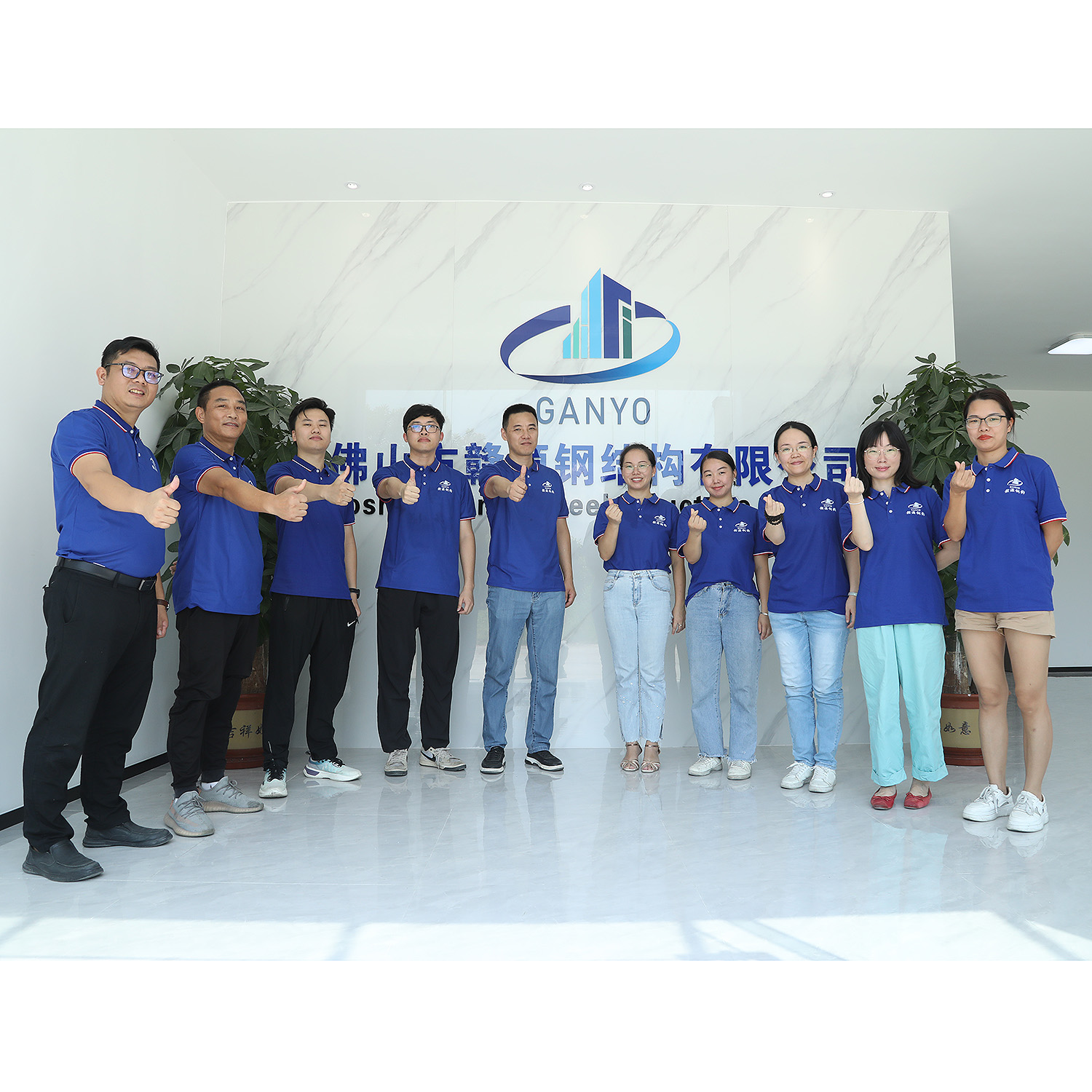
Foshan Ganyo Steel Structure Co., Ltd., based in Gaoming District, Foshan City, Guangdong Province, is a medium-sized production enterprise focused on prefabricated steel buildings. The company describes its own scope as integrated steel structure design, research and development, production and installation services. Its products cover a product chain that includes steel structure prefabricated buildings, prefabricated houses and container houses.
According to its published company profile, Ganyo operates two production factories. The large steel structure manufacturing factory is equipped with a fully automatic steel structure production line, H-shaped steel automatic assembly machines, CNC flame cutting machines and precision processing equipment. A separate light steel housing factory has sandwich panel lines and welding equipment. This factory structure matters for industrial buyers because a manufacturer that produces both the structural frame and the panel system can align procurement and schedule more cleanly than one that must coordinate multiple sub-suppliers for every order.
The company states that its annual steel structure output reaches 20,000 tons and that the light steel housing factory can produce 300,000 square metres of panels per year. The supplier also reports 65 employees and 12 engineers in research and development, which is useful context for buyers that need actual engineering support rather than a trading company interface.
Ganyo exports its products to more than 60 countries and regions across Asia, Africa and South America. Its stated export ratio is 100%, with primary markets in Africa, Southeast Asia and South America, mainly covering countries under the Belt and Road Initiative. For international buyers, this market position means the company has direct experience with export logistics, overseas site coordination and building code differences.
Capacity and lead-time benchmarks for recurrent orders
Capacity is the first filter for a long-term prefabricated steel building supply strategy. A supplier that can handle one order every few months may not be able to support two simultaneous production runs. Buyers should therefore look for clear capacity figures rather than vague promises.
For a medium-sized exporter such as Ganyo, the published fabrication benchmarks are as follows:
| Parameter | Published supplier benchmark |
|---|---|
| Annual steel structure output | 20,000 tons |
| Monthly production capacity | 1,000–2,000 tons |
| Typical production lead time | 30–45 days |
| Minimum order quantity | 200 square metres |
| Delivery method | FOB |
| Pre-shipment verification | Pre-shipment test |
| Payment structure | 30/70 |
These figures are not universal guarantees for every possible building design. A 30–45 day lead time assumes that the design is ready, the materials are available and the order is within the quoted production cycle. More complex structures, unusual spans, high wind or snow load requirements, or long shipping schedules can extend the full project timeline. The value of the published range is that buyers can use it as a starting point for production planning.
For a buyer running an ongoing building programme, a predictable lead time may be more valuable than a lower unit price. If a supplier can consistently hold to the same fabrication window, the buyer can plan site preparation, foundation work, erection teams and handover dates with greater confidence.
Engineering continuity: standard, repeatable design inputs
Long-term buyers need repeatable engineering. A steel structure warehouse ordered in 2026 may need to be extended in 2029. A commercial metal building project in one country may later be replicated in another country with different wind or seismic requirements. Standardisation of design inputs is therefore not just an engineering detail; it is a procurement strategy.
The Ganyo product line allows customised design parameters for most prefabricated steel buildings. Available design variables include location per country or area, overall dimensions in millimetres, wind load, snow load, seismic resistance per local building code, wall type, insulation type, door and window quantities, and crane system capacity if required. Wall type can be customised with brick wall heights of 1.2 metres or 1.5 metres. Insulation options include EPS, fibreglass wool, rock wool, polyurethane panels or plain steel sheet, depending on the building use.
Material grades used in the steel frame are generally Q355B or Q235B, two common structural steel grades in the Chinese fabrication market. Buyers should confirm that the specified grade matches the local design code for their site. What matters for repeat projects is that the same grade and section standard can be applied again in later phases when consistent structural behaviour is required.
Drawing design is another aspect of continuity. A reliable prefabricated steel building supplier should be able to provide clear general arrangement drawings, member lists, connection details, anchor plans and erection drawings. These documents become the baseline for site quality control. Ganyo's stated integration of design, research and development, production and installation services means drawing data can be passed from the engineering team to the workshop without translation gaps that often appear when a trading house handles the order.
Lifecycle maintenance and corrosion protection
Long-term relationships are not only about the first installation. Steel buildings have long service lives, but they are not maintenance-free. Buyers must understand the environmental risks that can undermine a structure over time.
One clear risk is corrosion in coastal high-salt, high-humidity environments. Salt-laden air attacks exposed steel surfaces, particularly near connection points, base plates and roof edges. For projects in such conditions, the control method is hot-dip galvanizing for anti-corrosion protection. Ganyo reports that all steel components receive 100% hot-dip galvanizing treatment, that coating thickness is checked by third-party quality inspection, and that the company provides long-term anti-corrosion warranty support.
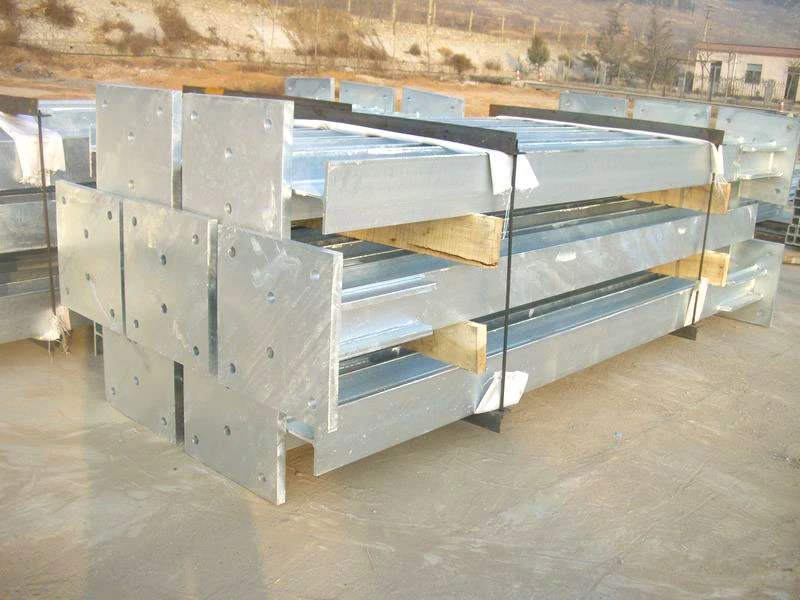
Hot-dip galvanizing creates a zinc layer that protects the base steel and heals small scratches through cathodic action. For repeat buyers, the important point is not only that galvanizing is mentioned in a sales brochure, but that coating thickness can be inspected and verified before shipment. Buyers should ask for third-party inspection data on representative members.
Regular anti-corrosion and fire prevention maintenance is still required over the life of a steel building. Paint systems, fire-protection coatings and sealants may need local maintenance after transport, erection and years of exposure. A long-term supplier relationship makes this maintenance planning easier because the original specifications are known and replacement components can be matched with the original drawing and coating data.
Steel versus concrete from a lifecycle perspective
For industrial buildings, the comparison between prefabricated steel and traditional concrete or brick construction deserves a balanced lifecycle view. Prefabricated steel structures are based on a factory fabrication and dry assembly model. This can reduce the influence of excessive rain or snow on construction progress because most components are manufactured indoors before arriving at the site.
| Comparison point | Prefabricated steel structure | Traditional concrete and brick building |
|---|---|---|
| Construction model | Factory prefabrication plus on-site assembly; dry construction | Wet trades and extensive on-site work; more dependent on weather |
| Building self-weight | Extremely light, roughly 1/2 to 1/3 of a concrete building | Heavier, requiring more foundation treatment in some soil conditions |
| Large-span capability | Large column spacing gives spacious, flexible interiors | Span options are often more limited by beam and column dimensions |
| Seismic behaviour | High toughness and ductility; can deform and dissipate energy; less likely to collapse in severe conditions | Rigid and brittle in many cases; can crack and show limited ductility under earthquake forces |
| Environmental and recycling | Low-pollution site; steel can be recycled after demolition; less construction waste | Dismantling is difficult and material recycling is more complicated |
| Maintenance requirement | Regular anti-corrosion and fire prevention inspections are necessary | Maintenance profile is different but not zero |
Prefabricated steel structures are especially well suited to industrial plants, warehouses, workshops, logistics parks, large-span buildings and emergency or temporary structures. However, the table also explains an important boundary condition. A steel building cannot be treated as a zero-maintenance asset. The owner must plan periodic checks for coating damage, condensation, corrosion around bolted connections and the condition of fire-protection materials.
Decision framework for a long-term prefabricated steel building supplier
For Decision-stage and Execution-stage buyers, practical evaluation is more useful than generic advice. The following framework can be used when comparing prefabricated steel building manufacturers for recurrent projects.
- Verify production capacity. Request monthly and annual production figures, plus the number and type of production lines. For example, Ganyo states monthly capacity of 1,000–2,000 tons and a 20,000-ton annual output of steel structures.
- Confirm lead times for similar projects. Ask what lead time applies to an order of your size and specification. Ganyo states a typical production lead time of 30–45 days, which can be used as a planning baseline.
- Check commercial flexibility. Minimum order quantities matter for phased projects. A 200-square-metre MOQ, as Ganyo states, makes it practical for a buyer to run a smaller first phase before making a major commitment.
- Understand payment and delivery terms. FOB terms and a 30/70 payment structure are common in the Chinese steel export market. A pre-shipment test should be included so that coating thickness, dimensions and assembly fit are checked before goods leave the factory.
- Ask who controls the engineering. In-house design and R&D capability means the supplier can prepare and revise structural drawings. This is especially valuable when the same standard design must be adjusted for different wind, snow and seismic loads in different locations.
- Clarify corrosion protection and after-sales boundaries. Review whether galvanizing, coating thickness inspection and warranty support are included in the quotation. Ganyo reports 100% hot-dip galvanizing and third-party inspection on coating thickness.
- Map logistics to your region. If your projects are in Africa, Southeast Asia or South America, a supplier that already ships to those regions may be better prepared for local packaging, documentation and site coordination.
This framework is designed to raise the quality of conversation between buyers and suppliers. It is not a formula for selecting the lowest price; it is a way to identify suppliers that can remain useful after the first invoice is paid.
Applications that benefit from supplier continuity
Prefabricated steel buildings in the Ganyo product line include steel structure prefabricated workshops and warehouses, multi-storey steel structures, and custom prefabricated steel garages or sheds. These applications overlap with many industrial buying patterns in emerging markets.
A steel structure warehouse, for example, can start as a compact storage unit and expand into a logistics building with a wider clear span. Industrial steel buildings used as workshops may need cranes installed later; the design parameters therefore need to include crane loads from the beginning. Cold storage steel buildings and other thermal envelope applications depend on insulated panel systems. The availability of EPS, fibreglass wool, rock wool or polyurethane panels gives a buyer options when the same building shell is adapted to different climates.
Steel structure hangars and other large-span applications place heavy demands on engineering and fabrication accuracy. A hangar roof usually carries significant wind uplift, and door openings may require long-span frame members. For buyers in regions such as Africa, where the Middle East and Africa steel building market is projected to expand, overseas project logistics and reliable supplier support become part of the investment decision.
Market context: why long-horizon decisions matter in 2026
Market data published by independent research firms supports the importance of long-term sourcing strategy. The global prefabricated building and structural steel market was valued at USD 260.6 billion in 2025 according to IMARC Group. Grand View Research estimated the pre-engineered metal building market at USD 44.1 billion in 2025 and projected it to reach USD 87.0 billion by 2033. In the Middle East and Africa, Technavio expects the steel building market to grow by USD 300.4 million between 2025 and 2030, with a compound annual growth rate of 4.1%.
These figures point to a market where project volume is large and competition among suppliers is intense. At the same time, World Steel Association data indicates that Africa produced roughly 39.49 million tons of steel in 2023, with a projection of 51.86 million tons by 2032. Increasing local production does not automatically eliminate the need for imported pre-engineered systems; many construction schedules and project-specific design requirements still depend on specialist fabrication capacity outside the project region.
From a buyer perspective, the practical conclusion is that capacity is becoming a strategic issue, not just a vendor management issue. Suppliers with visible production records are easier to plan around, while suppliers that cannot provide capacity evidence pose a long-term execution risk.
Future outlook: supplier ecosystems over transactional quotes
As global industrial buyers expand steel building usage across borders, the procurement model will probably shift from single-project transactional quotes toward long-term supply agreements. The reason is simple: repeated buildings need repeated engineering, repeated component quality and repeated maintenance support.
Manufacturers that combine structural steel fabrication, panel production, engineering design and installation services are better positioned for this model than trading companies that outsource each component. Buyers can reserve annual production capacity, reuse approved drawings, standardize component specifications and accumulate inspection data across multiple projects. When a future phase is approved, the cost estimating process becomes faster because the buyer already knows the supplier capacity, MOQ, lead time and coating standard.
For suppliers such as Ganyo, the path forward is to maintain visible production data and engineering support systems that can be audited by clients. For buyers, the path forward is to evaluate the evidence behind the supplier rather than relying only on the latest quotation.
A company profile reference for Foshan Ganyo Steel Structure Co., Ltd. is available here: Public company brochure (PDF). All figures quoted in this article should be independently verified against a current quotation and contract before commercial commitment.
FAQ
What monthly production capacity should a buyer expect from a medium-size prefabricated steel building manufacturer?
A medium-size manufacturer with export programs may state monthly capacity in the range of 1,000 to 2,000 tons. Foshan Ganyo Steel Structure Co., Ltd., for example, reports monthly production capacity of 1,000 to 2,000 tons, with an annual steel structure output of 20,000 tons.
What is a typical production lead time for prefabricated steel buildings?
A typical production lead time is 30 to 45 days, depending on design readiness, material availability and the complexity of the structure. More complex custom designs or unusually high wind and snow load requirements may require additional engineering and fabrication time.
What are common minimum order quantity, delivery and payment terms for prefabricated steel building orders?
Foshan Ganyo states a minimum order quantity of 200 square metres, FOB delivery, a pre-shipment test, and a 30/70 payment structure. Buyers should treat these as a baseline and confirm them against the supplier's current commercial terms.
How should steel structures be protected in coastal or high-humidity environments?
Hot-dip galvanizing is the main protection method used for steel components in coastal high-salt and high-humidity environments. Ganyo reports 100% hot-dip galvanizing of steel components, third-party inspection of coating thickness, and long-term anti-corrosion warranty support.
What design parameters should be fixed before placing repeat steel building orders?
Location, building dimensions, wind load, snow load, seismic resistance, wall type, insulation type, doors and windows, and crane system requirements should all be fixed. For Ganyo products, material grades Q355B or Q235B are common, and insulation can be specified as EPS, fibreglass wool, rock wool, polyurethane panel or plain steel sheet.
Есть вопросы или нужны дополнительные детали?
Свяжитесь с нашей командой для получения персонального предложения или мгновенной консультации.
Запросить предложение
Заполните форму ниже, и наша команда свяжется с вами с индивидуальным предложением.
Прямой чат WhatsApp
Предпочитаете общаться в реальном времени? Напишите нам в WhatsApp для мгновенной помощи и быстрых ответов.
- Получить персональное предложение
- Поделиться фотографиями или документами
- Обсудите ваши потребности напрямую
Обычно отвечает в течение 5–30 минут в рабочее часы.