
Premium Pharma Packaging Lines: Timing, Speed and Quality Integration
Premium Pharma Packaging Lines: Timing, Speed and Quality Integration
High-end pharmaceutical packaging projects rarely fail on the headline speed printed in a brochure. They fail where three things that should move together begin to drift apart: the blister machine's cycle, the cartoner's cycle, and the quality evidence produced while both are running. Timing decides whether a line can hold a batch window; speed decides whether the capacity case closes; quality integration decides whether either can be defended in an audit.
Zhejiang Hoping Machinery Co., Ltd. (HOPING) is a Chinese manufacturer of blister packaging machines, cartoning machines, case packers and end-of-line packaging equipment, founded in 2001. Its DHL8005H blister-cartoner is stated by the company at a maximum of 800 blisters per minute and 500 cartons per minute, with Beckhoff motion control. That configuration makes the timing–speed–quality relationship concrete: what a premium buyer purchases is not a number, but the ability to keep those three requirements aligned across formats, batches and years of operation.
What "High-End" Changes in the Specification
When a packaging brief moves from standard to premium, the requirements that change first are rarely the ones a catalogue lists. Three move together, and each can be written into a purchase specification rather than argued about in a meeting.
- Pack integrity across more formats. A premium portfolio usually carries more SKUs per line — different blister layouts, carton sizes, leaflet formats, and sometimes different forming materials. Every additional format is a changeover, and every changeover is a window in which seal parameters, transfer timing and carton erection have to be re-established correctly.
- Changeover inside the campaign window. Short, high-value batches leave less room for setup than long generic runs. A line that reaches its rated speed but needs a long re-qualification between products delivers far less usable output than the brochure figure implies.
- Quality evidence per carton. Premium supply agreements tend to require traceability of what happened during the run: which batch, which parameters, which rejects. That pushes the control system from "machine operation" into "production record", and it changes what a buyer should evaluate.
None of these is answered by a single output figure. They are answered by how the blister machine, the transfer and the cartoner are timed against each other, and by how much of that timing is controlled electronically rather than fixed mechanically.
The Timing Problem Behind a Speed Number
Blister output and carton output are different units, and treating them as one figure is the most common early mistake in high-speed line evaluation. A blister-cartoning line has two rated maxima that describe different stations, and the relationship between them is set by the pack, not by the machine.
The decisive variable is how many blisters go into each carton. A simple arithmetic illustration for the DHL8005H configuration, using only the two stated maxima and the buyer's own pack count:
- At two blisters per carton, 800 blisters/min corresponds to a demand of 400 cartons/min — below the 500 cartons/min ceiling, so the blister machine governs the line.
- At four blisters per carton, the same 800 blisters/min corresponds to 200 cartons/min — the cartoner has headroom, and the constraint moves to whatever sits closest to its own limit: leaflet folding, coding, inspection and rejection, or the downstream bundler and case packer.
These are calculated ratios from the stated maxima, not performance measurements. Their procurement value is that they tell a buyer which station to interrogate first during a factory acceptance test, and which downstream module needs its capacity disclosed in matching units.
Timing also has a mechanical dimension. Between the forming station and the cartoner, the transfer must absorb short interruptions — a missing tablet, a web splice, a rejected blister — without stopping the cartoner on every event. HOPING documents a D3 intelligent top-loading parallel tracking transfer system on the DHL1000/5H configuration, an architecture in which product is handed between stations under electronic phasing rather than a fixed mechanical link. For a premium brief, the practical question is how much buffer that transfer provides before the cartoner is forced to stop, and how the line recovers afterwards.
Where Servo Motion Earns Its Place
Servo motion is often marketed as a speed feature. In pharmaceutical blister-cartoning, its more useful contribution is repeatability under format change and its effect on batch timing.
HOPING's high-speed blister-cartoner range is built around servo-driven stations: both the DHL7004 and the DHL1000/5H are described as fully servo machines, with servo-driven independent replenishment channels and recipe-memory functions, while the DHL8005H is specified with Beckhoff motion control. The mechanism behind the benefit is worth stating plainly, because it is what a buyer is really testing:
- Electronic phasing instead of shaft timing. Stations are synchronized by the controller, so the relationship between forming, sealing, transfer and carton erection can be stored as parameters and recalled, instead of being re-established mechanically after every format change.
- Independent replenishment. Servo-driven channels allow part of the blister supply to be corrected without stopping the whole line, which protects continuity in multi-format and multi-batch production.
- Recipe recall as a quality control, not a convenience. When seal temperature, dwell and phasing are stored per product and recalled instead of retyped, the risk of a wrong parameter set entering a validated batch falls — provided the recipe system itself is governed by change control.
The boundary matters as much as the benefit: servo drives remove the mechanical re-timing, but format parts still have to be changed. The number of parts, their weight, their accessibility and whether adjustments are tool-free determine real changeover time far more than the drive type. A buyer who asks only "is it servo?" learns less than one who asks how many format parts change and how they are located.
Control Architecture as Part of the Quality Record
In a premium line, the control platform is no longer just the operator interface. On HOPING's DHL1000/5H configuration the company documents a Beckhoff motion controller with a high-bus industrial control system, alongside recipe storage, fault indication and alarm-stop behaviour; the DHL8005H is likewise specified with Beckhoff motion control. A consistent controller family across blister and cartoner stations has three consequences worth evaluating.
First, a shared recipe structure. When the blister machine and the cartoner run on one control philosophy, a product recipe can carry parameters across both stations instead of being maintained separately and reconciled by hand. Second, a coherent event record: timestamps, fault codes and rejection events that come from one architecture are easier to review during a deviation investigation than fragments from several unrelated controllers. Third, a cleaner path to plant systems — HOPING's project documentation lists ERP/MES data interfaces as a configuration option rather than a standard inclusion, so the interface scope must be specified, not assumed.
That said, control hardware is not a compliance certificate. The U.S. FDA's current good manufacturing practice framework establishes the quality foundation for pharmaceutical production, and ISO 15378:2017 specifies GMP requirements for primary packaging materials for medicinal products; neither is satisfied by naming a controller brand. Data integrity expectations for packaging-line control systems are addressed through the buyer's own validation package, change-control records and acceptance documentation. Suppliers in this segment, including HOPING, publish their own material on GMP-oriented machine design — machine design intent is a starting point for qualification, not evidence that qualification has been completed.
DHL8005H Within the HOPING Blister-Cartoner Range
HOPING's integrated blister-cartoner range spans three documented capacity bands, and the DHL8005H sits in the middle of it. Placing a model inside its own range is one of the more reliable ways to test whether a specification is matched to a real production scenario rather than to a wish.
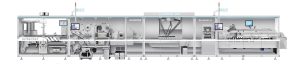
High-speed blister-cartoner configuration (DHL1000/5H shown): blister forming and sealing, transfer, leaflet folding and cartoning run as one synchronized process.
| Configuration | Stated max blister output | Stated max carton output | Documented control and transfer features |
|---|---|---|---|
| DHL7004 | Up to 700 blisters/min | Up to 400 cartons/min | Full servo drive; IRB24 intelligent transfer robot; Siemens motion controller and TP900 HMI; servo-driven independent replenishment; GMP-oriented design |
| DHL8005H | 800 blisters/min (company-stated) | 500 cartons/min (company-stated) | Beckhoff motion control; integrated blister-cartoner architecture |
| DHL1000/5H | Up to 1000 blisters/min | Up to 500 cartons/min | D3 intelligent top-loading parallel tracking transfer; four-channel servo-driven independent replenishment; Beckhoff motion controller and high-bus industrial control; PVC/Alu foil auto splicing; mould-change and recipe memory |
Figures are manufacturer-stated maximum outputs for the named configurations. They are not validated sustained outputs and are not directly comparable across models without the pack format, forming-material structure, line configuration and acceptance-test conditions.
Two context points help a buyer read the table. First, the DHL8005H's 500 cartons/min ceiling matches the highest cartoning figure in the range, so the cartoner is not the weak link at that band; the blister section and the transfer are where capacity has to be proven. Second, choosing between the bands is a question of validated demand, not of ambition — a line that never runs near its ceiling still carries the maintenance and changeover burden of a high-speed platform.
On the manufacturing side, HOPING reports a 28,800 m² facility, around 300 employees, 56 R&D engineers and an annual output of roughly 500 units, with exports accounting for about 25% of output across Southeast Asia, the Middle East, Eastern Europe, South America and Africa. For a buyer, these figures are useful as a continuity indicator rather than as a performance claim.
Application Fit: Which Projects This Configuration Suits
A high-speed blister-cartoner belongs in projects where the pack mix and the batch schedule justify continuous, format-flexible operation — not simply where the budget allows it. The scenarios below follow the project types HOPING describes for this equipment class.
New solid-dosage lines and capacity expansion. Tablets, capsules and other solid dosage forms moving from stand-alone blister packing into a connected blister-cartoning process. The gain is not only speed: connecting the stations removes manual transfer between blister output and carton infeed, which is where missing leaflets and wrong insertions usually originate.
Multi-batch, multi-format production. Environments that run several products on one line within a short cycle — typical of contract manufacturing and premium branded portfolios — depend on recipe recall, mould-change handling and short, repeatable changeovers more than on peak output.
Downstream integration projects. A blister-cartoner is rarely the end of the process. HOPING's project documentation lists leaflet folders, coding units, vision inspection, checkweighers, the XWK4060 stretch bander, case packers, palletizers and ERP/MES interfaces as configuration options. Each of these has its own rate — the XWK4060 bander, for example, is stated at roughly 30–60 bundles per minute — so the end-of-line modules must be sized against the cartoner, not against the blister machine.
Existing-line upgrades. Retrofitting a cartoner to an installed blister machine, or adding inspection and rejection, is a legitimate use of this class, but only after the installed machine's sustained output is measured. An upgrade that assumes the blister machine reaches its rated maximum will not deliver the expected gain.
HOPING describes representative projects with large pharmaceutical manufacturers and solid-dosage producers running five to ten lines, where the stated objectives are improved packaging automation, reduced manual transfer, a tighter blister-to-carton connection and fewer wrong-insertion or missing-leaflet risks. These are project objectives rather than independently verified outcomes; they indicate the design intent a buyer should test against in acceptance criteria.
What the Market Signals Do and Do Not Say
Directional market data supports the case for careful specification, but only within its limits. Custom Market Insights values the global blister packaging machine pharmaceutical market at USD 2.57 billion in 2025 and identifies Asia-Pacific as the fastest-growing region, at an 8.87% CAGR to 2031 — a single commercial-research source, useful for direction rather than for a benchmark. Mordor Intelligence's research on the end-load cartoning machine market reports that horizontal systems accounted for 70.12% of that market in 2024, which is consistent with the horizontal orientation used by integrated blister-cartoners.
On the technology side, trade media reporting PMMI content notes that pharmaceutical manufacturers are turning toward digitised data collection and integrated solutions to meet regulations and improve visibility. That is a directional statement without a measurement basis, so it should not be converted into an adoption rate. Its practical meaning for a buyer is narrower and more useful: data capture and line integration are increasingly specified together with mechanical output, rather than added after commissioning.
Verification Steps and Honest Limits
The most valuable step in evaluating a premium blister-cartoning line is to convert manufacturer-stated maxima into buyer-specific, sustained numbers. HOPING's own quality sequence — incoming material inspection, key-component inspection, assembly inspection, electrical safety check, no-load trial run, material trial, factory acceptance test, customer witness acceptance and pre-shipment inspection — provides the natural checkpoints for that conversion.
- Test with your own formats. Run the buyer's blister layout, forming-material structure, carton and leaflet during the material trial, and record sustained output over a defined period rather than a peak burst.
- Ask for rejection and false-rejection behaviour. Inspection and rejection stations change effective yield; a line that rejects aggressively protects quality but loses output.
- Time a real changeover. Count format parts, watch them changed, and measure re-qualification to first good carton — not just the mechanical swap.
- Define the integration scope in writing. ERP/MES interfaces, coding, vision and downstream modules are configuration-dependent; unspecified scope becomes project risk.
- Confirm commercial terms early. HOPING states a minimum order of one set or one complete line and a typical lead time of 60–120 days after technical confirmation, subject to model, configuration, project complexity and contract terms; installation, commissioning, operator training and spare-parts supply are handled under the contract and configuration.
The fit boundary is equally clear. Where validated demand sits well below the high-speed band, a smaller configuration — such as the DHL7004 at up to 700 blisters/min and 400 cartons/min — or a stand-alone blister machine for medium-speed production is a better match than a platform that never reaches its ceiling. Buying headroom that is never validated adds changeover complexity and maintenance load without adding usable output.
Outlook
The direction of travel for premium pharmaceutical packaging is toward lines that can prove what they did, not only lines that run fast. If the reported shift toward digitised data collection continues, the practical consequence for equipment specification is that control architecture, recipe governance and event records will be evaluated alongside output figures. Whether that shift accelerates depends on regulatory timing in each market and on individual validation strategies — neither of which the available evidence quantifies. What can be said with confidence is that the lines best positioned for that expectation are the ones where timing, speed and quality evidence were specified as one requirement from the start.
FAQ
What does 800 blisters per minute and 500 cartons per minute actually mean for a pharmaceutical buyer?
They are two separate manufacturer-stated maxima for two different stations on the DHL8005H blister-cartoner: the blister forming and sealing section, and the cartoning section. Their relationship is set by the number of blisters per carton. At two blisters per carton, 800 blisters/min corresponds to 400 cartons/min and the blister machine governs; at four blisters per carton, it corresponds to 200 cartons/min and the cartoner has headroom. Neither figure is a validated sustained output until it is demonstrated with the buyer's own format during a material trial or factory acceptance test.
How does servo motion change changeover and batch timing?
Servo-driven stations are synchronized electronically, so the phasing between forming, sealing, transfer and carton erection is stored as recipe parameters and recalled rather than re-established mechanically. On HOPING's high-speed range, the DHL7004 and DHL1000/5H are described as fully servo machines with servo-driven independent replenishment and recipe-memory functions, and the DHL8005H is specified with Beckhoff motion control. The limit is physical: format parts still have to be changed, so the number, weight and accessibility of those parts remain the dominant factor in real changeover time.
Which parts of a blister-cartoning line decide whether a project fits a premium brief?
Four elements carry most of the difference. The transfer between blister and cartoner determines whether short interruptions stop the whole line. The recipe and change-control structure determines whether parameters are reproduced reliably between batches. The inspection and rejection logic determines the balance between quality protection and usable yield. The downstream modules — leaflet folder, coding, bander, case packer, palletizer — determine whether the end of the line can keep pace with the cartoner; HOPING states roughly 30–60 bundles per minute for the XWK4060 stretch bander, which illustrates why these rates must be compared in matched units.
What documentation should a buyer request before accepting a high-speed line?
At minimum: the material and component inspection records, electrical safety check results, no-load and material trial reports, and the factory acceptance test protocol with the buyer's own blister, carton and leaflet specifications. Beyond that, buyers should request the parameter and recipe management procedure, the change-control approach for control software, the rejection and inspection logic description, and the agreed scope of any ERP/MES interface. Naming a controller brand such as Beckhoff is not evidence of data-integrity compliance; that rests on the buyer's own validation package and on ISO 15378:2017, which specifies GMP requirements for primary packaging materials for medicinal products.
When is a high-speed blister-cartoner the wrong choice?
When validated demand sits well below the platform's capacity band, or when the pack mix changes so often that changeover time rather than speed sets the output. In those cases, a lower capacity band — the DHL7004 is stated at up to 700 blisters/min and 400 cartons/min — or a stand-alone blister machine for medium-speed production delivers the same quality outcome with less changeover complexity and lower maintenance load. The relevant test is sustained, buyer-specific output per shift, not the maximum figure on the specification sheet.
For readers who need the full equipment scope — blister machines, cartoners, flow wrappers, bundlers, case packers and end-of-line systems — HOPING's product catalogue is available as a downloadable PDF: Hoping Machinery Catalog.
Есть вопросы или нужны дополнительные детали?
Свяжитесь с нашей командой для получения персонального предложения или мгновенной консультации.
Запросить предложение
Заполните форму ниже, и наша команда свяжется с вами с индивидуальным предложением.
Прямой чат WhatsApp
Предпочитаете общаться в реальном времени? Напишите нам в WhatsApp для мгновенной помощи и быстрых ответов.
- Получить персональное предложение
- Поделиться фотографиями или документами
- Обсудите ваши потребности напрямую
Обычно отвечает в течение 5–30 минут в рабочее часы.