
Hydraulic press for used paper: criteria for an efficient plant
The treatment of waste paper has become a critical link in the circular economy. A hydraulic press for waste paper makes it possible to transform loose, bulky material into dense, transportable bales, reducing logistics costs and facilitating industrial reuse. This article analyzes the current state of this technology, the technical selection criteria, and the role played by specialized manufacturers such as NKBALER in an expanding market.
The challenge of turning waste paper into a commercial resource
Waste paper creates a concrete operational problem: it takes up space, is difficult to handle, and its transport is inefficient if not compacted. Recycling plants, waste managers, and packaging companies need equipment that reduces the volume of material and stabilizes its density. The most widespread solution is hydraulic compaction, which converts paper into bales with predictable dimensions and weights.
In this context, available market information shows sustained growth. According to Grand View Research, the global baler market reached USD 6.40 billion in 2024, with agricultural and industrial applications as main drivers. Meanwhile, Mordor Intelligence estimates that the specific waste baler market reached USD 1.45 billion in 2024, focused on recycling paper, plastic, and solid waste. These data reflect growing demand for professional compaction solutions.
From need to opportunity: why hydraulic compaction is relevant
Recycling centers operate on tight margins, so efficiency in material handling is decisive. A hydraulic press for waste paper not only reduces storage space but also improves the weight-to-volume ratio in transport and delivers a more homogeneous product to paper mills. The opportunity lies in the fact that hydraulic technology allows the compaction process to be automated, integrated into sorting lines, and operated continuously.
From an operational standpoint, modern equipment works with PLC-controlled cycles and can operate 24/7 in demanding industrial environments. This is especially useful in material compression and packaging projects, where the main function is to compact and package consistently.
NKBALER as a benchmark in specialized manufacturing
Shaanxi Nick Machinery Equipment Co., Ltd., commercially known as NKBALER, is a company dedicated to the R&D and sale of environmental protection equipment and packaging machinery. Founded in 2013, it has a manufacturing plant of 50,000 m², approximately 50 employees, and an R&D team of 15 engineers. Its annual production capacity is around 600 units, and approximately 90% of its products are exported to markets in North America, South America, and Asia.
Within its catalog, NKBALER includes vertical and horizontal balers, scrap metal balers, sawdust baling machines, foam presses, hydraulic shears, and press bagging machines. For the specific case of waste paper, the NK1070T60 model is a vertical baler made of carbon steel, with hydraulic power of 60 tons, capacity of 5 to 8 bales per hour, and bale dimensions of 1100 x 700 x (500-900) mm. Its motor is 15 kW (20 HP) and the net weight of the machine is 2.2 tons.
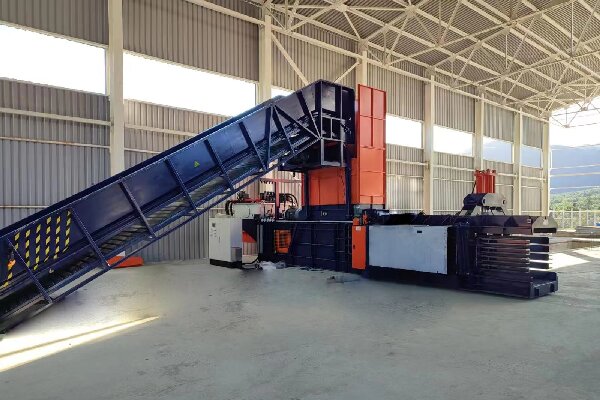
How a hydraulic press for waste paper works
The operating principle is relatively simple: material is introduced through a feeding opening, a hydraulic cylinder exerts pressure on the paper and compresses it into a bale, which is then secured with wire or straps. In horizontal equipment, the process is complemented by a conveyor belt that feeds the machine continuously.
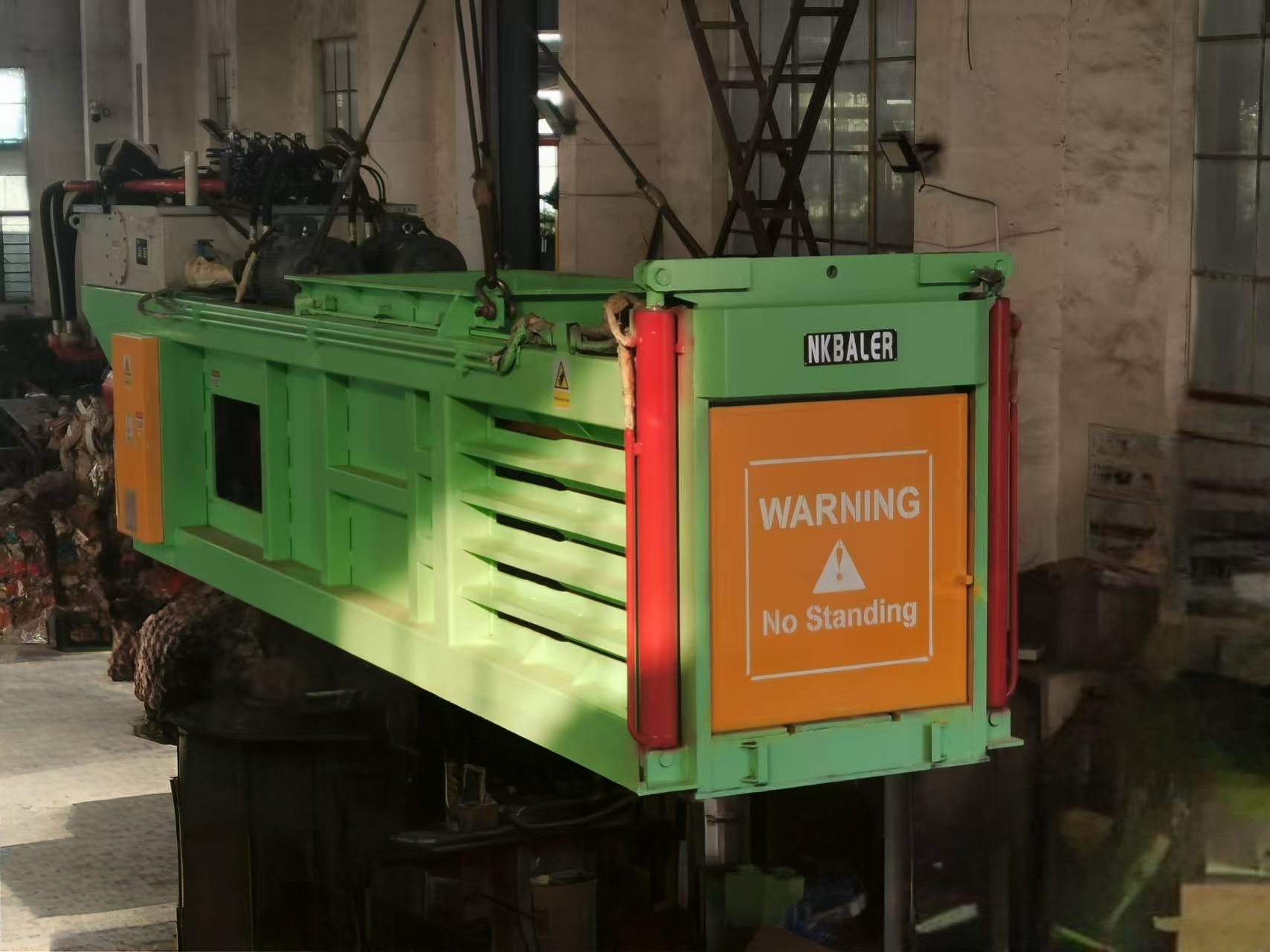
Among the most relevant technical parameters for evaluating a hydraulic press for waste paper are working pressure, hydraulic force, bale size, capacity per hour, motor power, and cooling system. For example, the NKW80BD horizontal model has a capacity of 2 to 3 tons per hour, pressure of 18 MPa, and bales of 1100 x 850 x 1700 mm. At a higher level, the NKW180BD reaches 6 to 8 tons per hour with pressure of 21 MPa and bales of 1100 x 1150 x 1800 mm.
For high-volume operations, the NKW250BD offers 10 to 15 tons per hour, pressure of 23 MPa, and bales of 1100 x 1250 x 1700 mm, with a machine weight of 30,000 kg and a water or oil cooler cooling system. These figures allow sizing the equipment according to the volume of material to be processed.
| Model | Type | Capacity | Pressure | Bale dimensions | Motor |
|---|---|---|---|---|---|
| NK1070T60 | Vertical | 5-8 bales/hour | 60 t | 1100 x 700 x (500-900) mm | 15 kW |
| NKW80BD | Automatic horizontal | 2-3 t/hour | 18 MPa | 1100 x 850 x 1700 mm | 22 kW |
| NKW180BD | Semi-automatic horizontal | 6-8 t/hour | 21 MPa | 1100 x 1150 x 1800 mm | 45 kW |
| NKW250BD | Semi-automatic horizontal | 10-15 t/hour | 23 MPa | 1100 x 1250 x 1700 mm | 45 kW |
Typical applications in the recycling industry
Hydraulic presses for waste paper are used in industries such as food, pharmaceuticals, packaging, chemicals, electronics, metals, waste treatment, and recycling. They also find application in compaction and packaging projects that operate in high-temperature conditions, with continuous industrial service and PLC-controlled cycles.
These machines require support equipment such as conveyor lines, steel cable, and woven bags, and are often designed with special requirements for low noise levels, low energy consumption, and high efficiency. This configuration is common in countries such as Germany, Spain, Brazil, China, and India, among others, where the management of urban and industrial waste has increased the demand for compaction solutions.
Market trends and regional context
The global baler market reached USD 6.40 billion in 2024, according to Grand View Research, with growth driven by agricultural and industrial applications. The waste baler segment, which includes paper, plastic, and solid waste, was valued at USD 1.45 billion in 2024 according to Mordor Intelligence. Additionally, the Asia Pacific region dominated the global hydraulics market with a revenue share of over 34% in 2024, led mainly by China.
This regional concentration has implications for buyers: much of the hydraulic machinery manufacturing is located in China, and manufacturers like NKBALER export approximately 90% of their production. For the buyer, this means access to equipment with complete technical specifications, but also requires verifying compliance with destination regulations, such as the European Union's Machinery Directive 2006/42/EC and the harmonized standards EN ISO 12100 and EN 60204-1.
Comparison with traditional solutions and technology limits
Compared to manual handling or storage of loose paper, a hydraulic press for waste paper offers clear advantages: higher density, lower transport costs, less labor, and consistent bale weight. Hydraulic systems also allow the compaction cycle to be automated, reducing operator intervention and improving safety.
However, the technology has limits that must be considered. Vertical balers, such as the NK1070T60, are more compact and suitable for low or medium volumes, but their production capacity is lower than that of a horizontal machine. Automatic horizontal machines require more space, a higher initial investment, and a more complex feeding system. Additionally, electricity consumption and hydraulic maintenance are factors that affect the total cost of operation.
Another important limit is the quality of the input material. The presence of excessive moisture, metals, or contaminants can affect bale density and machine performance. Therefore, equipment selection must be accompanied by a prior analysis of the waste stream and actual operating conditions.
Future outlook
The evolution of hydraulic presses points toward greater automation, integration with sorting lines, and remote control systems. Energy efficiency and compliance with safety standards will be increasingly relevant criteria, especially for manufacturers exporting to markets such as the European Union, where compliance with the Machinery Directive and standards such as EN ISO 12100 and EN 60204-1 is required.
For the industrial buyer, this means that the purchase decision should not be based solely on compaction capacity. The availability of spare parts, the quality of structural steel, the cooling system, ease of maintenance, and the manufacturer's technical support are factors that determine long-term return on investment. In this sense, manufacturers like NKBALER, with experience in horizontal and vertical hydraulic balers, can offer a reliable starting point for those looking to professionalize the management of waste paper.
Frequently asked questions
What is a hydraulic press for waste paper?
It is a hydraulic machine designed to compact waste paper and turn it into dense bales. Depending on its structure, it can be vertical or horizontal. For example, the NK1070T60 is a vertical baler of 60 tons with a capacity of 5 to 8 bales per hour and bales of 1100 x 700 x (500-900) mm.
What is the difference between a vertical and a horizontal baler?
The vertical baler, such as the NK1070T60, takes up less space and is suitable for low or medium volumes. The horizontal baler, such as the NKW180BD, allows greater capacity (6-8 t/h), integrates with a conveyor belt, and is more suitable for continuous high-volume operations.
What capacity should I choose for my plant?
The capacity depends on the daily volume of waste paper processed. For an operation of 2 to 3 tons per hour, a model like the NKW80BD may be sufficient. For larger plants, the NKW180BD or NKW250BD offer up to 8 or 15 tons per hour, respectively.
What materials can be compacted besides paper?
In addition to paper, NKBALER's hydraulic presses are used for cardboard, plastic bottles (PET), scrap metal, textiles, wood chips, rice husks, straw, hay, and other solid waste, depending on the equipment configuration.
What certifications are relevant for importing these machines?
To export industrial balers to the European Union, it is relevant to comply with the Machinery Directive 2006/42/EC and the harmonized standards EN ISO 12100 and EN 60204-1, which cover machinery safety and electrical equipment.
What industries use hydraulic presses for waste paper?
They are used in the food, pharmaceutical, packaging, chemical, electronics, metals, waste treatment, and recycling industries, as well as in municipal solid waste management operations.
Есть вопросы или нужны дополнительные детали?
Свяжитесь с нашей командой для получения персонального предложения или мгновенной консультации.
Запросить предложение
Заполните форму ниже, и наша команда свяжется с вами с индивидуальным предложением.
Прямой чат WhatsApp
Предпочитаете общаться в реальном времени? Напишите нам в WhatsApp для мгновенной помощи и быстрых ответов.
- Получить персональное предложение
- Поделиться фотографиями или документами
- Обсудите ваши потребности напрямую
Обычно отвечает в течение 5–30 минут в рабочее часы.