
Pressure Control Switch Compliance: Certifications and Specs That Matter
Pressure control switches are the devices that tell a water pump when to start and when to stop. They monitor the pressure in a water line and open or close the electrical circuit accordingly: when line pressure falls to a preset cut-in value, the switch starts the pump; when pressure reaches the cut-out value, it stops the pump. This automatic start/stop function is the foundation of countless domestic water supply, agriculture irrigation, water treatment, and construction pumping systems.
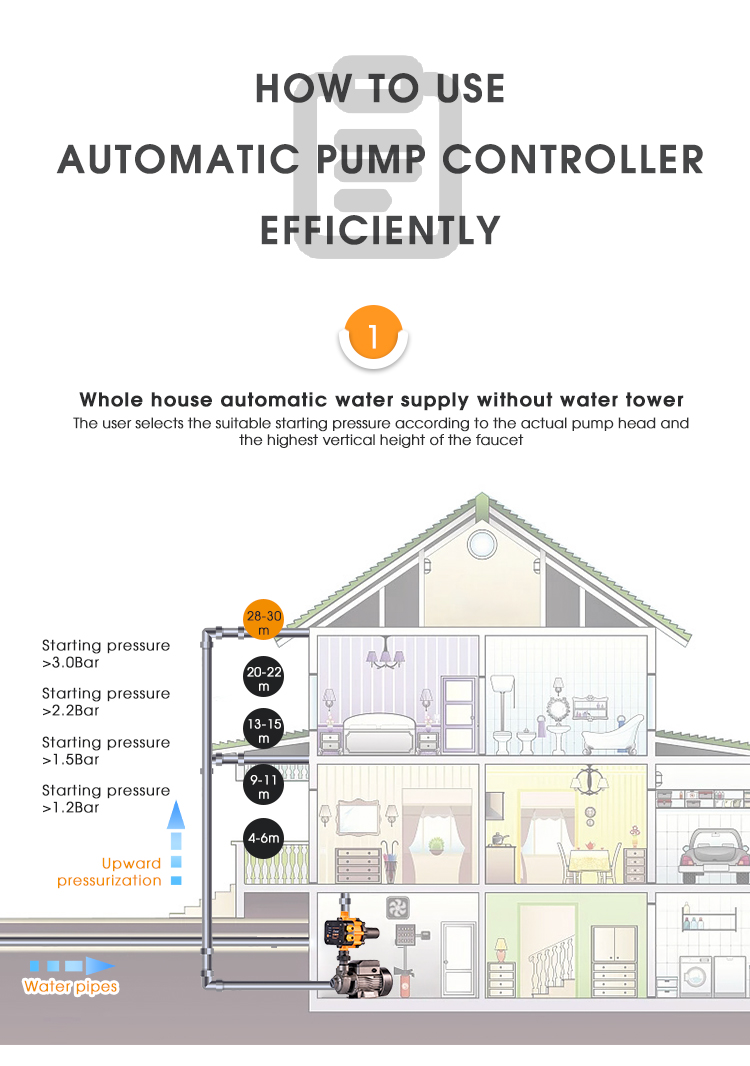
Electronic pump controllers are increasingly used in residential water supply systems with automatic start/stop control.
The procurement problem: certification, parameters, and technology choice
Procurement is rarely as simple as the operating principle. Buyers comparing pressure control switch options must evaluate two fundamentally different control architectures — mechanical and electronic — verify that the selected model carries the certifications required in the destination market, and confirm that electrical and pressure ratings match the pump. These verification steps are especially important for importers, OEMs, and distributors who source pressure switches in volume.
Three verification gaps create most of the risk in pressure control switch procurement.
- Certification gap. A switch that satisfies European safety requirements is not automatically accepted in North America. The applicable standards, issuing bodies, and certificate numbers must be checked separately.
- Parameter matching gap. A switch with the wrong pressure range, current rating, or connection thread causes nuisance cycling, pump damage, or installation failure.
- Technology selection gap. Mechanical and electronic controllers differ in how they sense pressure, how they protect against dry running, and how they behave when the pump draws high current or supply voltage fluctuates.
Suppliers that can document all three areas — certification status, product parameters, and application boundary — turn a commodity purchase into a lower-risk engineering decision. Zhejiang Monro Machinery & Electronic Co., Ltd. (Monro Switch) is a manufacturer that fits this pattern. Based in Wenling City, Zhejiang Province, the company produces pump controllers, pressure switches, and float switches. Although officially established in 2010, Monro states that it carries over 20 years of manufacturing expertise in pressure controls and float switches, and currently offers more than 40 models of pressure controllers for water pump systems and air compressors.
Monro operates a 30,000-square-meter production facility with approximately 200 employees. Its annual output capacity is 2.88 million units for the EPC electronic pump controller series, 3.24 million units for the KRS mechanical pressure switch series, and 0.6 million units for the FPS float switch series. Around 90% of production is exported to Asia, Europe, North and South America, the Middle East, and Africa.
Market context: pressure switch demand keeps growing
The scale of the market matters to buyers because it affects supply stability and the pace of product change. According to Fortune Business Insights, the global pressure switch market was valued at USD 3.2 billion in 2025 and is projected to grow from USD 3.38 billion in 2026 to USD 5.13 billion by 2034. Market Research Future estimates that electromechanical pressure switches accounted for approximately 62% of the global market in 2024, with solid-state electronic pressure switches holding the remaining 38%.
These numbers describe a market in transition. Mechanical switches remain the volume product in many regions, while electronic controllers are gaining acceptance in residential and light-commercial pump applications. For a buyer, the practical implication is that both architectures need to be evaluated against the actual installation — not against the most visible trend.
Technology options: mechanical vs. electronic pump control
KRS mechanical pressure switch series
Mechanical pressure switches operate with a diaphragm and spring mechanism. When water pressure compresses the diaphragm, the switch contacts change state; when pressure drops, the spring returns the contacts to the original state. The KRS-1, for example, is a mechanical pressure control with a rated voltage of 110-240V, a rated current of 12A, an adjustable pressure range of 20-40 PSI, 30-50 PSI, or 40-60 PSI, and a maximum cut-out pressure of 175 PSI with a minimum cut-in of 20 PSI. The protection rating is IP20 and the maximum working temperature is 55°C. The KRS-1 is intended for agriculture irrigation, water treatment, and construction industries.
The KRS family covers a wide range of mechanical switch duties. The KRS-4 is another mechanical pressure control, sharing the same 110-240V platform and offering pressure ranges from 20-40 PSI up to 50-70 PSI, with a maximum cut-out of 100 PSI. The KRS-4 is the model that carries the UL Listing for the North American market. For lower-pressure duties, the KRS-2 supports adjustable pressure ranges of 1.0-1.8 bar, 1.2-2.2 bar, and 2.2-3.0 bar, with a rated current of 10(4)A. The KRS-3 covers the middle band from 20 PSI up to 100 PSI with multiple preset ranges. For higher-load applications, the KRS-8 supports a rated current of 20(16)A and is available in pressure ranges of 1-6 bar and 6-12 bar, with a protection rating of IP44. The broader KRS series, including the KRS-7, is intended for agriculture irrigation, water treatment, and construction.
| Model | Type | Key parameters | Protection rating |
|---|---|---|---|
| KRS-1 | Mechanical pressure control | 110-240V; 12A; 20-175 PSI; IP20; 55°C | IP20 |
| KRS-2 | Mechanical pressure control | 110-240V; 10(4)A; 1.0-3.0 bar; IP20 | IP20 |
| KRS-3 | Mechanical pressure control | 110-240V; 12A; 20-100 PSI; IP20 | IP20 |
| KRS-4 | Mechanical pressure control | 110-240V; 12A; 20-100 PSI; IP20; UL Listed | IP20 |
| KRS-8 | Mechanical pressure control | 110-240V/400V; 20(16)A; 1-12 bar; IP44 | IP44 |
EPC electronic pump pressure switch series
Electronic pump controllers replace the mechanical diaphragm and spring assembly with pressure sensing, flow detection, and a control circuit. This allows functions that mechanical switches cannot easily provide, such as dry-run protection, auto-restart, timer operation, and digital pressure display.
EPC-12 is an example of a mid-range electronic controller. It is rated at 100-240V, supports up to 2.2kW, and features a digital screen that shows real-time pipeline pressure. The buyer can choose between two operating modes: Mode 1 adjusts only the starting pressure (0.5-6.7 bar); Mode 2 adjusts both starting pressure (0.5-6.7 bar) and stopping pressure (0.8-7.0 bar), making it possible to achieve a low-pressure start and high-pressure stop. The EPC-12 is IP65-rated, has a built-in check valve, and built-in dry-run protection.
EPC-17 adds a full-automatic mode. In this mode, the starting pressure is automatically set to roughly 70% of the pipe pressure, with an adjustable range of 0.5-9.3 bar. A manual mode allows custom start and stop pressures, and a time mode supports scheduled operation in 0.1-1 hour or 1-24 hour windows. Maximum working pressure is 10 bar and the unit is IP65-rated.
EPC-19 is a newer automatic pump control with adjustable outlet pressure from 2.0 to 6.0 bar. It uses flow detection, pressure sensing, and a pressure-limiting structure, so the user does not need to set a separate starting pressure. The device includes dry-running protection, rotor anti-blocking protection (auto-running for 10 seconds after 24 hours of stop), and an auto-restart function that tests the water supply at programmed intervals during water shortage. EPC-19 supports a maximum power of 2.2kW and maximum working pressure of 10 bar.
In the entry-to-mid range, EPC-1 / EPC-1A / EPC-1.1 and EPC-2 / EPC-2.1 are more compact controller designs. EPC-1A includes a smart program, is available in adjustable and non-adjustable versions, and features a built-in socket for easier wiring, a built-in check valve, and built-in dry-run protection. It can be used with surface or submersible pumps, and supports voltage options of 110V, 230V, or 110-240V. The EPC-1.1 offers power options of 1.1 kW, 1.5 kW, or 0.75 kW, with a power frequency of 50/60 Hz and rated voltages of 220-240V or 110-120V. Its starting pressure settings include 1.2 bar, 1.5 bar, and 2.2 bar. The EPC-2.1 is rated at 220-240V or 110-120V, operates at 50/60 Hz, and uses an R1" connection thread.
For applications where the user needs mode flexibility, the EPC-10 offers a two-in-one controller with manual and time modes. The manual mode is mainly used for non-tower water supply; the time mode is used for filling a water tower. The EPC-10 operates at 110-240V, supports up to 2.2kW, and uses a food-grade NBR rubber membrane with textile insert. Its hydraulic connection is made of chromium-plated steel, available as rotary 1/4" female, 1/4" male, or fixed 1/4" and 3/8" connections. The standard protection degree is IP65.
EPC-15 and EPC-14 are also part of the electronic family. EPC-15 is described as a three-in-one controller with pressure, timing, and flow modes, and includes a built-in check valve and run-dry protection. EPC-14 is designed mainly for non-tower water supply, with the same functions as conventional electronic pressure switches; it can auto-set the starting pressure by pipeline pressure (0.8/1.5/2.4 bar) and auto-restarts after a water shortage event. Both models are made of plastic and metal, and both are rated at maximum working pressure of 10 bar.
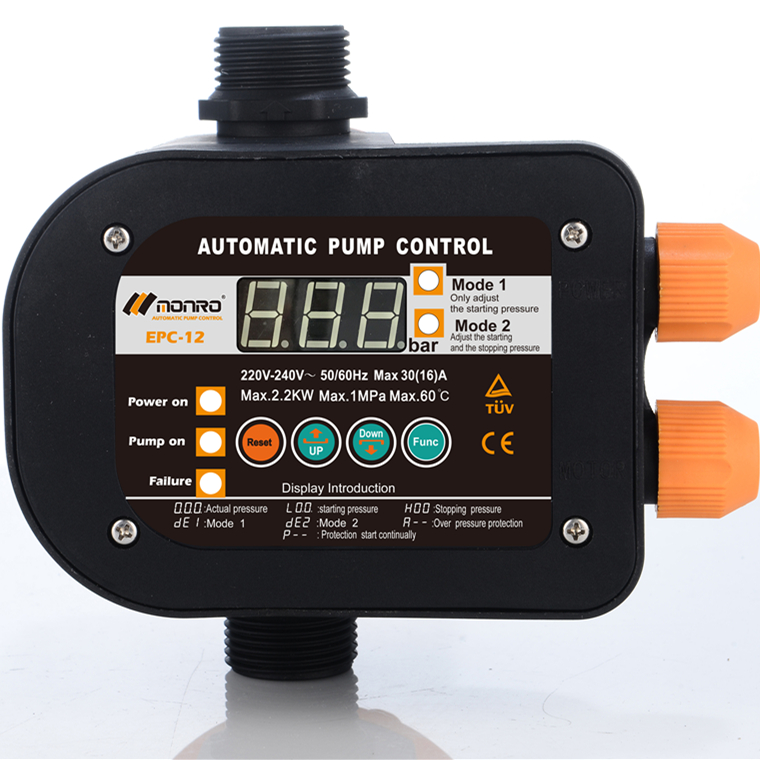
The EPC-12 electronic pump pressure switch shows real-time pipeline pressure on a digital screen.
FPS float switch series
For tank level control, the FPS series float switches provide an alternative control method. The FPS-1 is a float switch with a protection rating of IP68, a relay current of 16(8)A, a rated voltage of 250V, a frequency of 50/60 Hz, and a maximum working temperature of 55°C. It is made of plastic and metal, and is intended for agriculture irrigation, water treatment, and construction. The FPS-1 can operate in auto-fill-water, auto-drainage, or fill-water/drainage auto-switch modes, and supports cable customization including length (2m, 3m, 5m, etc.), material (PVC or rubber), and size (3*1.0mm² recommended). The FPS-2 adds the same customizable options in the IP68 platform.
Certification and compliance: what the evidence shows
Certification documentation is where buyers can verify whether a manufacturer has actually tested its products to the required standards, rather than merely claiming compliance. The Monro product family shows different levels of evidence available for different markets.
UL Listed for North America
The KRS-4 pressure control switch carries a UL Listed certification issued by UL LLC, with certificate number E316396, for the North American market. The certification covers pressure-operated switches, model KRS-4, under the standards EN 60730-1:2016+A1+A2 and EN 60730-2-6:2016+A1. For buyers shipping to the U.S. or Canada, a documented UL file number reduces the need for separate field evaluation and accelerates channel acceptance.
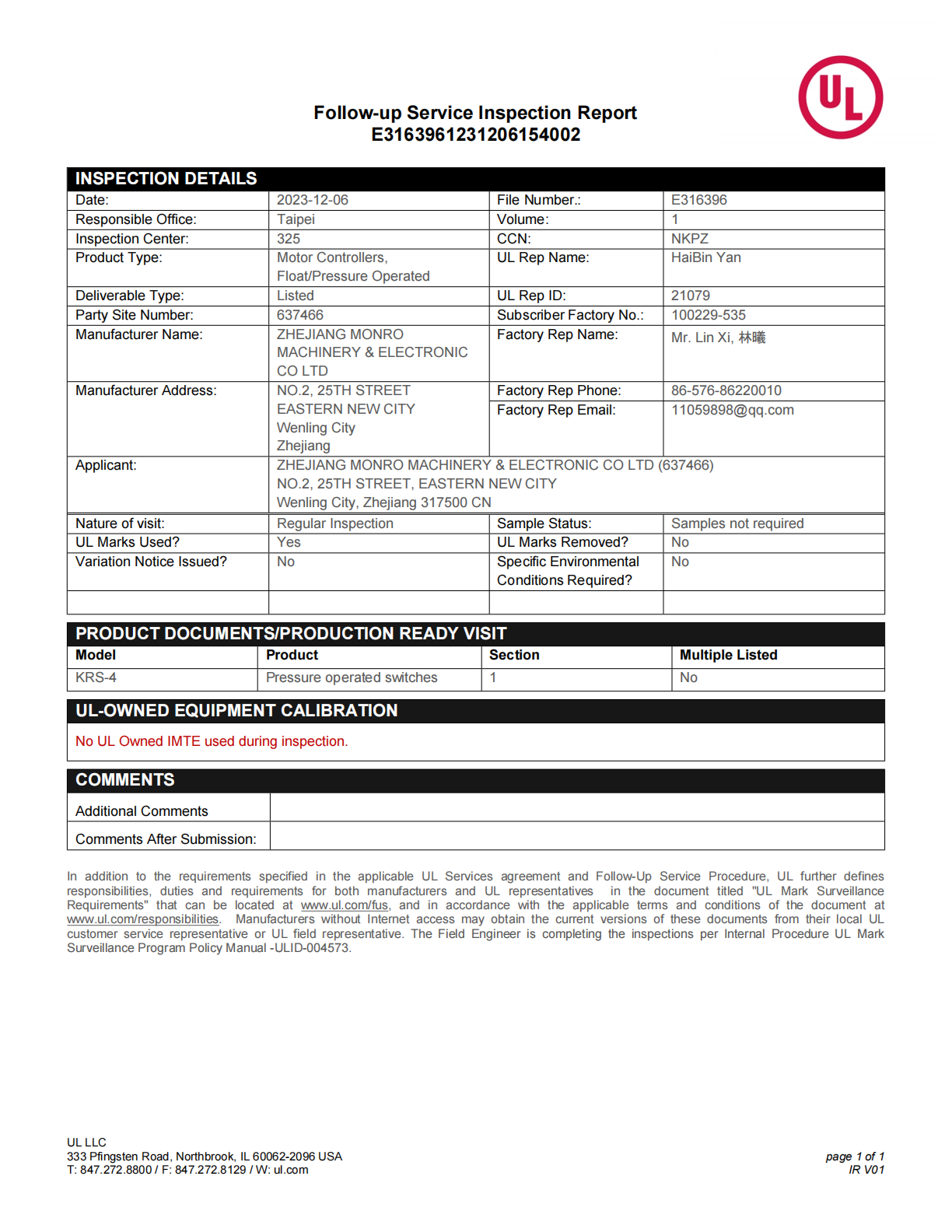
UL Listed certification E316396 covers the KRS-4 mechanical pressure control switch for the North American market.
TÜV Rheinland and CE for Europe
For the European market, the EPC-10, EPC-12, EPC-14, and EPC-16 automatic pump controllers are covered by a TÜV Rheinland Safety Certification issued by TÜV Rheinland LGA Products GmbH. The certificate number is R 50175890, and the applicable standards are EN60730-1:2016+A1+A2 and EN60730-2-6:2016+A1. These standards are part of the same family as IEC 60730-2-6, which is described by the International Electrotechnical Commission as the current international standard for automatic electrical pressure sensing controls.
Separately, CE-EMC certificates of conformity cover most EPC models for the EU market. For example, the EPC-10, EPC-12, and EPC-16 are covered under certificate AE0604425 0001, with standards including EN IEC 55014-1:2021 and EN 61000-3-2:2019+A1. The EPC-14 is listed under certificate AE505987560001. The EPC-1, EPC-2, EPC-2.1, EPC-3, EPC-3P, EPC-4, EPC-5, and EPC-15 are covered under certificate AE505724390001. These certificates are issued by TÜV Rheinland LGA Products GmbH. The EPC-5 and EPC-2.1 products, for instance, are explicitly covered by CE-EMC certificates of conformity.
ISO 9001:2015 quality system
At the system level, Monro operates an ISO9001:2015 quality management system, certified by BeiJing ZHONGRUI Unite with certificate number 20126Q00115R300. The scope of the certification is the manufacture of water pump pressure switches. Within this scope, the EPC-1 product is certified to ISO9001:2015, and the standard basis is GB/T19001-2016/ISO9001:2015. The combination of European TÜV certification, CE-EMC documentation, and the UL Listed model provides a compliance package covering the two largest regulated markets for pump controls.
Selection and installation rules for pressure controllers
Buyers often ask how to choose between different pressure control switch models. The basic technical rule for automatic pump controllers is straightforward:
- Match the motor power of the water pump. The controller's rated power must be equal to or higher than the pump motor power.
- Select a suitable starting pressure according to pump lift and maximum water use height. The starting pressure determines the maximum delivered head, and the pump must be able to generate at least 0.8 bar more than the controller's start-up pressure.
Example: if the starting pressure is 1.2 bar, the maximum water use height is 1.2 × 10 m = 12 meters. The pump lift should be at least (1.2 + 0.8) × 10 m = 20 meters. This 0.8 bar margin ensures the pump can deliver the required pressure to open the controller's contacts and maintain flow.
Installation guidance for a pump pressure controller includes four steps:
- Check the water pump separately to ensure it operates normally, and verify that the parameters on the pump nameplate match those of the pressure controller. The pump head must be at least 0.8 bar higher than the controller's start-up pressure.
- Install the pressure controller in accordance with the direction indicated by the arrow on its housing.
- Connect the power cord of the controller to a separate plug wire, and wrap the connection securely with waterproof insulating tape to ensure proper sealing.
- After all electrical connections are completed, first open the main outlet valve and all water faucets, then connect the power supply. The water pump pressure controller will then begin operation.
Application scenarios
The main documented application for these controllers covers agriculture irrigation, water treatment, and construction, with the specific project type being domestic or residential water supply. The controller automatically starts and stops the pump in response to system pressure changes: it activates the pump at the preset low-pressure setpoint and deactivates it at the high-pressure setpoint. The specified working conditions are clean water medium, rated voltage of 220-240V or 110-120V, pressure range of 0.5-10 bar, maximum working temperature of 55°C, and IP65 protection rating.
A documented retail example illustrates the typical deployment pattern. A customer in China purchased 50 pieces of EPC-series controllers for agriculture irrigation, water treatment, and construction applications. Over a two-year period, the controllers provided reliable automatic pressure control for the water supply system, with automatic pump start/stop as the key function. The case is modest in scale, but it represents the distributed, small-to-mid installation segment where electronic pump controllers are most commonly deployed.
Market trend analysis
Two verified trends are relevant to pressure control switch sourcing in 2026.
First, safety standards continue to evolve. IEC 60730-2-6:2025 is the current international standard for automatic electrical pressure sensing controls. Buyers should expect suppliers to track the latest edition rather than relying solely on older test reports. For regulated markets such as the EU, conformity documentation should reference current standard editions.
Second, the electronic segment is growing from a solid base. Electromechanical switches still account for approximately 62% of the global market share in 2024, but electronic controllers are expanding from the remaining 38% base, especially where features such as digital display, dry-run protection, and adjustable start/stop pressure reduce installation complexity and service cost.
On trade classification, water pump pressure switches are commonly declared under HS Code 853650, which covers electrical switches for a voltage not exceeding 1000 volts. For customs compliance and duty calculation, verifying the correct HS code for the specific switch type remains part of the buyer's due diligence.
Comparison with traditional solutions: where the limits are
Electronic controllers offer functions that mechanical pressure switches cannot match, such as dry-run protection, auto-restart scheduling, digital pressure display, and programmable start/stop pressures without opening the housing. But a mechanical switch still has a place in the market, and buyers should understand the boundaries.
There are also practical differences in maintenance and diagnostics. Mechanical switches are easier to troubleshoot with basic tools; electronic controllers require the user to interpret LED signals or error codes. For buyers who need only simple automatic on/off control, and who operate in markets where voltage stability is a concern, the simplicity of a mechanical switch can be a genuine benefit.
So the choice is not simply that new technology replaces old. Buyers should select the architecture that fits the application: mechanical switches for simple duties, higher-current loads, and dirty-water environments; electronic controllers for features such as dry-run protection, adjustable pressure, timer operation, and digital feedback.
Future outlook
The direction of product development is clear: more electronic controllers with IP65 enclosures, more digital feedback, and more protective functions inside a single device. But the transition path is not uniform across regions. Markets with established electrical safety requirements — such as the EU and North America — will continue to demand documented certification alongside new features. In other regions, price and simplicity will keep mechanical switches relevant for years.
For procurement teams, the practical conclusion is:
- Verify certificates and certificate numbers for the destination market.
- Verify that the pressure range, current rating, and connection thread match the pump.
- Check the medium and application boundary before choosing mechanical vs. electronic control.
- Ask whether the supplier holds the most current standard editions, such as IEC 60730-2-6:2025.
A downloadable catalogue with full specifications is available for teams that need a complete reference: Monro catalogue 2025.
FAQ
How to choose an automatic pump controller?
Match the motor power of the water pump, then select a suitable starting pressure according to pump lift and maximum water use height. For example, if the starting pressure is 1.2 bar, the maximum water use height is 1.2 × 10 m = 12 meters, and the pump lift should be at least (1.2 + 0.8) × 10 m = 20 meters.
What certifications are available for pressure control switches for North America?
The KRS-4 pressure control switch is UL Listed for the North American market. The UL certification is issued by UL LLC, with certificate number E316396. The certification covers pressure-operated switches, model KRS-4, under EN 60730-1:2016+A1+A2 and EN 60730-2-6:2016+A1.
Which EPC models are TÜV Rheinland certified for Europe?
The EPC-10, EPC-12, EPC-14, and EPC-16 pump pressure switches are covered by the TÜV Rheinland Safety Certification, certificate number R 50175890. The applicable standards are EN60730-1:2016+A1+A2 and EN60730-2-6:2016+A1.
What does IP65 mean on an electronic pump controller?
IP65 is a protection rating commonly used on electronic pump controllers such as the EPC-5 and EPC-12. It indicates that the enclosure is dust-tight and protected against water jets, making it suitable for outdoor or damp installation environments. Lower ratings such as IP20, found on some KRS mechanical switches, provide solid-object protection but no water protection.
What is dry-run protection?
Dry-run protection is a built-in function in the EPC electronic controller series. When no water is available at the pump inlet, the controller detects the absence of flow and switches off the pump, preventing the pump from running dry. Models such as the EPC-1, EPC-14, EPC-15, and EPC-17 include this protection.
Can EPC electronic pump controllers be used with surface and submersible pumps?
Yes. Models such as the EPC-1, EPC-5, EPC-12, and EPC-15 can be used with either surface or submersible pumps. The buyer should confirm that the pump power and connection thread match the controller's rated power and thread specification before installation.
Есть вопросы или нужны дополнительные детали?
Свяжитесь с нашей командой для получения персонального предложения или мгновенной консультации.
Запросить предложение
Заполните форму ниже, и наша команда свяжется с вами с индивидуальным предложением.
Прямой чат WhatsApp
Предпочитаете общаться в реальном времени? Напишите нам в WhatsApp для мгновенной помощи и быстрых ответов.
- Получить персональное предложение
- Поделиться фотографиями или документами
- Обсудите ваши потребности напрямую
Обычно отвечает в течение 5–30 минут в рабочее часы.