
Printed Office Craft Gifts: AHA's Capability Evidence
Office craft gifts are a low-spend, high-exposure category. A printed notebook, a boxed stationery set, a desk magnet or a customised sticky-note pad can stay on a client's desk for a year, and every one of those months either reinforces the brand or quietly erodes it. That combination — modest unit price, long dwell time, heavy personalisation — is why supplier capability rather than catalogue breadth decides whether an office gift programme holds together.
The capability that matters narrows to five testable facts: who actually manufactures the product, on what printing and finishing equipment, under what inspection routine, at what minimum order quantity, and with what export and documentation experience. This article reads those five facts for Wenzhou Aha Craft Gifts Co., Ltd. (AHA), a printed-gift manufacturer established in 2017 in Wenzhou, Zhejiang Province, China, and applies them specifically to office craft gifts — the segment where buyers most often discover, after delivery, that a supplier's claims were never evidence at all.
Why office craft gifts stress-test a supplier faster than other printed gifts
Office gifting applies three pressures at once, and each pressure maps onto a different part of a factory.
Dwell time. A desk item is handled daily and viewed at close range. Print adhesion, edge finishing and dimensional consistency matter more here than the first visual impression, and those qualities are determined by substrate choice and finishing control rather than by artwork.
Mixed-material kits. One office gift box can carry paper (notebook, sticky notes, bookmark), plastic or metal (pen barrel, clip, magnet backing) and printed packaging. Each substrate behaves differently: offset printing suits paper volume, screen printing suits large solid logo areas, UV digital printing suits short runs and photographic artwork, and embossing or debossing gives a logo without ink. A supplier that controls only one of these processes has to subcontract the rest, and every handover is a place where colour and deadline drift.
Per-SKU minimums. An office programme frequently needs several designs at a few hundred units each rather than one design at ten thousand. That turns minimum order quantity from a single figure into a structural question about how a factory prices its set-ups.
The opportunity side is equally concrete. Printing was the single largest personalisation method by market value in 2025, and office gifting is one of the few corporate categories where a printed item is used in public, by the recipient, in front of colleagues and clients.
An evidence ladder: how much weight should each supplier claim carry?
Most supplier comparisons collapse three very different kinds of information into one word — capability — which is why so many supplier pages read as adjectives. A buyer evaluating printed office gifts should instead assign weight by evidence tier.
| Evidence tier | What it contains | Example tied to office craft gifts | How to use it |
|---|---|---|---|
| Tier 1 — supplier-reported operating facts | Founding year, facility size, headcount, capacity, reference MOQ, stated lead time, production mode | A 2,000 m² facility, roughly 100 staff, 5,000,000-unit annual output, 2,000-unit reference MOQ | Shortlisting and planning assumptions; treat as directional until confirmed |
| Tier 2 — third-party or public records | Supplier-directory profiles, standards bodies, regulatory guidance | A third-party profile describing OEM/ODM capability and multi-colour offset equipment; published toy-safety and product-safety rules | Cross-checking; can remove a supplier from the shortlist, rarely qualifies one on its own |
| Tier 3 — buyer-held documents | Signed specification sheets, golden samples, test reports, audit findings, approved proofs | A test report covering the exact office SKU and its destination market | The basis for releasing production and accepting delivery |
The practical rule is simple: Tier 1 gets a supplier onto a list, Tier 2 keeps it there or removes it, and Tier 3 is what actually releases a purchase order. A supplier that cannot move from Tier 1 to Tier 3 on request is a supply-chain risk regardless of how favourable its quotation looks.
AHA's operating baseline, read through a single scenario
AHA operates as a manufacturer and supplier of custom promotional gifts, creative household products, stationery, toys and packaging supplies, with one-stop OEM and ODM service covering design, mould development, mass production, printing, packaging and international logistics. Its reported operating figures are summarised below and are then translated into what they mean for an office gift programme.
| Parameter | AHA reference | What it implies for an office gift programme |
|---|---|---|
| Established | 2017 | Roughly nine years of operating history — long enough for repeat programmes, young enough that buyers should still verify process maturity |
| Location | Wenzhou, Zhejiang Province, China | Sits inside a mature light-industry cluster with an established supply base for paper, plastics, printing and packaging |
| Facility size | 2,000 m² | Small-to-mid manufacturing footprint; suitable for multi-SKU gift programmes rather than single-commodity volume |
| Workforce | Approximately 100 employees | Capacity for dedicated QC and packing functions rather than combined roles |
| R&D team | 5 engineers | Indicates in-house design and technical support for structural changes rather than artwork-only service |
| Annual output | 5,000,000 units | Company-reported scale reference for annual planning |
| Monthly capacity | 500,000 units | A 10,000-unit office programme would use a small fraction of one month's output — relevant to reorder risk |
| Production mode | OEM / ODM, one-stop from design to packaging | Mixed-material kits and custom gift boxes can be coordinated under one supplier |
| Reference MOQ | 2,000 units | Both small trial orders and large bulk orders are stated as accepted, with reasonable MOQs |
| Production lead time | 15–30 days | Production time only; sampling, artwork approval and freight sit outside this window |
| Quality control | Full-process inspection; 100% inspection | Inspection runs from raw material selection through production processing to finished-product packaging |
| Export share | 100% | All output is produced against export requirements rather than domestic channels |
| Main markets | EU / USA / SA / ME / SEA | Routine orders, packaging and documentation already run through these destination requirements |
Two of those rows deserve emphasis for office buyers. First, a 100% export ratio means the factory's normal routine is export routine — artwork versions, carton marking and packaging specifications are part of standard order flow, not exceptions requested by a single client. Second, the five-engineer R&D function matters in office gifting precisely because the product is rarely standard: a notebook with a debossed logo, a lidded gift box with a printed insert, or a magnet with a die-cut silhouette all require someone to convert a brand guideline into a manufacturable specification.
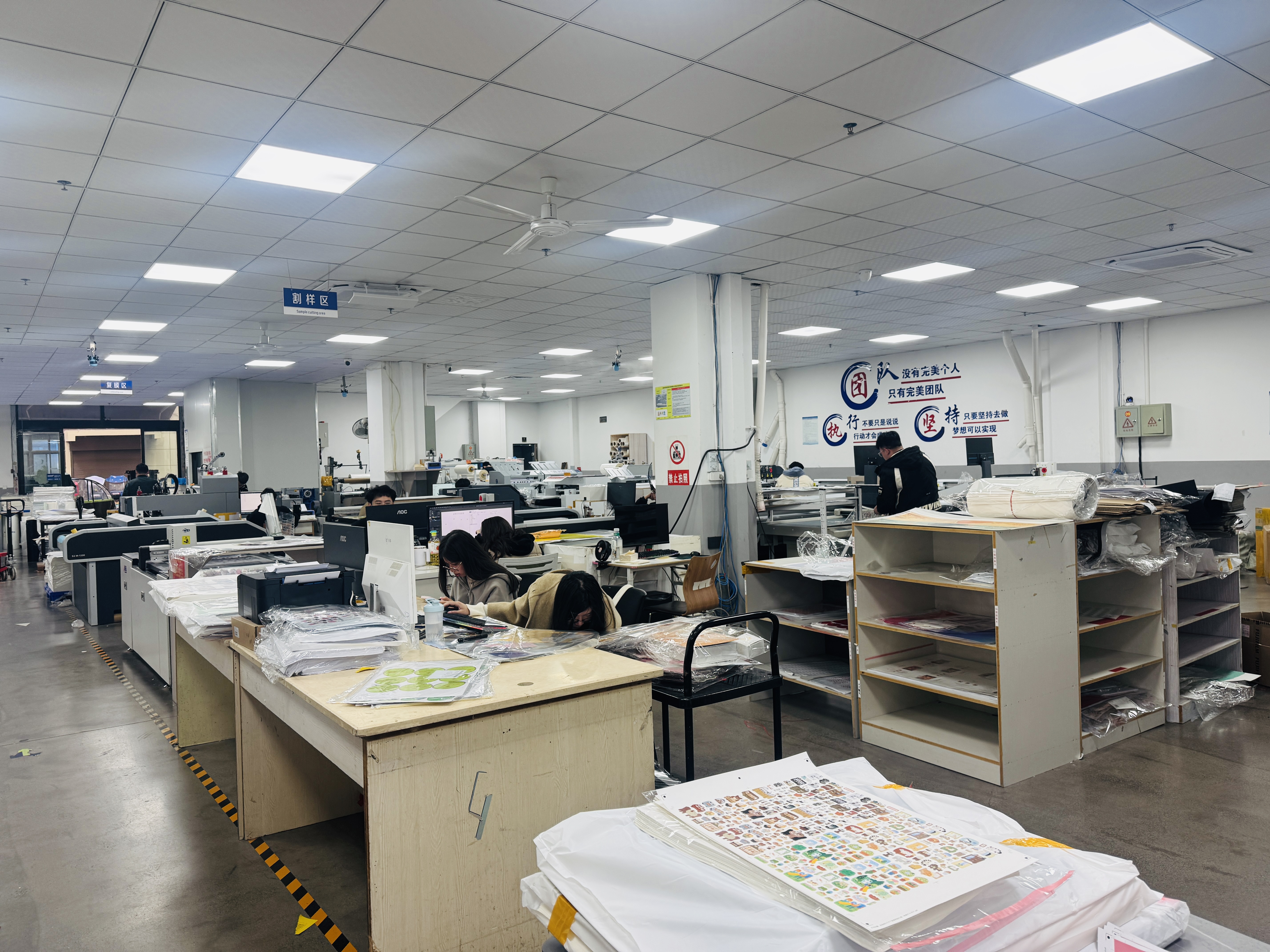
Office environments are the primary setting for office craft gifts; dwell time on a desk is what turns a printed item into a long-running brand surface.
From specification sheet to desk: the AHA-CG Series parameters, translated
The craft gifts and stationery line — AHA-CG Series (Fully Customizable) — covers sticky notes, pens and erasers, and is the part of AHA's portfolio most directly relevant to office programmes. Its published parameters are useful only when read as decisions rather than as a list.
| Specification | Published range | Decision it affects |
|---|---|---|
| Product size | Fully customisable; standard range A5 / A6 / A7; sticky notes 76×76 mm or 100×100 mm | Format fit against desk space, mailer size and shipping cost |
| Material thickness | Paper 80–300 g; plastic or metal 1.5–3 mm | Perceived value: lighter paper reads as a giveaway, heavier stock as a premium gift |
| Printing method | Offset, screen printing, UV digital printing, embossing / debossing | Cost curve across run length and colour complexity |
| Ink | Eco-friendly water-based ink, non-toxic and fade-resistant | Stability of the printed surface over months of desk use |
| Packaging | OPP bag, colour box, gift box, blister pack | Landed cost, unboxing experience and retail readiness |
| Safety standards listed | EN71, REACH, RoHS — stated as compliant and available upon request | Documentation path for EU and US buyers; must be confirmed per SKU |
| Key features | Custom logo and design, reusable, eco-friendly, BPA-free for plastic items | Alignment with corporate sustainability statements |
Paper weight is a specification, not a description
An office programme that specifies only 'notebook' has not specified anything. The 80–300 g paper range in the AHA-CG Series covers everything from a light promotional pad to a heavy cover stock, and the difference is visible the moment a recipient picks the item up. Buyers should fix the value in the specification sheet and in the approved sample, because a supplier that substitutes within the permitted range is still technically compliant.
The printing method determines the cost curve
Offset printing rewards volume; UV digital printing keeps short runs and photographic artwork economic; screen printing holds large solid logo areas; embossing or debossing produces a logo with no ink at all, which many corporate buyers prefer on a premium desk item. Because AHA integrates printing inside the same operation as production and packaging, the method can be chosen for the artwork and order size rather than for what a subcontractor happens to run that week — a distinction that only becomes visible when a reorder arrives with a slightly different red.
Packaging belongs inside the capability question
One-stop service that runs from design through to packaging means the gift box, blister or colour box is produced inside the same order flow as the product. For office gifts, packaging is not a detail: a boxed stationery set and an OPP-bagged pad can share a unit cost but almost never share a perceived value, and mismatched packaging is one of the most common reasons a corporate gift programme underperforms its brief.
Quality control: what to check 'full-process inspection' against
AHA describes full-process inspection from raw material selection through production processing to finished-product packaging, backed by a 100% inspection routine in its capability data. For office craft gifts, that promise is only meaningful when it is pinned to four checkpoints.
- Incoming substrate. Paper weight and whiteness, plastic and metal thickness, magnet grade and coating, verified against the approved specification before the run starts.
- Print run. Colour measured against the approved proof or Pantone reference, with a retention sample pulled from the start, middle and end of the run.
- Assembly and packing. Count, orientation, insert fit, box integrity and closure — the failure points that a print check alone will not catch.
- Pre-shipment. Artwork version, barcode and label accuracy, carton marking and drop performance before the container is sealed.
Where an office item is intended for, or could reasonably be used by, children — desk toys, novelty stationery, small parts — a different rule set applies. ASTM F963-23 is the mandatory US toy safety standard for products intended for children under 14, so a supplier's general product-safety posture is not a substitute for the standard that governs the specific item.
Documentation retention is the other half of quality control. UK product-safety guidance indicates that producers and other responsible parties must ensure products are safe, carry adequate instructions and warnings, and keep conformity assessment records for at least ten years. A manufacturer that treats documentation as a one-off email attachment rather than a retained record is a risk to the importer, not only to itself.
MOQ, lead time and order structure for office gift programmes
AHA's capability data lists a reference MOQ of 2,000 units, a production lead time of 15–30 days and a monthly capacity of 500,000 units, and states that both small trial orders and large bulk orders are accepted with reasonable MOQs — with the trade-off being responsiveness rather than product quality.
The MOQ figure is where most office programmes need to ask a second question. A programme covering eight designs at 400 units each is not the same commercial request as one design at 3,200 units, and whether the 2,000-unit reference applies per SKU or per order changes the plan materially. Buyers should establish that before costing, along with whether sampling is charged and whether artwork revisions fall inside the quoted price.
Lead time needs the same discipline. Fifteen to thirty days describes production; it does not include briefing, sampling, artwork approval, packaging production or international transit. An office programme timed to a fixed corporate event should therefore be planned backwards from the delivery date with explicit buffers at each stage rather than by adding days to the production window.
Capacity is the quieter signal. With 500,000 units of monthly output, a 10,000–20,000-unit office programme represents a small share of one month's production, which is a reasonable indicator for reorder feasibility — subject to the caveat that capacity figures are company-reported and not independently audited. AHA's case record describes a US-based distributor, promotional agency or corporate client relationship running three years, with bulk orders in the 10,000+ unit range and smaller orders negotiable, supported through one-stop custom service and a broad product portfolio.
Where printed office craft gifts are actually used
The operating conditions published for AHA's custom craft gift programmes cover indoor environments, offices, homes, retail stores, event venues, schools, hotels and resorts — which is a fair description of where a printed desk item ends up. Project types include custom promotional products, corporate gift programmes, branded merchandise, souvenir production and event giveaways, and the operating model is OEM/ODM customisation with both small and large batch production under a one-stop service.
In practice, office craft gifts concentrate in five programme types:
- Onboarding kits. Notebook, pen and sticky notes in a printed box, issued on day one and kept on the desk — the highest dwell time of any corporate gift format.
- Client appreciation. Heavier stock, debossed logo, gift-box packaging; the format where paper weight and finishing carry the entire brand message.
- Event and conference giveaways. Higher volume, lower unit value, tighter deadline; UV digital printing and standard sizes usually serve this best.
- Internal recognition. Milestone and anniversary items where personalisation per recipient matters more than volume.
- Retail and e-commerce co-branding. Stationery produced for resale, where packaging choices such as blister or colour box determine whether the item can sit on a shelf.
Each of these has a different failure mode, and the supplier's capability is what determines which one a buyer will meet.
Market trend: printing remains the scale engine
Two published figures frame the category. The global personalised gifts market was valued at USD 33.70 billion in 2025 and is projected to reach USD 69.20 billion by 2033, according to Data Bridge Market Research, and the printing segment held a leading global share of 31.78% of that market in 2025, according to Fortune Business Insights. Both are commercial research estimates with their own product boundaries.
The interpretation matters more than the headline. If printing remains the dominant personalisation method as the category grows, then the capability that scales is print capability: colour consistency across runs, substrate handling, and the ability to move between short and long runs without changing quality. For office gifting specifically, that shifts the evaluation away from catalogue size and towards print control, inspection routine and reorder repeatability.
The honest limitation is that no printed-gift-specific market size, growth rate or trade dataset exists in this evidence set, and the two figures above describe personalised gifts as a whole rather than office craft gifts. Buyers should treat them as directional context for category growth, not as a forecast for their own programme volume.
Direct manufacturer, trading company or local print shop
Office gift buyers typically choose between three supply models, and each solves a different problem.
| Dimension | Direct manufacturer (AHA) | Trading company | Local print shop or decorator |
|---|---|---|---|
| Product scope | Craft gifts, stationery, paper, plastic, metal and packaging under one operation | Broad catalogue assembled from multiple factories | Paper-based print work, usually single-substrate |
| Customisation depth | Logo, design, size, colour and packaging; in-house design and technical support | Limited to what each underlying factory offers | Artwork and print only; structural changes usually out of scope |
| Minimum order | 2,000 units reference MOQ, with small trial and bulk orders stated as accepted | Varies by underlying factory and by order | Low minimums, often a few hundred units |
| Quality control | Full-process inspection and 100% inspection, company-reported | Depends on factory access; less direct visibility | Typically visual check at output |
| Lead time | 15–30 days production | Factory lead time plus coordination time | Short, domestic |
| Export experience | 100% export share; EU / USA / SA / ME / SEA | Variable | Usually domestic market only |
| Principal limitation | A 2,000-unit reference MOQ and no published independent audit; capacity and certification claims require buyer verification | An additional margin layer and split accountability between seller and factory | Cannot produce a mixed-material office kit or an export-compliant gift box |
None of these models is universally better. A buyer running a small local event is usually better served by a local printer; a buyer assembling a multi-material, export-bound office programme needs a manufacturer that controls printing, assembly and packaging together. The point of the table is to make the trade-off explicit rather than to rank the models.
Where AHA's evidence stops
Supplier credibility is built as much by stated boundaries as by stated strengths, so the limits of the available evidence deserve equal weight.
- Capacity and headcount are company-reported. The 2,000 m² footprint, approximately 100 staff, 5,000,000-unit annual output and 500,000-unit monthly capacity come from the supplier and are not accompanied by a published independent factory audit.
- No verified public certificate set. EN71, REACH and RoHS appear as available upon request; buyers must obtain the actual reports for their SKU and market.
- Third-party profile, variant entity name. A third-party supplier profile describes an entity under a slightly different name — Wenzhou Aha Art & Gift Co., Ltd. — established in 2017 as a manufacturer and trading company offering OEM/ODM services with Heidelberg four-colour and five-colour printing machines. That is third-party reporting of a company-reported claim, and equipment should be confirmed during a factory visit or a sample order rather than assumed.
- Case evidence is described, not named. The three-year US distributor relationship is presented without a named client, so it supports a pattern rather than a reference.
- No published cost data. There are no verified quotations, tooling costs, freight rates or landed-cost figures, so any total-cost comparison has to be built from buyer RFQs.
- MOQ is not broken down. Whether the 2,000-unit reference applies per SKU, per design or per order is not stated and must be confirmed in writing.
Future outlook
For 2026 and beyond, the direction of travel in printed office gifts is from price comparison towards evidence comparison. Buyers are increasingly asking for per-SKU MOQ disclosure, test reports scoped to the exact item, retention periods for conformity documentation, and factory access — requests that a manufacturer with in-house printing, inspection and packaging can answer more completely than a reseller.
The structural driver is the printing share itself. As long as printing remains the dominant personalisation method, the manufacturers that win repeat corporate business will be those that can prove print consistency across runs rather than those that quote the lowest first order. That is also the change buyers should watch in their own supplier reviews: not whether a supplier claims full-process inspection, but whether it can produce the checkpoint records that make the claim verifiable.
Frequently asked questions
Can office craft gifts be customised with a company logo, and how far does customisation extend?
Yes. AHA's AHA-CG Series (Fully Customizable) covers craft gifts and stationery such as sticky notes, pens and erasers, with customisation available for logo, design, size, colour and packaging. Supported printing methods are offset printing, screen printing, UV digital printing and embossing or debossing, and packaging options include OPP bag, colour box, gift box and blister pack. The exact customisation depth should be confirmed per SKU, since structural changes and print method availability depend on the specific item and order quantity.
What is the minimum order quantity for office craft gifts, and can a buyer start with a small trial order?
AHA's capability data lists a reference MOQ of 2,000 units and states that both small trial orders and large bulk orders are accepted with reasonable minimums. The company's case record describes standard bulk orders in the 10,000+ unit range, with smaller orders negotiable. Buyers should confirm in writing whether the 2,000-unit reference applies per SKU, per design or per total order, because an office programme with several designs will be costed differently under each interpretation.
How much production time should an office gift programme plan for?
AHA's stated production lead time is 15–30 days. That window covers production only; briefing, sampling, artwork approval, packaging production and international transit sit outside it. Monthly capacity is stated at 500,000 units against 5,000,000 units of annual output, so a typical office programme represents a small share of a month's production — relevant to reorder feasibility, though capacity figures are company-reported.
What quality control applies, and which documents can a buyer request?
AHA describes full-process inspection from raw material selection through production processing to finished-product packaging, together with a 100% inspection routine. For a specific office gift, buyers can reasonably request the signed specification sheet, an approved golden sample, colour retention samples from the run, and the test report applicable to that SKU and destination market. EN71, REACH and RoHS are listed as available upon request, which is an availability statement rather than proof of certification, so the actual report, laboratory and scope should be obtained. Where an item is intended for children under 14, the US mandatory toy safety standard ASTM F963-23 applies to that product category.
Which markets does AHA export to, and what does that mean for compliance?
AHA reports a 100% export share, with main markets in the EU, USA, South America, the Middle East and Southeast Asia. That means orders are routinely produced against export requirements rather than domestic ones. It does not transfer compliance responsibility: importers and own-branders remain responsible for ensuring their product is safe and correctly labelled. UK product-safety guidance, for example, indicates that responsible parties must provide adequate instructions and warnings and retain conformity assessment records for at least ten years, so buyers should confirm documentation practice before the first shipment.
Есть вопросы или нужны дополнительные детали?
Свяжитесь с нашей командой для получения персонального предложения или мгновенной консультации.
Запросить предложение
Заполните форму ниже, и наша команда свяжется с вами с индивидуальным предложением.
Прямой чат WhatsApp
Предпочитаете общаться в реальном времени? Напишите нам в WhatsApp для мгновенной помощи и быстрых ответов.
- Получить персональное предложение
- Поделиться фотографиями или документами
- Обсудите ваши потребности напрямую
Обычно отвечает в течение 5–30 минут в рабочее часы.