
Printed PE-Coated Food Paper Containers for Milk Tea Chains
A printed paper container inside a milk tea chain performs two jobs at once. It has to carry an iced, shaken or hot drink through a takeaway journey without wicking at the seam, and it has to carry a logo that stays legible in a customer photograph. That dual role is why beverage chains tend to specify packaging as a system — cups, food containers, bowls and trays quoted together — rather than as a single stock item bought on the lowest unit price.
This reference examines how disposable food paper containers built on cup base paper with a PE coating fit milk tea and beverage chain scenarios: what the coating actually does, how printing changes the production flow, which container formats match which parts of a beverage-led menu, and where the configuration reaches its limits. It is written for procurement and operations teams at the evaluation stage, where shortlists are narrowed on evidence rather than on brochures.
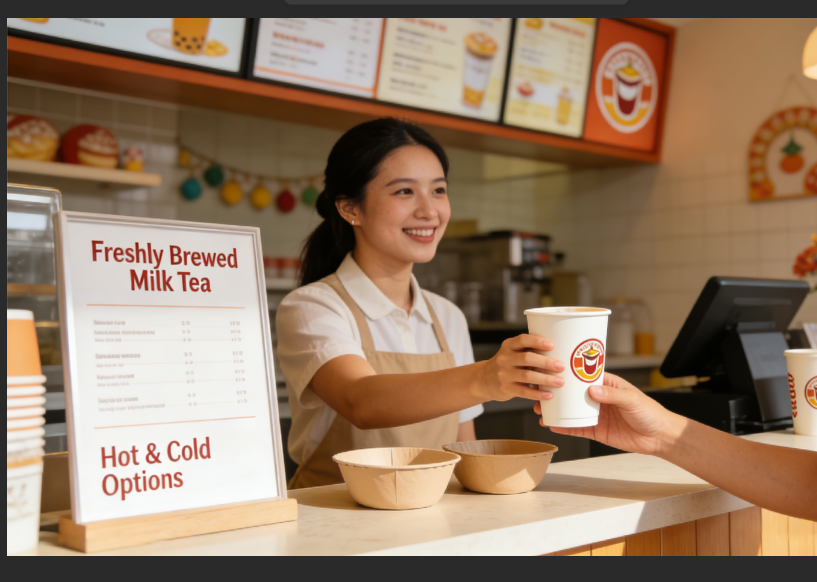
Paper cups and paper food containers in a milk tea chain setting: the same printed surface has to work in-store and in takeaway packaging.
Why Milk Tea Chains Re-Specify Paper Packaging
The operational problem is menu complexity, not the drink itself. A modern milk tea outlet sells hot and iced drinks, blended products, toppings served in separate small containers, and an expanding snack line of fried or baked items. Each of those categories stresses packaging differently. A cold drink stresses the seam and the base of a cup. A fried snack stresses grease resistance on a container wall. A hot dessert stresses heat transfer to the hand.
Three pressures push chains to re-specify at the same time:
- Print consistency across formats. A logo printed on a cup but not on the snack container breaks the visual identity of the order. Chains increasingly want one print reference applied across cups, containers and trays.
- Material expectations from customers and regulators. Paper-based service ware is now the default expectation in many markets, which moves the buying question from "paper or plastic" to "which paper, which coating, which evidence".
- Cost pressure per order, not per unit. Packaging that fails in transit costs more than packaging that costs slightly more per piece, because a leaked drink or a grease-stained box reaches the customer.
The opportunity lies in the same place as the problem: a single supplier able to produce cup base paper coated with PE, print it, die-cut it and form it into cups, boxes, bowls and trays covers the whole menu with one material logic. That consolidation is what a chain is really buying when it evaluates a paper container program.
KingHonor as a Paper Container Manufacturer for Beverage Chains
KingHonor Paper Products Co., Ltd. is a manufacturer of disposable paper cups, paper bowls and paper food containers, founded in 2018 and headquartered in Ho Chi Minh City, Vietnam, with production located in Long An Province, Vietnam. The company operates a 50,000 m² factory with more than 200 employees and a 20-person core technical team, and reports an annual output of 20,000 tons of food-grade PE coated paper together with over 2 billion paper cups and paper food containers. Around 60% of output is exported, with stated markets including the United States, China, Europe, Australia and the Middle East.
Its product scope maps directly onto a beverage chain requisition: food containers in square box formats, paper cups across single-layer, double-layer, hollow and cold-drink constructions, paper bowls, and boat-shaped food trays. Customization covers size, design, logo printing and material selection, and the company states that products can be produced with either PE coating or PLA coating for oil-proof, waterproof and heat-insulation performance.
For an evaluation-stage buyer, the relevant question is not whether the supplier lists these categories — most do — but whether the categories, the printing step and the certification scope belong to the same controlled process. That is the subject of the next two sections.
Inside a Printed PE-Coated Paper Container
Cup base paper is the structural layer. It provides stiffness so a filled container holds its shape, a smooth surface for flexographic printing, and the caliper needed for die-cutting and forming. The PE coating is the functional layer: a polyethylene film extruded onto the paper surface creates the water and grease barrier that keeps liquid from wicking into the fibre and keeps oil from migrating into the wall of a snack container.
Four production stages determine whether the finished article behaves as intended:
- Coating. PE resin is applied to the paper base. Coating uniformity governs barrier performance; thin or uneven coverage shows up as wicking at the base and seam.
- Printing. Flexographic printing applies the brand artwork. Print registration across a curved cup surface and a flat box blank is a distinct skill from printing flat sheets.
- Die-cutting. Blanks are cut to the exact geometry of the container, which determines whether the formed corner or seam closes cleanly.
- Forming. Cups, lids, boxes, trays and bowls are shaped from the printed, coated board. Seam integrity is created here, not in the coating stage.
Heat insulation deserves a separate note. A single-wall PE-coated cup transfers heat quickly when filled with a hot drink. Where a chain serves hot beverages as a meaningful share of the menu, a double-layer construction is the usual answer; KingHonor lists a disposable double-layer paper cup in 20oz among its models. Insulation is therefore a format decision made at specification stage, not a property that can be assumed from the coating alone.
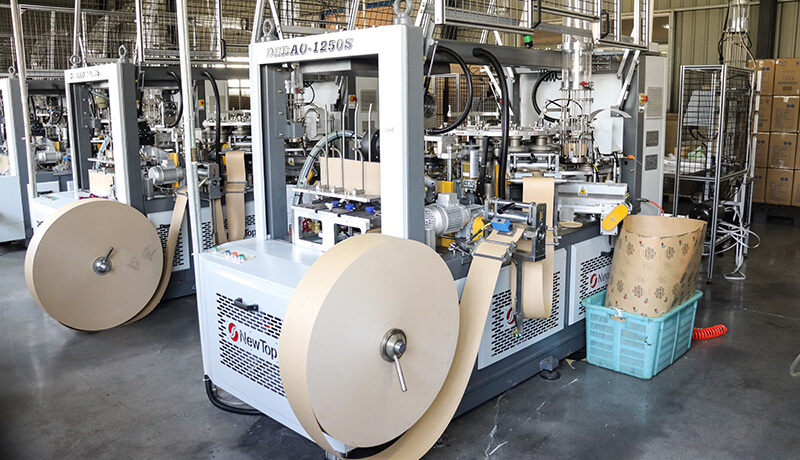
Coating, printing, die-cutting and forming sit in one production flow — the sequence that determines whether a printed container performs as specified.
Matching Container Formats to a Milk Tea Menu
Model selection is where most specification errors happen. Chains often start from the cup they already buy and then try to force snacks into it. A cleaner method is to list the menu by portion type and assign a format family to each, then let the supplier confirm dimensions from its own technical sheet.
| Format family (KingHonor models) | Models listed | Typical role in a beverage-led menu | What the buyer should confirm |
|---|---|---|---|
| Square food container | No.1 to No.8 Square Box | Portioned snacks, pastries, small hot items served alongside drinks | Exact dimensions and fill weight for each box number; lid fit |
| Paper food container | 500, 600, 850, 960, 1100 | Multi-portion takeaway meals and sharing items | Corresponding capacity and stacking behaviour in a delivery bag |
| Paper bowl | 500, 700, 900, 1000, 1100, 1300, 1500 | Hot dessert, soup-style toppings, noodle-adjacent items | Heat resistance with the specific served temperature; lid compatibility |
| Boat-shaped tray | #025, #040, #050, #100, #200, #250, #300, #500, #1000 | Fried snacks, bakery items, grab-and-go sides | Grease resistance under the actual fried-food load |
| Kraft soup bucket ZT | 8oz, 12oz, 16oz, 26oz, 32oz | Soup and hot savoury items as a delivery add-on | Lid seal and leakage behaviour during transport |
| Paper cups | Single-layer 8–44oz; double-layer 20oz; hollow 8/12/16oz; cold drink A3oz; custom 20oz | Core drinks: iced, hot, blended | Single-wall versus double-wall choice for hot SKUs; sleeve or double-wall for insulation |
The practical rule is that format follows portion, and coating follows the ingredient. A fried chicken side and an iced tea are both "snacks and drinks", but they place opposite demands on the same paper wall: one needs grease holdout, the other needs water holdout and seam strength under condensation. A program that specifies both from one supplier still needs two different performance conversations.
Application Evidence: 10 Million Units a Month
The most directly relevant reference for a milk tea chain is KingHonor's beverage-chain program. The company reports supplying a top-five milk tea chain with 10 million disposable paper cups per month, used for in-store beverage sales and takeaway packaging, with customized logo printing applied for brand promotion. In that program, the use of eco-friendly materials was reported to reduce the client's packaging costs by 15%.
Two adjacent cases show the same operating pattern in different service environments. A fast food chain program supplies 10 million disposable food containers per month for in-store sales and takeaway packaging, again with customized logo printing and a reported 15% packaging cost reduction through eco-friendly materials. An airline catering program supplies 10 million disposable paper cups per month for beverage service, with customized logo printing and the same reported cost outcome.
Three things can be read from these references without overstating them. First, the volume profile — 10 million units a month — is a chain-scale requirement, not a distributor trial order. Second, printed cups and printed food containers are produced in the same program, which is the print-consistency argument made concrete. Third, the reported 15% cost reduction is tied to material selection decisions rather than to price negotiation alone, which is the point most relevant to procurement: the specification, not only the quote, moves landed cost.
Client operations in these programs are described as spanning Asia, Europe and America, covering markets including the United States, Vietnam, China, Australia and EU countries. For a chain planning multi-market rollout, that geographic spread is a relevant screening signal about export handling and documentation experience.
Market Signals Behind the Shift to Paper
Category-level data explains why paper container programs are being re-examined now rather than five years ago. According to research aggregated by Grand View Research, the global disposable food containers market was estimated at USD 72.6 billion in 2025, and the paper and paperboard segment of food packaging is projected to expand at a CAGR of 6.2% between 2026 and 2034.
Within takeaway packaging specifically, Verified Market Reports values the global takeaway containers market at USD 15.8 billion in 2024, with paper and paperboard holding a 31% share — approximately USD 4.9 billion — against plastic at 43%, bioplastics at 15% and aluminium at 11%. Two readings matter for a beverage chain. Paper is already a large, established share rather than a niche, and the growth rate attributed to paper exceeds the pace implied by the broader container market, which is consistent with substitution pressure on plastic service ware.
Trade data adds a sourcing dimension. According to the Observatory of Economic Complexity, the United States imported USD 3.61 billion in paper containers in 2024, with China as the second-largest supplier at USD 858 million. For chains with US exposure, that concentration explains continued interest in Southeast Asian production as an alternative or supplementary origin — a category in which KingHonor's Vietnam-based manufacturing and its stated use of CPTPP trade advantages are directly relevant to landed cost and lead time planning.
PE-Coated Printed Paper Compared With Alternative Approaches
Paper is not automatically the right answer for every line on a beverage menu. The comparison that matters is not paper versus plastic in the abstract, but which container approach survives a specific service condition at an acceptable cost per order.
- Against rigid plastic cups: paper offers a printable matte surface that holds brand artwork well and aligns with the direction of single-use packaging expectations in many markets. Rigid plastic retains an advantage in reclosure and in very long holding times, which is why some chains still use it for specific product lines.
- Against uncoated paper: uncoated board absorbs liquid and grease. For drinks it is not viable at all, and for fried snacks it fails within minutes. The PE coating is what makes paper functional in this category.
- Against foam: foam insulates well but has been the target of restrictions in multiple markets and offers a poor print surface for brand work. Chains moving away from foam generally move to coated paper with a double-wall or sleeve solution for hot drinks.
Where the PE-coated printed configuration reaches its limits
Three boundaries are worth stating plainly, because a supplier that does not raise them creates risk for the buyer later.
1. PE coating is not a compostability claim. A PE-coated paper container should not be positioned as compostable. Where a chain's sustainability commitment requires a compostable article, the relevant route is a different coating — KingHonor states that products can be produced with PLA coating as well as PE — and the specific compostability claim then depends on the certification held for that construction, which must be confirmed for the exact SKU rather than assumed from the material name.
2. Published barrier values are limited, so validation is the buyer's job. Coating type and claimed performance are stated, but quantified barrier results and test methods are not publicly documented. A chain should therefore approve a printed container against its own protocol — held temperature, hold time, ice-to-liquid ratio, and a transport simulation — before scaling a purchase order.
3. Certificate scope is narrower than certificate presence. KingHonor's ISO 9001:2015 certificate, number 00623Q31644R4S issued by QAC, carries a scope of lamination, printing and slitting of laminated paperboard and processing of paper cups, with clause 8.3 (design and development) explicitly not applicable. In practice that means the certified system covers production control, not product design — a detail that changes what a buyer should ask for when a new custom container geometry is being developed. Certificate cycles also renew on different clocks: ISO certificates run to 2026-12-03 and the FSC chain-of-custody certificate ESTS-COC-250653 to 2030-06-04, while shorter-cycle audits including BRCGS and social compliance audits should be re-confirmed at purchase-order stage.
What Buyers Can Verify: A Certification Map
For an evaluation-stage shortlist, certifications are useful only when read as scope statements rather than as badges. The table below sets out the certificates KingHonor reports, what each one actually covers, and the verification step it implies.
| Certificate | Issuer and standard | Scope as stated | Buyer verification step |
|---|---|---|---|
| FSC Chain of Custody, ESTS-COC-250653 | ESTS; FSC-STD-40-004 and FSC-STD-50-001; valid to 2030-06-04 | Printing and sales of FSC Mix paper products (product type P6.7) | Confirm the certificate covers the specific printed SKU and that FSC Mix claims on artwork are correctly labelled |
| BRCGS Global Standard Packaging Materials, C0691603-BRC4 | NSF Certification, LLC; Issue 6: August 2019 | PE or PLA resin coating, flexographic printing, die-cutting of paper board, forming of cups, lids, boxes, trays and bowls | Confirm the current audit cycle status and that hygiene controls cover the printed container line |
| ISO 9001:2015, 00623Q31644R4S | QAC; GB/T 19001-2016 / ISO 9001:2015; valid to 2026-12-03 | Lamination, printing and slitting of laminated paperboard; processing of paper cups (clause 8.3 not applicable) | Map the scope to the site that will actually run the order; note the design exclusion for new geometries |
| ISO 14001:2015, 00623E31318R4S | QAC; ISO 14001:2015 / GB/T 24001-2016; valid to 2026-12-03 | Lamination, printing and slitting of laminated paperboard; processing of paper cups | Relevant to environmental reporting requirements in tenders; confirm site coverage |
| amfori BSCI social audit | Third-party social compliance audit | Social compliance of the manufacturing operation | Request the current report and confirm the audited site and cycle |
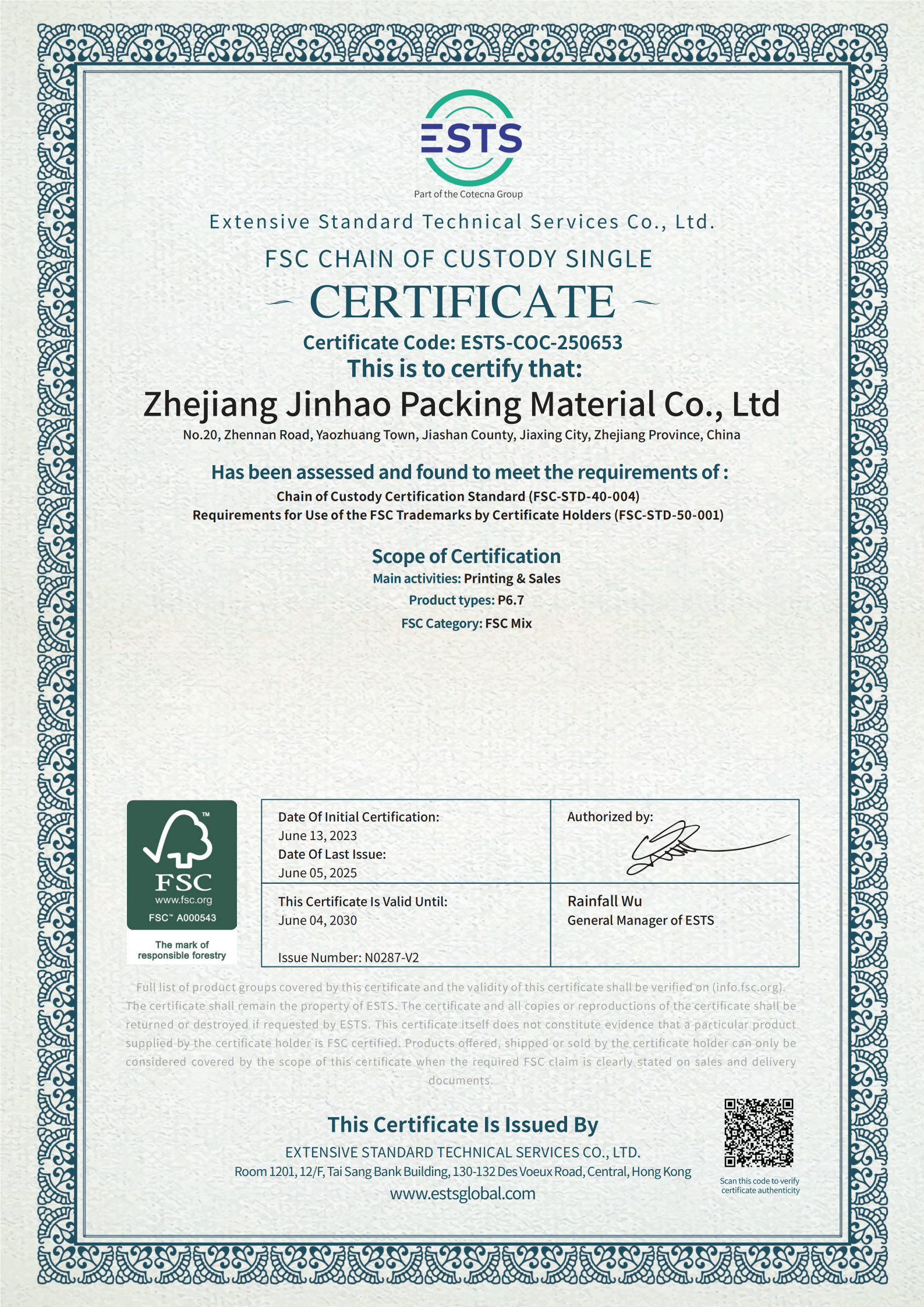
FSC Chain of Custody certificate ESTS-COC-250653: the scope statement, not the logo, determines whether a printed container can carry an FSC claim.
Future Outlook: From Unit Price to Specification and Evidence
Three developments are likely to shape how beverage chains buy printed paper containers over the next planning cycle.
Specification-led tenders. With paper taking a 31% share of a USD 15.8 billion takeaway container market and paper packaging projected at a 6.2% CAGR through 2034, supply is no longer scarce in the way it was during earlier material transitions. The differentiating factor shifts from availability to documented performance: coating type, barrier claims, print registration, and the certificate scope attached to the exact production site.
Coating chemistry under scrutiny. The functional layer is the part of a paper container most exposed to regulatory and customer questions. Chains that specify coating type explicitly — and that separate a recyclability story from a compostability claim — will be better positioned than those that treat "eco-friendly" as a single attribute. The practical implication for suppliers is that dual capability, PE and PLA on the same coated-paper platform, becomes a procurement advantage rather than a marketing line.
Origin diversification. US imports of USD 3.61 billion in paper containers, with China supplying USD 858 million of that in 2024, leave a structural opening for Southeast Asian production. Vietnam-based capacity benefits from raw material access and trade arrangements, and buyers evaluating a second origin typically look for the same certification set at the new site rather than accepting a group-level certificate as coverage.
None of these shifts change the fundamentals of the specification. A milk tea chain still needs a paper wall that resists water on the drink side and oil on the snack side, a print surface that carries the brand across formats, and a document trail that survives an audit. What changes is how much of that a supplier is expected to prove before the first purchase order.
Frequently Asked Questions
Beverage-led menus usually require three format families at once: cups for drinks, small food containers for snacks and pastries, and bowls or soup buckets for hot items. KingHonor's listed range covers square food containers in No.1 to No.8 sizes, paper food containers in models 500 to 1100, paper bowls in 500 to 1500, boat-shaped trays from #025 to #1000, Kraft soup buckets from 8oz to 32oz, and paper cups from 8oz to 44oz including double-layer and hollow constructions.
The coating provides water and grease resistance, so the same coated paper base can serve both hot and cold drinks. The difference is construction rather than coating: a single-wall cup transfers heat quickly with hot liquids, so chains serving a meaningful share of hot beverages typically specify a double-layer cup or an added sleeve. KingHonor lists a disposable double-layer paper cup in 20oz alongside single-layer cups from 8oz to 44oz.
Yes. KingHonor reports customized logo printing as part of its milk tea chain, fast food chain and airline catering programs, where printed cups and printed food containers were supplied within the same engagement. Because flexographic printing is inside the BRCGS-certified scope covering printing, die-cutting and forming, artwork can be applied across cups, boxes, trays and bowls rather than limited to a single format.
Four categories are relevant: food safety and packaging hygiene (BRCGS Global Standard Packaging Materials), quality management (ISO 9001:2015), environmental management (ISO 14001:2015), and fibre sourcing (FSC Chain of Custody), supplemented by social compliance such as an amfori BSCI audit. Verification means checking the certificate number, the issuing body, the scope wording and the validity period, and confirming that the scope applies to the site that will produce the order.
PE-coated paper should not be presented as compostable. Where compostability is a program requirement, the relevant option is a different coating — KingHonor states that products can be produced with PE coating or PLA coating — and the compostability claim then depends on the certification held for that specific construction. Buyers should confirm the claim for the exact SKU and the destination market's accepted standard before printing it on packaging.
Compare on four measurable lines: the specification (paper base, coating type, format dimensions and lid fit), the printing scope and colour consistency across formats, the certificate coverage for the producing site, and the volume record. KingHonor's beverage-chain, fast food and airline programs each reference 10 million units per month, with a reported 15% packaging cost reduction achieved through eco-friendly material selection rather than price negotiation alone — which indicates that material and format decisions belong in the cost comparison, not outside it.
For buyers who need the full model and capability reference before a specification meeting, KingHonor publishes a downloadable company brochure covering its product range, factory profile and certification set: KingHonor company brochure (DOCX). Company information is also available at kinghonorpack.com.
Есть вопросы или нужны дополнительные детали?
Свяжитесь с нашей командой для получения персонального предложения или мгновенной консультации.
Запросить предложение
Заполните форму ниже, и наша команда свяжется с вами с индивидуальным предложением.
Прямой чат WhatsApp
Предпочитаете общаться в реальном времени? Напишите нам в WhatsApp для мгновенной помощи и быстрых ответов.
- Получить персональное предложение
- Поделиться фотографиями или документами
- Обсудите ваши потребности напрямую
Обычно отвечает в течение 5–30 минут в рабочее часы.