
Private Label Aerosol Cosmetics: A Brand Discovery Guide
Private Label Aerosol Cosmetics: A Brand Discovery Guide

Private label aerosol cosmetics are pressurized cosmetic products — sprays, mists, mousses and foams — manufactured under a brand owner's own name, while formulation development, aerosol filling, can and valve sourcing and export documentation are handled by a specialist aerosol manufacturer. The term covers formats as different as SPF sunscreen spray, hair removal spray, body mist, hair styling spray and shaving foam. It is also one of the few cosmetic categories where the choice of manufacturing partner determines whether a brand can ship across borders at all.
For a brand at the research stage, the useful question is not whether aerosol formats sell, but which parts of the supply chain can be delegated to a manufacturing partner, which parts must stay with the brand, and what a realistic first production order looks like. That framing is what separates a workable private label aerosol program from a costly learning experience.
What Private Label Aerosol Cosmetics Covers
Private label aerosol cosmetics describe an ownership model rather than a single product. The brand owner owns the name, the artwork, the claims and the market registration; the manufacturing partner owns the formulation work, the pressurized filling process, the packaging supply chain and the technical export file. This split is why the category behaves differently from conventional private label skincare, where most factories can absorb the packaging step without specialized equipment.
The category is normally organized by delivery format first, because format determines both the equipment required and the consumer experience:
- Continuous spray and fine mist — sun care sprays, facial mists, body mists, setting sprays and hydration mists.
- Mousse textures — cleansing mousses, foaming hair masks and similar aerated formulas.
- Dense foam — shaving foam and comparable foam-format personal care products.
- 360-degree and bag-on-valve spray — formats chosen where orientation-free spraying or propellant-free output is required.
Product families used in private label aerosol programs generally span five groups: sun care, body care, hair care, facial care, and a broader group of specialized aerosol applications that includes custom perfume, shoe and sock deodorant spray, nasal care mist, eye care mist, pet outdoor protection spray and pet protection combined with cooling spray. A brand entering the category usually starts with one or two formats and expands only after the first order has cleared customs and reached shelf.
Why Aerosol Production Is a Different Manufacturing Discipline
Aerosol cosmetics cannot be produced on standard cream and lotion equipment. Aerosol production requires a dedicated pressurized filling workshop, pressure-resistant production equipment and dangerous-goods production qualification. General factories producing cream, lotion or sheet mask formats do not operate this equipment and cannot carry out aerosol filling in house.
Two procurement consequences follow directly. First, the filling step itself has to be treated as a qualification criterion rather than a line item: a supplier may present a broad cosmetic portfolio while subcontracting the aerosol filling to a third party, which makes production cycles and quality consistency harder to control. Second, the finished product is classified as pressurized dangerous goods for transport, so a UN dangerous-goods packaging certificate and SDS/MSDS documentation are required for customs clearance. Those documents originate with the party that actually performs the filling.
Where Private Label Aerosol Projects Commonly Stall
Buyers researching the category tend to encounter the same three failure points. General cosmetic factories without aerosol qualification outsource aerosol filling, which produces unstable quality and missing dangerous-goods documents. Suppliers that cannot issue a valid UN certificate create customs detention risk at destination. And unqualified aerosol valves and cans create leakage risk that surfaces only after the goods are filled and shipped.
Practical mitigation, based on how aerosol manufacturers describe their own controls:
- Confirm that the supplier operates its own aerosol filling qualification rather than outsourcing the pressurized step.
- Verify the full set of export dangerous-goods documents before production begins, not before shipment.
- Require strict incoming inspection of aerosol valves and cans to prevent leakage issues.
BOV Versus Conventional Aerosol: The Technical Choice Behind the Product

BOV stands for Bag-on-Valve, an aerosol packaging technology in which the cosmetic formula is sealed inside an inner flexible bag and fully separated from the non-flammable propellant — compressed air or nitrogen — that fills the outer chamber of the can. When the nozzle is pressed, the external gas squeezes the inner bag and pushes the product out through the valve. Product and propellant never mix, which is the source of most of the technical differences buyers care about.
Stated benefits of BOV include non-flammable construction for safer transport, 360-degree spraying at any orientation, nearly full product evacuation with product utilization described as up to 99%, better formula stability and longer shelf life, and good compatibility with sensitive, natural and alcohol-free formulas. BOV formats are commonly used for alcohol-free perfume, facial mist, sunscreen spray, after-sun care and sensitive body care products.
The limitation is commercial rather than technical: BOV hardware carries a higher unit cost than a standard aerosol can. Manufacturers that run both systems generally position BOV for premium or regulated-positioning products and conventional aerosol for cost-driven, high-volume formats.
| Comparison dimension | BOV (Bag-on-Valve) | Conventional aerosol |
|---|---|---|
| Formula and propellant | Formula sealed in an inner flexible bag, fully isolated from the propellant gas | No inner bag separation; the can holds one shared chamber |
| Propellant | Compressed air or nitrogen, described as non-flammable | Propellant type depends on the system selected for the formula |
| Spray orientation | 360-degree spraying at any orientation | Depends on valve and system design |
| Product evacuation | Nearly full evacuation, described as product utilization up to 99% | Residual product typically remains in the can |
| Formula compatibility | Suited to sensitive, natural and alcohol-free formulas | Propellant contact must be evaluated formula by formula |
| Unit cost | Higher hardware cost | Lower hardware cost than BOV |
Inside a Working Private Label Aerosol Supply Chain
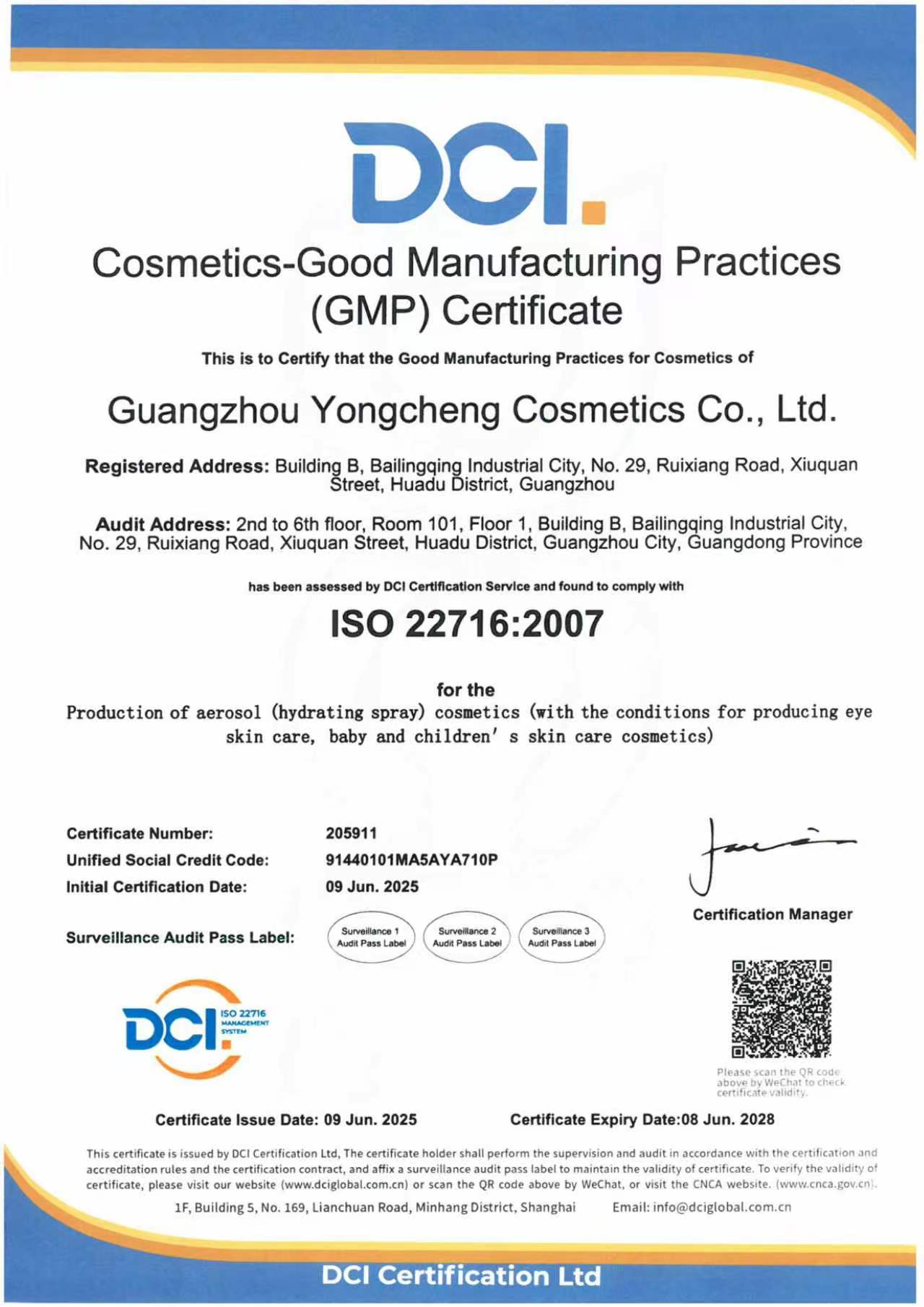
Guangzhou Yongcheng Cosmetics Co., Ltd. is an aerosol cosmetics OEM and ODM manufacturer founded in 2018 and based in Huadu District, Guangzhou, China. The company develops formulas, fills aerosol products, manages packaging and delivers finished goods to brand owners in international markets, and it holds ISO 22716 certification with a 100,000-class GMP cleanroom.
Its stated operating profile is specific enough to be useful as a reference point for what a specialist aerosol supplier looks like: a 12,000 m² manufacturing base, a 2,000 m² R&D laboratory, six fully automated production lines plus six dedicated aerosol lines, a 15-engineer R&D team (with the company listing 10 or more senior engineers at an average of 10 years of experience), annual output of 100,000,000 cans, 150 employees, an export ratio of 50%, and more than 100 global beauty brands served. Its stated main markets are ASEAN, Central Asia, the Middle East and Latin America, and it also holds special cosmetics R&D and registration capability.
For a buyer, three of those facts carry more weight than the rest. Dedicated aerosol lines indicate that the pressurized filling step stays in house instead of being subcontracted, which is the variable most closely linked to quality stability and complete dangerous-goods documentation. ISO 22716 certification paired with a 100,000-class GMP cleanroom is directly reusable in a brand's own compliance file. A 50% export ratio suggests the export documentation routine — UN packaging certificate, SDS/MSDS, COA and CPSR for the EU market — is part of normal operations rather than an exception.
Representative Aerosol Formats Available for Private Label Programs
The formats below illustrate the range that a private label aerosol program can cover in a single supply relationship. Volumes and product types are taken from existing finished-product specifications rather than concept descriptions.
| Product | Model reference | Volume | Format and function |
|---|---|---|---|
| Sunscreen Spray | miluvcare Cooling Sunscreen Spray | 150 ml | SPF 50+ PA+++, broad-spectrum UVA/UVB protection, aerosol spray with cooling skin feel |
| Hair Removal Spray | miluvcare Hair Removal Spray | 150 ml | Aerosol depilatory spray, Wild Rose scent, moisturizing care, for women and men |
| Instant Body Brightening Spray | Quarxery Tone-Up Brightening Spray | 90 ml | Skin tone-up and brightening spray, lightweight and fast absorbing |
| Hair Styling Spray | Caliph Klong Men's Fragrance Strong Styling Spray | 300 ml | Strong hold styling with fragrance, ultra-fine mist, non-stiff flexible hold |
| Hydration and Soothing Toner Mist | LUCENBASE Centella Asiatica Soothing And Moisturizing Spray | 300 ml | 4X soothing complex with Centella Asiatica, ceramide, hyaluronate and panthenol, fine mist aerosol |
| Makeup Setting Spray | Eyevmy Skin Nourishing Essence Makeup Setting Spray | 120 ml | Dual-pack aerosol system with no propellant, oil control and moisturizing, peptide complex |
| Watery Milk Cleansing Oil | HEYUEJI Watery Milk Cap Cleansing Oil Mousse | 150 ml | Mousse format, gentle cleansing and makeup removal, rinse-off |
| Shaving Foam | SOLEHE soft and refreshing shaving foam | 250 ml | Dense foam texture, beard softening and shaving lubrication, botanical soothing formula |
| Eye Care Spray | ESCP Lutein Eye Care Spray | 90 ml | Fine mist aerosol with lutein, external eye-area skin care only |
Application Scenarios and Buyer Fit
Aerosol cosmetic manufacturing for global brands operates under defined conditions: normal ambient temperature, indoor storage and a daily-use cosmetic environment, with manual valve actuation producing continuous spray output. The matched equipment set is an aerosol filling line, a cosmetic mixing and batching system, and a clean production workshop. The stated special requirements are GMP compliance, ISO 22716, aerosol safety requirements and cosmetic regulatory compliance for global markets.
Within those conditions, product families map to distinct buyer needs:
- Sun care — sunscreen spray with cooling, sunscreen mousse, sunscreen spray with whitening, sunscreen lotion and non-aerosol sunscreen spray formats.
- Body care — instant brightening spray, hair removal with fragrance, deodorant with body fragrance, sports cooling spray, shower mousse and body acne care spray.
- Hair care — hair styling with fragrance, dry shampoo with fragrance, styling wax mousse, foaming hair mask and hair oil spray.
- Facial care — hydration mist with soothing, facial toner with fragrance, foundation mist, setting spray, VC essence mousse, cleansing oil mousse and cleansing mousse with shaving.
- Specialized applications — custom perfume, shoe and sock deodorant spray, nasal care mist, eye care mist, pet outdoor protection spray and pet protection combined with cooling spray.
Brands sourcing for the first time generally do best with a single hero format — a sunscreen spray, a body mist or a hair styling spray — because the format determines the can, the valve, the nozzle and the regulatory file, and standardizing on one construction reduces both tooling complexity and document workload.
Market Context: Why the Category Keeps Attracting New Brands
Two structural characteristics explain continued interest in private label aerosol cosmetics. The first is consumer-side: spray and mousse formats are applied without contact, dry quickly, and suit the reapplication habits of sun care, body care and hair styling categories. The second is regulatory and commercial: aerosol products require documented dangerous-goods handling, which narrows the viable supplier pool and makes a documented manufacturing partner more valuable than a low quotation.
Aerosol suppliers positioned for export markets reflect this pattern. Guangzhou Yongcheng Cosmetics states an export ratio of 50%, with main markets in ASEAN, Central Asia, the Middle East and Latin America, and reports more than 100 global beauty brands served. Export share at that level usually accompanies routine familiarity with SDS/MSDS, UN packaging certificates, COA documents and CPSR requirements for the EU market — documents that a brand cannot generate on its own without a factory behind it.
Format-level demand is also shifting toward technologies that solve formulation problems rather than cost problems. BOV construction, for example, exists because alcohol-free and sensitive-skin formulas behave poorly when they share a chamber with a propellant. As alcohol-free positioning spreads through fragrance and facial mist categories, BOV evaluation has moved from a niche question to a routine one in supplier discussions.
Limits and Trade-offs Compared with Conventional Solutions
Aerosol private label is not the cheapest route to a cosmetic product, and the constraints are worth stating plainly before a brand commits:
- Minimum order quantity. The regular MOQ for aerosol cosmetic OEM production is 10,000 cans per formula.
- Lead time. Production typically runs 30 to 45 working days after sample confirmation, and lead time is affected by the aerosol can packaging supply cycle.
- BOV cost premium. Bag-on-Valve hardware costs more per unit than a standard aerosol can.
- Small-batch trial orders. Trial volumes carry a higher unit price, limited availability and potentially longer lead time because of packaging minimum order constraints.
- Logistics classification. Aerosol goods must move through dangerous-goods logistics channels rather than ordinary freight, with hazard marking on outer cartons.
- Registration responsibility. Official registration requires brand-owned legal information, so the brand must appoint a local responsible party; the factory can supply documents but cannot act as registrant.
The practical implication is that aerosol private label rewards brands that plan a standard production order for a real market launch, and treats small-batch production as a testing instrument rather than a sourcing strategy. For very small volumes with no export requirement, a non-aerosol pump or lotion format may be the more economical starting point.
Procurement Criteria: A Four-Point Verification Framework
Supplier selection in this category follows a short, checkable list. Each point maps to a risk that has a documented consequence.
| Verification point | What to confirm | Risk if unverified |
|---|---|---|
| In-house aerosol filling | The supplier operates an aerosol production workshop and pressure filling equipment, not only outward packaging assembly | Subcontracted filling with uncontrollable production cycles and inconsistent quality |
| Qualification set | Cosmetic production license, ISO 22716, ISO 9001, ISO 45001, plus dangerous-goods export supporting documents | Incomplete documentation for customs clearance and overseas filing |
| Regulatory document capability | Ability to issue MSDS, SDS, COA, CPSR and other technical dossiers for target markets | Cargo detention at port or blocked market entry |
| Real project references | Completed aerosol finished-product export projects, ideally in the brand's target region | Unproven process capability discovered during the first production run |
Buyers comparing a self-operated aerosol filling factory with an outsourced subcontracting factory should weigh the two differently. The self-operated model offers an independent pressure filling workshop, complete dangerous-goods qualification and full-set export regulatory documents; the subcontracting model offers lower entry barriers but introduces production-cycle and documentation risk that rarely appears in a quotation.
Future Outlook
Three developments are likely to shape private label aerosol cosmetics over the next planning cycle. Formula positioning will keep moving toward alcohol-free and sensitive-skin claims, which favors BOV and dual-pack aerosol constructions over conventional propellant systems. Documentation readiness will become a screening criterion rather than a service, because more markets now expect a complete technical file at the point of import. And brand owners will increasingly evaluate aerosol suppliers on process ownership — who actually performs the pressurized filling — rather than on catalogue breadth.
For brands still at the research stage, the most useful next step is a short internal brief: which formats are in scope, which markets are targeted, and which documentation the target market requires. That brief determines whether the first conversation with an aerosol manufacturer should be about BOV, conventional aerosol, or both.
Reference documents
Guangzhou Yongcheng Cosmetics company profile (PDF): https://cdn.socialarks.com/sbsp/25202/common/2026/0827/Guangzhou%20Yongcheng%20Cosmetics-E%20Profile%2020260730.pdf
Company website: https://www.gzyc-cosmetics.com/
FAQ
1. What is BOV aerosol?
BOV stands for Bag-on-Valve, an aerosol packaging technology in which the cosmetic formula is fully sealed inside an inner flexible bag and completely separated from the non-flammable propellant — compressed air or nitrogen — that fills the outer chamber of the can. When the nozzle is pressed, the external gas squeezes the inner bag and pushes the product out through the valve. Because product and propellant are fully separated, the system supports 360-degree any-angle spraying, high product utilization described as up to 99%, better formula stability and longer shelf life. It is widely applied to sensitive-skin cosmetics, alcohol-free perfumes, skincare sprays and sun care aerosols.
2. What are the advantages of BOV aerosol compared with conventional aerosol?
Compared with a conventional aerosol, BOV keeps the formulation isolated from the propellant gas, which protects active ingredients and avoids chemical reaction between formula and propellant. The stated benefits are non-flammable construction for safer transport, 360-degree spraying at any orientation, nearly full product evacuation, and good compatibility with sensitive, natural and alcohol-free formulas. The trade-off is cost: BOV unit cost is higher than a standard aerosol. Manufacturers that operate both systems typically recommend the construction that balances budget, market regulation and product positioning.
3. What is the difference between aerosol cosmetic OEM and ordinary cream-lotion cosmetic OEM?
Aerosol cosmetic production requires a dedicated aerosol filling workshop, pressure-resistant production equipment and dangerous-goods production qualification. Factories that produce only cream, lotion or mask formats cannot carry out aerosol filling. Aerosol OEM therefore typically covers formula development, aerosol filling, can and packaging customization, and global regulatory document output as one chain, and it applies to spray, mousse and foam products. Ordinary cream-lotion OEM applies to non-pressurized skincare items and does not include pressurized filling or dangerous-goods export documentation.
4. What is the MOQ and lead time for an aerosol cosmetic OEM order?
The regular MOQ for aerosol cosmetic OEM is 10,000 cans per formula, and lead time is 30 to 45 working days after sample confirmation. Lead time is affected by the aerosol can packaging supply cycle. Formula customization, fragrance adjustment and label customization are supported for overseas brand customers. Small-batch trial orders are possible but carry a higher unit price, limited availability and potentially longer lead time because of packaging minimum order constraints.
5. What certifications and export documents can an aerosol cosmetic manufacturer provide?
A qualified aerosol cosmetic manufacturer can provide a cosmetic production license, ISO 22716, ISO 9001 and ISO 45001. Export supporting documents include MSDS/SDS, a UN packaging certificate, CPSR for the EU market, COA with batch-wise quality test results, and technical dossiers for local cosmetic regulatory notifications in multiple target markets. These documents comply with aerosol dangerous-goods export requirements. A supplier lacking dangerous-goods export documents creates a real risk of cargo detention at port.
6. Can the factory complete regulatory registration for the brand's target market?
A factory can supply the complete technical dossier needed for registration, including SDS, COA, CPSR and the ingredient list, and can support document preparation for the EU and Southeast Asian markets. Official registration, however, requires brand-owned legal information, so submission must be handled by the customer's local responsible party. The manufacturer cannot act as registrant and provides document support only. Buyers should confirm local regulatory rules for the target sales region in advance.
7. What storage and shipping risks apply to aerosol cosmetic products?
Aerosol products are pressurized. Storage in high-temperature environments or direct sunlight, and heavy physical impact in transit, can trigger swelling, bursting or leakage. Because of this, aerosol cosmetic goods must be shipped through dangerous-goods logistics channels rather than ordinary freight, and outer cartons carry hazard warning labels. Practical mitigation is to keep goods away from high temperature and direct sunlight during storage, avoid heavy impact during transport, and require the supplier to provide complete shipping operation guidance and a UN packaging certificate.
8. How should a buyer select a reliable Chinese aerosol cosmetic OEM factory?
Four verification points matter most. First, confirm the supplier possesses an aerosol production workshop and pressure filling equipment rather than performing outward packaging assembly only. Second, confirm complete qualifications: cosmetic production license, ISO 22716, ISO 9001 and dangerous-goods export supporting documents. Third, confirm the capability to issue MSDS, SDS, COA and other global regulatory files. Fourth, ask for real finished-product aerosol project cases, ideally in the target region. Self-operated aerosol filling factories generally offer more stable quality control and complete customs-clearance documents than subcontracting suppliers.