
Private Label Baby Diapers: Constraints Buyers Must Verify
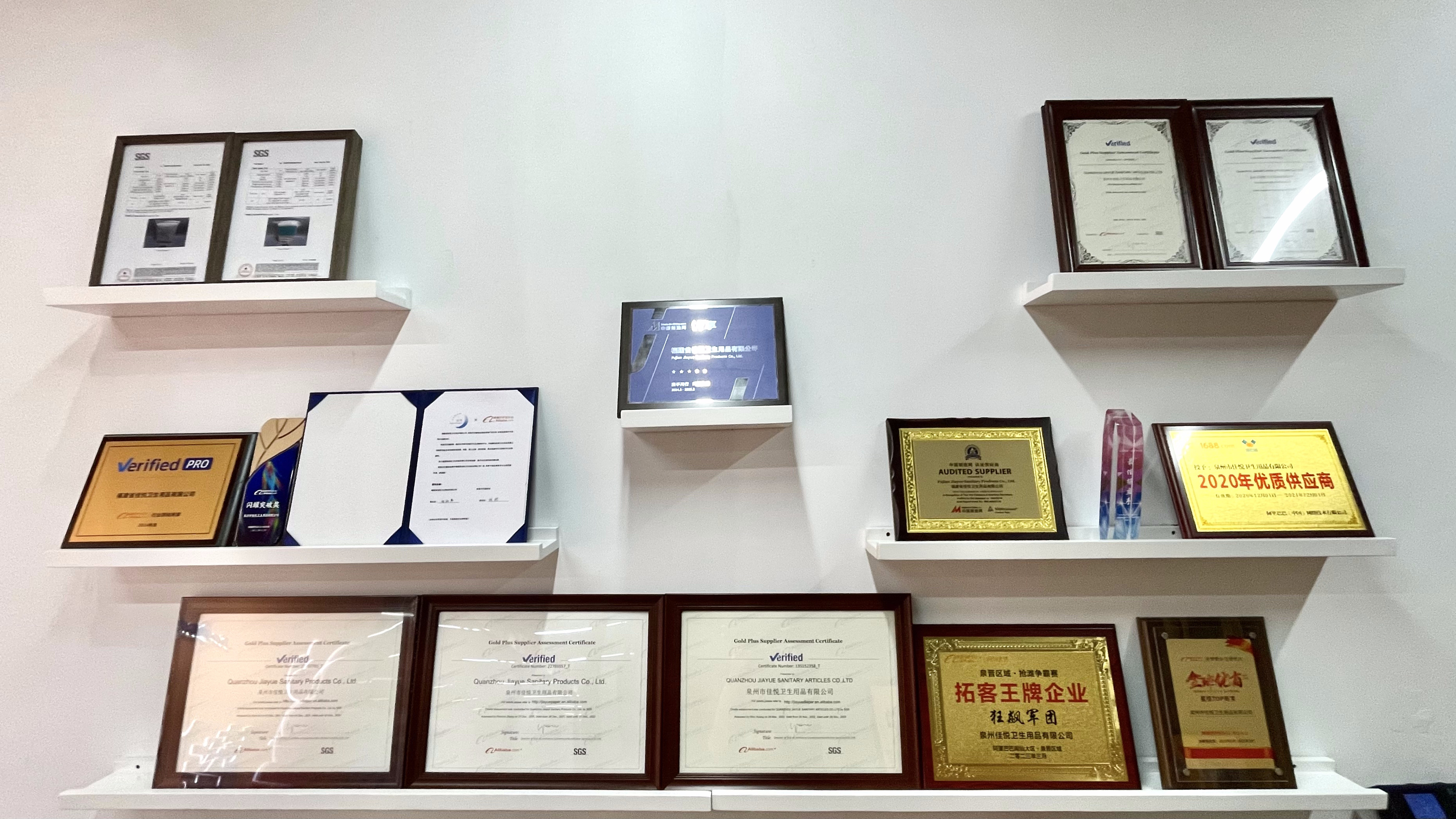
Quality management and conformity documentation maintained by the manufacturer. Certificate scope, not the certificate logo, is what a private-label buyer should read.
A private-label baby diaper program is not decided by brand ambition. It is decided by a short list of binding constraints — size curve, reference absorbency, absorbent-core structure, conformity documentation for the destination market, packaging artwork, minimum order quantity and lead time — all of which must be fixed and approved before production begins. This reference explains where those constraints sit, what evidence supports them, and which limitations a buyer should accept rather than assume away.
Why the Specification Comes Before the Brand
The global baby diaper market was valued at USD 83.3 billion in 2025, according to Grand View Research. Fortune Business Insights places Asia Pacific at 61.92% of the global diaper market in 2025. A market of that size, concentrated in one manufacturing region, attracts private-label entrants in import, distribution, e-commerce and retail channels. It also means that most prospective suppliers can describe comparable production capability.
That is why capability alone rarely settles a supplier decision in this category. When several factories can laminate a diaper, the differentiator becomes narrower: can the supplier freeze a specification, document conformity for a defined destination market, hold a size mix, and repeat the same output on a second and third order? These are constraint questions, not capability questions, and they are answered by documents, parameters and samples — not by adjectives.
What a Private-Label Baby Diaper Specification Actually Contains
The reference configuration for Yibero Premium Quality Ultra Cloudy Baby Diapers — a tape-style disposable baby diaper supplied by Fujian Jiayue Sanitary Products Co., Ltd. for OEM/ODM and private-label programs — shows the parameters that a buyer has to agree before mass production.
| Size | Dimensions | Baby weight range | Reference absorbency | Unit weight |
|---|---|---|---|---|
| S | 400 × 320 mm | 4–8 kg | 500 ml | 26 g |
| M | 450 × 320 mm | 6–11 kg | 600 ml | 29 g |
| L | 500 × 340 mm | 9–14 kg | 700 ml | 33 g |
| XL | 540 × 340 mm | 12–17 kg | 800 ml | 35 g |
Two implications follow. First, absorbency in this category is expressed as a reference value that scales with size, which means a buyer cannot negotiate a single absorbency figure for a whole program — the target has to be set per size. Second, unit weight moves with size, and unit weight is one of the parameters that interacts directly with material cost. A buyer who specifies absorbency without specifying weight and core structure is defining only part of the product.
Size, weight and absorbency targets are not fixed menus. Customization can cover product size and weight, absorbency target, absorbent-core type, topsheet material, backsheet type, fastening format, leak guards, wetness indicator, waistband, graphics, printed bags and cartons, pack count and size mix. Whichever combination is chosen, the final configuration is confirmed in the signed specification and the approved sample.
Absorbent Core, Backsheet and Topsheet: Where Cost and Performance Are Decided
The listed construction of the Yibero reference diaper is a soft topsheet, an absorbent core containing imported SAP and fluff pulp, reusable magic tape, a nonwoven frontal tape, an elastic waistband, and a cloth-like breathable backsheet.
Within that list, the core and the backsheet do most of the work in a private-label brief. The core sets absorbency behaviour and thickness. The backsheet sets the breathability impression the end user feels and the print surface the brand owner uses. Both are customizable, and both change the cost base.
Two core directions are commonly compared: a fluff pulp and SAP core, which combines cellulose fluff pulp with superabsorbent polymer, and an ultra-thin SAP paper core, which uses SAP paper as the main absorbent structure. Jiayue offers both core options for selected diaper products. There is no universal performance advantage between them. Buyers should compare thickness, target absorbency, product weight, fit, material configuration and test results against the approved specification and sample under the same conditions.
The same logic applies to nonwoven selection, where hot-air and spunbond nonwoven are both available options in the customization scope. The honest position is that material naming is not a ranking. It is a variable that has to be linked to a test method and an acceptance criterion.
Certification and Conformity: Read the Scope, Not the Logo
Fujian Jiayue Sanitary Products Co., Ltd. is a hygiene and personal-care product supplier based in Quanzhou, Fujian, China, established in 2016, operating a production base of approximately 20,000 m² and serving customers in more than 70 countries and regions. Its documentation set is specific enough to be checked line by line.
| Document | Number | Standard | Issuer / basis | Validity | Scope note |
|---|---|---|---|---|---|
| ISO 9001 Quality Management System Certificate | NOA2314690 | GB/T 19001-2016 / ISO 9001:2015 | NOA Testing & Certification Group Ltd. | Issued 2023-12-12; valid until 2026-12-11 | Sales of sanitary products, maternal and infant products, and Class I medical devices |
| ISO 13485 Medical Devices Quality Management System Certificate | NOA2314356 | GB/T 42061-2022 / ISO 13485:2016 | NOA Testing & Certification Group Ltd. | Issued 2023-12-06; valid until 2026-12-05 | Limited to Class I medical device sales |
| CE Declaration of Conformity — Baby Diapers | CE/PPE-JY-01 | Regulation (EU) 2016/425; Module A according to Annex IV | Self-declaration by Fujian Jiayue Sanitary Products Co., Ltd.; EU representative SUNGO Europe B.V. | Issued 2025-05-15; no recorded expiry date | Baby diapers, sizes NB–XXXXXL; length 36–58 cm; width 28–45.5 cm; Category I |
Three constraint details matter more than the certificate names. First, the ISO 13485 certificate is scoped to Class I medical device sales, not to every diaper SKU in the portfolio — so it should not be presented by either side as a blanket product approval. Second, the CE Declaration of Conformity for baby diapers is a self-declaration by the manufacturer under the PPE Regulation, supported by an EU representative; self-declaration is a legitimate conformity route within its category, but it places the verification burden on the documentation and the representative, which is exactly where a buyer should look. Third, both ISO certificates currently in force carry expiry dates in December 2026, which makes renewal status a live item in any contract that extends beyond that window. Selected products may additionally be supported by SGS test reports and other compliance documents according to the applicable product, destination market and order requirements.
The company's stated position is that final capacity, MOQ, lead time, testing requirements and payment terms are confirmed in the quotation, the approved sample and the sales contract. For a compliance-driven category, that is the correct place for them.
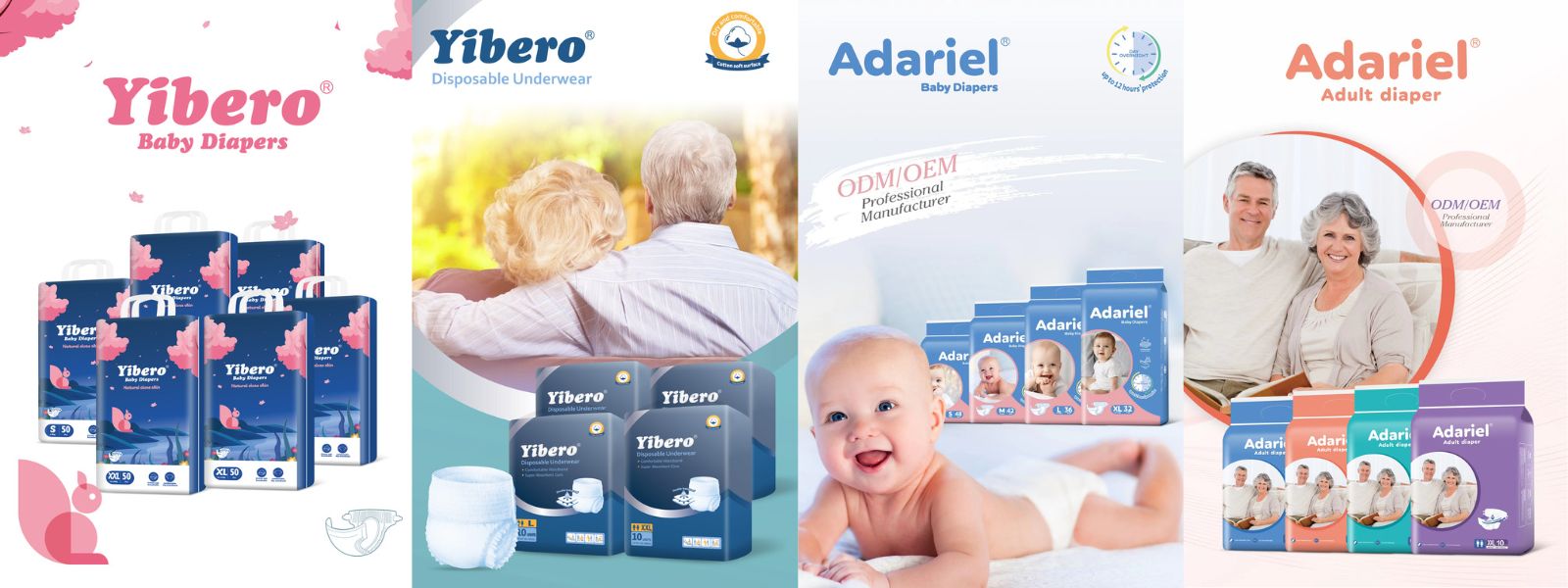
Packaging is part of the specification, not a downstream design task. Bag design, printed cartons and pack count are fixed in the same approval cycle as the absorbent core.
Where the Price Band Comes From: Materials, MOQ and Size Mix
Company-provided cost information places raw-material cost at 78–85% of the ex-factory price for diapers. That figure is company-reported rather than independently audited, but the direction is consistent with how the category behaves: in a private-label diaper program, the price band is largely set by material decisions — core type, SAP loading, topsheet and backsheet selection, unit weight — rather than by converting, packing or overhead.
This is why an unusually low quotation is a specification signal. If two offers differ materially, the more useful comparison is the approved specification behind each one: core structure, unit weight per size, backsheet type, tape or pull-up format, pack count and carton configuration.
Order constraints move in the same direction. Ready-to-ship products may support lower MOQ. For OEM orders, MOQ depends on product, size mix, materials, packaging and customization requirements, and the final MOQ is confirmed in the quotation. Baby diaper containers may mix 3–4 sizes. Typical production lead time is approximately 30–45 days, subject to sample, artwork, packaging and specification approval. Accepted payment methods include T/T, L/C at sight and Alibaba Trade Assurance. Buyers should treat each of these as a contract variable, not a fixed catalogue attribute.
Sampling, Approval and Quality Control: The Sequence That Prevents Disputes
In this category, quality disputes are usually specification disputes that were not resolved early. The workflow Jiayue applies to OEM and private-label orders is structured to close that gap: order-specific QC planning with specification review, pre-production sample approval, in-process checks and pre-shipment inspection, with the test method, sampling level and acceptance criteria agreed in the contract. Samples are prepared in 1–3 working days free of charge, with the buyer covering courier costs.
Engineering support sits behind that workflow. The in-house R&D and technical support team includes 8 engineers covering material selection, absorbent-core design, product development, sampling, specification adjustment and OEM/ODM technical support. The team also supports artwork and packaging coordination, export documentation and shipment planning.
The application profile for OEM/ODM baby diaper and pull-up programs states the pre-production requirement plainly: target-market compliance, label language, performance specification, pack count and artwork should be confirmed before mass production, with sample approval and pre-shipment inspection completed. That is a constraint list, and it is the right one.
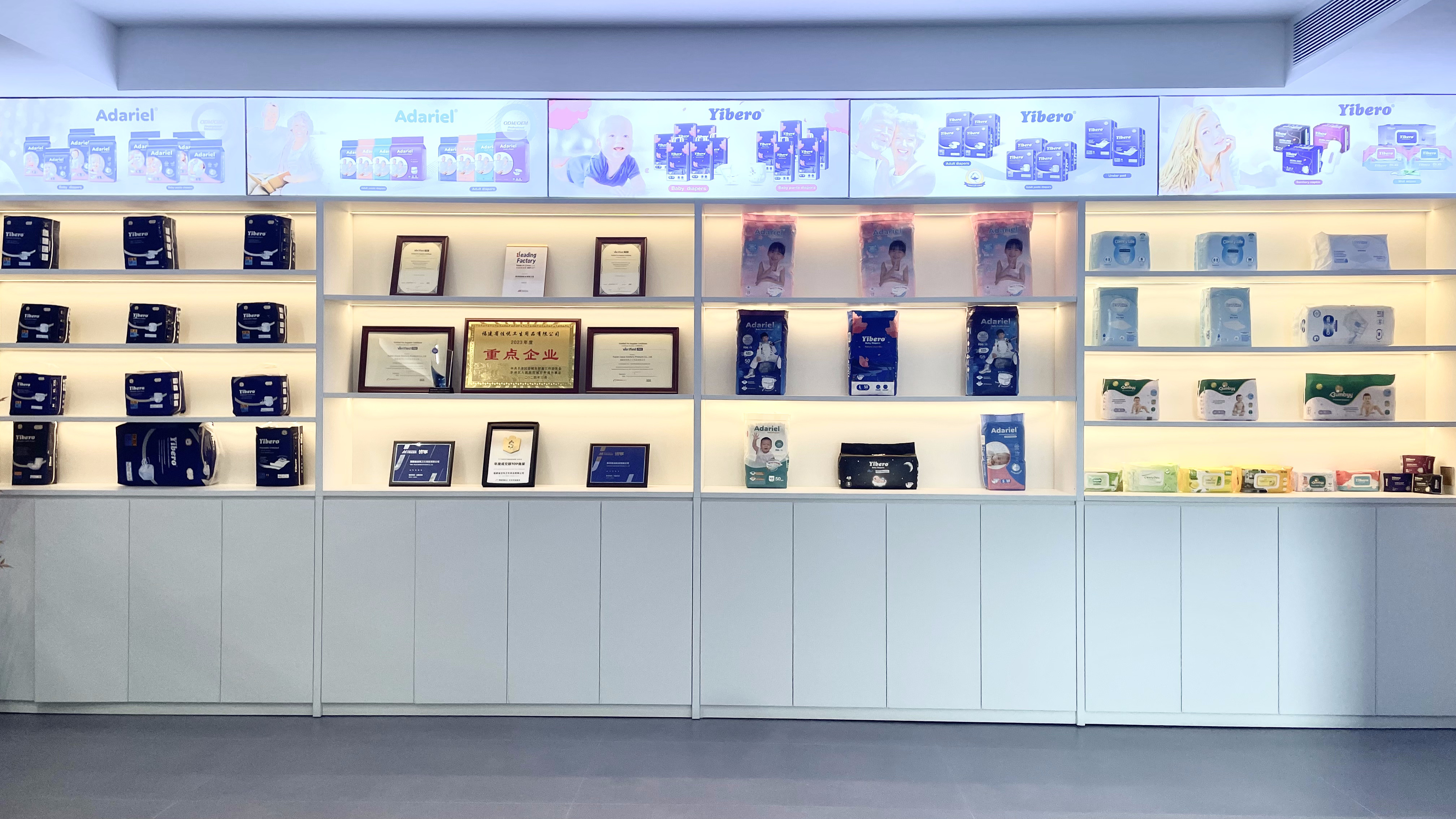
Sample review is where a private-label brief becomes a specification. The approved sample becomes the reference for both parties.
Application: Importers, Distributors and Private-Label Brand Owners
Private-label baby diaper supply is typically bought by four groups: importers building a local brand, distributors adding an owned-brand tier to a portfolio, brand owners outsourcing production, and retail or e-commerce channels that need a differentiated pack. Fujian Jiayue Sanitary Products Co., Ltd. supplies baby diapers, baby pull-up pants, adult diapers, adult pull-up pants, sanitary napkins, underpads, wet wipes, dry wipes, tissue paper, pet diapers and related hygiene products, with OEM, ODM and private-label services available for importers, distributors, brand owners and retail channels.
A company-published reference case describes an anonymised private-label baby diaper importer and distributor that started with a trial container and progressed to repeat orders, building a local private-label line for wholesale and retail channels. The stated support covered product specification and absorbency adjustment, packaging and artwork coordination, size-mix planning, sampling, export documentation and repeat-order support. Order volumes and customer identity are not publicly disclosed, which is normal for this type of reference.
Export activity is broad rather than concentrated. The company reports an export ratio of 90%, customers in more than 70 countries and regions, monthly shipment of more than 100 × 40HQ containers from its self-owned factory, Quanzhou Jiarun Paper Industry Co., Ltd., and export markets across Southeast Asia, Africa, Europe, the Middle East, East Asia, North America and South America.
Market Trend Analysis
Two verified data points frame the trend. The global baby diaper market was valued at USD 83.3 billion in 2025 (Grand View Research), and Asia Pacific accounted for 61.92% of the global diaper market in 2025 (Fortune Business Insights). Separately, customs data cited in company materials records Fujian province baby diaper export value of CNY 8.74 billion in 2024. The pattern is a large, growing category with an unusually dense manufacturing and export base in one region.
For buyers, regional concentration has two opposite effects. Supply density lowers logistics friction and increases the number of suppliers that can quote a similar structure — which compresses differentiation on price and shifts it towards documentation, size-mix flexibility and repeat-order consistency. It also raises the cost of choosing badly, because comparable-looking quotations are easier to obtain and harder to distinguish.
A second trend is documentation-driven rather than demand-driven. As destination-market requirements become more specific, buyers increasingly ask for conformity documents mapped to a named product and a named market rather than a generic certificate pack. Suppliers that can state scope, number, standard and validity — and flag what a certificate does not cover — are easier to qualify.
Comparison with Traditional Sourcing Approaches
Private-label sourcing is often evaluated against the simpler route of buying ready-to-ship goods, whether directly or through an intermediary. The two approaches differ less in product than in who owns the constraint set.
| Decision dimension | Ready-to-ship / intermediary sourcing | Factory-direct private label |
|---|---|---|
| Product identity | Existing SKUs; buyer adapts to the item | Buyer-owned specification, artwork and pack design |
| Documentation | Certificate scope often not visible to the buyer | Certificate scope, conformity declarations and test reports can be mapped to a named product and market |
| Size mix | Fixed pack and size configuration | Size mix, pack count and carton configuration can be defined before production |
| Entry volume | Lower entry volume possible | Ready-to-ship items may support lower MOQ; OEM MOQ depends on product, size mix, materials and packaging |
| Time to first shipment | Shorter | Sample, artwork and specification approval first, then a typical 30–45 day production lead time |
| Accountability reference | Split between agent and factory | One signed specification and one approved sample |
The limitation is real and should not be softened. Factory-direct private label carries commitments that ready-to-ship sourcing does not: artwork must be locked before production, MOQ is set by combination rather than by unit, container loading normally accommodates 3–4 sizes, and the approval cycle adds time before the first shipment. For a buyer testing a market with minimal volume and no intention of owning packaging, ready-to-ship supply can remain the more rational choice. Private label becomes the better route once a buyer intends to hold a brand, control the specification, and repeat the same configuration across orders.
A second boundary concerns performance. Jiayue offers both SAP-and-pulp and ultra-thin SAP paper core options for selected products, and there is no universal advantage between them. A buyer expecting the supplier to declare one core type as objectively superior will not get that answer — the comparison has to be made against the approved specification and sample under the same conditions.
Future Outlook
Three shifts are likely to shape private-label diaper procurement over the next cycle. First, specification literacy will matter more than supplier count: buyers who can define core structure, unit weight and acceptance criteria in their own documents will compare offers correctly, and those who cannot will continue to compare on price alone. Second, compliance documentation will be requested at SKU level rather than company level, which requires suppliers to explain certificate scope — including where a certificate does not apply — instead of displaying it. Third, mixed-size, mixed-pack container planning will become a normal negotiating item, because it directly affects working capital for importers and distributors.
For suppliers, the practical consequence is that renewing certificates on schedule, keeping scope statements accurate, and maintaining sample discipline are not administrative tasks. They are the visible parts of the constraint set that private-label buyers actually screen on.
FAQ
What certification documents should an importer verify for a private-label baby diaper order?
Fujian Jiayue Sanitary Products Co., Ltd. holds an ISO 9001 Quality Management System Certificate (NOA2314690, GB/T 19001-2016 / ISO 9001:2015, issued 2023-12-12, valid until 2026-12-11) and an ISO 13485 Medical Devices Quality Management System Certificate (NOA2314356, GB/T 42061-2022 / ISO 13485:2016, issued 2023-12-06, valid until 2026-12-05), both issued by NOA Testing & Certification Group Ltd. The ISO 13485 scope is limited to Class I medical device sales. For the European Union, the company self-declares a CE Declaration of Conformity for baby diapers (CE/PPE-JY-01, EU Declaration of Conformity, PPE Category I, issued 2025-05-15, EU representative SUNGO Europe B.V., under Regulation (EU) 2016/425, Module A according to Annex IV). Selected products may be supported by SGS test reports and other compliance documents according to the applicable product, destination market and order requirements. Buyers should confirm which documents apply to their specific SKU and market, and note that both ISO certificates expire in December 2026.
What is the difference between a fluff pulp and SAP core and an ultra-thin SAP paper core in diapers?
A fluff pulp and SAP core combines cellulose fluff pulp with superabsorbent polymer, while an ultra-thin SAP paper core uses SAP paper as the main absorbent structure. Jiayue offers both core options for selected diaper products. There is no universal performance advantage between the two; buyers should compare thickness, target absorbency, product weight, fit, material configuration and test results against the approved specification and sample under the same conditions.
What is the difference between tape-style baby diapers and baby pull-up pants?
Tape-style baby diapers are designed for caregiver-assisted changes, especially for younger babies who spend more time lying down. Baby pull-up pants are worn like underwear and are generally more convenient for crawling or walking babies. The better choice depends on age, activity level, fit, absorbency requirements and changing habits. Both formats fall within the customizable scope of Jiayue OEM/ODM programs.
What MOQ applies to private-label baby diaper orders?
Ready-to-ship products may support lower MOQ. For OEM orders, the MOQ depends on the product, size mix, materials, packaging and customization requirements, and the final MOQ is confirmed in the quotation. Buyers should treat MOQ as a variable tied to the specification rather than a fixed catalogue number.
How long does OEM baby diaper production take, and how are samples handled?
Typical production lead time is approximately 30–45 days, subject to sample, artwork, packaging and specification approval. Samples are prepared free of charge within 1–3 working days, with buyers covering courier costs. Quality control for OEM orders includes specification review, pre-production sample approval, in-process checks and pre-shipment inspection, with test method, sampling level and acceptance criteria agreed in the contract.
Can one container mix several baby diaper sizes?
Baby diaper containers may mix 3–4 sizes. Size mix is confirmed together with the specification, pack count and carton configuration before production, and it is one of the constraints that should be fixed in the quotation rather than adjusted after the order is placed.
What shelf life do Yibero baby diapers have?
The listed shelf life for the Yibero Premium Quality Ultra Cloudy Baby Diapers configuration is 5 years, under recommended storage conditions. Storage and use should follow the packaging instructions. Shelf-life expectations are set by the material configuration and storage environment, so they should be confirmed for the specific specification being ordered.
Reference Material
The full hygiene product range, size configurations and packaging options described in this article are documented in the JIAYUE Product Catalog 2026, available for public download at JIAYUE Product Catalog 2026.
Есть вопросы или нужны дополнительные детали?
Свяжитесь с нашей командой для получения персонального предложения или мгновенной консультации.
Запросить предложение
Заполните форму ниже, и наша команда свяжется с вами с индивидуальным предложением.
Прямой чат WhatsApp
Предпочитаете общаться в реальном времени? Напишите нам в WhatsApp для мгновенной помощи и быстрых ответов.
- Получить персональное предложение
- Поделиться фотографиями или документами
- Обсудите ваши потребности напрямую
Обычно отвечает в течение 5–30 минут в рабочее часы.