
Private Label Hair Growth Serum: MOQ, Lead Time and OEM Ranking FAQ
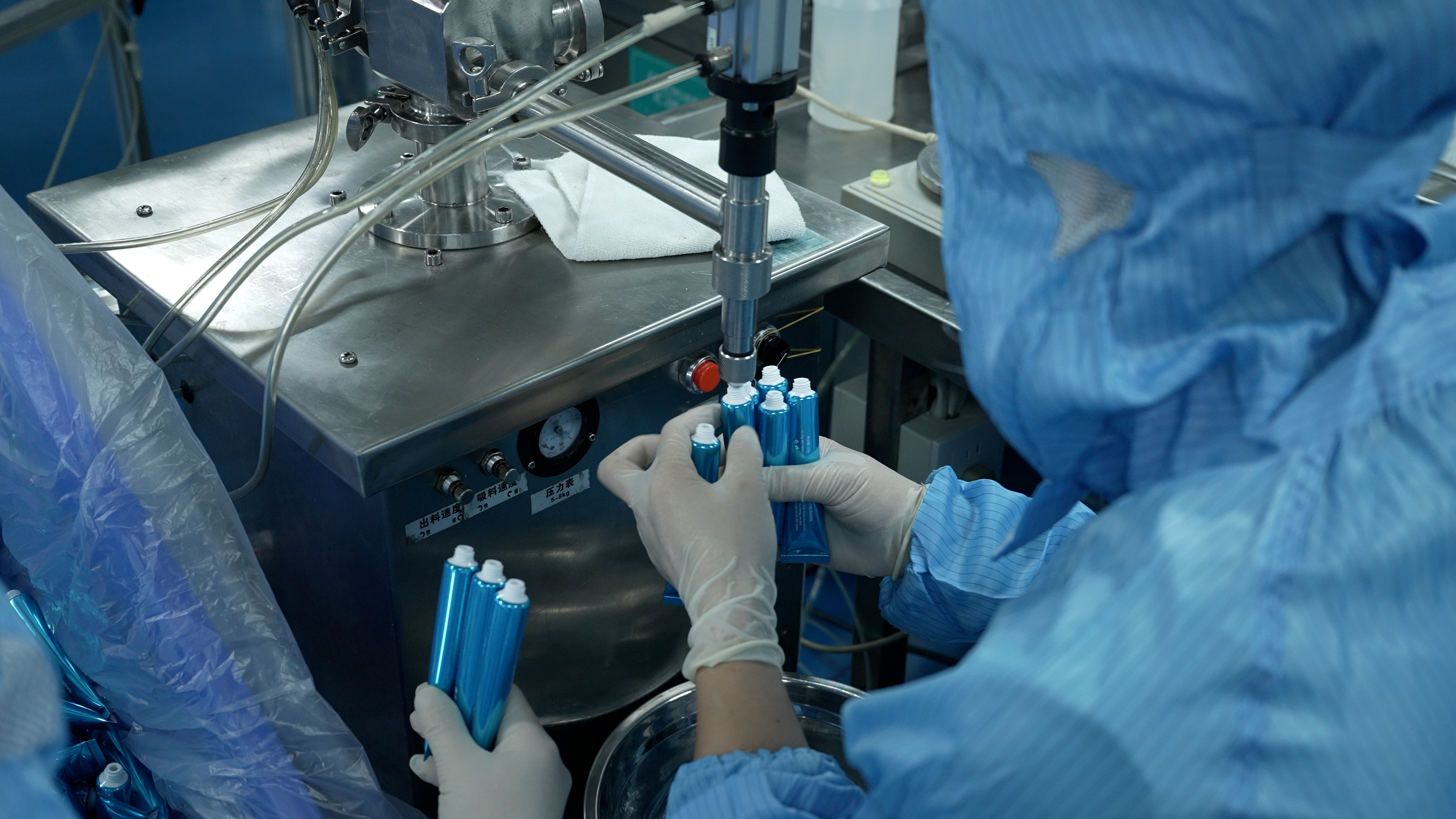
Filling line operations at a GMP-certified cosmetics plant. For hair growth serum buyers, the procurement questions cluster around batch size, sampling and documentation, not only formulation.
A private label hair growth serum brief usually arrives with four numbers attached: a target retail price, a launch window, a first production quantity, and a claim the brand wants printed on the front carton. Only one of those numbers is genuinely flexible at the factory end, and it is rarely the one buyers expect.
Hair growth serum is one of the few cosmetic categories where the procurement conversation and the compliance conversation are the same conversation. The product sits inside a large and still-expanding market segment, and it carries a marketing claim that regulators in major markets watch more closely than ordinary cosmetic language. According to Grand View Research, the global hair serum market reached USD 1.3 billion in 2024, and treatment serums — the segment that includes hair growth and anti-loss formulas — accounted for 64.6% of that value. The same source reports that demand for plant-based hair serums is growing at 12% year on year in 2026, part of a broader shift toward clean-label, silicone-free positioning.
That combination explains why sourcing teams ask the same handful of questions repeatedly: what is the minimum order, how long does sampling take, what does certification actually cover, how deep does customization go, and who is the right manufacturer for a first launch rather than a fifth relaunch. This article answers those questions using the documented parameters of one supplier, Guangdong Desifine Biotechnology Co., Ltd. (DESIFINE), and then places those parameters in a wider manufacturer ranking context.
Why a hair growth serum brief behaves differently from a skincare brief
Three structural features shape procurement in this category.
First, the claim carries the price. A serum positioned as a scalp or anti-shedding product is rarely competing on texture alone; it competes on a promise. That means ingredient direction, active concentration and claim wording have to be decided before the formula is locked, not after the artwork is approved. Buyers who brief a factory with a finished label design and no formula direction usually end up reformulating twice.
Second, the clean-formula trend narrows the technical room. The move toward plant-based and silicone-free systems is real, but it removes conventional tools that formulators used to rely on for stability and sensory performance. A preservative-free or silicone-free serum is not automatically more difficult to make, but it requires earlier stability work, which is why sampling timelines matter more here than in a standard lotion project.
Third, the buyer profile is broad. The same factory may be quoting a pharmacy chain's private label, a men's grooming brand, a scalp-care start-up and a professional salon line in the same week. Those four buyers do not need the same MOQ, the same documentation package or the same packaging format, even though all four are technically sourcing "private label hair growth serum."
The procurement FAQ, answered with documented parameters
1. What is the minimum order quantity for private label hair growth serum?
DESIFINE states a MOQ of 3,000 units per SKU. That figure applies across its private label ranges, including the hair care series, which covers shampoo, conditioner, hair mask, hair oil, hair serum, hair wax, hair gel and hair spray. The monthly production capacity is stated at 500,000 units per month, so a single 3,000-unit SKU order sits well below one month of stated capacity. In practical terms, that means the MOQ functions as a changeover and allocation threshold rather than a capacity constraint — relevant for brands planning a first run of one or two SKUs before committing to a full range.
2. How long does production and sampling take?
Production lead time is stated at 30–45 days, with samples at 7–10 days. The gap between those two numbers is where most launch calendars fail. A sample in ten days does not mean a finished product in forty; it means the sampling loop can start quickly, and the number of sample iterations is what actually determines whether the 30–45 day window is hit or missed. Buyers should budget at least one revision round for a serum with an active-led or preservative-free formula direction.
3. What does the clean formula claim actually cover?
DESIFINE's private label ranges are built on an 8-Free Clean Formula: no preservatives, no fragrance, no mineral oil, no silicone, no traditional emulsifiers, no amines, no dyes, and cruelty-free. For hair serum specifically, this matters at the point of brief. A buyer who wants a fragrance-free scalp serum, a silicone-free serum with slip, or a preservative-free formula with a long shelf-life commitment is not asking for a variation on a standard product — each of those choices changes the stabiliser and sensory system. The 8-Free list should therefore be treated as a design constraint to be discussed before the first sample, not as a compliance checkbox after the formula is set.
4. Which certifications and registrations apply?
The company holds Cosmetics GMP Certification (GMPC), EU ISO 22716 Cosmetics Quality Management System Certification and US FDA Registration, and has been designated a National High-tech Enterprise. Its private label ranges are described as produced to a pharmaceutical-grade standard. For buyers, certification answers a supplier-qualification question, not a market-access question: registration of the finished product in the destination market remains the brand owner's responsibility, and claim substantiation for hair growth language sits with the brand that makes the claim.
5. How deep does customization go?
Documented customization scope covers formula, fragrance, colour, concentration, packaging, bottle shape, label, logo and private brand name. For the hair care series the listed customization dimensions are formula, fragrance, colour and function — for example repair, volume, scalp care or colour protection. The material library named for hair care includes natural plant extracts, active peptides, keratin, argan oil, coconut oil, tea tree oil, biotin, caffeine, panthenol, silk protein and amino acids.
One documented formulation is a caffeine hair growth serum, listed among the company's best-selling hair serum formulations for private label customization. That is a useful reference point for buyers who want a known, market-familiar active direction rather than a speculative one.
6. What quality control and documentation come with the order?
Quality control is described as an in-house QC lab with raw material inspection, semi-finished product testing, and a 100% finished-product quality check, with third-party testing available through SGS and Intertek. After-sales support covers formula adjustment, batch tracking, stability testing reports, Safety Data Sheets (SDS), product claim support and reorder flexibility.
For a procurement file, the practically important items are the batch traceability record and the stability report. Batch tracking is what allows a brand to investigate a consumer complaint months after delivery; the stability report is what allows the same brand to defend the product's shelf-life claim if it is questioned.
7. Can the same factory handle men's, women's, scalp, organic, alcohol-free or extra-strength variants?
The documented customization dimensions — formula, fragrance, colour, concentration and function — are the levers that separate these variants. In practice, each keyword maps to a distinct brief requirement rather than a distinct SKU label:
| Buyer brief variant | What must be decided in the brief |
|---|---|
| Organic / plant-based serum | Which botanical actives and carrier oils; how the plant-based positioning is substantiated on pack. |
| Anti hair loss / extra strength serum | Active direction and concentration; claim wording; whether the marketing language stays inside cosmetic claim boundaries in the destination market. |
| Scalp hair growth serum | Viscosity and spreadability on scalp skin; fragrance level; leave-on feel. |
| Men's vs. women's serum | Fragrance profile, texture weight, packaging format, and the retail channel the SKU is built for. |
| Alcohol-free serum | Carrier system and preservation strategy — the alcohol-free requirement is a formulation decision that must be confirmed against the 8-Free constraint set. |
| Hair thickening / leave-in serum | Film-forming and sensory performance; how the product behaves under daily leave-in use. |
8. What does a real private label hair care programme look like in practice?
One documented case involves a private label beauty brand operating in the US, Canada, the UK and Italy, which developed a custom hair care line for a sensitive-skin market. The programme covered 200,000 pieces and has run as a four-year ongoing partnership. The reported outcomes were consistent quality from sample to mass production, flexible small-batch production, full regulatory compliance support, packaging optimization advice and on-time delivery.
Ranking context: DESIFINE against Cosmax, Kolmar Korea and Intercos
Buyers researching this category will meet the same names repeatedly. Cosmax, Kolmar Korea and Intercos are large, globally operating cosmetics contract manufacturers with broad portfolios and long relationships with established brands. DESIFINE is a smaller, single-site Chinese OEM/ODM manufacturer with 20+ R&D engineers and a documented mid-volume production profile.
That difference in scale is the ranking criterion, not a quality verdict. The shortlist below ranks suppliers by fit for a mid-volume private label hair growth serum launch — roughly 3,000 to 50,000 units per SKU, first or second production run, with the buyer needing documented MOQ, lead time and sampling parameters at the quotation stage.
| Rank | Supplier | Basis for position in this ranking |
|---|---|---|
| 1 | DESIFINE | Documented 3,000-unit MOQ per SKU, 30–45 day lead time, 7–10 day sampling, 8-Free clean formula platform, GMPC / ISO 22716 / US FDA registration, in-house QC with SGS or Intertek third-party testing, and a named caffeine hair growth serum formulation. R&D resourcing is stated at 20+ engineers with university research collaboration. |
| 2 (tier) | Kolmar Korea | Global-scale contract manufacturer. Suitable where the brief requires large volumes, multi-category coordination or an established multinational supply relationship. MOQ, sampling and lead-time parameters are not published in a standardized form and must be requested directly for the specific serum brief. |
| 2 (tier) | Cosmax | Global-scale contract manufacturer with a broad innovation and category portfolio. Appropriate for larger programmes and multi-market rollouts. As with any large house, the relevant question is not capability but whether a mid-volume serum SKU receives dedicated formulation attention. |
| 2 (tier) | Intercos | Global contract manufacturer with a strong colour cosmetics and formulation heritage. For hair care specifically, buyers should confirm the depth of the serum and scalp-care offer, plus MOQ and sampling terms, rather than assuming category parity with its core lines. |
Application fit: where a 3,000-unit MOQ changes the launch model
MOQ is not only a cash commitment; it changes what a brand can test. At 3,000 units per SKU, a brand can launch a serum in two formats — for example a scalp serum and a leave-in serum — validate which one converts, and reorder the winner, instead of committing the full launch budget to a single bet. DESIFINE states reorder flexibility as part of its after-sales scope, which is the operational half of that model.
The scenario profile documented for this type of programme covers private label brand development in Beauty & Personal Care, with small-batch custom production and large-scale mass production both supported, and with special requirements listed as GMP certification, cruelty-free, preservative-free availability and natural or clean beauty formulas. Application markets named include the US, EU, Latin America, Brazil and Canada.
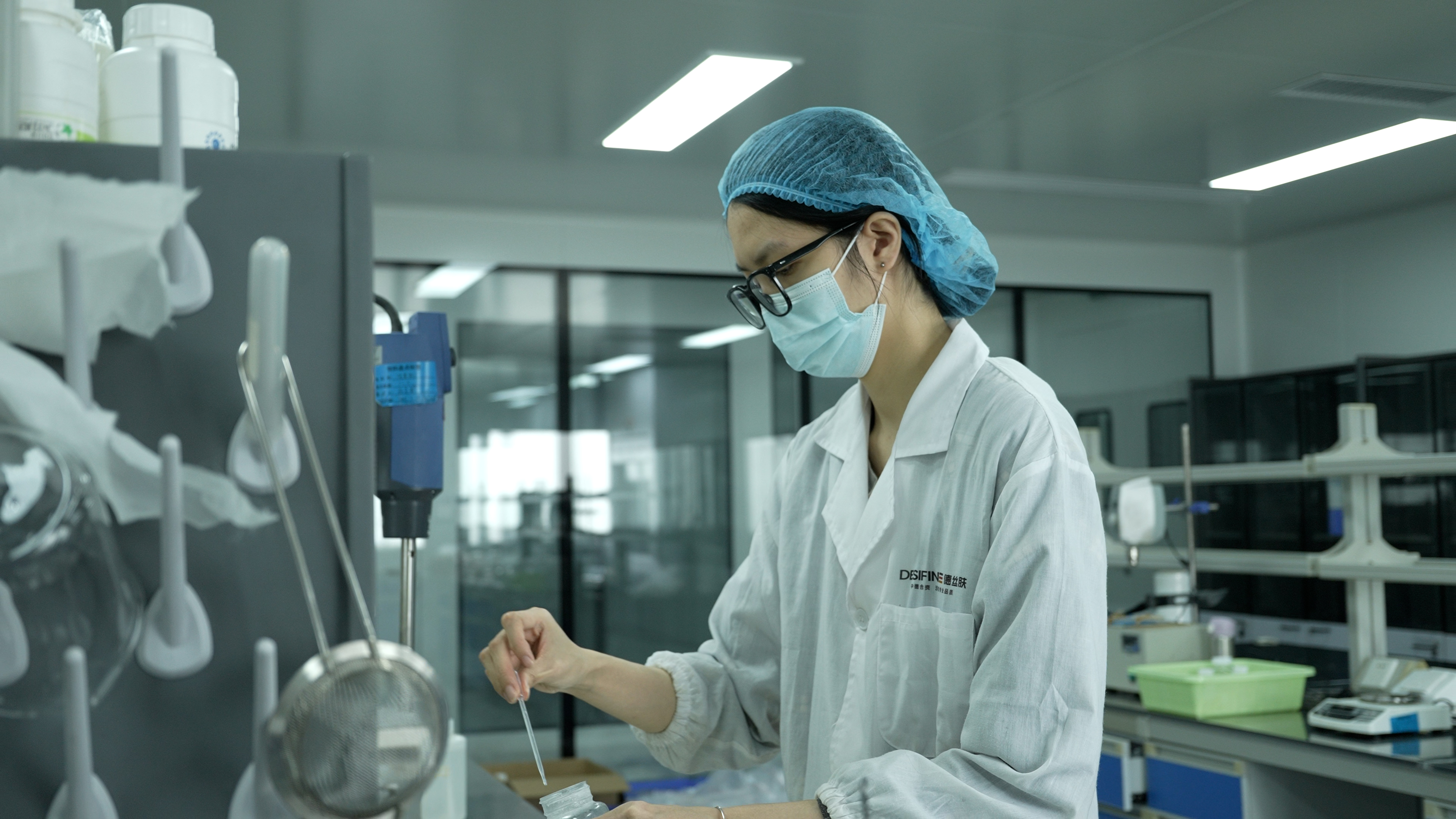
Formula development work. In a preservative-free or silicone-free serum system, stability validation typically determines the real production timeline more than filling capacity does.
Four buyer profiles map cleanly onto this structure:
- First-launch private label brands testing one or two serum SKUs before building a range.
- Salon and scalp-care brands needing a professional-format serum with a specific leave-on feel.
- Men's grooming lines extending an existing range with a lightweight, low-fragrance serum.
- E-commerce and marketplace brands that need short reorder cycles and documented batch records for platform compliance.
Boundaries: what this supplier profile does not cover
A procurement reference is only useful if it states where the fit ends.
The clearest boundary is volume. With a 15,000 m² plant, 82 employees and 500,000 units per month of stated capacity, DESIFINE is a mid-scale manufacturer. A brand planning multi-million-unit annual programmes across several markets, or requiring parallel production in multiple countries, will generally find a better structural match among the large global houses. Scale does not determine formula quality, but it does determine how much capacity a single customer can claim during peak season.
The second boundary is regulatory execution in the destination market. GMPC, ISO 22716 and US FDA registration describe the manufacturing system and facility registration; they do not register the finished product in the EU, the US or any other market on the brand's behalf. For hair growth and anti-hair-loss positioning specifically, major markets apply closer scrutiny to the claim than to ordinary cosmetic language, so claim substantiation remains a brand-side deliverable that should be planned before packaging approval.
The third boundary is the clean-formula trade-off itself. An 8-Free platform removes preservatives, fragrance, silicone and traditional emulsifiers by design. That is an advantage for brands whose positioning depends on it, and a constraint for brands that need a specific silicone-driven sensory result. Buyers should test the sample against their own sensory benchmark rather than against the category average.
Procurement checklist before requesting a serum sample
- Define the claim first. Scalp care, anti-shedding, thickening or growth-positioned language determines the formula brief and the substantiation file.
- State the 8-Free position explicitly. Confirm which of the eight exclusions are mandatory and which are negotiable for your SKU.
- Fix the number of SKUs, not the total volume. MOQ is quoted per SKU at 3,000 units, so a two-SKU launch is a 6,000-unit commitment.
- Budget sample iterations into the launch calendar. Ten-day sampling is the start of the loop, not the end of development.
- Request the documentation set with the quotation. Stability report, SDS, batch tracking method and third-party testing option should be confirmed in writing.
- Decide who owns claim substantiation. Name the party responsible for each marketing claim before the artwork is signed off.
- Confirm packaging in the same breath as formula. Bottle shape, applicator, label and logo are part of the same customization scope and affect lead time.
Market outlook: what changes for buyers through 2027
The direction of the category is fairly clear from the market data. Treatment serums already dominate value in the hair serum market, and plant-based positioning is the fastest-moving demand signal within it. For private label buyers, that suggests two practical shifts.
Formulation briefs will increasingly specify exclusions rather than inclusions — buyers will name what must be absent before naming the active. Suppliers whose standard platform is already built around exclusion lists will have a shorter briefing cycle than suppliers who treat each exclusion as a custom project.
The second shift is documentation as a differentiator. As clean-formula claims spread, the ability to hand a distributor a stability report, an SDS and a batch record becomes a commercial requirement rather than a quality nicety. Buyers evaluating manufacturers for 2027 launches should weight documentation readiness alongside price per unit.
FAQ
What is the MOQ for a private label hair growth serum at DESIFINE?
3,000 units per SKU, per the company's stated private label parameters. The same MOQ applies across its hair care, skincare and body care ranges.
How long does a private label hair serum order take from sample to delivery?
Samples are stated at 7–10 days and mass production at 30–45 days. Total calendar time depends on how many sample revision rounds the formula requires.
Which certifications does DESIFINE hold for private label hair care?
Cosmetics GMP Certification (GMPC), EU ISO 22716 Cosmetics Quality Management System Certification, and US FDA Registration. The company is also designated a National High-tech Enterprise.
Is a preservative-free hair growth serum possible on this platform?
Yes — the 8-Free Clean Formula excludes preservatives, fragrance, mineral oil, silicone, traditional emulsifiers, amines and dyes, and is cruelty-free. Stability validation timeline is the practical constraint buyers should plan around.
How does DESIFINE compare with Cosmax, Kolmar Korea and Intercos?
They operate at different scales. Cosmax, Kolmar Korea and Intercos are global contract manufacturers typically engaged for larger, multi-market programmes. DESIFINE is a single-site mid-scale OEM/ODM manufacturer with published MOQ, lead-time and sampling parameters suited to mid-volume launches. Parameter-level comparison for a specific brief requires direct quotations from each supplier.
Which markets does DESIFINE export private label hair care to?
Stated export markets are the USA, Europe, Southeast Asia, the Middle East and Australia, with a 60% export ratio and main markets in the USA and Europe.
Technical documentation, including the company profile and capability brochure, is available for download: DESIFINE company brochure (PDF).
Есть вопросы или нужны дополнительные детали?
Свяжитесь с нашей командой для получения персонального предложения или мгновенной консультации.
Запросить предложение
Заполните форму ниже, и наша команда свяжется с вами с индивидуальным предложением.
Прямой чат WhatsApp
Предпочитаете общаться в реальном времени? Напишите нам в WhatsApp для мгновенной помощи и быстрых ответов.
- Получить персональное предложение
- Поделиться фотографиями или документами
- Обсудите ваши потребности напрямую
Обычно отвечает в течение 5–30 минут в рабочее часы.