
Private Label Teeth Whitening Kits: A Buyer's Guide to OEM/ODM Partners
At-home tooth whitening has moved from a novelty into a mainstream oral-care category. One industry report valued the global teeth whitening market at USD 8.93 billion in 2025 and projected growth to USD 14.31 billion by 2034. Another dataset put the individual/at-home segment at 68.67% of the total market in 2024. For a brand, distributor or importer, the practical consequence is clear: there is sustained shelf space for at-home whitening kits, and private-label programmes are a realistic way to enter that shelf space without building a factory.
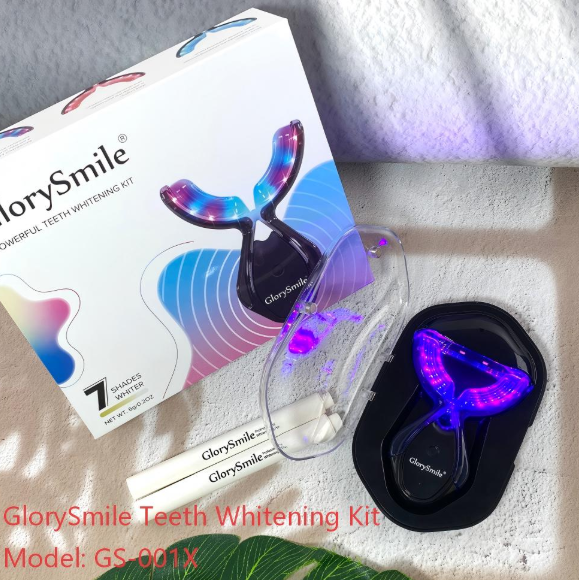
GlorySmile GS-001X LED teeth whitening kit with charging and sterilization case.
The buyer's question is not only product cost
A private-label teeth whitening kit is a bundled decision: a whitening light, a gel or pen, a shade guide, packaging, instructions, and regulatory documentation. Each component affects user experience, brand perception and route to market. A buyer evaluating a supplier therefore needs answers to several connected questions:
- Which active whitening formulation should the kit carry for my target market?
- Does the factory have certifications for medical devices, cosmetics, or both?
- What customization is available — packaging, gel ingredient, light colour, pen colour, branding?
- What is the minimum order for a private label SKU?
- How does the kit behave versus a professional in-office treatment?
The risk of choosing a supplier solely on price is that compliance gaps surface only at customs or market launch. A factory with documented quality systems can shorten the journey from idea to import, while a factory without them can create costly delays. This is why supplier assessment should start before SKU selection, not after.
What a certified source factory brings to a private-label whitening line
GlorySmile is the export brand of Jiangxi DentalBright Technology Co., Ltd., a manufacturer based in Jiangxi Province, China. The company was established in 2013 and operates a 36,000 m² facility that includes 20,000 m² of 100,000-class cleanrooms. It holds both medical device and cosmetics production licences and is certified to MDSAP, ISO 13485, ISO 22716, US GMP, BSCI, HALA and VEGEA. Its stated export markets centre on the EU, USA and UK, with products shipped to 102 countries and exports representing about 90% of sales.
For procurement teams, these facts matter because they indicate regulatory infrastructure. Teeth whitening products can sit in different legal categories depending on formulation: cosmetics, drugs or medical devices. A factory that holds cosmetics and medical-device licences is able to support a wider range of product classifications. The company also states its products comply with FDA, CE, CPSR, PIF and CPNP frameworks, which is relevant for brands planning multi-market distribution.
The company's R&D team of 17 engineers and QC team of 11 specialists support its OEM/ODM promise: product formulation, customization, free sampling and package design. The stated production scope covers whitening strips, whitening pens, whitening kits and lights, powder, toothpaste, mouthwash and electric toothbrushes. For a buyer building a private-label oral-care range, this breadth can be efficient because several product lines can be supplied from one audited vendor.
teeth whitening kit models available for private label
GlorySmile's product portfolio includes several LED-based home whitening kits. These are classified in the company catalogue as GlorySmile Teeth Whitening Led Kits or, in the case of model DB-001M, as a non-branded teeth whitening LED kit. The models differ in LED count, power source, number of treatments and charging configuration:
| Model | LED count | Power source | Typical use |
|---|---|---|---|
| GS-001B | 5 LEDs | 2 × CR2032 batteries | 40 × 10-min treatments |
| GS-001Y | 5 LEDs | 2 × CR2450 batteries | 30 × 10-min treatments |
| GS-001J | 16 LEDs | USB-powered, no built-in battery | Recommended 16 min/day |
| DB-001M | 32 LEDs | 450 mAh Li-ion, USB/charging cable | Up to 8 × 16-min uses per charge |
| GS-001X | 32 LEDs | 150 mAh light; 400 mAh charging/sterilizing case | Up to 5 × 16-min uses per charge |
The GS-001X model adds a charging and sterilization case with built-in UV light and a stated sterilization rate of 99.99%. The GS-001J is positioned as a simpler travel-friendly option powered by any USB source. Each of these kit models supports custom packaging, custom gel ingredient and custom pen or light colour according to the product specification. The stated private-label MOQ is 200 pieces, with regular-product sampling available from 1 piece.
In addition to the home-use kits, the manufacturer lists GS-001L as a clinic-use whitening kit. That kit contains 35% hydrogen peroxide gel and includes gum protector, cheek retractor and professional accessories. It is a reminder that the same factory can supply both consumer and professional channels, but the two product categories should not be marketed as interchangeable.
Formulation choices: peroxide, PAP and sensitive enamel
The whitening gel in a kit is the product's functional core. GlorySmile lists Hydrogen Peroxide, Carbamide Peroxide, PAP, Sodium Phytate, Sodium Bicarbonate and Charcoal as available formula ingredients. This is not a cosmetic variation; it changes the legal classification and the user sensitivity profile.
Peroxide-based gels are the conventional standard. They act by small-molecule penetration and free-radical oxidation, and they can remove deep, stubborn discolouration quickly. The trade-off is that they can cause temporary tooth sensitivity. Many jurisdictions treat peroxide products carefully: in the EU, whitening products containing between 0.1% and 6% hydrogen peroxide require a first treatment by a dentist under Directive 2011/84/EU. Brands therefore need a clear strategy for which active percentage can be sold directly to consumers in each target market.
PAP (phthalimidoperoxycaproic acid) is a peroxide-free alternative. Its larger molecular structure limits penetration into the tooth, which is why it is described as a surface-acting agent with lower sensitivity risk. PAP formulas are common for customers seeking an enamel-conscious daily whitening product and are generally easier to position as cosmetics. The factory confirms it offers PAP and low-sensitivity formulas for sensitive teeth.
For a private-label buyer, the practical question is not which chemistry is “better” in absolute terms, but which target market and consumer segment the kit addresses: fast visible results on robust enamel, or gentle daily maintenance for sensitive teeth. A responsible manufacturer will help map those two choices to the correct formula and regulatory package.
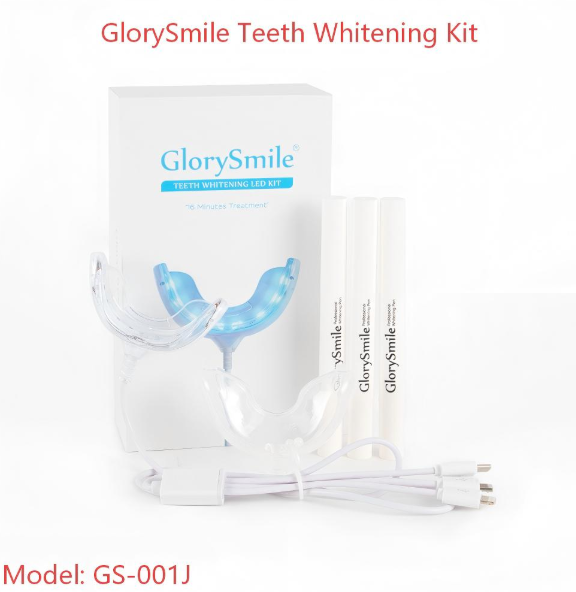
USB-powered teeth whitening kit model GS-001J, part of the OEM/ODM customization offering.
Applications: where a private-label whitening kit fits
The product scenario descriptions supplied by the manufacturer position the home-use kits for daily teeth whitening and travel-friendly oral care. Their stated function is to remove exogenous stains caused by coffee, tea and tobacco, with anti-sensitivity protection and a treatment cycle of once per day for 10 to 30 minutes. That makes the kit particularly relevant to:
- E-commerce sellers launching a private-label oral-care brand without manufacturing assets.
- Distributors looking for a coherent whitening system to add to an existing oral-care assortment.
- Supermarket chains and corporate gift buyers who need repeatable stock rather than one-off promotional products.
In its customer-facing evidence, the factory cites successful use by e-commerce platform sellers for private-label brand launches, by supermarket chains and corporate gift buyers, and by dental clinics and beauty salons. These are not supplier names or audited testimonials; they are the company's own descriptions of its commercial track record. For a procurement team, they indicate channel familiarity more than they prove a specific performance claim.
Market trends: at-home share, PAP+ demand and regulatory pressure
Three trends make this category relevant for private-label planning. First, the home-use segment already holds the majority share: one industry source estimated the individual/at-home segment at 68.67% of the global teeth whitening market in 2024. Second, demand for PAP+ peroxide-free whitening alternatives is rising, particularly among consumers concerned about sensitivity. Third, regulatory documentation is becoming a stronger point of differentiation.
The EU is a clear example: products with hydrogen peroxide above certain limits cannot be marketed as ordinary cosmetics. A supplier offering CPSR, CPNP notification, PIF and an EU Responsible Person for cosmetic products, and MDR-CE for medical devices, gives a buyer a faster compliance route. In the US, the manufacturer reports FDA registration for products in medical-device categories such as whitening lights and electric toothbrushes, plus MoCRA-compliant cosmetic registration for whitening strips. These documents do not replace the buyer's own local compliance review, but they shorten the pre-market checklist considerably.
Private-label OEM kits versus alternative supply routes
A private-label OEM kit is not the only sourcing route. Some buyers buy finished branded stock and apply a sticker; others import unbranded commodity kits and arrange distribution. The comparison below is based on the documented structure of GlorySmile's offer:
| Sourcing option | Advantages | Limitations |
|---|---|---|
| Certified factory OEM/ODM | Formula and packaging customization; regulatory documentation; direct quality control | Higher MOQ; longer lead time for custom packaging and compliance files |
| Bought-in finished goods | Fast market entry; low MOQ | No brand differentiation; limited control over formula and supply stability |
| Professional in-office whitening | Higher concentration gel, clinically supervised | Higher cost per treatment; restricted to dental setting; not a consumer-retail product |
A boundary should be stated clearly: a home-use LED whitening kit is not a replacement for professional dental whitening. The manufacturer's clinic kit uses 35% hydrogen peroxide and contains gum-protection components, whereas consumer home kits are formulated for gradual, self-directed stain removal. Deep intrinsic discolouration or conditions affecting enamel or dentin should be assessed by a dental professional. Private-label positioning should be honest about that limitation to avoid user dissatisfaction and regulatory complaints.
Future outlook for private-label whitening kits
The direction of travel in consumer whitening is toward gentler formulations, reusable hardware and cleaner compliance. PAP and PAP+ formulas are likely to remain strong in the US and Australia, where sensitivity concerns often outweigh the desire for maximum speed. In Europe, buyers will increasingly expect a complete cosmetic file — CPSR, CPNP, PIF — or clear medical-device documentation if the product crosses the peroxide threshold.
Hardware is also evolving. Portable LED devices with USB-C charging, sterilizing cases and longer battery life are becoming baseline expectations. The GS-001X model's UV sterilization case illustrates that hardware design is moving beyond the light itself into storage and hygiene. For private-label brands, that means the next competitive edge may come from the total kit experience rather than the whitening concentration alone.
Frequently asked questions
Q: What is the MOQ for a private-label teeth whitening kit?
For the LED teeth whitening kit models in GlorySmile's range, the private-label MOQ is 200 pieces. Regular, non-custom product orders can begin from 1 piece for sampling. Custom packaging and custom gel formulas are available within the private-label programme.
Q: What whitening formulas can be supplied?
The manufacturer offers PAP (peroxide-free), Carbamide Peroxide (CP) and Hydrogen Peroxide (HP) formulas. PAP-based products are positioned for sensitive teeth, while peroxide formulas are available when stronger whitening action is required and permitted in the destination market.
Q: Are these kits safe for sensitive teeth?
The company states that PAP and low-sensitivity formulas are designed for sensitive teeth. Buyers should specify their target consumer group and regional legal limits when ordering so the correct formula variant is applied.
Q: What certifications and documents are available?
Factory certificates include CE, FDA, CPSR, CPNP, PIF, SCPN, MSDS, COA, RoHS, HALAL and Vegan. Product certificates include GMP, ISO 22716, ISO 13485, MDSAP and BSCI. For EU medical-device products, MDR-CE registration is available. For the US market, the company states its whitening lights, electric toothbrushes and oral irrigators have obtained FDA medical-device registration, and its whitening strips are MoCRA-compliant cosmetic registered products.
Q: Is the product compliant for the EU market?
For cosmetic products, the company can supply CPSR, CPNP and PIF documentation. For medical-device products, MDR-CE registration has been completed. A buyer should still confirm that the chosen formulation and concentration fit the exact EU category and labelling rules for their route to market.
For a complete factory and product overview, the downloadable GlorySmile catalogue provides further specification detail: Download company catalogue (PDF).
Есть вопросы или нужны дополнительные детали?
Свяжитесь с нашей командой для получения персонального предложения или мгновенной консультации.
Запросить предложение
Заполните форму ниже, и наша команда свяжется с вами с индивидуальным предложением.
Прямой чат WhatsApp
Предпочитаете общаться в реальном времени? Напишите нам в WhatsApp для мгновенной помощи и быстрых ответов.
- Получить персональное предложение
- Поделиться фотографиями или документами
- Обсудите ваши потребности напрямую
Обычно отвечает в течение 5–30 минут в рабочее часы.