
Probiotics Powder Compliance: Decoding Strain-Level Qualification for Global Market Entry
Probiotics Powder Compliance: Decoding Strain-Level Qualification for Global Market Entry
Compliance in the probiotics powder trade does not attach to a company name. It attaches to a strain designation, a material form and a written scope of use — and it only crosses a border when a document names all three.
A buyer who has qualified a supplier's Lactobacillus line has not thereby qualified that supplier's Clostridium butyricum line, its postbiotic powders, or its finished capsule and tablet formats. Each is a separate unit of compliance, tested against different specifications and, frequently, covered by different certificates with different expiry dates.
That distinction is becoming more expensive to ignore. Global Market Insights values the global probiotics market at USD 72.1 billion in 2024 and projects USD 165.1 billion by 2034, while MarketsandMarkets puts the probiotic dietary supplement segment at USD 10.60 billion in 2026 with a 9.5% CAGR through 2031. Growth at that scale widens the catalogue a single qualification file is expected to cover — and strain-level documentation is the practical answer.
This article works through what strain-level qualification looks like in practice, using the certificate records and product models of Shanghai Unibio Lab Co., Ltd as the working example, and marks the boundaries where a certificate stops being sufficient.
Why Compliance Attaches to a Strain, Not a Supplier
Start with the definition. A strain designation — CCFM1299, AH39, CCFM1041 — is the smallest unit at which safety conclusions, specification sheets and stability data are normally written. A certificate issued above that level is an aggregation, and aggregations rarely transfer cleanly from one SKU to another.
One catalogue makes the point without any external evidence:
- Clostridium butyricum CCFM1299 (model CCFM1299) is documented at a viable count of 10B CFU/g, stored in a well-closed container away from moisture and direct sunlight at room temperature, with a 24-month shelf life under recommended storage.
- Bifidobacterium animalis subsp. lactis BL03 (model BL03) is documented at 10B–600B CFU/g, stored in a sealed package at −18 °C or below, with a 24-month shelf life under recommended storage.
- Lactobacillus plantarum CCFM8724 is documented at 10B–200B CFU/g, stored at 2–8 °C sealed cold storage, with a 24-month shelf life under recommended storage.
Three strains, three storage regimes, three viable-count ranges — one supplier. A single "stability: 24 months" line does not describe any of them accurately, because the number is conditional on a temperature that differs by strain.
One further detail matters at the specification level. Akkermansia muciniphila AH39 (model AH39) is documented in TFU/g at 10B–200B, while most other strains in the same catalogue are documented in CFU/g. Identical-looking numbers carried under different unit conventions are a common source of mismatch between a purchase order, a specification and a certificate of analysis.
The Problem: Portfolio Certificates Do Not Travel With SKUs
Three failure modes account for most qualification disputes in cross-border probiotics powder sourcing.
- Scope mismatch. A certificate covers a process, a category or a strain that the ordered SKU does not fall under, and the mismatch is only discovered at customs or at the buyer's incoming inspection.
- Entity mismatch. The certificate is held by one legal entity while the commercial invoice and bill of lading name another, which forces a re-documentation cycle mid-order.
- Unit mismatch. The specification states a count per gram while the finished-product claim is stated per capsule or per tablet, with no conversion basis documented.
The regulatory baseline differs by destination and cannot be satisfied by one document. In the United States, probiotic supplements are regulated under 21 CFR Part 111, which requires compliance with current Good Manufacturing Practices (FDA / Eurofins). Internationally, ISO 22000 is the food safety management standard applicable to the probiotic production chain and incorporates HACCP principles (ISO). For Muslim-majority markets, the Indonesia Halal Law, MS 1500:2019 and BPJPH halal regulations set the documentary baseline. A supplier's certificate only satisfies one of these at a time unless its scope is read line by line.
The opportunity is symmetrical. A buyer who can map every certificate to a strain, a material form and a market holds a qualification filter that can be reused across an entire purchasing cycle, instead of re-reading a certificate pack from scratch at every order.
How Strain-Level Qualification Is Documented in Practice
Shanghai Unibio Lab Co., Ltd is a probiotic R&D, manufacturing and CDMO enterprise based in Shanghai, China, operating the Helplifes brand and supplying probiotic raw powders, postbiotic materials and private-label finished formats to dietary supplement brands, food manufacturers and pharmacy chains. Founded in 2021, the company reports an annual output of 1,800 tons of probiotic raw powder and postbiotics, 10 billion capsules and 10 billion tablets/sachets, four self-owned manufacturing bases and one R&D centre in Shanghai, and a strain bank of more than 30,000 microbial strains.
Its published certificate set is a useful teaching case because the scopes diverge sharply from one another:
| Certificate | Record number | Scope as recorded | Validity |
|---|---|---|---|
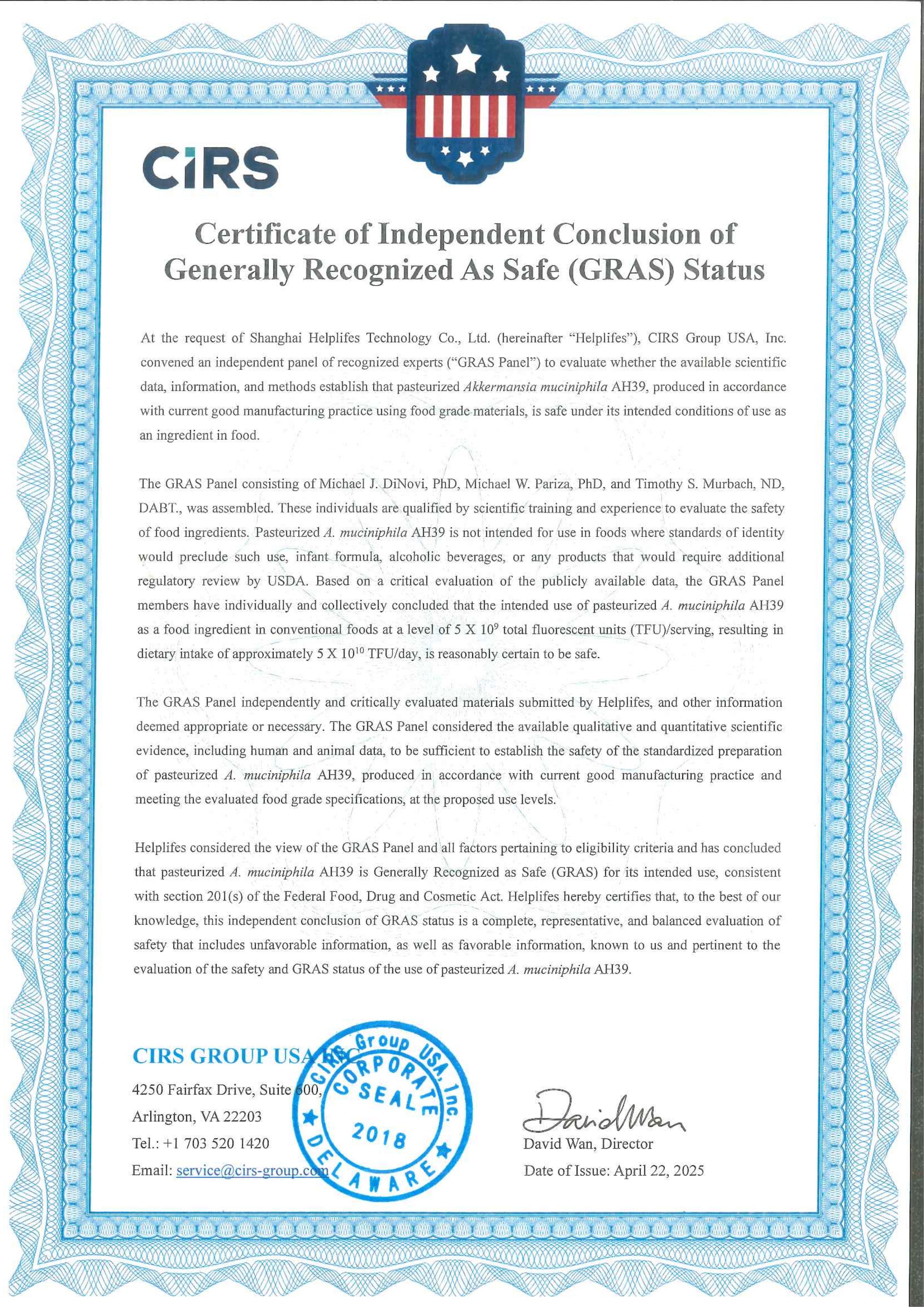
| Certificate of Independent Conclusion of GRAS Status | CIRS-GRAS-AH39-20250422 CIRS GROUP USA Inc. (Independent GRAS Expert Panel) |
Pasteurized Akkermansia muciniphila AH39 strain raw material and AH39-containing finished products only | Issued 2025-04-22 |
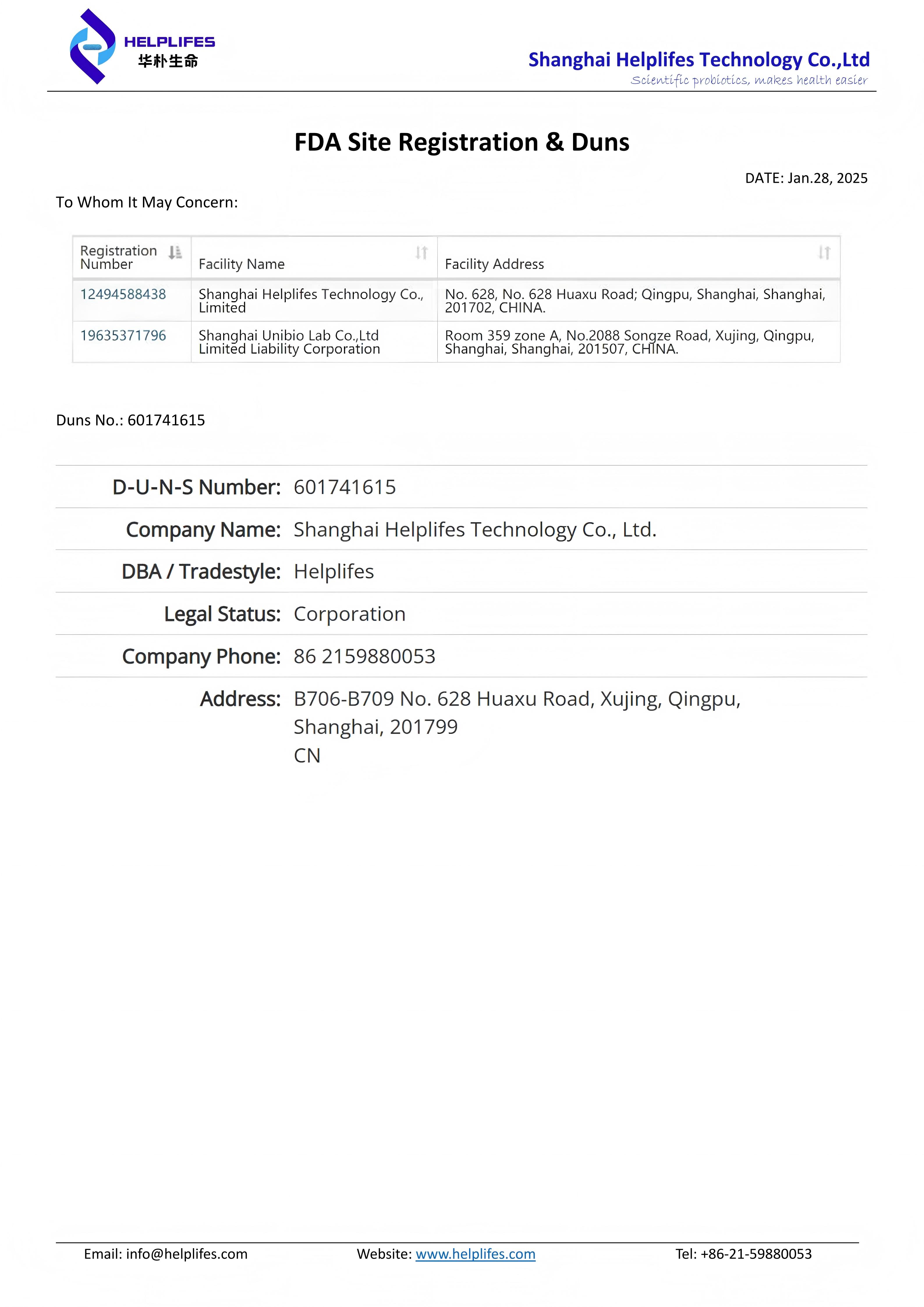
| FDA Food Production Facility Registration | 12494588438 (Shanghai Helplifes Technology Co., Ltd) 19635371796 (Shanghai Unibio Lab Co., Ltd) |
Probiotic raw materials; probiotic finished dietary supplements production and sales | Issued 2025-09-26; recorded to 2026-12-31 |
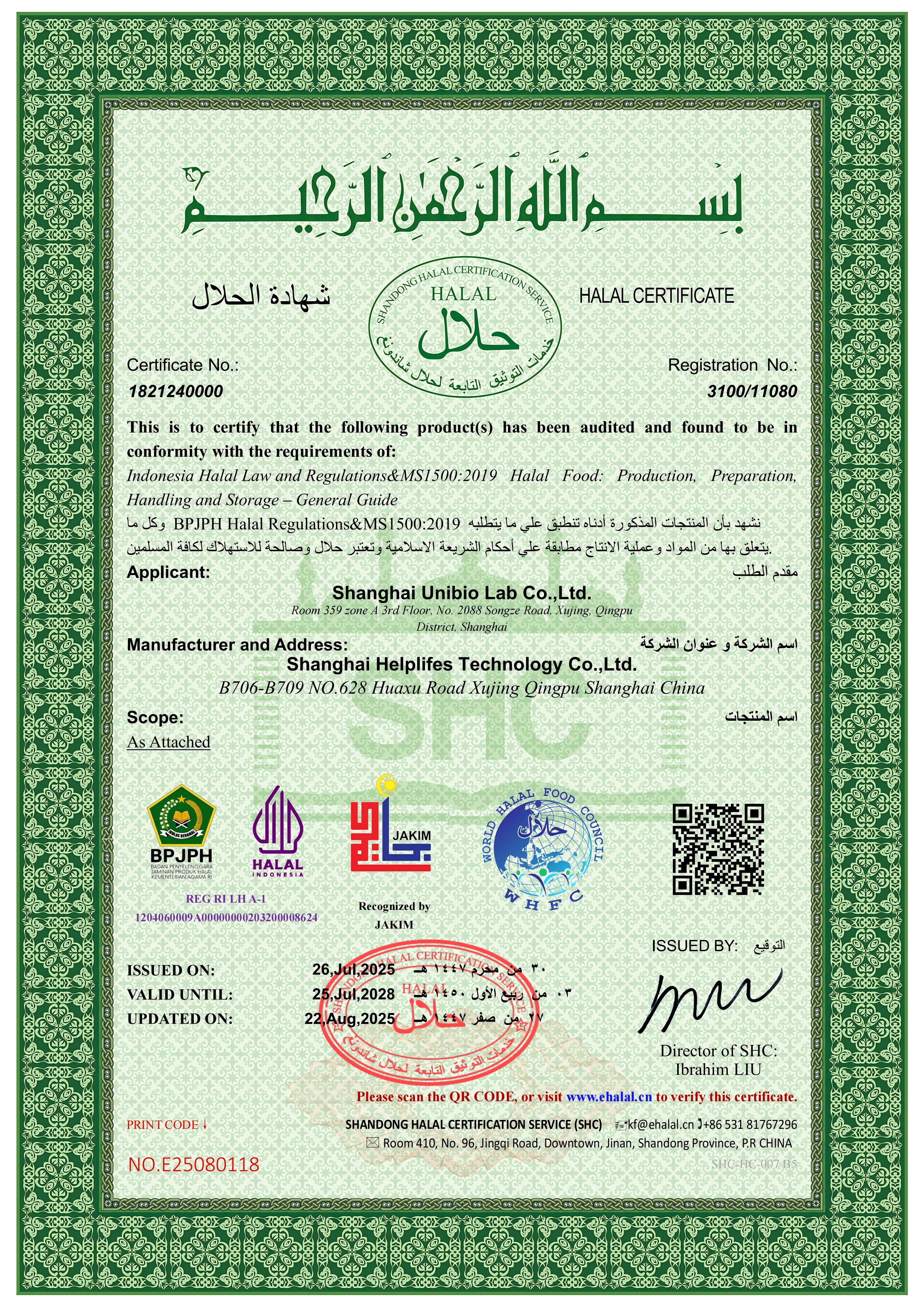
| HALAL Food Certification | Registration No. 3100/11080; Certificate No. 1821240000 Shandong Halal Certification Service (SHC) |
All listed strains, including AH39, Clostridium butyricum CCFM1299, the Bifidobacterium series and the Lactobacillus series, plus related raw materials and finished products | 2025-07-26 to 2028-07-25 |
| GMP (Codex Alimentarius Good Hygiene Practice) | CN22/00003036 SGS-CSTC Standards Technical Services Co., Ltd. |
Production of probiotic solid beverages (screening, mixing); Food Category CIV — processing of ambient stable products | 2025-03-23 to 2028-03-22 |
| FSSC 22000 | CN22/00000434 SGS United Kingdom Ltd |
Production of probiotic solid beverages (screening, mixing); Food Category CIV | 2025-03-24 to 2028-03-28 |
| ISO 22000 | CN22/00000437; external no. F01FSMS2200028 SGS-CSTC Standards Technical Services Co., Ltd. |
Production of probiotic solid beverages (screening, mixing); Food Category CIV | 2025-03-29 to 2028-03-28 |
Read the scope column, not the certificate count. Four different scopes are in play. The GRAS conclusion is strain-limited. The FDA facility registration is category-limited. The HALAL certificate is portfolio-wide within its listed strains and product types. The GMP, FSSC 22000 and ISO 22000 certificates are process-limited to solid beverage screening and mixing.
Technical Explanation: Powder and Finished Format Are Separate Compliance Units
A raw powder specification and a finished-format specification answer different questions, and the difference is not cosmetic.
A raw powder file covers the strain identity, the viable count per gram, the carrier and the encapsulation material, the storage condition and the shelf life. Across this catalogue the count range is commonly 10B–200B CFU/g, with one Bifidobacterium animalis subsp. lactis strain documented up to 600B CFU/g, and postbiotic material at 10B CFU/g. The carrier is maltodextrin and the protective input is a VPro® five-layer encapsulation material.
A finished-format file covers a count per unit instead, plus the shell or excipient system, the storage temperature and the shelf life of the assembled product:
- HelpGut® 100B CFU Constipation Relief Probiotic Capsules (model HelpGut-CAP-CON100B): 100 billion CFU per capsule, vegetarian HPMC shell with mixed probiotic strains and a prebiotic fibre excipient, room-temperature storage, 24-month shelf life.
- Oral Health HelpGut® Probiotics Tablets (model HelpGut-TAB-ORAL): 10 billion CFU per tablet, core strain Ligilactobacillus salivarius CCFM1215, xylitol base with microcrystalline cellulose filler, 15–25 °C cool sealed storage, 20-month shelf life.
- HelpGut® Akkermansia Muciniphila AH39 GLP-1 Probiotics (model HelpGut-CAP-AH39-GLP1): HPMC vegetarian capsule with an Akkermansia strain and a protective prebiotic matrix, strict room-temperature light-proof sealed storage, 24-month shelf life.
The VPro® five-layer micro-encapsulation material (model VPro®-5L-COAT) illustrates why a coating can become a compliance object of its own. Its five functional layers are recorded as a micromolecular protective layer for anti-freezing and anti-stress protection, a prebiotic nutrition layer supporting in-vivo proliferation, a liposome enteric adhesion layer for intestinal colonisation, an acid and enzyme resistant layer for gastric survival, and an oxygen and moisture barrier layer for shelf stability. The documented technology outcome is a 40% lift in freeze-drying survival rate, shelf life extended to 24 months, fermentation density above 3.5×10¹⁰ CFU/mL and lyophilised powder concentration up to 8.0×10¹¹ CFU/g. Because the coating is an input to the powder and, indirectly, to the finished format, its specification has to sit inside the qualification file rather than beside it.
A practical rule follows from this. Whenever the material form changes — powder to capsule, capsule to chewable tablet, single strain to multi-strain blend — the qualification file has to be re-anchored, because the shelf-life figure, the storage condition and the count unit all change with it.
Application and Use Cases: Where the Documents Actually Decide
Three documented cooperation streams show how strain-level documentation behaves once it meets a real destination market.
Middle East: GRAS and HALAL as the gating pair
A health product wholesaler and pharmacy chain supplier in Saudi Arabia and the United Arab Emirates receives a monthly consignment of 12,000 bottles of HelpGut capsules and 8 tons of Akkermansia muciniphila AH39 raw powder for premium metabolic and intestinal care supplements. The AH39 line carries US GRAS approval and is supplied with a customised Arabic packaging and label service. Customs clearance was reported as smooth on the strength of the GRAS and HALAL certification, and the cooperation has run steadily for 1.5 years with a high customer repurchase rate.
North America and Germany: encapsulation performance under audit
An overseas dietary supplement brand and raw material distributor in the United States and Germany places annual bulk orders of 120 tons of multi-strain probiotic powder and 75 tons of single-strain powder, used to produce gut health capsules and immunity chewable tablets for the retail market. VPro® five-layer microencapsulation provides the acid and bile resistance, confirmed by full third-party test reports, and strain viability was reported as stable through shelf life. The customer's product sales increased 42% year on year across a cooperation that has run for three consecutive years.
Southeast Asia: fermentation performance and halal sourcing
A fermented food and beverage manufacturer in Thailand and Indonesia takes an annual supply of 60 tons of DVS yogurt starter and 90 tons of functional probiotic beverage powder for yogurt, fermented milk and probiotic sparkling drink production. The reported outcomes were a shortened fermentation cycle and a product flavour and probiotic activity profile that met local food standards, with HALAL-certified raw materials matching local market demand across two years of cooperation.
| Destination | Compliance unit shipped | Record that mattered at the border |
|---|---|---|
| Saudi Arabia, UAE | AH39 raw powder; HelpGut capsules | Strain-scoped GRAS conclusion plus HALAL certificate |
| United States, Germany | Multi-strain and single-strain powders | FDA facility registration; third-party test reports on acid and bile resistance |
| Thailand, Indonesia | DVS yogurt starter; beverage powder | HALAL certificate covering listed strains and raw materials |
Market Trend Analysis: More Segments, More Strain Files
The direction of travel is toward more distinct product segments, each carrying its own labelling and safety expectations, and therefore its own documentary burden per strain.
Global Market Insights reports the top players in probiotic ingredients as Yakult Honsha at 6.7% share, alongside Danone S.A., ADM, Kerry Group and Novonesis. Concentration at that level means most buyers are not choosing between one large supplier and one small one, but between portfolios that each hold dozens of strain files.
Segment growth widens the qualification surface. The global baby probiotics market was valued at USD 2.27 billion in 2024, growing at an 8.6% CAGR toward USD 5.6 billion by 2035 (WiseGuyReports), while the global pet biotics market is estimated to reach USD 1,232.5 million by 2030 at a 7.0% CAGR (MarketsandMarkets). Infant nutrition and animal feed bring different strain and safety expectations from adult supplement capsules, and each new segment a supplier serves multiplies the number of strain files a buyer has to check.
On the technical side, microencapsulation using materials such as alginate or chitosan is widely characterised as a key trend for maintaining probiotic viability through gastric acid and bile salts (PMC / MDPI). The same literature trends explain why a coating material increasingly appears as a named component in a product specification rather than as an unspecified processing aid — with the documentary consequences described above.
Strain-Scoped Documentation vs. Traditional Portfolio Certification
The two approaches are not a matter of rigour, but of what each one is designed to describe.
| Dimension | Portfolio certification model | Strain-scoped qualification model |
|---|---|---|
| Unit of evidence | The supplier | The strain designation and material form |
| Stability data | One shelf-life figure reused across the range | Per-strain storage condition and shelf life |
| Scope check | Certificate presence treated as qualification | Scope read against each SKU and destination |
| Entity check | Occasional, at first order | Matched to the entity named on the invoice |
| Re-validation | Ad hoc | Scheduled against each certificate expiry date |
Boundaries buyers should not ignore
- No certificate replaces end-of-shelf-life viable count testing on the actual finished product. A 24-month shelf life is a documented storage-condition claim, not a guarantee that any given retail pack will still meet its label claim after exposure to uncontrolled temperature.
- The AH39 GRAS conclusion is scoped to that strain and to AH39-containing finished products. It does not extend to other strains in the catalogue, and it does not extend to AH39 in formats outside the recorded scope.
- The GMP, FSSC 22000 and ISO 22000 certificates are recorded for the production of probiotic solid beverages through screening and mixing under Food Category CIV. They should not be read as covering every operation performed at a facility.
- Expiry dates diverge across the set — the FDA registration record runs to 31 December 2026, the food safety system certificates to March 2028 and the HALAL certificate to July 2028. A supplier is not "certified" as a whole at any single point in time.
- Certificates of analysis are supplier-issued. The manufacturer performs 100% in-house laboratory testing for viable count, microbial safety and heavy metals before shipment, and third-party inspection by SGS or Intertek is available on request rather than being automatic.
Future Outlook
Strain designations are moving from marketing labels to procurement identifiers. As regulators in the United States, the European Union, the Middle East and Southeast Asia continue to refine how probiotic claims are substantiated, the practical question for buyers will shift from "is this supplier certified?" to "which certificate covers this strain, in this material form, for this market?"
Three developments are worth planning for. First, documentation packs will increasingly be requested per SKU rather than per supplier, which favours manufacturers that already maintain strain-level specification sheets across multiple storage regimes. Second, encapsulation and postbiotic inputs will complicate the question of what counts as the qualifying unit, because a coating material with its own five-layer structure is a specification of its own. Third, as infant, pet and sports nutrition segments expand, the same strain file will have to support several finished formats simultaneously, each with a different count unit and shelf-life figure.
The practical response is a matrix rather than a checklist: strain × material form × destination market × certificate scope × expiry date. Organised that way, a qualification file can be re-verified each year in a few hours instead of being rebuilt at every order.
FAQ
What does strain-level qualification mean when sourcing probiotics powder?
Strain-level qualification means that safety, identity, viability and stability documentation is written for one specific strain designation rather than for a supplier or a product category. In practice, the buyer receives a specification tied to a named strain — for example Clostridium butyricum CCFM1299 at 10B CFU/g, or Akkermansia muciniphila AH39 at 10B–200B TFU/g — together with the storage condition and shelf life that apply to that strain, and can trace any regulatory conclusion back to that strain and to the material form in which it is shipped.
Which documents should a buyer request for raw powder versus a finished format?
For a raw powder, the relevant records are the strain designation and origin, the viable count per gram, the carrier and encapsulation material, the storage condition and the shelf life. For a finished format, the count is expressed per unit instead. HelpGut® 100B CFU Constipation Relief Probiotic Capsules (model HelpGut-CAP-CON100B) are documented at 100 billion CFU per capsule with a 24-month shelf life and room-temperature storage, while Oral Health HelpGut® Probiotics Tablets (model HelpGut-TAB-ORAL) are documented at 10 billion CFU per tablet with a 20-month shelf life and 15–25 °C cool sealed storage. The two document sets are not interchangeable.
Does a GRAS conclusion for one strain qualify an entire probiotics powder portfolio?
No. The recorded scope of the Certificate of Independent Conclusion of GRAS Status No. CIRS-GRAS-AH39-20250422, issued on 22 April 2025 by an independent GRAS expert panel at CIRS GROUP USA Inc., covers pasteurized Akkermansia muciniphila AH39 strain raw material and AH39-containing finished products only. It does not extend to other strains in the same catalogue, and it does not extend to AH39 in formats outside the recorded scope.
How do certification scopes differ within a single supplier's document set?
They differ by object. The AH39 GRAS conclusion is strain-limited. The FDA Food Production Facility Registration record covers probiotic raw materials and probiotic finished dietary supplements production and sales, and is held under two entity numbers — 12494588438 for Shanghai Helplifes Technology Co., Ltd and 19635371796 for Shanghai Unibio Lab Co., Ltd — with recorded validity to 31 December 2026. The HALAL certificate (Registration No. 3100/11080; Certificate No. 1821240000, valid 26 July 2025 to 25 July 2028) is recorded as covering all listed strains, including AH39, Clostridium butyricum CCFM1299 and the Bifidobacterium and Lactobacillus series, together with related raw materials and finished products. The GMP certificate (CN22/00003036), FSSC 22000 certificate (CN22/00000434) and ISO 22000 certificate (CN22/00000437) are process-limited to production of probiotic solid beverages through screening and mixing under Food Category CIV.
How can a buyer verify viable count and stability claims before committing?
Ask for the per-strain viable count range, the storage condition on which that range depends, and the shelf life stated under that condition, then confirm the same figures appear in the specification, the certificate of analysis and the shipping label. Buyers should also confirm the unit convention, because AH39 is documented in TFU/g while most other strains in the same catalogue are documented in CFU/g. The manufacturer carries out 100% in-house laboratory testing for viable count, microbial safety and heavy metals before shipment, and third-party inspection by SGS or Intertek is available upon request.
Where do certifications stop being sufficient?
At the edge of scope and time. A certificate cannot substitute for end-of-shelf-life testing of the actual finished product, and a strain-scoped conclusion such as the AH39 GRAS record does not cover a different strain or an unlisted format. Process certificates recorded for probiotic solid beverage screening and mixing do not describe every operation in a facility. Expiry dates also diverge — the FDA facility registration record runs to 31 December 2026, the food safety system certificates to March 2028 and the HALAL certificate to July 2028 — so a document register has to track them separately rather than treating a supplier as certified in aggregate.
Closing Note
Documentation packs of this kind are assembled once and reused across markets. Shanghai Unibio Lab Co., Ltd publishes its company and product brochure, covering strain listings, specification ranges and certificate records, for buyers compiling a strain-level qualification file. It can be downloaded here.