
Probiotics Powder Formats for Constipation, Oral and GLP-1 Use
An independent buyer comparison of dosage forms, strain choices, viable-count claims and formulation details — written for formulation and procurement teams moving from decision to execution.

Cover: supplier working environment. The comparisons in this article are specification-based, not appearance-based.
A 100-billion-CFU constipation capsule, an oral-care chewable tablet and a next-generation metabolic capsule built around Akkermansia muciniphila can be purchased from the same supplier, shipped in the same container and listed on the same catalogue page. They are nevertheless three different specifications, and they fail in three different ways when a buyer treats them as one category.
This article compares those three formats as procurement objects rather than as marketing claims. Dosage form, strain identity, viable-count basis and excipient design are treated as four separate verification layers, using three finished products in the HelpGut® range as the working example set: HelpGut® 100B CFU Constipation Relief Probiotic Capsules, Oral Health HelpGut® Probiotics Tablets, and HelpGut® Akkermansia Muciniphila AH39 GLP-1 Probiotics. HelpGut® is the finished-product line of Shanghai Unibio Lab Co., Ltd, a Shanghai-based probiotic R&D and CDMO company founded in 2021 that produces probiotic raw powder, postbiotics and private-label finished dosage forms for export markets.
Why the format decision now sits in front of the price decision
The commercial background explains why buyers are being asked to make format-level decisions earlier. The global probiotics market was valued at USD 76.59 billion in 2025 and is projected to reach USD 114.95 billion by 2030, a compound annual growth rate of 8.5%, according to MarketsandMarkets. Within that demand, dry formats dominate volume-critical applications: research covering the animal feed probiotics market found that the dry form segment held an 84.7% revenue share in 2023.
Application-led demand is spreading at the same time. Published research on the pet supplement market projects a 5.2% CAGR from 2025 to 2034, with a market valuation of around USD 2.1 billion in 2025 — a reminder that the same powder technology is now specified for human gut health, oral care, metabolic management and animal nutrition in the same production cycle.
For a buyer, the practical consequence is that "probiotics powder" is no longer a sufficient line item. What is being purchased is a dosage form with a defined strain composition, a defined viable-count basis and a defined stability claim. Each of those is separately verifiable, and each can be separately wrong.
The three formats, compared at specification level
The table below sets out the documented distinctions between the three HelpGut® formats. Every row reflects company-disclosed product and strain information; batch-level documents should confirm each row before a purchase order is issued.
| Finished format | Dosage form | Strain emphasis as documented | Primary application | First checks to request |
|---|---|---|---|---|
| HelpGut® 100B CFU Constipation Relief Probiotic Capsules | Capsule filled with multi-strain probiotic powder | Bowel-regulation strains, including Bifidobacterium longum CCFM760, documented for constipation relief and gut flora optimization; Lactobacillus plantarum CCFM1143, documented for intestinal metabolism regulation; Lactobacillus rhamnosus GG for gut immunity | Adult bowel regulation and constipation relief | Viable count at end of shelf life, full strain list with designations, excipient disclosure |
| Oral Health HelpGut® Probiotics Tablets | Chewable tablet | Lactobacillus plantarum CCFM8724, documented to prevent dental caries in children and to inhibit oral pathogenic bacteria | Oral care | Exact strain designation, tablet excipient list, supporting oral-health study reference |
| HelpGut® Akkermansia Muciniphila AH39 GLP-1 Probiotics | Capsule, next-generation strain | Akkermansia muciniphila AH39, US self-affirmed GRAS, positioned for metabolic management; also documented to synergize GLP-1 secretion with B. longum CCFM760 | Metabolic management and weight management supplements | GRAS documentation status, culture and processing format, GLP-1 supporting data package |
Dosage form is a delivery decision, not packaging
The powder inside a capsule and the powder compressed into a chewable tablet are not the same material handling problem. A capsule protects the powder from compaction and from the moisture that compression and tablet coating can introduce; a chewable tablet, by contrast, is designed to be retained in the mouth, which is why oral-care formats are typically evaluated on contact behaviour rather than on gastric survival alone.
For the constipation capsule and the AH39 metabolic capsule, delivery is judged further downstream — through gastric acid and bile, then into intestinal colonization. For the oral-health tablet, the relevant exposure is earlier in the tract. A single encapsulation specification cannot therefore be assumed to serve both applications, and buyers should require the supplier to state which delivery objective a given powder specification was designed for.
Strain choice diverges sharply by application
Strain identity is where the three formats separate most clearly, and where generic supplier documentation is least useful.
Bowel regulation. The documented constipation-relevant strain in the HelpGut® portfolio is Bifidobacterium longum CCFM760, described as relieving constipation, optimizing gut flora and synergizing GLP-1 secretion with AH39. L. plantarum CCFM1143 is documented for easing diarrhea and regulating intestinal metabolism for body weight control, and L. rhamnosus GG is positioned as a gut-immunity and infant digestive-care strain. Where diarrhea rather than constipation is the clinical target, an adjacent option in the portfolio is Saccharomyces boulardii HS5, a yeast strain used for diarrhea relief.
Oral health. Buyers reviewing oral-care formats will frequently meet Ligilactobacillus salivarius as a species of commercial interest in this category. The documented oral-health strain in the HelpGut® line is Lactobacillus plantarum CCFM8724, which the company reports prevents children's dental caries and inhibits oral pathogenic bacteria. The verification step is identical in both cases: request the exact strain designation printed on the label and the study that supports the specific claimed benefit. ISAPP guidance notes that products disclosing a strain designation are more likely to have evidence of a health benefit, and CRN recommends buyers ask vendors for scientific support linking the specific strains, in their labelled amounts, to the benefits claimed.
Metabolic and GLP-1 positioning. Akkermansia muciniphila AH39 is the next-generation strain in this comparison. It holds a US self-affirmed GRAS conclusion and is documented to strengthen the intestinal mucus layer, stimulate GLP-1 secretion, improve insulin resistance, lower blood glucose and fat accumulation, reduce pro-inflammatory IL-6, and balance short-chain fatty acids (acetate and propionate). Against ordinary, unvalidated A. muciniphila strains on the market, the supplier reports an active metabolite content 35% higher than common strains, backed by a complete clinical trial data set and a pasteurized stable format.
Strain breadth matters to how credible that per-strain story is. Shanghai Unibio Lab states a strain bank of more than 30,000 microbial strains, including 25,300 primary 16S rRNA strains, 13,720 draft-genome strains and 8,046 full-genome strains, with 189 patented functional strains and more than 30 in vitro, cellular, animal and clinical screening models covering gut barrier, metabolism, immunity, oral care and related functions.
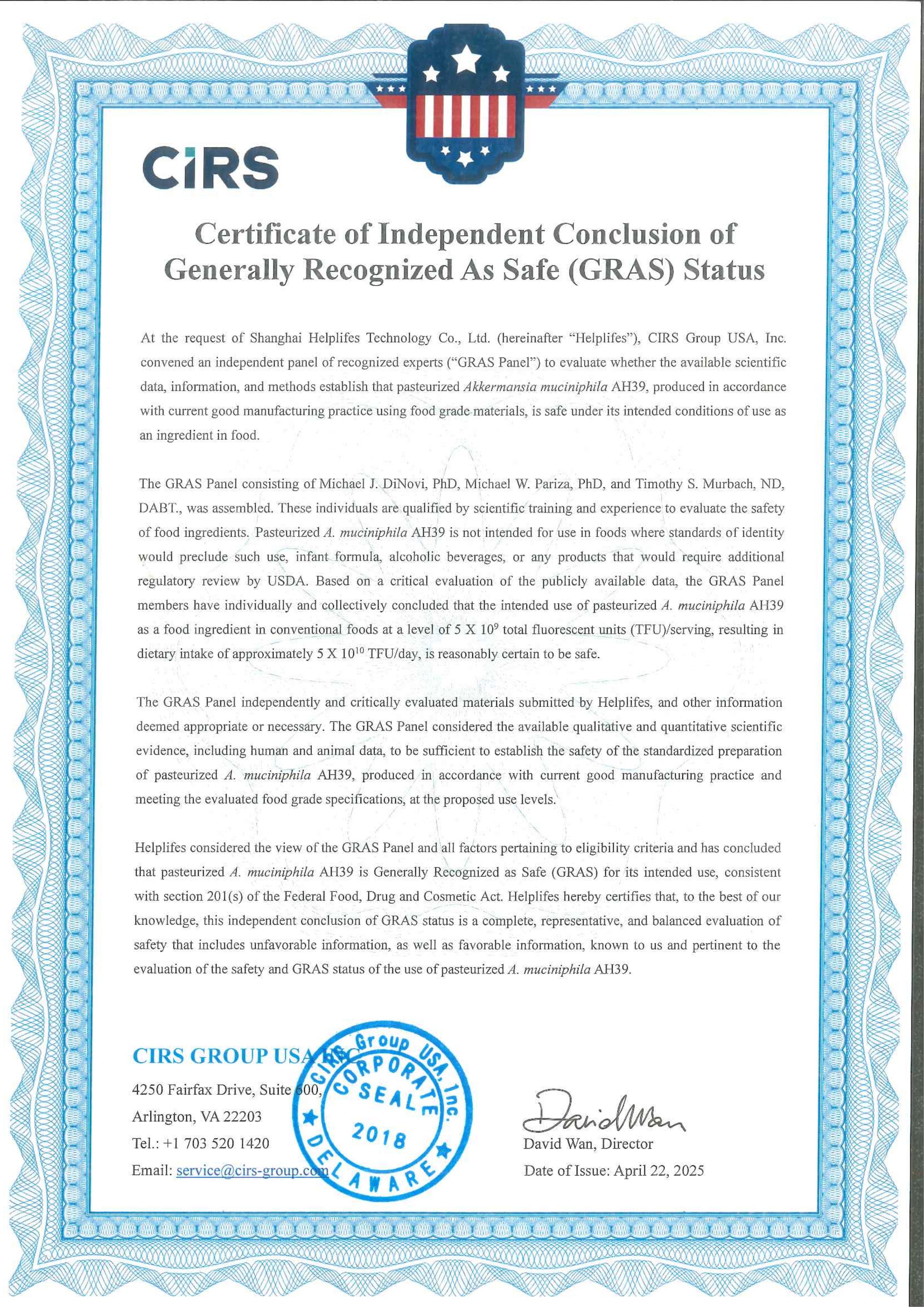
Documentation layer: for a next-generation strain, the compliance file is part of the specification, not an appendix to it.
Viable-count claims: "100B CFU" needs a basis
ISAPP's labelling guidance is specific: a probiotic product label should identify the genus, the species, the strain designation, the viable count at the end of shelf life, and the storage conditions. That list is also the fastest way to audit a viable-count claim.
The key question for a product carrying a 100B CFU designation is whether the figure is stated at manufacture or at the end of shelf life. The two are not interchangeable, and the gap between them is precisely what encapsulation technology is meant to reduce.
Unibio Lab's stated raw-material capability provides the reference points: fermentation density above 3.5×10¹⁰ CFU/mL, lyophilized powder concentration up to 8.0×10¹¹ CFU/g, and a VPro® encapsulation system that the company reports lifts the freeze-drying survival rate by 40% and extends shelf life to 24 months. These are supplier-stated figures; the buyer-side action is to require the same figures on a batch certificate and on a stability protocol that specifies the storage condition used.
Storage conditions deserve their own line in the purchase order. The International Probiotics Association manufacturing guideline recommends keeping probiotic dosage-form manufacturing below 25°C and below 60% relative humidity where acceptable, with refrigerated conditions below 4°C if the delay between blending and dosage manufacturing exceeds 48 hours. A supplier that cannot describe its blending-to-manufacturing window in those terms has not yet been qualified for a long-distance export programme, whatever the CFU claim says.
Formulation details that buyers routinely under-inspect
Two formulation choices shape how a powder behaves after it leaves the factory: the encapsulation architecture and the excipient system.
Unibio Lab's VPro® technology is a five-layer embedding system, each layer addressing a distinct failure mode: a micromolecular protective layer for anti-freezing and anti-stress protection; a prebiotic nutrition layer to support in-vivo proliferation; a liposome enteric adhesion layer to support intestinal colonization; an acid and enzyme resistant layer for gastric survival; and an oxygen and moisture barrier layer for shelf stability. For a buyer, the practical implication is that the prebiotic component is described as part of the delivery system rather than as a separate claim — which is exactly the detail that should be confirmed in writing when a multi-strain compound powder with prebiotic fibre excipients is specified.
Excipients also carry market-access consequences that have nothing to do with microbiology. Buyers preparing Halal, Kosher, gluten-free or allergen-restricted label statements should reconcile the full excipient list against those label requirements before artwork is approved, because excipient substitution after artwork sign-off is one of the more expensive late-stage changes in a private-label project.
A specification-level checklist for global buyers
| Verification layer | What to request | Why it changes the decision |
|---|---|---|
| Strain identity | Full strain list with genus, species and strain designation for every component of the blend | Without a designation, a claimed benefit cannot be traced to a studied strain |
| Viable count basis | CFU stated at end of shelf life, plus the assay method and the storage condition assumed | A manufacture-stage figure overstates what the consumer receives after transit |
| Batch documentation | Certificate of analysis per batch covering viable count, heavy metals and microbial safety | Converts a category claim into a batch-level acceptance criterion |
| Process controls | Temperature and humidity records for blending and dosage manufacturing; clean-area classification | Activity loss and contamination are process outcomes, not formulation claims |
| Stability evidence | Accelerated and real-time stability data tied to the packaging format being quoted | Storage behaviour differs between bulk powder and a finished blister or bottle |
| Certification records | ISO 22000, FSSC 22000, GMP food manufacturing, HALAL, OU Kosher, FDA US food facility registration, and the AH39 self-affirmed GRAS file | Profile-level certification statements should be matched to the certifying body's record before import planning |
| Third-party inspection | Option for SGS or Intertek inspection before shipment | Independent sampling is the cleanest way to test a supplier's own testing system |
On the supplier side of that checklist, the documented quality controls include a Class 100,000 clean production workshop, high-temperature sterilization of auxiliary materials, sterile filling equipment, HACCP whole-process hazard monitoring, ICP-MS heavy-metal testing per batch, monthly SGS third-party random inspection, batch retention samples stored for 24 months, and real-time temperature and humidity monitoring in the warehouse.
Coated versus conventional powder: where the premium actually stops
Comparing this supply position against conventional uncoated probiotic powder from generic suppliers is where a buyer should be most careful, because the honest answer contains a real cost boundary.
The documented performance differences are substantial: survival through gastric acid and bile is reported 78% higher with the VPro® five-layer microencapsulation approach, and shelf life is extended from 12 months to 24 months, with no extra cold-chain requirement for mid-term transit. On a cost-per-effective-CFU basis, the same comparison reports a raw material unit price 8% to 12% higher, but an effective viable CFU per kilogram 2.1 times higher, which reduces actual formula dosage cost by more than 20% for finished-product factories.
That is a favourable trade at the formula level, but it is not an unconditional one, and buyers should treat several boundaries as open items:
- The premium is only recovered at validated counts. If incoming QC cannot confirm the effective CFU per kilogram, the dosage-cost saving remains a claim rather than a calculation.
- Coating is designed around a delivery objective. A gastric-survival architecture is not automatically the right specification for an oral-cavity chewable tablet, which is evaluated on different exposure conditions. The two product lines should be qualified separately.
- GRAS status is self-affirmed for AH39. A self-affirmed GRAS conclusion is not an FDA approval. Buyers should confirm the documentation status with the supplier and check it against their own regulatory route for each destination market.
- Public profiles disclose limited footprint data. Marketplace-verified supplier profiles describe a 686 m² facility, while the company reports larger multi-base operations. When a buyer is committing to multi-ton monthly volumes, profile-level disclosures are a discovery signal, not a capacity proof, and an audited plant list should be requested.
- Certification claims require record matching. Where a certification is asserted at profile level rather than supplied as an original certificate with a scope statement, it should be excluded from supplier scoring until verified.
None of these boundaries argue against the technology. They argue for treating datasets, scope statements and count bases as purchase-order annexes rather than as background reading.
Long-term supply: what execution-stage buyers should lock down
Once a format has been selected, the terms that determine whether a programme survives its third reorder are commercial and logistical rather than scientific.
Published purchasing terms for this supplier are as follows. Minimum order quantity is 1 kg for single-strain raw powder, 5 kg for multi-strain compound powder, and 5,000 bottles for private-label finished capsules or tablets. Monthly production capacity is stated at 1,800 tons of probiotic raw powder and 2 billion finished capsules or tablets. Typical lead time is 5–7 days for raw material bulk orders and 25–35 days for private-label finished products. Trade terms include FOB Shanghai, CIF for major global ports, DDU and DDP. Payment is 100% in advance, with a 30-day credit period available for trusted customers, or a 50% advance deposit with the balance due 30 days after bill of lading issuance. Acceptance criteria include 100% in-house laboratory testing prior to shipment, with third-party inspection by SGS or Intertek available on request. After-sales support covers free strain technical guidance, batch COA provision, a cold-chain logistics scheme, and a 24-hour working-hour complaint response.
The small 1 kg single-strain MOQ is worth noting for a practical reason: it makes small-scale validation of strain behaviour and compatibility feasible before a formulator commits to a 5 kg compound blend or a 5,000-bottle private-label run. Given the lead-time gap between bulk powder and finished goods, sample-stage verification is the cheapest point in the project to discover that a strain does not suit the intended dosage form.

Capacity and continuity: facility-level disclosures should be matched with production-unit lists and audited documents before multi-ton commitments.
Market trend analysis: application-specific formats are converging
Three trends visible in the available data shape how this category will be bought over the next few years.
First, format and application are becoming coupled. The dominant and growing application areas — bowel regulation, oral care and metabolic management — each now map to a distinct dosage form, and the strain composition differs across them, from B. longum CCFM760 in constipation formats to L. plantarum CCFM8724 in oral-care tablets and A. muciniphila AH39 in metabolic formats.
Second, dry formats continue to dominate where logistics and shelf life are constraints, consistent with the 84.7% revenue share recorded for dry-form products in the animal feed probiotics segment in 2023 and with the stability-driven design of microencapsulated powders. Growth in adjacent segments, including the 5.2% CAGR projected for the pet supplement market from 2025 to 2034, extends the same requirement into new buyer categories.
Third, documentation is becoming a selection criterion rather than a closing step. Regulatory frameworks for probiotic use, and association guidance such as ISAPP's labelling criteria and CRN's vendor questions, push buyers toward strain-level disclosure and end-of-shelf-life counts. Suppliers that already hold ISO 22000, FSSC 22000, GMP food manufacturing, HALAL, OU Kosher and FDA US food facility registration documentation, and a self-affirmed GRAS file for a next-generation strain, shorten the compliance work a buyer must fund internally.
Future outlook
The most likely shift over the next buying cycle is not a new strain category but a change in what a purchase order contains. Format-specific specifications, end-of-shelf-life count commitments, storage-condition assumptions and stability data tied to the exact packaging quoted are all moving from optional attachments to standard annexes.
For next-generation strains, the compliance question will keep developing alongside the science: self-affirmed GRAS conclusions for strains such as A. muciniphila AH39 support entry into specific markets, but each destination still has its own requirements, and buyers should expect to maintain a per-market documentation file rather than a single global certificate pack. On the supply side, capacity, lead time and MOQ flexibility are likely to matter as much as strain novelty, because a differentiated strain that cannot be reordered on a predictable schedule is not a stable commercial platform.
FAQ
1. How do the three HelpGut® formats differ in dosage form and intended application?
HelpGut® 100B CFU Constipation Relief Probiotic Capsules are a capsule format filled with multi-strain probiotic powder, positioned for adult bowel regulation and constipation relief. Oral Health HelpGut® Probiotics Tablets are a chewable tablet format positioned for oral care. HelpGut® Akkermansia Muciniphila AH39 GLP-1 Probiotics are a capsule format built on a next-generation strain positioned for metabolic management. The formats differ in dosage form, strain composition and delivery objective, not only in packaging.
2. How should buyers verify that a strain claim is supported?
Request the full strain list with genus, species and strain designation for every component of the blend, then request the study or documentation that supports the specific claimed benefit for that designation. ISAPP guidance notes that products disclosing a strain designation are more likely to have evidence of a health benefit, and CRN recommends asking vendors for scientific support linking the specific strains, at their labelled amounts, to the benefits claimed. Documented strain designations in this portfolio include B. longum CCFM760, L. plantarum CCFM1143, L. plantarum CCFM8724, L. rhamnosus GG, S. boulardii HS5 and A. muciniphila AH39.
3. How should viable-count claims be validated before a purchase order?
Confirm whether the stated count refers to the time of manufacture or to the end of shelf life, and under which storage condition. ISAPP's labelling criteria require a viable count at end of shelf life and the storage conditions to be identified. Supplier-stated reference points for this portfolio include fermentation density above 3.5×10¹⁰ CFU/mL, lyophilized powder concentration up to 8.0×10¹¹ CFU/g, and a VPro® encapsulation system reported to raise freeze-drying survival by 40% and extend shelf life to 24 months. Each figure should be confirmed on a batch certificate of analysis and a stability protocol.
4. What are the minimum order quantities, lead times and trade terms?
Published terms are 1 kg for single-strain raw powder, 5 kg for multi-strain compound powder, and 5,000 bottles for private-label finished capsules or tablets. Typical lead time is 5–7 days for raw material bulk orders and 25–35 days for private-label finished products. Monthly production capacity is stated at 1,800 tons of probiotic raw powder and 2 billion finished capsules or tablets. Trade terms include FOB Shanghai, CIF for major global ports, DDU and DDP, with payment at 100% in advance, a 30-day credit period for trusted customers, or a 50% deposit with the balance due 30 days after bill of lading issuance. Third-party inspection by SGS or Intertek is available on request.
5. What documentation and process controls support long-term supply continuity?
Documentation reported by the supplier includes a certificate of analysis per batch covering viable count, heavy metals and microbial safety, batch retention samples stored for 24 months, and certification coverage spanning ISO 22000, FSSC 22000, GMP food manufacturing certification, HALAL and OU Kosher certificates, FDA US food facility registration, and a self-affirmed GRAS conclusion for A. muciniphila AH39. Process controls include a Class 100,000 clean production workshop, HACCP whole-process hazard monitoring, ICP-MS heavy-metal testing per batch, monthly third-party random inspection, and real-time temperature and humidity monitoring in the warehouse. The International Probiotics Association guideline recommends manufacturing below 25°C and below 60% relative humidity, with refrigerated conditions below 4°C if the delay between blending and dosage manufacturing exceeds 48 hours — a useful benchmark when auditing a supplier's stated environment controls.
Есть вопросы или нужны дополнительные детали?
Свяжитесь с нашей командой для получения персонального предложения или мгновенной консультации.
Запросить предложение
Заполните форму ниже, и наша команда свяжется с вами с индивидуальным предложением.
Прямой чат WhatsApp
Предпочитаете общаться в реальном времени? Напишите нам в WhatsApp для мгновенной помощи и быстрых ответов.
- Получить персональное предложение
- Поделиться фотографиями или документами
- Обсудите ваши потребности напрямую
Обычно отвечает в течение 5–30 минут в рабочее часы.