
Procurement FAQ: Acceptance Criteria and Purity Bands for Oncology Intermediates
Procurement FAQ: Acceptance Criteria and Purity Bands for Oncology Intermediates
Oncology intermediates are bought twice: once as a specification on a quotation, and again as a lot in a warehouse. The questions that decide whether the second purchase matches the first are practical ones — which acceptance criteria a supplier will commit to in writing, how the purity band printed on the certificate was actually generated, and what paperwork travels with the drum. Haohong (Qihe) Pharmaceutical Technology Co., Ltd. — a Chinese manufacturer of innovative active pharmaceutical ingredients and pharmaceutical intermediates based in Qihe County, Shandong, with its production base in Liaocheng — publishes product-level purity specifications, a defined quality-control sequence and a lot file built around a certificate of analysis (COA) and supporting technical documentation.
This reference is written in FAQ form because the material under discussion is a set of criteria and documents rather than a product announcement. It addresses the point in a project where a shortlisted supplier becomes an approved one, and where a specification sheet has to survive a quality agreement, an incoming inspection and, eventually, an audit.
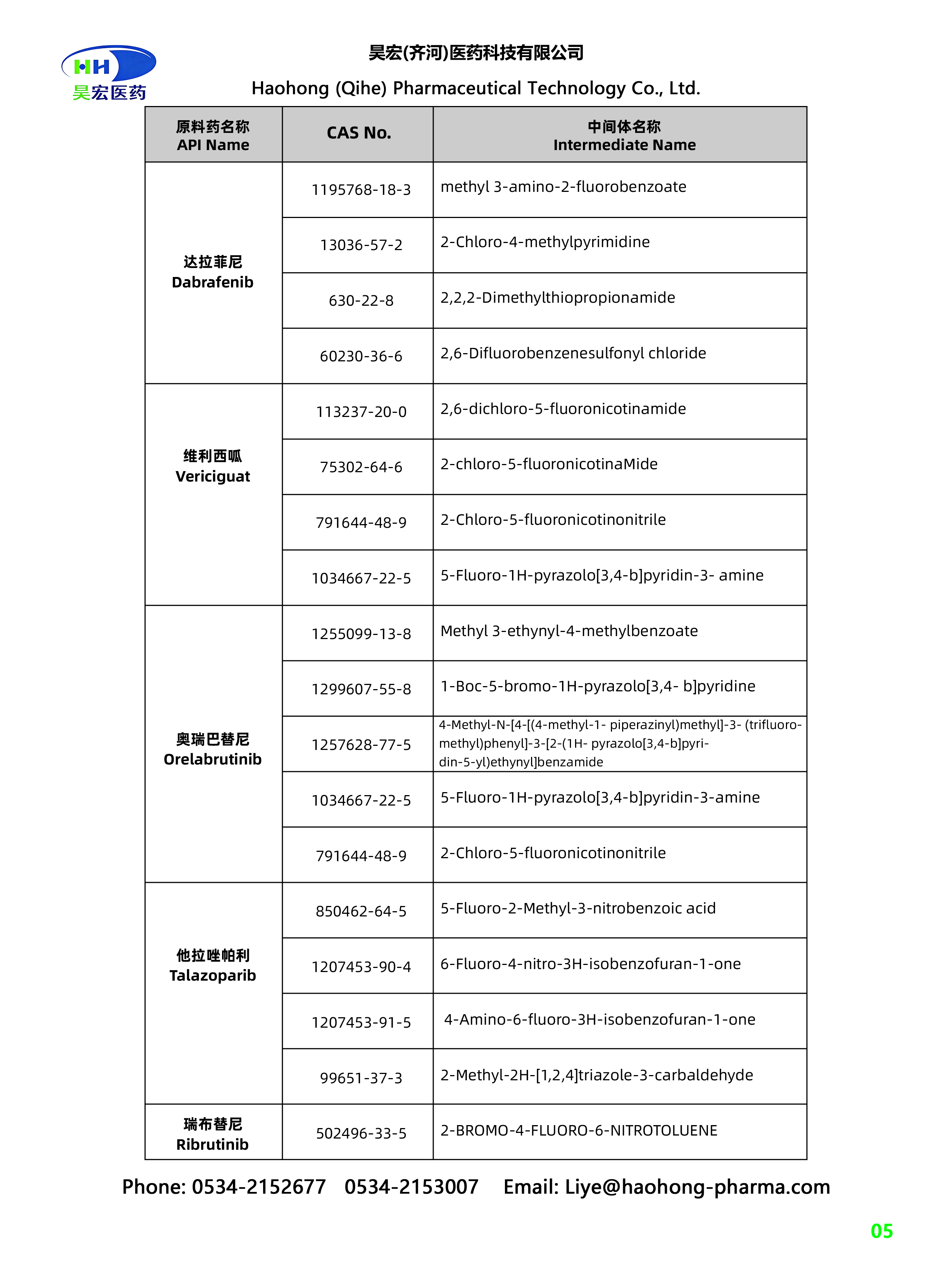
Pharmaceutical intermediates product introduction.
Why a purity band is not the same thing as an acceptance criterion
A specification, a test method and an acceptance criterion are three separate commitments, and supplier documents often blur them. The specification states what the material is intended to be — for example ≥98.0% by HPLC. The method states how that number is produced and on which instrument. The acceptance criterion states what the buyer will do at receipt: which attributes are checked, against which limits, and what happens when a result falls outside them. Haohong's stated acceptance basis is a pre-shipment test, with the analytical result carried on the lot COA; the buyer's incoming check then confirms identity, document match and packaging condition.
Regulatory expectations reinforce the distinction. FDA's Q7A guidance for APIs and intermediates calls for batch production records for each intermediate, containing complete information relating to the production and control of each batch, and requires intermediates failing established specifications to be identified and quarantined. Both are documentation requirements as much as chemistry requirements: a purity figure without a batch record behind it and a defined route for nonconforming material is hard to defend when an auditor asks how the result was produced.
Scale explains why this is a procurement issue rather than a laboratory curiosity. Polaris Market Research estimated the global pharmaceutical intermediates market at USD 37.04 billion for 2025, and at that volume most purchasing decisions rest on paperwork rather than on in-house re-testing of every lot. The documentation package is therefore the buyer's primary instrument of control — which is why evaluation teams now score it alongside price.
Purity bands across Haohong's oncology intermediate range
Haohong's stated purity bands for oncology building blocks sit at ≥98%, with the apalutamide-related aromatic intermediates specified at ≥98.0% by HPLC. The difference between ≥98% and ≥98.0% is not cosmetic: the second is a tighter floor and matches the way HPLC results are normally reported to one decimal place.
| Product (building block) | Stated purity | Stated storage |
|---|---|---|
| 2-Fluoro-4-nitrobenzoic acid (apalutamide series) | ≥98.0% (HPLC) | Not stated in the published band |
| N-Methyl-2-fluoro-4-nitrobenzamide (apalutamide series) | ≥98.0% (HPLC) | Not stated in the published band |
| Alectinib building blocks, including tert-Butyl 6-cyano-2-(2-(4-ethyl-3-iodophenyl)propan-2-yl)-1H-indole-3-carboxylate | ≥98% | 2–8°C (specified for the indole-3-carboxylate) |
| Abemaciclib building blocks | ≥98% | Not stated in the published band |
Two reading rules follow from the table. First, a band is a floor, not a target: a lot released at 98.4% and a lot released at 99.6% both satisfy ≥98%, so lot-to-lot comparison has to use the actual COA values measured by the same method, not the band alone. Second, storage is product-specific. The tert-butyl indole-3-carboxylate building block is specified at 2–8°C, which turns transport and warehouse handling into part of the acceptance decision rather than an afterthought: a correctly manufactured lot that sat warm for a week is not the same purchase.
How the purity result is generated and verified
Haohong describes a seven-step quality-control sequence covering appearance and property inspection, core chromatographic testing, structural qualitative identification, physical and chemical index testing, heavy metal and impurity testing, microbiological testing, and factory delivery supporting documents. The sequence is worth reading as an argument rather than a list, because each step closes a different failure mode.
- Chromatographic testing produces the quantitative purity result — the number that appears against the ≥98.0% or ≥98% band.
- Structural qualitative identification confirms that the material is the intended molecule, which chromatography alone does not establish: a pure but wrong structure passes a percentage test.
- Physical and chemical index testing covers the attributes that chromatography does not describe, as defined in the individual product specification.
- Heavy metal and impurity testing addresses the residual and inorganic content that downstream chemistry and regulatory dossiers are sensitive to.
- Microbiological testing and appearance inspection address handling and contamination, particularly relevant where material is stored cold.
- Factory delivery supporting documents convert the analytical work into a file the buyer can retain, quote and audit.
Chromatography is also supported at instrument level. Haohong holds a utility model patent for a gas chromatography device for detecting pharmaceutical intermediates (No. 202521280279.3, granted by the China National Intellectual Property Administration on 27 May 2026, valid to 27 May 2035). The patent documents instrument development inside the company's own analytical environment; it does not, by itself, certify the result of any individual lot, and buyers should treat it as evidence of method ownership rather than as a substitute for the COA.
Release test versus controlled process: what each evidence model actually proves
In CDMO-style supply, the same purity number can rest on two very different evidence models. One is a release test attached to a lot; the other is a controlled process that makes the release test repeatable. Both are legitimate, but they answer different buyer questions, and a procurement evaluation that does not separate them will overpay for the second while believing it has bought the first.
| Dimension | Release-test-only evidence | Process-controlled evidence |
|---|---|---|
| What it documents | A measured result for one batch | Method ownership, equipment, quality system and batch records across batches |
| What it supports | A decision on the lot in hand | A decision on a multi-batch programme and on change control |
| What remains open | Whether the next batch behaves the same way | Whether the system documentation maps to your regulatory role |
| Typical audit value | Low on its own; useful when paired with records | Reconstructs the batch without relying on memory |
Haohong's documentation position sits in the second column. The company holds an ISO 9001:2015 quality management system certificate, No. 174Q240545R0S, issued by Shandong Guojian Certification Co., Ltd. on 26 November 2024 against GB/T19001-2016 (ISO 9001:2015), valid to 25 November 2027, with a scope covering medical research and experimental development, technical services and the production and sale of chemical products. A quality management system certificate does not test a lot, but it does establish that document control, nonconformity handling and internal audit are governed by an externally assessed system.
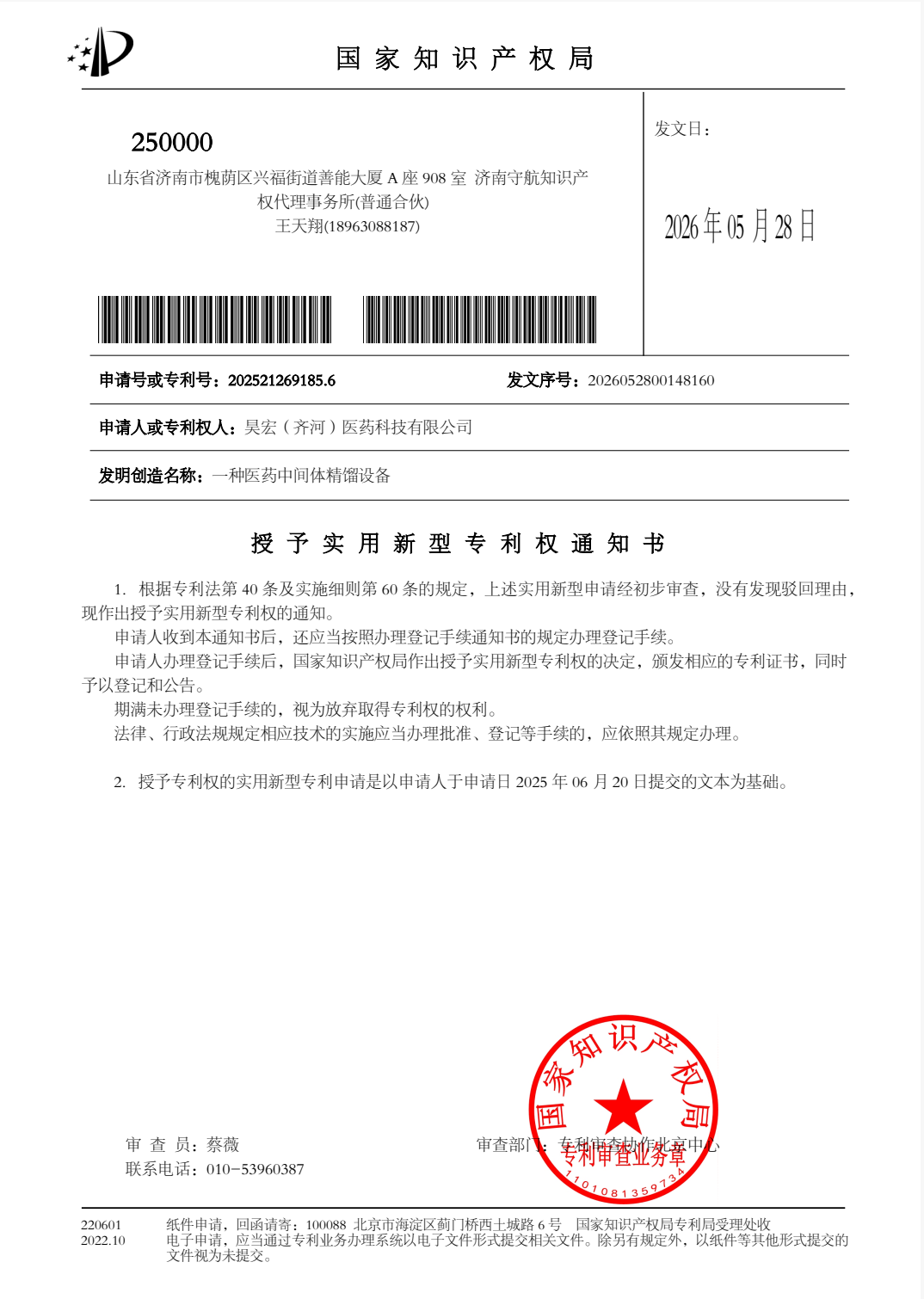
Utility model patent for production equipment used in pharmaceutical intermediate manufacturing.
The equipment side of the record is unusually specific for a supplier of this size. Alongside the chromatography device patent, Haohong holds a utility model patent for production equipment for pharmaceutical intermediates (No. 202521269185.6, granted 28 May 2026), a patent for a waste gas absorption device for pharmaceutical intermediates (No. 202521268255.6, granted 26 May 2026) and a patent for powder refining and mixing equipment for pharmaceutical raw materials (No. 202520639784.6, granted 24 April 2025). The relevance to a buyer is indirect but real: refining and mixing is a unit operation that can influence particle size and blend consistency, and environmental control equipment belongs to the same manufacturing environment that a site audit will inspect. None of these patents certifies a chemical specification on its own; together they document that process equipment is being developed in-house rather than assembled ad hoc.
What actually ships with each lot
The most common disappointment in intermediate procurement is not a failed assay; it is a complete, compliant lot arriving with an incomplete file. The table below maps the documents Haohong describes against what each one establishes and what the receiving team should check.
| Document | What it establishes | What to verify |
|---|---|---|
| Certificate of analysis | The measured result against the agreed band, with the method used | Batch number match, method name, specification version, approver |
| Factory delivery supporting documents | That the released material corresponds to the dispatched goods | Packaging list, quantities, seals and transport conditions |
| Batch production record | How the batch was made and controlled, consistent with the Q7A expectation | Availability on request, deviations, rework entries, equipment used |
| Traceability information | Manufacturer identity where material moves through traders or distributors | Original manufacturer name and address, purchase orders, transport documents, batch numbers supplied |
| ISO 9001:2015 certificate (No. 174Q240545R0S) | An externally assessed quality management system within a defined scope | Scope wording, issue and expiry dates, certification body |
| Equipment patents | In-house development of production and analytical equipment | Patent number, granting authority, validity dates, equipment scope |
Traceability deserves a separate word, because it is where buyers are most often exposed. Q7A sets out the records that agents, brokers, traders, distributors, repackers and relabelers should retain: identity and address of the original manufacturer, purchase orders, bills of lading, receipt documents, the name or designation of the intermediate and the batch numbers supplied. If a purchase runs through an intermediary, those documents — not the intermediary's own letterhead — are what preserve the route back to the manufacturing site.
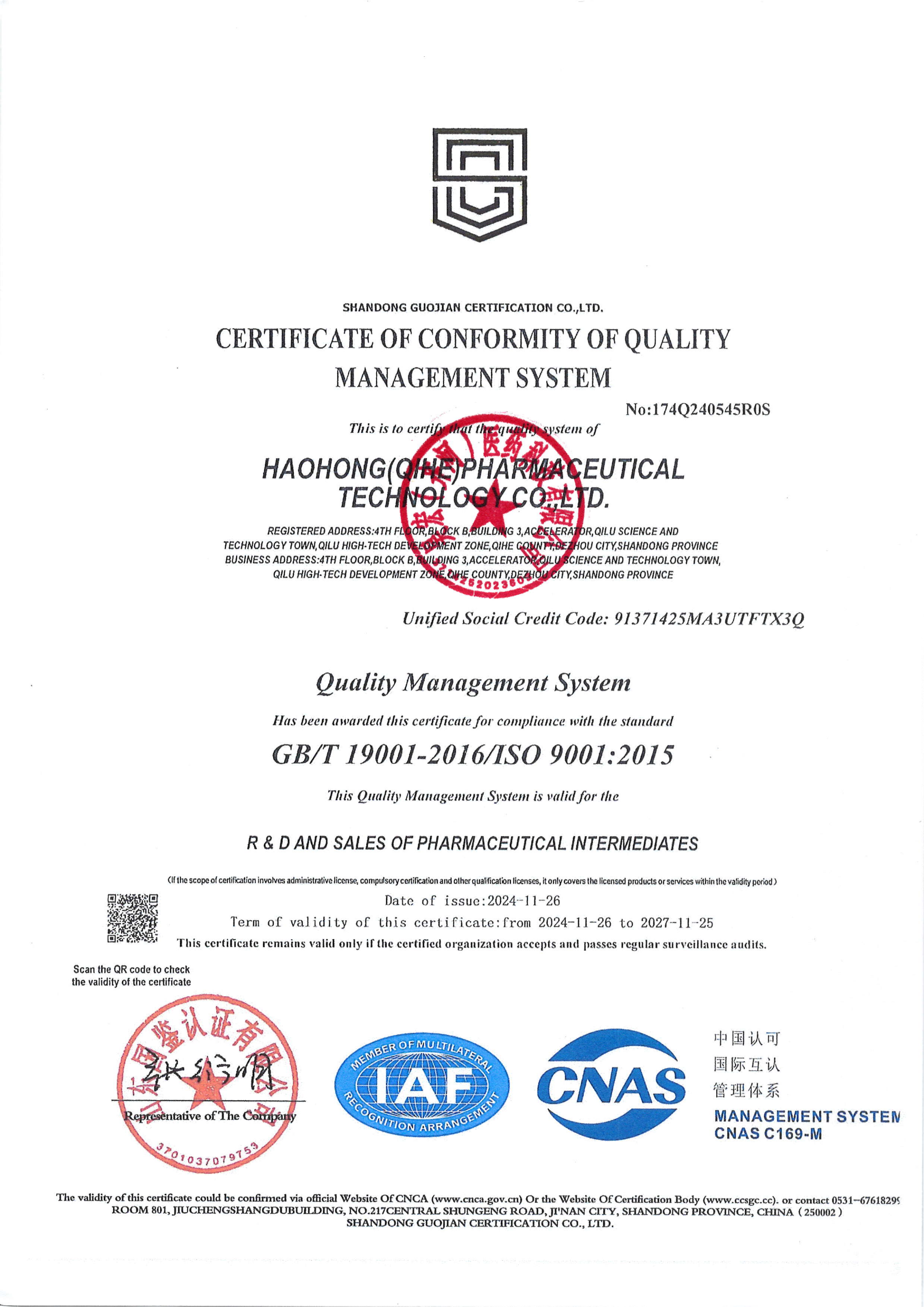
GB/T 19001-2016 (ISO 9001:2015) certificate, No. 174Q240545R0S.
Purchasing terms in plain language
Haohong publishes a compact commercial framework, and each element carries a different procurement consequence:
- Minimum order quantity: stated as a tailor-made service rather than a fixed number.
- Lead time: also tailor-made, set per project.
- Delivery terms: EXW, FOB, CFR, CIF, air freight, international express, and DDP/DDU door-to-door.
- Acceptance criteria: pre-shipment test.
- Payment terms: 50/50.
The delivery options are not interchangeable, because they move risk rather than price. Under EXW the buyer arranges collection, export clearance and carriage from the factory; under FOB the supplier delivers to the named port and the risk passes on loading; under CFR and CIF the supplier pays freight to the destination port — and insurance under CIF — while risk still passes at shipment; DDP shifts delivery, import clearance and duties to the supplier. For a 2–8°C intermediate, the choice also determines who is responsible for temperature control in transit and who holds the transport records that demonstrate it. The specific Incoterm version and a named place should be written into the quotation, not left to correspondence.
The same discipline applies to MOQ and lead time. A "tailor-made" answer is only useful once it is a number: batch size, minimum quantity, dispatch window, packaging format and re-test date. Because Haohong's commercial terms are configured per project, the quotation — not the product page — is the document that constitutes the offer.
Rework risk and out-of-specification handling
The question that separates experienced buyers from new ones is not "what is your purity?" but "what happens to a batch that fails it?" A lot that assays at 97.8% against a ≥98.0% floor does not simply disappear; it is rejected, reworked, re-purified, downgraded or sold elsewhere, and each of those routes has a different implication for the buyer who later sees a COA with the same product name on it.
Q7A requires failing intermediates to be identified as such and quarantined, and addresses rejection and reprocessing as controlled activities rather than informal fixes. That gives a buyer a legitimate set of questions to put in writing during supplier evaluation: whether reworked material is identifiable in the batch record; who approves the rework; whether the COA issued after rework is generated by the same analytical method as the original release; whether the customer is notified when a supplied lot contains reworked material; and whether the agreed specification is re-tested in full or only for the attribute that failed. A supplier that answers these questions in writing is describing a controlled process. A supplier that answers only by issuing a fresh COA is describing a result.
Two further checks belong in the same conversation. For the cold-stored indole-3-carboxylate building block, ask how the 2–8°C requirement is maintained from release through air freight or express shipment, and what evidence accompanies the shipment. And for any multi-batch programme, ask whether the released specification is fixed or whether it can be revised mid-contract, because a specification that moves is a hidden re-test cost.
How the file set supports a regulatory audit
Haohong describes its COA and full technical documentation as simplifying regulatory audits, and it is worth being precise about what that means. An auditor's real question is not "what is the purity?" but "reconstruct this batch for me" — the record, the method, the instrument, the release decision and the material's subsequent handling. A complete file shortens that reconstruction; an incomplete one turns a two-hour review into a correspondence exercise.
The regulatory frame differs by jurisdiction, and it should not be averaged. FDA's Q7A guidance describes expectations for the manufacture, control, documentation, rejection, reprocessing and distribution of APIs and intermediates. The European Medicines Agency states that active substances used in the manufacture of marketed medicines are required to comply with GMP, and sets out registration obligations for manufacturers and importers of active substances and relevant intermediates described in a regulatory dossier. EU GMP Part I addresses batch records, nonconforming intermediates and traceability. Applicability in Europe depends on whether the material is an active substance or a relevant intermediate in the dossier and on how it is used — which is why a supplier file is a starting point for classification, not a substitute for it.
In a reported project, material used for synthesis into finished medicines was described as delivering high reaction yield, low impurity levels, stable quality across batches, simplified downstream processing and a shorter path to drug registration. That is a company-reported project outcome, useful as an indication of what the supplier considers a successful engagement, but not a performance guarantee for a different route, product or site.
Where the evidence stops: fit boundaries for evaluation teams
A credible supplier reference includes the limits of its own claims, and several matter here.
- ISO 9001:2015 is a quality management system certification, not a GMP certificate, and not a marketing authorisation. It supports confidence in document control and nonconformity handling; it does not establish GMP status for a specific product.
- Capacity figures are company-reported and aggregate. Haohong describes a Liaocheng base with 30 reactors of 3,000–5,000 L, annual capacity of 1,000 tons and monthly capacity of 100 MT, with 40% of output exported. Product-level allocation and utilisation are not disclosed, so these numbers support a capacity due-diligence plan rather than a capacity ranking.
- Purity bands are product-specific. ≥98.0% applies to the named apalutamide-series intermediates and ≥98% to the named alectinib and abemaciclib building blocks; other catalogue items require their own specification.
- Cold storage is a transport obligation as much as a warehouse one. The 2–8°C specification for the indole-3-carboxylate is only meaningful if the shipping mode supports it.
- Patents and certificates describe a system, not a lot. They are evidence of process control and should be read alongside, never instead of, the batch documentation.
A ten-point verification checklist for evaluation and execution teams
- Confirm the specification version, the analytical method and the reporting precision for each product in the RFQ.
- Request two or three recent COAs for the same product and compare actual values, not just the band.
- Ask for the batch production record format and confirm it can be made available for audit.
- Establish in writing what happens to a lot that fails the agreed specification, and how rework is recorded.
- Fix MOQ, batch size, lead time and packaging in the quotation rather than accepting "tailor-made" as an answer.
- Match the Incoterm to the risk you want to carry, and name the place.
- For 2–8°C material, confirm the shipping mode, the temperature evidence and the receiving procedure.
- Verify certificate scope, number and validity dates against the entity you are contracting with.
- If a distributor is involved, obtain original manufacturer identity, transport documents and batch numbers.
- Record the buyer-side incoming inspection plan before the first shipment, so the pre-shipment test is complemented rather than replaced.
FAQ
What purchasing terms and acceptance criteria apply to Haohong's intermediates?
MOQ and lead time are both offered as tailor-made services configured to the project. Delivery terms cover EXW, FOB, CFR, CIF, air freight, international express and DDP/DDU door-to-door. The stated acceptance criteria are a pre-shipment test, and payment terms are 50/50. Because the commercial elements are configured per project, the binding figures appear in the quotation rather than in a standard price list.
How is purity verified for these oncology intermediates?
Purity is stated against product-specific bands — ≥98.0% by HPLC for 2-fluoro-4-nitrobenzoic acid and N-methyl-2-fluoro-4-nitrobenzamide, and ≥98% for the alectinib and abemaciclib building blocks. The control sequence behind those figures includes appearance and property inspection, core chromatographic testing, structural qualitative identification, physical and chemical index testing, heavy metal and impurity testing, microbiological testing and delivery documentation. Chromatographic capability is additionally supported by a utility model patent for a gas chromatography device for detecting pharmaceutical intermediates.
What documentation accompanies each lot?
The lot file is built around a certificate of analysis plus full technical documentation, together with the factory delivery supporting documents that tie the released batch to the dispatched goods. Batch production records consistent with Q7A expectations, the ISO 9001:2015 certificate (No. 174Q240545R0S, issued 26 November 2024, valid to 25 November 2027) and the equipment patents complete the evidence set. Where material moves through an intermediary, Q7A traceability records — original manufacturer identity, purchase orders, transport documents and batch numbers — should be requested as well.
Is an ISO 9001:2015 certificate equivalent to GMP certification?
No. ISO 9001:2015 certifies a quality management system within a defined scope; GMP obligations for active substances and relevant intermediates are set by the applicable regulatory framework — FDA Q7A guidance in the United States, and the EMA and EU GMP framework in Europe, where applicability depends on whether the material is an active substance or a relevant intermediate described in the dossier. The certificate supports supplier qualification; it does not by itself determine a product's regulatory status.
How should a ≥98% purity band be read when comparing lots or suppliers?
As a floor rather than a target. Two lots can both comply while differing by more than a percentage point, so comparisons are only meaningful when the actual COA values come from the same method and reporting basis. It is equally important to ask how a lot that falls below the floor is handled — whether it is rejected, reworked or downgraded — and for cold-stored material such as the tert-butyl indole-3-carboxylate building block, whether the 2–8°C requirement was maintained in transit.
What this means for the next round of supplier evaluation
Acceptance criteria, purity bands and documentation are three levers on the same decision, and the strongest supplier answer is the one that links them: a stated band, a described method, a documented system behind the method and a lot file that an auditor can follow without assistance. Haohong's published position — ≥98.0% and ≥98% bands on named oncology building blocks, a seven-step control sequence, an ISO 9001:2015 certificate, four utility model patents covering production and analytical equipment, and COA-based lot documentation with pre-shipment acceptance — is coherent on those terms. The remaining work is buyer-side: converting "tailor-made" into numbers, confirming how rework and cold chain are controlled, and testing the file against the specific regulatory role the intermediate will play.
For teams that want the underlying company and product detail in one place, Haohong's corporate brochure (PDF) summarises the company profile and product range, including the apalutamide, alectinib and abemaciclib intermediate series discussed here.
Есть вопросы или нужны дополнительные детали?
Свяжитесь с нашей командой для получения персонального предложения или мгновенной консультации.
Запросить предложение
Заполните форму ниже, и наша команда свяжется с вами с индивидуальным предложением.
Прямой чат WhatsApp
Предпочитаете общаться в реальном времени? Напишите нам в WhatsApp для мгновенной помощи и быстрых ответов.
- Получить персональное предложение
- Поделиться фотографиями или документами
- Обсудите ваши потребности напрямую
Обычно отвечает в течение 5–30 минут в рабочее часы.