
Procurement FAQ: Stainless Steel Jewelry Terms, MOQ, Payment & Acceptance
Procurement FAQ: Stainless Steel Jewelry Terms, MOQ, Payment & Acceptance
Procurement FAQ: Stainless Steel Jewelry Terms, MOQ, Payment & Acceptance
A custom stainless steel jewelry order is settled by four documents rather than by a product photograph: the term sheet, the approved physical sample, the contract specification, and the test reports attached to both. Buyers who reach the evaluation stage usually feel confident about design and finish. What they tend to leave undefined is everything that has to be written down before mass production starts.
Stainless steel jewelry has shifted from an informal fashion category into a documented export category. Wholesalers, DTC brands and platform sellers now ask for material reports, plating performance data and social compliance evidence alongside a unit price, and suppliers increasingly expect to provide them. That changes what a quote means in practice: a price per piece is only the first line of an order file that also fixes quantity, currency, delivery terms, freight mode and the criteria against which delivery will be accepted or rejected.
Jusnova Jewelry Co., Ltd is a Guangzhou-based manufacturer of stainless steel bangles, bracelets, rings and earrings, founded in 2009 and producing in 316L stainless steel with in-house PVD and 18K gold plating. Its published order terms follow the pattern of a vertically integrated export manufacturer, which makes them a usable reference structure for buyers who want to compare several quotations on the same basis instead of on price alone.
The questions below are ordered the way an evaluation usually unfolds: commercial terms first, then delivery and freight, then acceptance criteria and the compliance evidence that supports them.
The order file at a glance
| Term | Stated position | What to confirm before signing |
|---|---|---|
| Minimum order | 100 pcs per style | Whether plating colours, engraving variants and packaging configurations count as separate styles |
| Payment | PayPal and bank transfer | Currency, who absorbs transfer fees, deposit-to-balance split |
| Delivery terms | FOB, CIF or DDP | Named port or destination, importer of record, whether duty is itemised |
| Freight | DHL/FedEx air express or sea freight | A firm written quote presenting both modes side by side |
| Acceptance | Contract specification plus a jointly approved physical sample | Who holds the sealed sample, and which tolerances are measured at inspection |
| Compliance | Three SGS reports and an Amfori BSCI audit report | That report scope covers the item actually ordered, and that validity is current |
| Capacity | 250,000 units per month; 25–30 day lead time | Capacity available in the intended production month |
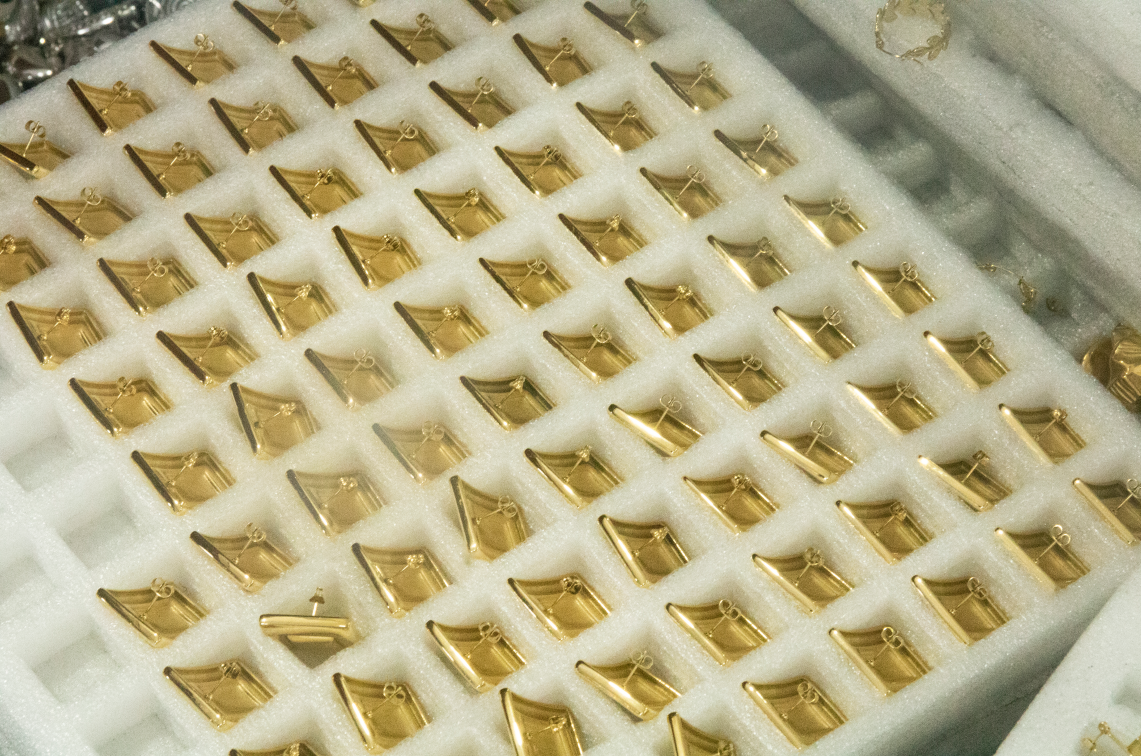
Export staging: the physical order file, not the product photo, determines whether a shipment is accepted on arrival.
Quantity: what a 100-piece-per-style MOQ actually constrains
The minimum order quantity is 100 pieces per style. The unit matters more than the number. A per-style threshold means a five-style collection order is five separate minimums, so the entry cost of a range is driven by how many styles are launched rather than by total units. Two practical consequences follow.
First, assortment planning and quantity planning become the same decision. Removing one style from a launch set removes 100 pieces from the order before any price negotiation begins, which is usually a larger saving than a marginal per-piece concession. Second, buyers should clarify at quotation stage whether a plating colour, an engraving layout or a packaging configuration is treated as a separate style or as a variant of one style. That single definition changes the effective minimum for a collection by a wider margin than most buyers expect.
A per-style minimum also signals how the supplier schedules work: batch production with fixed setup in casting, polishing and finishing, rather than on-demand single-piece output. For a buyer mapping a seasonal calendar, the relevant ceiling is stated capacity of 250,000 units per month against a 25–30 day lead time, which sets how many styles a single production window can realistically absorb.
Payment: PayPal and bank transfer are not interchangeable
The supplier accepts PayPal and bank transfer. The two channels solve different problems and should be assigned to different stages of a buyer relationship rather than chosen by habit.
PayPal is generally used at the start of a relationship and for lower order values, because it generates a transaction record with a defined dispute path and does not require the buyer's finance team to set up an international beneficiary. Bank transfer is generally used for repeat orders, where settlement cost, settlement time and a clean invoice trail matter more than dispute mechanics. Neither channel changes the commercial terms; both require the same specification and acceptance documents.
Three items belong in the term sheet regardless of channel: the invoicing currency, the party absorbing transfer and conversion fees, and the split between deposit and balance. The deposit-to-balance split should be written into the quotation rather than assumed from a previous order, because it interacts directly with the sample approval sequence — a large deposit paid before sample approval exposes the buyer to a specification dispute with the money already committed.
Incoterms: FOB, CIF and DDP describe three different risk lines
FOB, CIF and DDP are all offered. They differ less in price than in where responsibility transfers, and the choice should follow the buyer's own logistics capability.
- FOB — the supplier delivers to the named port of shipment; the buyer nominates the forwarder and bears main-carriage cost and risk. Widest cost visibility, and the normal choice for buyers with established freight contracts.
- CIF — the supplier arranges and insures carriage to a named destination port, while the buyer still handles import clearance and duty. Convenient when the buyer lacks a freight relationship, but the freight and insurance components are embedded in the unit price.
- DDP — the supplier delivers duty paid to the buyer's destination. Simplest operationally, and the least transparent commercially, because duty and freight sit inside the quoted price unless the buyer asks for the build-up.
The duty component is not trivial and should be itemised on any DDP quotation. Descartes Datamyne trade data for HTS 7117.19.90.00, the classification covering imitation jewelry of base metal, reports an effective duty rate of 31% for imports from China into the United States, comprising an 11% general duty and a cumulative 20% under Section 301. On a DDP quote to that market, duty is therefore a material line in the landed cost and can move the effective unit price well beyond the ex-works figure. Buyers who cannot see that line cannot compare a DDP offer against an FOB offer from a different supplier.
Freight: air express or sea, quoted side by side
Air express through DHL or FedEx and sea freight are both available, and the choice is usually a function of the sales calendar rather than of freight cost alone. Air express fits first orders, launch quantities and replenishment where a missed selling window costs more than the freight premium. Sea freight fits planned programmes where per-unit freight is the dominant variable and the delivery date can absorb the longer transit.
Because the two modes produce very different landed costs and very different arrival dates, a firm shipping quote presenting them side by side is more useful than a single-mode estimate. A comparison-capable quote should state the airport or port pair, the chargeable weight or volume basis, the transit estimate, the period for which the rate holds, and what the rate excludes. A quote that lists only one mode forces the buyer to source a second estimate from elsewhere, which reintroduces exactly the inconsistency the quotation process was meant to remove.
Acceptance criteria: contract specification plus an approved physical sample
Acceptance runs on two instruments used together. Neither is sufficient alone: a specification without a sample leaves surface appearance open to interpretation, and a sample without a specification leaves the measurable parameters unrecorded.
The contract specification
The written specification is the reference against which any dispute is resolved, and it should be specific enough that two inspectors would measure the same result. For a stainless steel program it normally fixes:
- Material grade and the test report that evidences it — 316L hypoallergenic stainless steel, supported by the material content analysis cited below.
- Dimensions in millimetres: diameter range and thickness, stated as a target with an agreed measurement tolerance.
- Finish type and colour target — PVD coating or gold plating, with the colour reference taken from the approved sample rather than from a screen image.
- Setting type where applicable: cubic zirconia, man-made crystal or moissanite, with stone size and placement.
- Logo method and placement — laser engraving, stamping, screen printing or epoxy doming — since each produces a visibly different result on a curved surface.
- Packaging configuration: OPP bag, velvet pouch or premium gift box, including any branded insert.
The approved physical sample
A physical sample confirmed by both parties before mass production resolves what a written specification cannot describe: how a PVD colour reads on a curved surface, how deep an engraving cuts, how a clasp closes and how a chain hangs. The sample should be sealed, dated, retained by both sides and referenced on the purchase order, so that later discussion refers to a physical object rather than to a recollection. Buyers should also treat sample approval as a calendar item: mass production follows approval, so a 25–30 day production window starts after sign-off, not before it. Logo application samples are stated at 2–3 days, which keeps that step short but does not remove it.
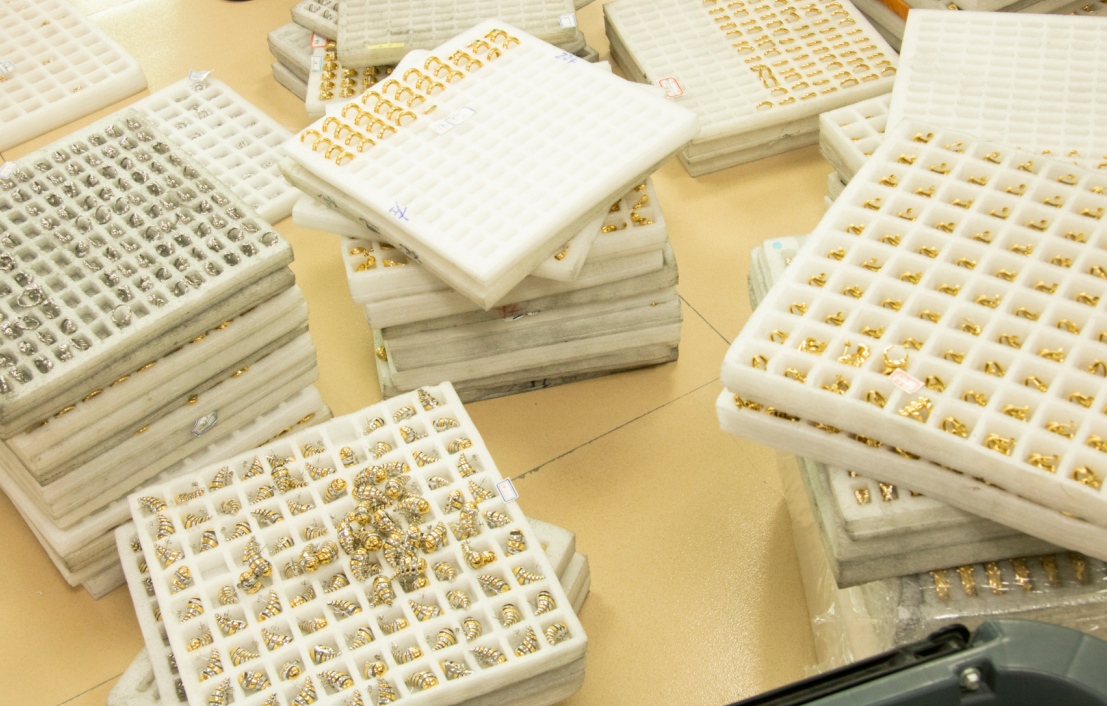
Pre-shipment inspection compares finished output against the contract specification and the approved physical sample.
Where inspection sits in an eight-stage process
Acceptance is not a single event at the end of production. In the stated quality-control sequence, checks run at eight points: raw material incoming inspection, forming or casting, polishing and surface preparation, pre-plating or pre-PVD cleaning, 18K gold plating or PVD, stone setting where applicable, logo or laser engraving where applicable, and clasp or closure function. Plating adhesion and colour, stone security and engraving depth are all determined in the middle of that sequence, which means a pre-shipment check can confirm but cannot repair them. Buyers comparing suppliers should therefore ask where inspection data is recorded, not only whether a final inspection exists.
Post-delivery handling is part of the same framework. The stated after-sales position is a response to any quality inquiry within 24 hours, a structured six-step resolution process that traces batch numbers back through production records, manufacturing defects such as plating peeling, stone loss or colour mismatch covered at the supplier's cost when reported within 30 days of receipt, transit damage replaced free of charge with carrier claims handled by the supplier, a standard 6–12 month warranty, and repair at material cost after the warranty period. Buyers should confirm that these terms appear in the contract rather than only in correspondence.
Compliance evidence that belongs in the order file
Four documents support the material, durability and social compliance claims attached to item 5609, model GEN000516bhia-066. They are lab-issued reports with numbers that can be quoted, checked and dated — which is the difference between a claim and evidence.
| Document | Standard | Reference number | Validity |
|---|---|---|---|
| SGS 316L Material Content Analysis | ASTM A276/A276M-25 | GZIN2606005050ML01_EN | Issued 26 Jun 2026; valid to 26 Jun 2027 |
| SGS Salt Spray Test | ISO 9227 | GZHL260603029801JW | Issued 29 Jun 2026; valid to 29 Jun 2027 |
| SGS Artificial Sweat Test | ISO 3160-2 | GZMR260602153701 | Issued 30 Jun 2026; valid to 30 Jun 2027 |
| Amfori BSCI audit report | BSCI social compliance, EU market | 25-0339245 | Audit cycle dated 15 Aug 2025 to 15 Aug 2026 |
Each report answers a different buyer question. The material content analysis establishes that the alloy supplied is 316L to a recognised specification, which is the foundation of the hypoallergenic and zero nickel release positioning; the artificial sweat test addresses skin contact behaviour under a defined method; the salt spray test addresses corrosion and finish durability under ISO 9227, the technical basis behind non-tarnish and waterproof claims. The BSCI report addresses the social compliance question that European retail buyers increasingly raise before appointment rather than after.
Scope note: the three SGS reports relate specifically to item 5609 / model GEN000516bhia-066. A report evidences the tested item, not an entire catalogue, and social audit reports run on renewal cycles — buyers should confirm both scope and current validity at the time of order rather than relying on a copy filed in a previous season.
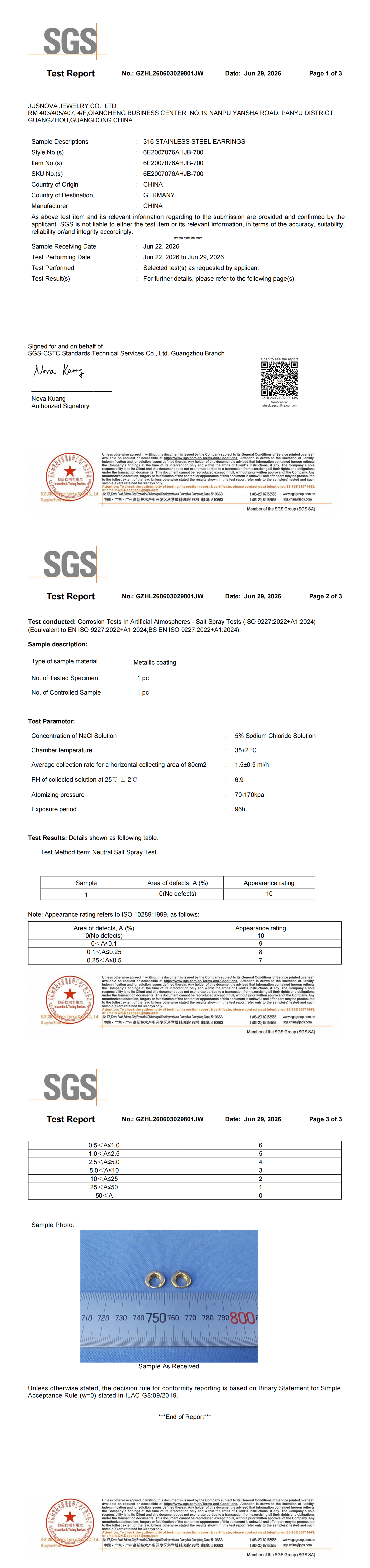
The salt spray report under ISO 9227 is the document that substantiates non-tarnish and waterproof claims.
Specification reference points to quote in an RFQ
An RFQ becomes comparable when it carries the same parameter set to every supplier. The following reference points describe the range a custom stainless steel jewelry programme can be quoted against, and they can be copied directly into a request.
| Parameter | Reference point | Why it belongs in the RFQ |
|---|---|---|
| Material | 316L hypoallergenic stainless steel; zero nickel release claim tested to EU REACH and FDA standards | Locks the alloy and the compliance basis before price discussion |
| Diameter | 5–80 mm | Defines whether bangles, rings and small components sit in one quotation |
| Thickness | 0.5–3.0 mm | Drives weight, feel and plating behaviour; must be measured, not assumed |
| Finish | PVD coating with 20+ colour options and Delta E < 1.0 batch colour consistency, or 18K gold plating | Determines durability positioning and cross-batch colour control |
| Settings | Cubic zirconia, man-made crystal or moissanite | Changes stone-setting checks and unit cost |
| Logo application | Laser engraving, stamping, screen printing or epoxy doming | Each method produces a different surface result on curved geometry |
| Packaging | OPP bag, velvet pouch or premium gift box | Affects freight weight, landed cost and unboxing consistency |
| Capacity and timing | 250,000 units per month; 25–30 day lead time; 100 pcs per style MOQ | Tests whether the requested quantity fits the supplier's production calendar |
These parameters also underpin the customisation capability a buyer is effectively procuring: laser engraved custom stainless steel jewelry, PVD gold plated stainless steel finishes, custom logo trendy jewelry and personalised engraved stainless steel jewelry are all variations on the same production base rather than separate product lines. That matters at evaluation stage, because a supplier able to hold colour consistency across batches is solving a different problem from a supplier able to produce an attractive single sample.
Market context that changes which terms you should ask for
Two market signals explain why finish documentation has moved from optional to expected. WiseGuyReports values the global stainless steel jewelry market at USD 7.08 billion in 2025, projected to reach USD 10.8 billion by 2035 at a compound annual growth rate of 4.3%. Within that total, Verified Market Reports projects the waterproof jewelry segment growing from USD 2.12 billion in 2026 to USD 4.60 billion by 2034, a CAGR of 10.16% — roughly twice the pace of the category as a whole.
The gap between those two growth rates is the analytical point. Demand is not simply expanding; it is shifting toward the finish-dependent part of the category, where waterproof and non-tarnish claims carry the commercial weight. A claim of that kind is only defensible with a test method behind it, which is why a salt spray report under ISO 9227 belongs in the order file rather than in a marketing deck. Buyers evaluating suppliers in this segment should treat finish evidence as a procurement term, not as a nice-to-have attachment.
The second signal is cost structure. With US imports of base metal imitation jewelry under HTS 7117.19.90.00 carrying an effective duty rate of 31% per Descartes Datamyne, the difference between an FOB quotation and a DDP quotation can be larger than any per-piece negotiation. Buyers comparing offers across markets should normalise to a landed-cost basis before drawing conclusions about which supplier is cheaper.
Where this model does not fit — and what it replaces
A documented custom programme is not the right structure for every buyer, and the boundaries are worth stating plainly. The comparison below sets a documented custom order against conventional catalogue or stock purchasing.
| Dimension | Catalogue / stock purchasing | Documented custom programme |
|---|---|---|
| Entry quantity | Can start below 100 pieces per style | 100 pcs per style, multiplied by the number of styles |
| Specification control | Limited to what is in stock | Defined in a written contract specification |
| Colour consistency | Varies between replenishments | Controlled to Delta E < 1.0 within agreed batch parameters |
| Time to first shipment | Immediate if stock is available | Sample approval, then 25–30 days production |
| Branding | Usually unavailable or limited to labels | Laser engraving, stamping, screen printing or epoxy doming |
| Documentation | Rarely item-specific | Test reports and audit evidence filed with the order |
The limitations are real. First, a 100-piece-per-style minimum does not suit micro-testing: a brand validating twenty designs at ten units each cannot use this structure economically, and a stock or ready-made programme is the better instrument for that stage. Second, sample approval adds calendar time that stock purchasing does not carry, so the model is a poor fit for an urgent restock where the selling window is already open. Third, report scope is item-specific — the SGS evidence cited here attaches to item 5609 / model GEN000516bhia-066, and a new geometry or a new finish needs its own validation rather than an inherited certificate. Fourth, a Delta E < 1.0 colour consistency figure describes controlled batch production; it should be verified on the approved sample for the actual geometry and finish ordered, because plating reads differently across surface area and curvature. Fifth, social audit reports follow renewal cycles, so a buyer requiring current BSCI coverage must confirm which cycle is active at the time of the order.
For buyers whose volume, branding requirements and compliance exposure all sit above those thresholds, the documented model replaces a set of informal assumptions with four checkable artefacts. That is the trade: more administration up front, fewer unresolvable arguments at arrival.
Outlook
The direction of travel in this category is toward per-item documentation rather than per-supplier documentation. As the waterproof and non-tarnish segment continues to outgrow the wider market, buyers will increasingly expect test evidence tied to the specific SKU they ordered, with validity dates inside the commercial window. The same logic is likely to reach commercial terms: DDP quotations that do not itemise duty will become harder to compare as duty exposure becomes a larger share of landed cost, and side-by-side freight quotes covering both air express and sea freight will read as a baseline rather than a courtesy.
For suppliers, the practical implication is that order administration becomes part of the product. For buyers, it means the evaluation checklist should be built before the first quotation arrives, not assembled after the first dispute.
FAQ
What is the minimum order quantity for custom stainless steel jewelry?
The stated minimum is 100 pieces per style. Because the threshold is expressed per style rather than per order, a multi-style collection is the sum of the style-level minimums, and buyers should confirm whether plating colours, engraving layouts or packaging configurations are counted as separate styles. Stated production capacity is 250,000 units per month, with a 25–30 day lead time following order confirmation and sample approval.
Which payment methods are accepted, and what should be fixed in writing?
PayPal and bank transfer are accepted. The term sheet should state the invoicing currency, which party absorbs transfer and conversion fees, and the deposit-to-balance split. PayPal is typically used for first orders and lower values where a transaction record and dispute path matter; bank transfer is typically used for repeat orders where settlement cost and invoice trail take priority.
How should a buyer choose between FOB, CIF and DDP?
FOB suits buyers with their own freight contracts who want maximum cost visibility; CIF suits buyers who want the supplier to arrange carriage and insurance to a named port while the buyer still clears import; DDP suits buyers who prioritise a single delivered price. Under DDP, buyers should request the duty and freight build-up, because duty can be material — Descartes Datamyne reports an effective duty rate of 31% on HTS 7117.19.90.00 imports from China into the United States, including an 11% general duty and a cumulative 20% under Section 301.
What should a firm shipping quote contain?
A comparison-capable quote presents both modes side by side — air express via DHL or FedEx, and sea freight — with the airport or port pair, the chargeable weight or volume basis, the transit estimate, the period the rate holds, and any exclusions. A single-mode estimate cannot be compared against another supplier's quotation without reintroducing the inconsistency the quotation process is meant to remove.
What are the acceptance criteria for a custom stainless steel jewelry order?
Acceptance rests on two instruments used together: a contract specification covering material grade, measured dimensions, finish and colour target, setting type, logo method, packaging configuration and agreed tolerances; and a physical sample approved by both parties before mass production, sealed, dated, retained by both sides and referenced on the purchase order. Pre-shipment inspection compares finished output against both documents.
Which documents support the material, durability and compliance claims?
Three SGS reports and one social audit report: a 316L material content analysis to ASTM A276/A276M-25 under reference GZIN2606005050ML01_EN, a salt spray test to ISO 9227 under GZHL260603029801JW, an artificial sweat test to ISO 3160-2 under GZMR260602153701, and an Amfori BSCI report for the EU market under 25-0339245 with an audit cycle dated 15 August 2025 to 15 August 2026. The SGS reports relate to item 5609 / model GEN000516bhia-066, and validity dates should be checked at the time of order.
What specification range can be quoted in an RFQ?
316L hypoallergenic stainless steel with zero nickel release, tested to EU REACH and FDA standards; diameters from 5 mm to 80 mm; thickness from 0.5 mm to 3.0 mm; PVD coating in 20+ colours with Delta E < 1.0 batch consistency, or 18K gold plating; cubic zirconia, man-made crystal or moissanite settings; logo application by laser engraving, stamping, screen printing or epoxy doming; and packaging in OPP bag, velvet pouch or premium gift box, against a stated capacity of 250,000 units per month.
A procurement file built from these seven points is not longer than a product brief. It is simply arranged so that the price, the delivery date and the acceptance decision can each be traced to something written down.
Есть вопросы или нужны дополнительные детали?
Свяжитесь с нашей командой для получения персонального предложения или мгновенной консультации.
Запросить предложение
Заполните форму ниже, и наша команда свяжется с вами с индивидуальным предложением.
Прямой чат WhatsApp
Предпочитаете общаться в реальном времени? Напишите нам в WhatsApp для мгновенной помощи и быстрых ответов.
- Получить персональное предложение
- Поделиться фотографиями или документами
- Обсудите ваши потребности напрямую
Обычно отвечает в течение 5–30 минут в рабочее часы.