
Procurement FAQ: Technical and Sourcing Answers for Flexible Warning Post Buyers

Verifiable supplier documentation is part of flexible warning post evaluation, alongside material and reflective performance data.
Flexible warning posts are usually specified on material behaviour rather than appearance. Global road marker post demand reached USD 3.4 billion in 2024 and is projected to reach USD 5.4 billion by 2032 (Road Marker Posts Market Size Analysis), while the wider traffic safety products market is expected to expand at a 6.6% CAGR from 2026 to 2034 (Dataintelo). For buyers in the evaluation stage, the decisive question is narrower: which published specification can be verified before an order is placed, and which cannot.
A flexible warning post — described in tenders as a warning spring post, traffic delineator post, PU warning post or flexible safety bollard — is a vertical guidance marker engineered to deflect under vehicle contact and return to an upright position instead of staying bent, cracked or dislodged. This reference collects the technical and sourcing questions buyers most often raise about two Mnsd models, YD-WP45 (450 mm) and YD-WPS75 (750 mm), and answers each one from published product evidence.
Tiantai Yuanda Traffic Device Co.,Ltd, established in 2007, is a Chinese road safety equipment manufacturer with over 15 years of operational experience. Its Mnsd brand supplies warning posts, traffic cones, convex mirrors, speed bumps and related traffic safety products to importers, distributors, wholesalers, contractors and infrastructure project suppliers, with exports reaching Asia, the Middle East, Europe and South America.
Direct Answers: The Six Questions Buyers Ask First
- Structural flexibility: YD-WP45 and YD-WPS75 are published as 360° flexible and impact resistant, with rapid rebound after a vehicle crush.
- Material strength: tensile strength 15.0 MPa, elongation at break 400%, hardness 80–85 Shore A.
- Reflectivity: High-Intensity Prismatic (HIP) / Class 1 tape, 250 mm wide, in silver white or fluorescent yellow, with a published visibility distance of 200+ metres.
- Installation: expansion bolt fixing through 3 or 4 holes in the base, with an optional ring top for chain attachment.
- Durability: operating range −40 °C to +70 °C, UV-stabilized coating, anti-oxidant and colorfast performance for over 3 years, water and oil resistance.
- Sourcing: MOQ 200 pcs, 10–15 days lead time for bulk orders, 50,000 pcs monthly capacity, and customization of height, colour and reflective tape brand.
Structural Configuration: What 360° Flexibility Means in Practice
Both models separate two functions inside one product: the post body provides elastic deflection and rebound, while the base provides stability and the fixing surface.
What materials form the post and the base?
The post body of YD-WP45 and YD-WPS75 is produced in high-elasticity polyurethane (PU) or heavy-duty PE. The base is either recycled rubber or an integrated plastic base. This distinction matters at evaluation stage, because the body material governs rebound behaviour while the base material governs how the unit sits on the surface and how the fixing performs over time.
What does “360° flexible and impact resistant” actually mean?
It means the post responds to deflection from any direction rather than only along one axis. In parking bays, road edges and work zones, vehicles approach at unpredictable angles, so multi-directional deflection is a practical requirement rather than a marketing phrase.
What do the tensile strength and elongation figures tell a buyer?
Tensile strength of 15.0 MPa describes the stress the material withstands before it fails. Elongation at break of 400% describes how far it stretches before breaking — approximately four times its original length. Together, these two values explain the behaviour that converts a vehicle impact into temporary bending instead of fracture. Hardness of 80–85 Shore A places the compound in a mid-to-firm band: firm enough to stand upright and hold reflective sleeves in position, elastic enough to return to shape after contact.
What happens after a vehicle drives over the post?
The published behaviour is self-recovery: rapid rebound after vehicle crush. At the manufacturing stage, the same behaviour is verified through a quality-control regime of 1,000+ times compression and rebound tests. Buyers evaluating suppliers can reasonably ask to see this test evidence before approving a first order, because rebound performance is what determines whether a post remains a functioning guide after a low-speed impact.
YD-WP45 and YD-WPS75: Published Specification Comparison
| Specification | YD-WP45 | YD-WPS75 |
|---|---|---|
| Height | 450 mm | 750 mm |
| Post dimensions | 450 × 80 × 200 mm | 750 × 80 × 200 mm |
| Post material options | High-elasticity PU or heavy-duty PE | High-elasticity PU or heavy-duty PE |
| Base material | Recycled rubber or integrated plastic base | Recycled rubber or integrated plastic base |
| Base size | 200 × 80 mm | 200 × 80 mm |
| Temperature resistance | −40 °C to +70 °C | −40 °C to +70 °C |
| UV and aging | UV-stabilized coating; anti-oxidant and colorfast over 3 years | UV-stabilized coating; anti-oxidant and colorfast over 3 years |
| Weatherproofing | Water and oil resistant | Water and oil resistant |
| Reflective grade | High-Intensity Prismatic (HIP) / Class 1 | High-Intensity Prismatic (HIP) / Class 1 |
| Reflective tape width | 250 mm, double or triple sleeves | 250 mm, double or triple sleeves |
| Reflective colours | Silver white / fluorescent yellow | Silver white / fluorescent yellow |
| Visibility distance | 200+ metres | 200+ metres |
| Physical performance | 360° flexible and impact resistant; rapid rebound after vehicle crush | 360° flexible and impact resistant; rapid rebound after vehicle crush |
| Tensile strength / elongation | 15.0 MPa / 400% at break | 15.0 MPa / 400% at break |
| Hardness | 80–85 Shore A | 80–85 Shore A |
| Installation | Expansion bolt fixing (3 or 4 holes) | Expansion bolt fixing (3 or 4 holes) |
| Top design | Ring top for chain attachment (optional) | Ring top for chain attachment (optional) |
| Colour options | Traffic orange / yellow / red / black | Traffic orange / yellow / red / black |
The two models differ in visible height, not in reflective grade, elastic behaviour or installation logic. That is a useful sourcing fact: buyers can specify a shorter or taller post for a site without reopening the material and reflectivity decision.
Reflectivity and Night-Time Visibility: Matching the Local Standard
What reflective specification is published for these posts?
High-Intensity Prismatic (HIP) / Class 1 reflective tape, 250 mm wide, applied in double or triple sleeves, in silver white or fluorescent yellow, delivering a visibility distance of 200+ metres.
Does the reflective colour fade over time?
The posts use a UV-stabilized coating, with anti-oxidant and colorfast performance published as over 3 years. The manufacturer additionally states an after-sales UV-resistance guarantee of no fading for 3 years.
Installation: Fixing Method, Base Footprint and Chain Attachment
How are the posts fixed to the surface?
Both YD-WP45 and YD-WPS75 are installed using expansion bolt fixing through 3 or 4 holes in the base. The base footprint is 200 × 80 mm on both models, which keeps the fixing pattern consistent whether a site mixes 450 mm and 750 mm posts.
Can several posts be linked together?
An optional ring top allows a chain to be attached, so consecutive posts can be linked to close off an area or define a continuous boundary, such as a parking bay edge, an entrance restriction or a temporary work-zone perimeter.
What operating conditions are covered?
The published operating range is −40 °C to +70 °C, and the posts are described as water and oil resistant, which is relevant for loading docks, workshops and wet-weather road edges where oil film and standing water are common.
One boundary is worth stating plainly: expansion bolt fixing depends on a receiving surface that can reliably hold the fixing. On soft or unpaved ground, the installation method should be confirmed against site conditions during evaluation rather than assumed from the standard configuration.
Durability, Aging and Weathering: What the Data Covers
- Temperature resistance: −40 °C to +70 °C.
- UV protection: UV-stabilized coating on the post body and reflective assembly.
- Aging resistance: anti-oxidant and colorfast performance stated as over 3 years.
- Weatherproofing: water and oil resistant.
- Quality control: 1,000+ times compression and rebound testing.
- After-sales statement: UV-resistance guarantee of no fading for 3 years.
Is there field evidence beyond laboratory statements?
Yes — a contractor-led road safety project in Vietnam used this product family to warn vehicles and pedestrians and to mark road edges and dangerous areas. The project record lists a service duration of 5–8 years, and the installation was completed and subsequently accepted by the local authority. Buyers assessing long-life claims should note the distinction: the colourfastness and UV guarantee is a 3-year statement, while the longer field duration in this case reflects a specific site, traffic pattern and maintenance regime.
What is not covered by the durability statement?
Reflective sleeves are the component most exposed to abrasion, dirt and road film, and their performance depends on cleaning and replacement practice at site level. No material statement removes that maintenance requirement, and buyers planning multi-year programmes should build sleeve inspection into their site routine.
Sourcing Answers: MOQ, Lead Time, Capacity and Customization
| Sourcing parameter | Published value |
|---|---|
| Minimum order quantity | 200 pcs |
| Lead time | 10–15 days for bulk orders |
| Monthly capacity | 50,000 pcs per month |
| Production mode | High-speed injection molding |
| Customization scope | Height, colour (orange / yellow / green), reflective tape brand (3M / Grade A) |
| Standard colour options | Traffic orange / yellow / red / black |
| Quality control | 1,000+ times compression and rebound test |
Two of these parameters carry more procurement weight than they appear to. First, a MOQ of 200 pcs supports pilot installations and single-site trials before a programme-wide rollout. Second, customisable reflective tape brand matters where a buyer already standardises on a specific tape grade across a product portfolio, because mixed tape grades create inconsistent night-time appearance across the same road network.
Application Scenarios Where Flexible Warning Posts Are Specified
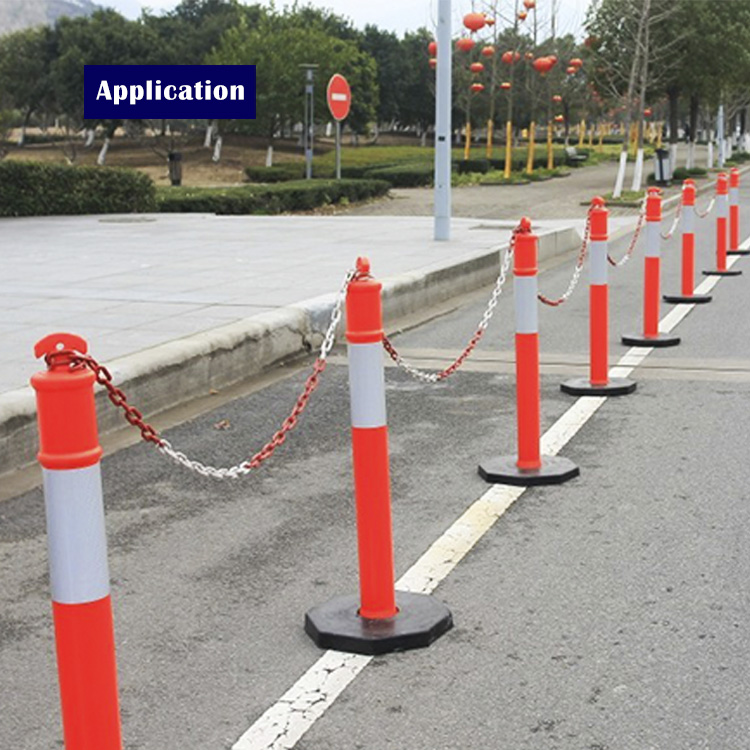
Warning posts in service on a road safety project: marking road edges and warning vehicles and pedestrians in a mixed-traffic environment.
The applicable environments published for these models span road traffic, parking lots, construction sites, industrial facilities, warehouses, logistics centres, airports, seaports, railway stations, schools, hospitals, commercial complexes, residential areas, highways, municipal engineering, public facilities, loading docks and bus terminals. That breadth reflects a simple functional fact: wherever vehicle paths and pedestrian areas overlap without a physical barrier requirement, a flexible, high-visibility marker is usually the practical solution.
In parking and logistics environments, the shorter YD-WP45 is normally sufficient because drivers approach at low speed and the post is seen at close range. On road edges, approach lanes and municipal works, the taller YD-WPS75 creates an earlier visual target. Where a site mixes both — for example an airport apron with service roads and parking zones — the shared base footprint and identical reflective specification keep installation and spare-part planning simple.
Market Context: Growing Demand, Rising Documentation Expectations
Demand signals support continued investment in delineation hardware. The global road marker posts market is valued at USD 3.4 billion in 2024 and is projected to reach USD 5.4 billion by 2032, and the traffic safety products market is expected to grow at a 6.6% CAGR from 2026 to 2034, driven by urban population growth and infrastructure investment.
Supply remains partly consolidated: among leading global traffic equipment manufacturers, 3M, Honeywell and SWARCO are named, with the top five suppliers collectively holding approximately 39.2% market share. That structure leaves substantial room for specialist manufacturers, and it also raises the bar on documentation — buyers comparing a specialist against larger brands increasingly ask for material data, test regimes and legal entity evidence rather than brochures alone.
Standards pressure reinforces this. EN 12899-3 in Europe addresses delineator posts and retroreflectors, while ASTM D2765 provides procedures for measuring gel content and swell ratio of crosslinked ethylene plastics used in industrial safety products. Third-party material guidance also continues to favour elastomers with high elastic recovery for impact-prone installation points. The practical consequence for procurement is that material and reflectivity claims are now expected to be traceable to test methods, not asserted.
Flexible Warning Posts vs Traditional Fixed Bollards
| Comparison criterion | Flexible PU/PE warning post (YD-WP45, YD-WPS75) | Fixed steel or concrete bollard |
|---|---|---|
| Impact response | Deflects in any direction and rebounds; published self-recovery after vehicle crush | Absorbs impact rigidly; typically deforms, tilts or requires repair |
| Condition after low-speed contact | Usually remains in a marking function | Often loses function until repaired or replaced |
| Vehicle damage risk | Lower, because the post yields on contact | Higher, because the post resists |
| Physical containment | Not designed as a crash barrier | Provides physical blocking where engineering requires it |
| Installation | Expansion bolt fixing through 3 or 4 base holes; optional ring top for chaining | Typically cast, anchored or embedded; heavier installation effort |
| Maintenance profile | Inspection and cleaning of reflective sleeves | Structural inspection after impact events |
| Typical fit | Lane edges, parking areas, work zones, industrial and logistics sites | Entry control, anti-ram protection, high-speed containment |
The limitation is important to state clearly, because it is where specification errors usually originate. A flexible warning post is a guidance and delineation device with impact tolerance; it is not a crash barrier and does not provide physical containment, anti-ram protection or structural blocking. On high-speed carriageways where containment is an engineering requirement, flexible posts complement barrier systems rather than replace them. Likewise, the 3-year colourfastness and UV statement covers fading, not unlimited mechanical wear — repeated heavy impacts and abrasion will eventually degrade any elastomer, and sleeve condition should be monitored in high-traffic installations.
Future Outlook for Warning Post Procurement
With infrastructure investment and urban population growth continuing to drive the traffic safety category at a 6.6% CAGR through 2034, three shifts are likely to shape buyer behaviour. Material specifications will be examined more closely, because rebound performance is what determines replacement frequency. Reflective requirements will tighten as standards such as EN 12899-3 and MUTCD retroreflectivity rules are applied more consistently to project specifications. And supplier qualification will rely increasingly on documentation — test regimes, aging statements and legal entity records — rather than on catalogue claims alone.
For buyers, the practical implication is that a warning post order is no longer only a price and quantity decision. It is a decision about which documented performance characteristics will hold up across the service life of an installation.
Frequently Asked Questions
What sizes and models are available in this flexible warning post range?
The range documented for these models includes YD-WP45 with a height of 450 mm and a base size of 200 × 80 mm, and YD-WPS75 with a height of 750 mm and the same 200 × 80 mm base. A separate model, YD-PE50, has a height of 500 mm and a Φ260 mm rubber base. Post bodies are specified in high-elasticity polyurethane (PU) or heavy-duty PE, with recycled rubber or integrated plastic bases.
How should a buyer choose between the 450 mm and 750 mm models?
Selection is driven mainly by the visible height required and the approach context. The 450 mm YD-WP45 suits locations where drivers and pedestrians see the post at close range and move slowly, such as parking areas, loading docks and site boundaries. The 750 mm YD-WPS75 provides a taller visual target for road edges, junctions and approaches where earlier warning is needed. Both models share the same published reflective grade, elastic behaviour, tensile and elongation values, so the choice is primarily geometric — and it should also be checked against the delineator height requirement of the applicable local standard.
How are the posts installed, and can several posts be linked together?
Both models are installed using expansion bolt fixing through 3 or 4 holes in the base. An optional ring top allows a chain to be attached, so consecutive posts can be linked to close an area or define a continuous boundary such as a parking bay edge or a work-zone perimeter. Because expansion bolt fixing depends on the receiving surface, buyers should confirm the substrate at the installation site before finalising the fixing method.
What reflective performance do the posts deliver, and how does that compare with local requirements?
The published specification is High-Intensity Prismatic (HIP) / Class 1 reflective tape, 250 mm wide, applied in double or triple sleeves in silver white or fluorescent yellow, with a visibility distance of 200+ metres. Requirements differ by market: the US MUTCD describes delineator visibility from 1,000 feet (approximately 305 metres) under high-beam illumination, and EN 12899-3 defines European requirements for delineator posts and retroreflectors. Buyers should compare the project’s standard requirement against the product’s published visibility distance.
What are the minimum order, lead time and customization terms?
The published terms are a minimum order quantity of 200 pcs, a lead time of 10–15 days for bulk orders, and a production capacity of 50,000 pcs per month using high-speed injection molding. Customization covers height, colour (orange / yellow / green) and reflective tape brand (3M / Grade A), while standard colour options include traffic orange, yellow, red and black.
How can a buyer verify durability claims and supplier legitimacy before ordering?
On durability, the published evidence includes an operating temperature range of −40 °C to +70 °C, a UV-stabilized coating, anti-oxidant and colorfast performance stated as over 3 years, water and oil resistance, a quality-control regime of 1,000+ times compression and rebound tests, and an after-sales UV-resistance guarantee of no fading for 3 years. A field reference is a Vietnam road safety project completed and accepted by the local authority, with a listed service duration of 5–8 years. On legal status, Tiantai Yuanda Traffic Device Co.,Ltd holds a Business License numbered 91331023669153260K, issued by the Market Supervision Administration on 2007-11-13 and valid to 2107-11-13, with an all-items scope covering the product range that includes YD-WP45 and YD-WPS75.
Further documentation
Detailed product and company information for the Mnsd warning post range is available in the downloadable brochure: Mnsd traffic safety product brochure (PDF).
Company reference: www.mnsdtraffic.com
Есть вопросы или нужны дополнительные детали?
Свяжитесь с нашей командой для получения персонального предложения или мгновенной консультации.
Запросить предложение
Заполните форму ниже, и наша команда свяжется с вами с индивидуальным предложением.
Прямой чат WhatsApp
Предпочитаете общаться в реальном времени? Напишите нам в WhatsApp для мгновенной помощи и быстрых ответов.
- Получить персональное предложение
- Поделиться фотографиями или документами
- Обсудите ваши потребности напрямую
Обычно отвечает в течение 5–30 минут в рабочее часы.