
Procurement FAQ: Validating Dredging Depth, Pump Power and CCS Class Data
Three specification fields cause more shortlist errors in dredging equipment procurement than any others: dredging depth, installed pump power, and class certification. This reference checks each field against published data for two specific vessels — the 2600 m³ CCS Split Hopper Barge and the 25 m³ Grab Dredger — and separates what a buyer can verify from documents today from what must be requested in writing before a purchase order is issued.
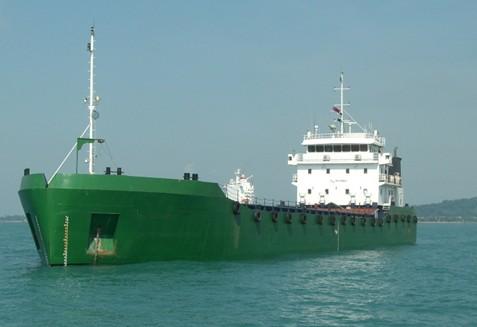
Split hopper barges in the 1200–3200 m³ series are self-discharging transport units used in coastal and inland waterway projects. Image: Yanyang Marine.
Why the Dredging Shortlist Has Become a Data-Validation Exercise
The global dredging equipment market was valued at USD 4.86 billion in 2023 and is projected to grow to USD 7.36 billion by 2030, according to Grand View Research. Within that market, hydraulic dredgers — the category that includes cutter suction dredgers — held the largest revenue share by type at approximately 46.65% in 2023. Trailing suction hopper dredgers are separately estimated to account for 46.0% of total dredging market activity by 2026, according to Future Market Insights.
Those figures describe demand. They do not describe how a buyer selects a vessel. In practice, the failure point in a dredging procurement file is rarely the commercial envelope and almost always the technical record: a depth figure quoted from one vessel type and applied to another, a pump power figure that never appears in writing, or a class certificate that is valid in one market and not in another.
Terminology compounds the problem. ISO 8384:2019 provides the international standard vocabulary and definitions for dredgers, including specific terms for trailing suction hopper dredgers and cutter suction dredgers. Where a specification sheet does not use that vocabulary, buyers should confirm which definition a supplier is applying before comparing numbers across models.
What “Validation” Means in a Dredging Procurement File
Validation is not verification of a supplier’s reputation. It is a three-step test applied to each individual parameter on a specification sheet.
- Applicability. Does the parameter belong to this vessel category at all? A transport barge and a hydraulic dredger do not share the same parameter set, and treating them as comparable produces false precision.
- Publication. Is the value actually stated in the product record, with a unit and a rated condition? Where the record is silent, the honest procurement position is a written data request, not an assumed figure.
- Coverage. Is the value supported by a class certificate, a factory test record or a contractual performance warranty? A number that is not covered by one of the three has no enforcement path if performance falls short.
The Shortlist Under Review
Zhenjiang Yanyang Engineering Co., Ltd., trading as Yanyang Marine, is a dredger manufacturer and exporter based in Zhenjiang, Jiangsu Province, China, founded in 1996. The company reports 50 employees and a 10-person R&D team, with more than 30 large dredger construction projects delivered and a 100% export ratio across markets that include the United Arab Emirates, Indonesia, India, Egypt, Turkey, Nigeria, South Africa, Tanzania, Saudi Arabia and Oman. Product records are published at www.yanyangmarine.com.
Two vessels from that portfolio are frequently compared by buyers working on coastal transport and near-shore dredging packages, even though they perform different jobs. The table below sets out the published parameters for both, taken from the manufacturer’s product specifications without modification.
| Published parameter | 2600 m³ Split Hopper Barge (CCS) | 25 m³ Grab Dredger (self-propelled) |
|---|---|---|
| Vessel category | 1200–3200 m³ split hopper barge | 25 m³ grab dredger |
| Year of completion | Not stated in the record | 2012 |
| Length overall | 76.95 m | 58.00 m |
| Waterline length | 75.92 m | 58.00 m |
| Moulded breadth | 15.60 m | 22.60 m |
| Moulded depth | 6.00 m | 4.80 m |
| Design draft | 4.00 m | 3.00 m |
| Hopper / grab capacity | 2600 m³ hopper | 25 m³ grab |
| Main engine power | 3740 kW × 2 | Weichai X6170ZC-21, 2 units × 456 kW at 1500 r/min |
| Reduction gearbox | Not stated in the record | HCD400A, ratio 5:1 |
| Generators | Not stated in the record | SB-HW4 × 2 |
| Designed displacement | Not stated in the record | 3651.308 t |
| Gross / net tonnage | Not stated in the record | 2349 T / 705 T |
| Crew | 10 persons | 10 persons |
| Ice class | Ice Class B | Not stated in the record |
| Navigation area | Not stated in the record | Coastal |
| Frame spacing | 0.60 m | 0.60 m |
| Class / certification | CCS Domestic Vessel Classification Certificate, No. ZA23DNB00274 | Record describes the vessel as ZC-classed |
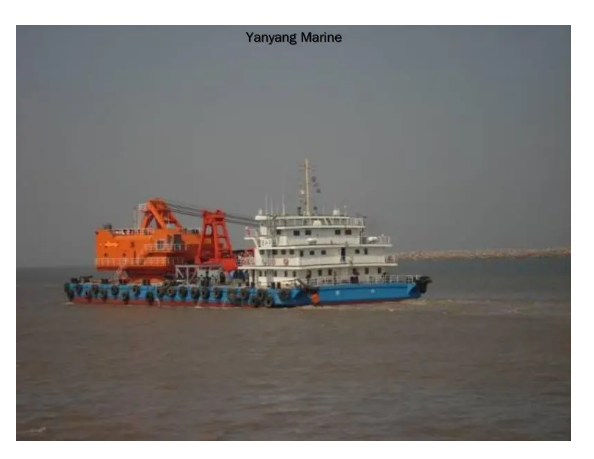
A self-propelled grab dredger. The 25 m³ unit in this shortlist is a 2012-built vessel operating in the coastal navigation area. Image: Yanyang Marine.
Validating Dredging Depth
Dredging depth is the parameter most often misapplied in shortlist documents, because it is a dredging-rated figure and not a general vessel attribute.
Where a published depth figure exists
Within the Yanyang Marine portfolio, two models publish an explicit dredging depth. The 1000–8000 m³/h cutter suction dredger is rated at 30 m dredging depth with an 8000 m discharge distance. The 26800 m³ trailing suction hopper dredger publishes a dredging depth of 40 / 70 / 115 m depending on the dredging configuration. Both figures appear in the product record with the associated capacity rating, which means a buyer can place them in a comparison table without qualification.
Where the parameter does not apply
The 2600 m³ Split Hopper Barge has no dredging depth rating because it is not a dredging unit. Its published role is transporting dredged material, and it is described as widely used in coastal and inland waterway projects. A split hopper barge receives material from a dredger, transports it, and discharges it through the split hull; it does not excavate. Placing a dredging depth value against this vessel in a comparison matrix would be a category error rather than a data gap.
Where the parameter is unpublished
The 25 m³ Grab Dredger record specifies the grab capacity, hull dimensions, propulsion and auxiliary machinery, but it does not publish a dredging depth figure. The vessel is described as offering robust performance for removing hard clay and soft sediment in near-shore operations, with navigation limited to the coastal area. That is a qualitative capability statement, not a rated depth.
Validating Pump Power
Pump power is the second field where shortlist documents commonly contain numbers that do not survive a documentation check. Within the current product records, only one model publishes a complete pump inventory.
The 26800 m³ trailing suction hopper dredger lists an inboard dredge pump rated at 2 × 6000 kW, an underwater pump rated at 2 × 3300 kW, and jet water pumps rated at 2 × 2000 kW, all inside a total installed power of 27,726 kW. Those figures are itemised by function, which allows a buyer to separate dredging power from jetting power and from propulsion.
The other models in the shortlist do not publish pump data in the same way. The cutter suction dredger record states an 8000 m discharge distance but does not itemise pump power. The Split Hopper Barge and the Grab Dredger are not pump-equipped vessels: the barge is a transport unit, and the grab dredger excavates mechanically with a 25 m³ grab rather than hydraulically. Asking a supplier to “confirm pump power” on either of those two vessels will produce an answer that has no engineering meaning.
Validating CCS Class Data
Class documentation is the field where a single missing qualifier can invalidate an otherwise clean shortlist. The certificate associated with the 2600 m³ Split Hopper Barge is set out below exactly as recorded.
| Certificate field | Recorded value |
|---|---|
| Certificate title | Domestic Vessel Classification Certificate |
| Certificate number | ZA23DNB00274 |
| Issuing authority | CCS |
| Classification standard | CCS Rules for Classification of Sea-going Ships |
| Scope | Coastal navigation area, self-discharging hopper barge |
| Applicable market | Domestic |
| Issue date | 2024-08-30 |
| Expiry date | 2029-08-29 |
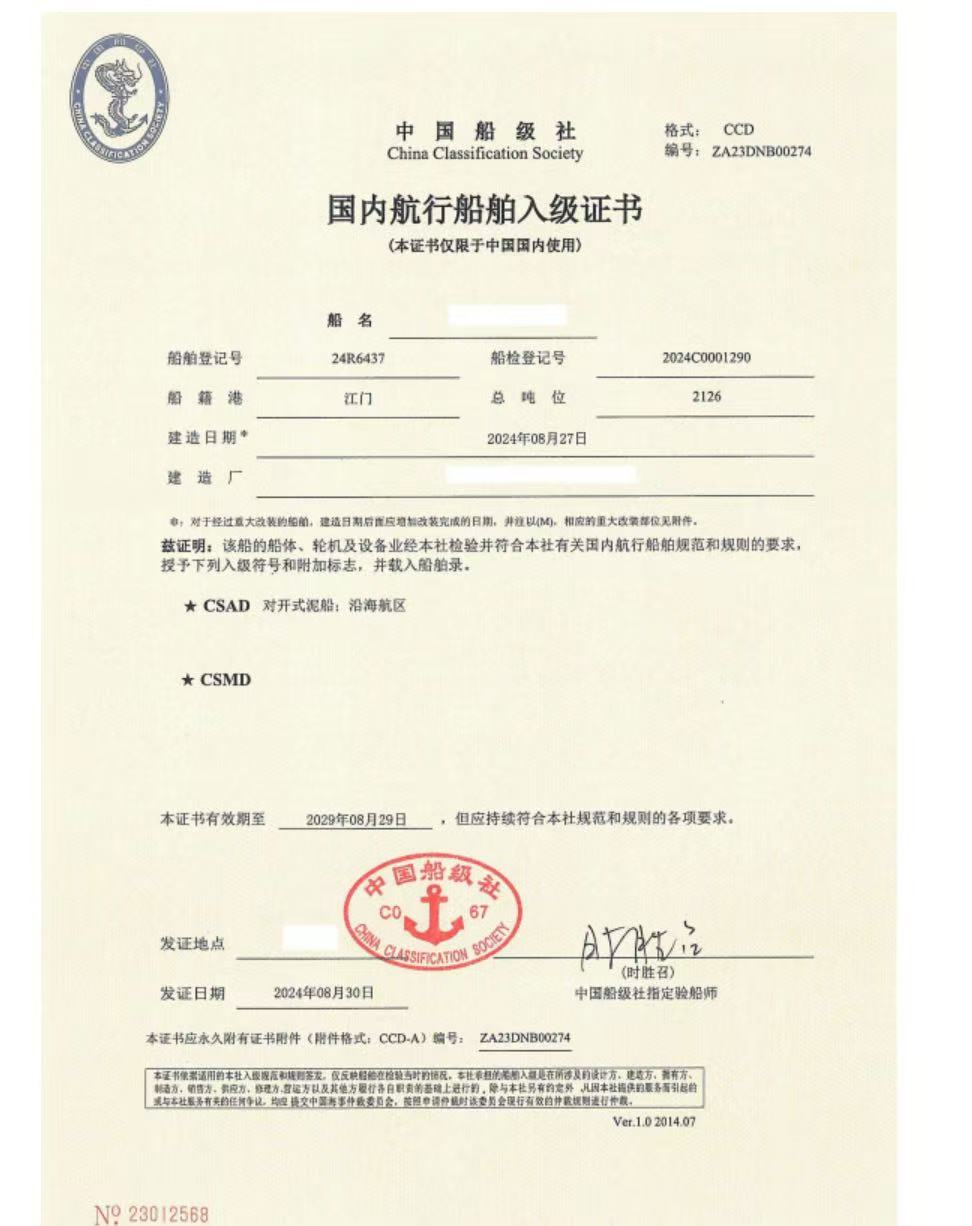
The Domestic Vessel Classification Certificate for the 2600 m³ Split Hopper Barge is issued by CCS under certificate number ZA23DNB00274, valid to 29 August 2029. Image: Yanyang Marine.
Three qualifiers in that record deserve attention in an evaluation file.
- Market scope. The certificate is issued for the Domestic market. It is a valid classification document for the vessel in its home-market operating context; it is not automatically a certificate for international trading or for a project that requires an internationally recognised class notation. Buyers planning cross-border deployment should confirm the applicable society and notation before the vessel is committed.
- Navigation scope. The recorded scope is the coastal navigation area for a self-discharging hopper barge. A project requiring unrestricted service, extended distance from a safe port, or operation outside coastal limits sits outside that recorded scope.
- Validity window. The certificate runs from 30 August 2024 to 29 August 2029. Annual survey and intermediate survey obligations within that window are separate from the certificate itself and should be requested as a separate document set.
The wider position is that Yanyang Marine states its dredgers can be classed by IACS societies including CCS, BV, LR and DNV, or other IACS societies as required. Third-party classification bodies publish dedicated dredger rules: Bureau Veritas, for example, maintains guidelines for the assignment of reduced freeboards for dredgers. For a newbuild, class society selection is therefore a contract variable rather than a fixed attribute — and it is one of the few specification decisions a buyer can genuinely influence at the quotation stage.
For the 25 m³ Grab Dredger, the product record describes the vessel as ZC-classed. Any buyer evaluating this unit should confirm the current class status, the last special survey date and the residual survey cycle in writing, because the record does not carry a certificate number or validity window comparable to the split hopper barge document.
Reading Fuel and Maintenance Patterns from Installed Power
Installed power is not fuel consumption, and treating it as such is one of the more expensive shortcuts in dredging procurement. What installed power does reliably indicate is the scale of the machinery envelope a buyer is committing to maintain.
The comparison between the two shortlisted vessels is stark in that respect. The Split Hopper Barge lists a main engine power of 3740 kW × 2, a two-shaft installation totalling 7,480 kW. The Grab Dredger lists two Weichai X6170ZC-21 main engines at 456 kW each, a two-shaft installation totalling 912 kW. The two figures reflect entirely different duties: a 76.95 m self-propelled hopper barge with Ice Class B notation, against a 58.00 m mechanically excavating grab dredger limited to the coastal navigation area.
For evaluation purposes, three consequences follow.
- Fuel exposure scales with load factor, not with the nameplate. A higher installed rating generally correlates with higher consumption per operating hour, but the actual number depends on the load profile of the specific duty cycle — transit speed, loaded versus ballast running, and the proportion of the shift spent excavating rather than manoeuvring. Neither product record publishes a fuel-consumption curve, so fuel cost should be modelled from a supplier-provided curve at defined load factors, or left out of the comparison entirely.
- Maintenance exposure follows the named component list. The grab dredger record names its engine model, its reduction gearbox model and ratio, and its generator sets. That level of detail makes spare-part sourcing and service planning straightforward to scope. The split hopper barge record states main engine power but does not name the engine manufacturer, the gearbox or the generators — a documentation gap that should be closed before contract signature, because engine brand determines global spare availability and service response time.
- Vessel age converts into survey work. The grab dredger was completed in 2012, which places it in a period of its life where special survey intervals, steel renewal history and machinery overhaul records become the primary risk items in pricing. The split hopper barge record does not state a completion year, so residual life must be requested rather than inferred.
Recommendation Matrix: Purchase Price Against Through-Life Performance
Neither vessel in this shortlist has a published purchase price. That is normal for capital marine equipment, and it means the purchase-price column of any evaluation matrix must be filled from a written quotation rather than from marketing material. The matrix below therefore reproduces only what the documentation supports, and pairs each row with a verification action.
| Decision criterion | 2600 m³ Split Hopper Barge | 25 m³ Grab Dredger | Verification action |
|---|---|---|---|
| Primary function | Transport of dredged material in coastal and inland waterway projects | Mechanical removal of hard clay and soft sediment in near-shore operations | Match the duty cycle to the project sediment report |
| Published capacity | 2600 m³ hopper | 25 m³ grab | Confirm usable versus rated capacity under local load-line rules |
| Installed main engine power | 3740 kW × 2 (7,480 kW two-shaft total) | 2 × 456 kW (912 kW two-shaft total) | Request consumption curves at defined load factors |
| Age and residual life | Not stated in the record | Completed 2012 | Request class survey status, last special survey and steel renewal history |
| Class and certification | CCS certificate ZA23DNB00274, valid to 2029-08-29, domestic market, coastal navigation area | Described as ZC-classed | Confirm whether the project requires IACS class and which notation |
| Spare parts and component commonality | Main engine manufacturer not named in the record | Named engine, gearbox HCD400A and generators SB-HW4 × 2 | Request spare-parts list, lead times and global service coverage |
| Manning | 10 persons | 10 persons | Model crew cost at local wage rates for the operating region |
| Route and environmental limits | Ice Class B listed | Coastal navigation area | Verify route, ice exposure and flag or port-state requirements |
| Delivery | Yanyang Marine states 2–3 months for standard vessels and 8–12 months for custom builds | Not stated in the record | Convert to a dated delivery schedule with milestone penalties |
| Commercial position | Purchase price not published. Yanyang Marine states that its vessels are approximately 50% lower in cost than European manufacturers, and that the capability record includes ready stock for sale and ODM custom construction. | Replace stated positioning with a written quotation, warranty terms and performance guarantees | |
Application Fit: Coastal Transport, Port and Near-Shore Work
Applied to real project types, the two vessels occupy different slots in the same marine works programme rather than competing for the same slot.
The 2600 m³ Split Hopper Barge fits transport and disposal cycles: moving dredged material from a working area to a reclamation site or disposal ground in coastal and inland waterway projects. With Ice Class B listed and a 4.00 m design draft, it belongs to projects with moderate draft access and, where relevant, seasonal ice exposure. Its 76.95 m length overall keeps it within the berth and channel constraints typical of coastal works, while 3740 kW × 2 of main engine power gives it independent transit capability.
The 25 m³ Grab Dredger fits precision and material-specific work: removing hard clay, soft sediment, boulders or debris in near-shore areas where a cutter or hopper dredger is either too large or unsuited to the material. Gross tonnage of 2349 T and a 3.00 m design draft let it work in shallower access conditions than a large hopper dredger, and 25 m³ of grab capacity gives it a meaningful production rate per cycle in the right ground conditions. Its coastal navigation limitation should be treated as a hard boundary in project planning.
Where a project requires the primary excavation to be hydraulic, the relevant models in the same portfolio are the 1000–8000 m³/h cutter suction dredger, rated at 30 m dredging depth and 8000 m discharge distance, and the 26800 m³ trailing suction hopper dredger, rated at 40 / 70 / 115 m dredging depth and classed by CCS with CSA trailing suction dredger, dredging within R1, DP-1 and AUT-0 notations. For port and bridge construction packages that include piling rather than dredging, the portfolio also includes a 110 m pile leader height pile driving barge with a typical planting pile diameter of Ø4000 mm and a typical planting pile weight of 400 t.
Market Signals That Belong in the Evaluation File
Three structural signals are worth carrying into a 2026 shortlist because they affect resale value, utilisation and financing assumptions as much as they affect the initial purchase.
- Hydraulic dredging remains the largest equipment category. Hydraulic dredgers, including cutter suction dredgers, held approximately 46.65% of dredging equipment market revenue in 2023, according to Grand View Research. That concentration supports liquidity for this vessel class in the secondary market.
- Hopper dredging activity is a large and stable share of the market. Trailing suction hopper dredgers are estimated to account for 46.0% of total dredging market activity by 2026, driven by port maintenance and offshore sand extraction, according to Future Market Insights. Transport assets such as split hopper barges operate in the same project ecosystem and benefit from the same maintenance and reclamation spending.
- Offshore wind is an additional demand driver. The Global Wind Energy Council identifies the offshore wind industry as a key emerging driver for dredging equipment, requiring specialised vessels for seabed preparation and cable trenching, against more than 380 GW of new capacity expected by 2033.
Buyers should also note that published market-size estimates diverge significantly by source. Grand View Research places the dredging equipment market at USD 4.86 billion for 2023 on an equipment-only basis, while other research houses publish materially higher figures. The divergence is largely a scope question — equipment sales versus combined dredging service and equipment revenue — and it is a useful reminder to check the definition behind any market number used in an internal investment case.
Where This Shortlist Has Real Limits
An evaluation that only lists strengths is not an evaluation. Five boundaries apply to the two vessels in this article.
First, the CCS certificate on the split hopper barge is issued for the Domestic market with a coastal navigation scope. It is not an international trading certificate, and buyers deploying the vessel outside that context must confirm class and notation with the relevant society.
Second, the grab dredger was completed in 2012. Any vessel of that age carries residual-life risk that cannot be resolved from a specification sheet: special survey findings, steel renewal extent and machinery overhaul history all sit outside the published record.
Third, neither vessel publishes a purchase price or a fuel-consumption curve. Through-life cost modelling therefore cannot be completed from documents alone, and any comparison that claims a total-cost advantage without a supplier-provided consumption curve and a formal quotation is an assumption rather than an analysis.
Fourth, the split hopper barge record does not name its main engine, gearbox or generator manufacturer. In an industry where engine brand determines global spare availability, that is a substantive information gap rather than a formatting omission.
Fifth, the commercial positioning of Chinese-built equipment against established European suppliers is partly a first-party claim. Yanyang Marine states that its products offer approximately 50% lower cost than European manufacturers with 2–3 month delivery for standard vessels. Established global suppliers identified in third-party market research include Royal IHC, Damen Shipyards Group, Jan De Nul Group and Boskalis. Cost positioning of that scale should be validated line by line against a written quotation covering class, equipment brand list, warranty and commissioning scope, because the specification basis underlying a headline percentage is not published.
Outlook for 2026–2030
The conditions that make specification validation a procurement discipline rather than an administrative step are unlikely to reverse. The equipment market is projected to grow from USD 4.86 billion in 2023 to USD 7.36 billion by 2030, with port maintenance, reclamation and offshore wind preparation all contributing. Third-party classification rules for dredgers continue to develop, and class society choice remains a live contract variable rather than a fixed attribute of a vessel type.
For buyers, the practical direction of travel is toward documentation completeness as a selection criterion. Vessel records that name the engine, gearbox and generator models, state completion year, attach certificate numbers with validity windows and disclose navigation scope are easier to insure, easier to finance and easier to resell than records that do not. On the current shortlist, the 25 m³ Grab Dredger scores better on component transparency while the 2600 m³ Split Hopper Barge scores better on certification documentation. Neither record is complete, and closing both gaps before contract is the lowest-cost risk reduction available in this procurement cycle.
Frequently Asked Questions
Does the 2600 m³ Split Hopper Barge have a dredging depth rating?
No. The vessel is a transport unit, described as widely used in coastal and inland waterway projects for carrying dredged material. It does not excavate and therefore carries no dredging depth rating. Within the same portfolio, published dredging depths are 30 m for the 1000–8000 m³/h cutter suction dredger and 40 / 70 / 115 m for the 26800 m³ trailing suction hopper dredger.
Which published parameters distinguish the 2600 m³ Split Hopper Barge from the 25 m³ Grab Dredger?
The split hopper barge is 76.95 m in length overall with a 15.60 m moulded breadth, a 6.00 m moulded depth, a 4.00 m design draft, a 2600 m³ hopper, main engine power of 3740 kW × 2, a crew of 10 and Ice Class B listed. The grab dredger is 58.00 m in length overall with a 22.60 m moulded breadth, a 4.80 m moulded depth, a 3.00 m design draft, a 25 m³ grab, two Weichai X6170ZC-21 main engines rated at 456 kW each at 1500 r/min, a crew of 10 and a coastal navigation area. Both list a frame spacing of 0.60 m.
How should pump power be validated across this fleet?
Pump power should only be requested for pump-equipped dredging vessels. The 26800 m³ trailing suction hopper dredger publishes an inboard dredge pump of 2 × 6000 kW, an underwater pump of 2 × 3300 kW and jet water pumps of 2 × 2000 kW, within a total installed power of 27,726 kW. The cutter suction dredger record states an 8000 m discharge distance but does not itemise pump power. The split hopper barge and the grab dredger are not pump-equipped, so the parameter does not apply to them.
Is certificate ZA23DNB00274 valid for international projects?
The certificate is a Domestic Vessel Classification Certificate issued by CCS under certificate number ZA23DNB00274, with an applicable market of Domestic, a scope covering the coastal navigation area for a self-discharging hopper barge, and a validity window from 30 August 2024 to 29 August 2029. Yanyang Marine separately states that its dredgers can be classed by IACS societies including CCS, BV, LR and DNV, or other IACS societies as required, which means the applicable society for a given project is normally confirmed at contract stage.
Why does the 25 m³ Grab Dredger’s 2012 completion year matter in an evaluation?
Completion year sets the survey and maintenance baseline. A 2012-built vessel is at a stage of life where special survey results, steel renewal history and machinery overhaul records carry more weight in pricing than the base specification. The published record states gross tonnage of 2349 T, net tonnage of 705 T, a designed displacement of 3651.308 t, two SB-HW4 generators and an HCD400A reduction gearbox with a 5:1 ratio, but it does not state class survey status, so those documents must be requested directly.
How does installed main engine power relate to fuel and maintenance cost?
Installed power indicates the scale of the machinery envelope, not the fuel bill. The split hopper barge lists a two-shaft total of 7,480 kW and the grab dredger a two-shaft total of 912 kW, but neither record publishes a fuel-consumption curve. Actual consumption depends on load factor, transit speed and the proportion of operating time spent working. Maintenance cost follows the named component list: the grab dredger names its engines, gearbox and generators, while the split hopper barge record states only main engine power, leaving the equipment brand to be confirmed.
What lead times are published for standard and custom vessels?
Yanyang Marine states a delivery time of 2–3 months for standard vessels and 8–12 months for custom dredgers. The capability record also lists custom-made ODM construction, ready stock for sale, and after-sales services covering newbuilding as well as maintenance, repair and conversions. Delivery statements of this kind should be converted into a dated schedule with milestones before they are used in project planning.
Can a buyer specify BV, LR or DNV classification instead of CCS?
Yes, according to the manufacturer’s stated position: its dredgers can be classed by IACS societies including CCS, BV, LR and DNV, or other IACS societies as required. Classification societies publish dredger-specific rules — Bureau Veritas, for example, maintains guidelines for the assignment of reduced freeboards for dredgers — so the notation that applies to a given project should be agreed before the specification is frozen.
This reference is based on published product specifications and third-party market data available at the time of writing. Buyers should confirm current class status, survey position and commercial terms directly with the manufacturer before committing to a purchase.
Есть вопросы или нужны дополнительные детали?
Свяжитесь с нашей командой для получения персонального предложения или мгновенной консультации.
Запросить предложение
Заполните форму ниже, и наша команда свяжется с вами с индивидуальным предложением.
Прямой чат WhatsApp
Предпочитаете общаться в реальном времени? Напишите нам в WhatsApp для мгновенной помощи и быстрых ответов.
- Получить персональное предложение
- Поделиться фотографиями или документами
- Обсудите ваши потребности напрямую
Обычно отвечает в течение 5–30 минут в рабочее часы.