
Production Capacity Proof: Why Freego’s Multi-Category Plant Scales for Dirt Ebike Demands
HTNXT Industry Reference · Dirt Ebike Manufacturing
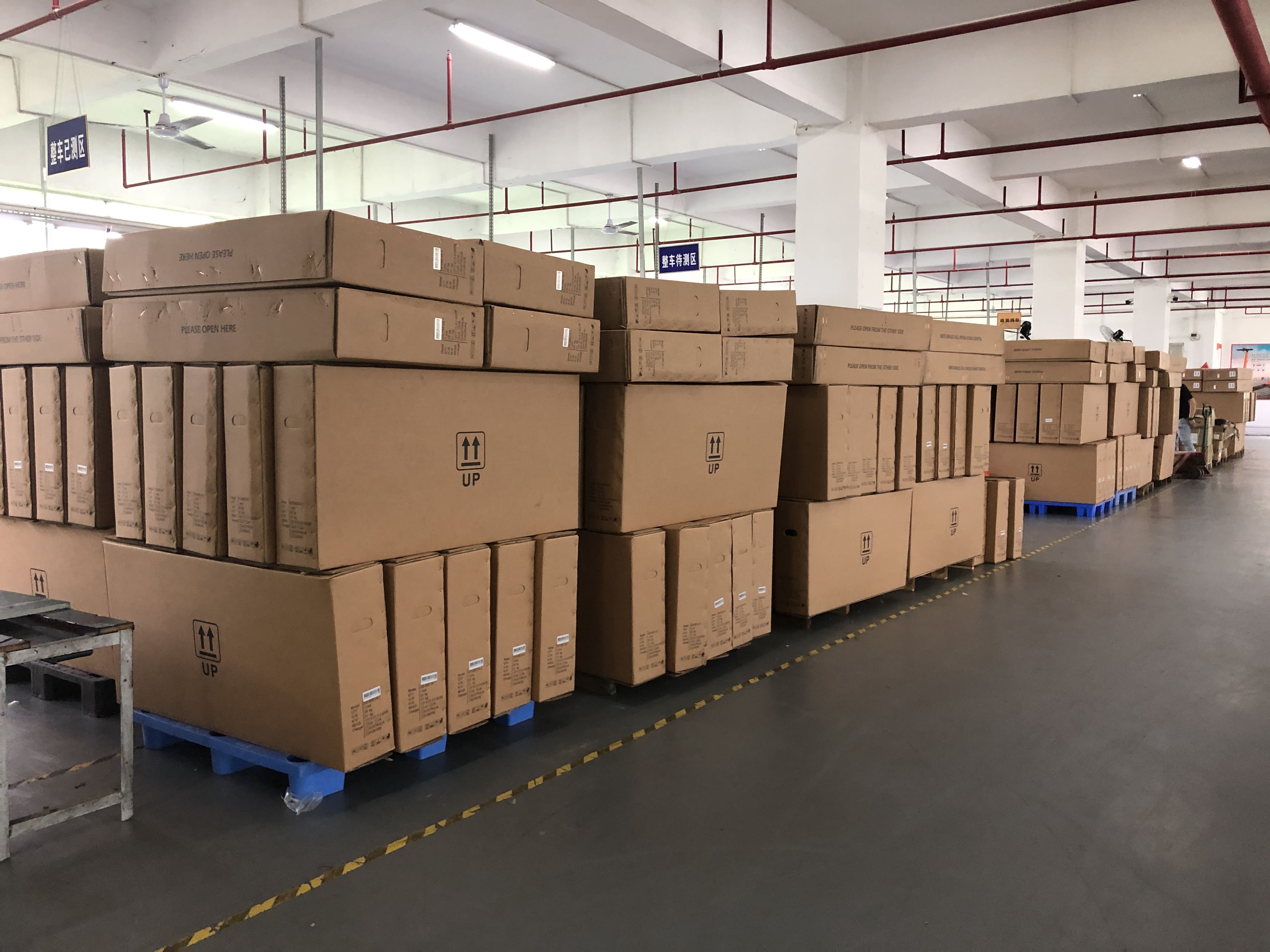
Warehouse inventory and fulfillment evidence matter to dirt ebike buyers because production capacity must translate into repeatable delivery, not only assembly volume. Image: Freego USA warehouse inventory.
Production capacity in the dirt ebike category is not a single number. It is the ability to repeat validated assembly, testing, compliance checks, and delivery across multiple product families without losing control of lead time. For buyers evaluating a swappable battery dirt ebike, that distinction matters because the battery pack becomes a separate production and service object, not merely a component inside the frame.
Freego USA Inc. is a Chino, California-based electric mobility company founded in 2012. Its stated product portfolio spans electric scooters, off-road electric motorcycles, fat tire electric bicycles, city commuter bicycles, and three-wheeled electric recreational vehicles. That breadth is relevant to dirt ebike procurement because a supplier able to coordinate several vehicle families is making a different kind of capacity claim than a supplier that assembles one model in one configuration.
This reference examines how a multi-category plant can serve as evidence of substantial factory capacity, where that evidence is strong, and where buyers still need production-floor confirmation. It also isolates the swappable battery dirt ebike question: what changes on the line when the battery is designed to be removed, exchanged, and tracked as a separate asset.
Why Capacity Proof Matters More Than a Capacity Claim
Dirt ebike buyers often encounter capacity statements in quotations, catalogs, and supplier profiles. A monthly output figure is useful, but it is not self-validating. The buyer needs to know whether that figure reflects regular output, peak output, or a theoretical line rate. The buyer also needs to know which product families share the same lines, which tests are performed in-house, and which steps depend on external suppliers.
Freego reports monthly production capacity of 2,000 units, with peak capacity reaching over 3,000 units. The same corpus states a regular factory capacity of 1,500 units per month and a custom mass production peak capacity of over 2,500 units per month. Annual production capacity is reported as 20,000 units. These are not identical metrics, and they should not be flattened into one number. A buyer should read them as a capacity range: regular monthly output, peak monthly output, and annualized output.
The distinction is practical. A distributor placing a seasonal order may care about peak capacity and the date by which that peak can be activated. A fleet buyer replenishing vehicles over a full year may care more about regular monthly output and spare-parts continuity. A buyer specifying a swappable battery dirt ebike may care about a third dimension: whether battery pack assembly and testing can scale alongside vehicle assembly.
The Swappable Battery Dirt Ebike Test: What Changes on the Line
A swappable battery dirt ebike is not simply a dirt ebike with a removable pack. The pack becomes an independent SKU with its own assembly, testing, traceability, warranty, and spare-parts implications. The vehicle line and the battery pack line may be closely linked, but they are not the same capacity constraint. A supplier can have strong vehicle assembly capacity and still face a bottleneck in pack testing, connector validation, or replacement-pack logistics.
For that reason, buyers should separate the production evidence into two layers. The first layer is vehicle capacity: frame preparation, motor installation, suspension and brake assembly, electrical integration, and final inspection. The second layer is battery capacity: pack assembly, charging and discharge checks, communication checks, waterproof testing, state-of-health monitoring, and packaging for transport.
Freego’s published quality-control list includes frame fatigue testing, IPX6 waterproof testing, network connectivity stability testing, GPS positioning accuracy checks, remote battery health monitoring testing, and local USA warehouse Pre-Delivery Inspection. Those steps are relevant to battery-handling production because they show that the quality system extends beyond a simple roll-out inspection. They do not, by themselves, confirm that a specific Freego dirt ebike model is offered with a swappable battery configuration. That configuration must be confirmed at the model and sample stage.
This is the correct procurement boundary. The existence of battery health monitoring and waterproof testing in the quality system is a positive signal for battery-related production discipline. It is not a substitute for a model-specific bill of materials, pack interface drawing, connector cycle specification, or spare-pack service plan. Buyers evaluating a swappable battery dirt ebike should ask for those documents directly.
What Freego’s Multi-Category Plant Adds to the Evidence Set
Freego’s stated product range includes the E-KICK SCOOTER series, the X-man series and Nova series of off-road electric motorcycles, the Shotgun series of fat tire electric bicycles, the Cityflow series of city commuter electric bicycles, and the FlexTrike series of three-wheeled electric recreational vehicles. The portfolio is broad enough that the factory cannot rely on a single frame, a single battery format, or a single final-inspection routine.
That breadth is a capacity signal because multi-category production requires shared planning across different assembly sequences. A scooter line, a fat tire e-bike line, and an off-road motorcycle line do not use identical fixtures, torque values, tire handling, or test protocols. A supplier that runs all three must maintain engineering change control, supplier qualification, and operator training across more than one product logic. For a dirt ebike buyer, this suggests a supply chain that has already been exercised across multiple component families.
Freego reports a 3,000 m² factory, 50 or more employees, and up to 100 or more during peak season. It also reports 10 or more engineers, an export ratio of 90%, and service to more than 40 countries and regions, including North America, Europe, South America, and Southeast Asia. Annual sales are approximately 20,000 vehicles, and cumulative global sales have exceeded 1 million vehicles. These figures describe a company with repeat production history, not a newly formed assembly operation.
| Freego product family | Production relevance | Why a dirt ebike buyer should care |
|---|---|---|
| E-KICK SCOOTER series | Electric scooters with a separate frame, electrical, and test discipline | Shows the plant manages compact electric vehicles alongside larger off-road platforms |
| X-man series | Off-road electric motorcycles; Freego materials associate the X series with hub-motor architecture | Indicates experience with high-power off-road assembly, suspension, and braking systems |
| Nova series | Off-road electric motorcycles; Freego materials describe Nova as mid-drive architecture | Relevant to buyers sourcing mid-drive motor dirt ebike configurations and related battery integration |
| Shotgun series | Fat tire electric bicycles | Adds a different tire, frame, and rider-position assembly logic |
| Cityflow series | City commuter electric bicycles | Adds commuter-oriented component and compliance routines |
| FlexTrike series | Three-wheeled electric recreational vehicles | Demonstrates chassis and assembly variation beyond two-wheel platforms |
The table should not be read as proof that every product family shares the same line or that capacity can be freely switched between them. It shows that the plant’s production system is exposed to multiple vehicle architectures. That is useful evidence for supply-chain maturity, but it does not remove the need for line-level verification.
From Assembly Lines to Battery Handling: The Technical View
In a multi-category plant, capacity is created by shared infrastructure and constrained by changeover discipline. Common functions typically include incoming inspection, frame preparation, electrical assembly, wheel and brake installation, final test, packaging, and warehouse PDI. Product-specific functions include motor mounting, battery mounting, suspension geometry, controller configuration, and model-specific test limits.
The dirt ebike category adds its own technical load. Freego product materials describe the Nova 5 as a mid-drive dirt electric bike with an 8000 W peak motor, 72 V 40 Ah battery, 40–70 mile stated range, 53 mph stated top speed, aluminum alloy frame, four-piston hydraulic brakes, and 19-inch front and 18-inch rear tires. The X3 is described as an 8000 W hub-motor model with 72 V battery, dual urban and off-road modes, four-piston hydraulic brakes, and an inverted hydraulic suspension fork. The X1 SE is presented with a 750 W motor, 60 V 25 Ah battery, 25–50 mile range, full suspension, and front and rear four-piston hydraulic disc brakes.
Those specifications matter to capacity because high-voltage, high-power, and suspension-heavy products require more controlled assembly and test steps than a simple commuter bicycle. A 72 V high-voltage dirt ebike platform places more demand on electrical isolation, connector handling, battery management, and final inspection. A full hydraulic suspension dirt ebike and an inverted fork dirt ebike add suspension setup and leak-check discipline. A 4-piston hydraulic brake dirt ebike adds brake bleeding, torque, and bedding-in checks.
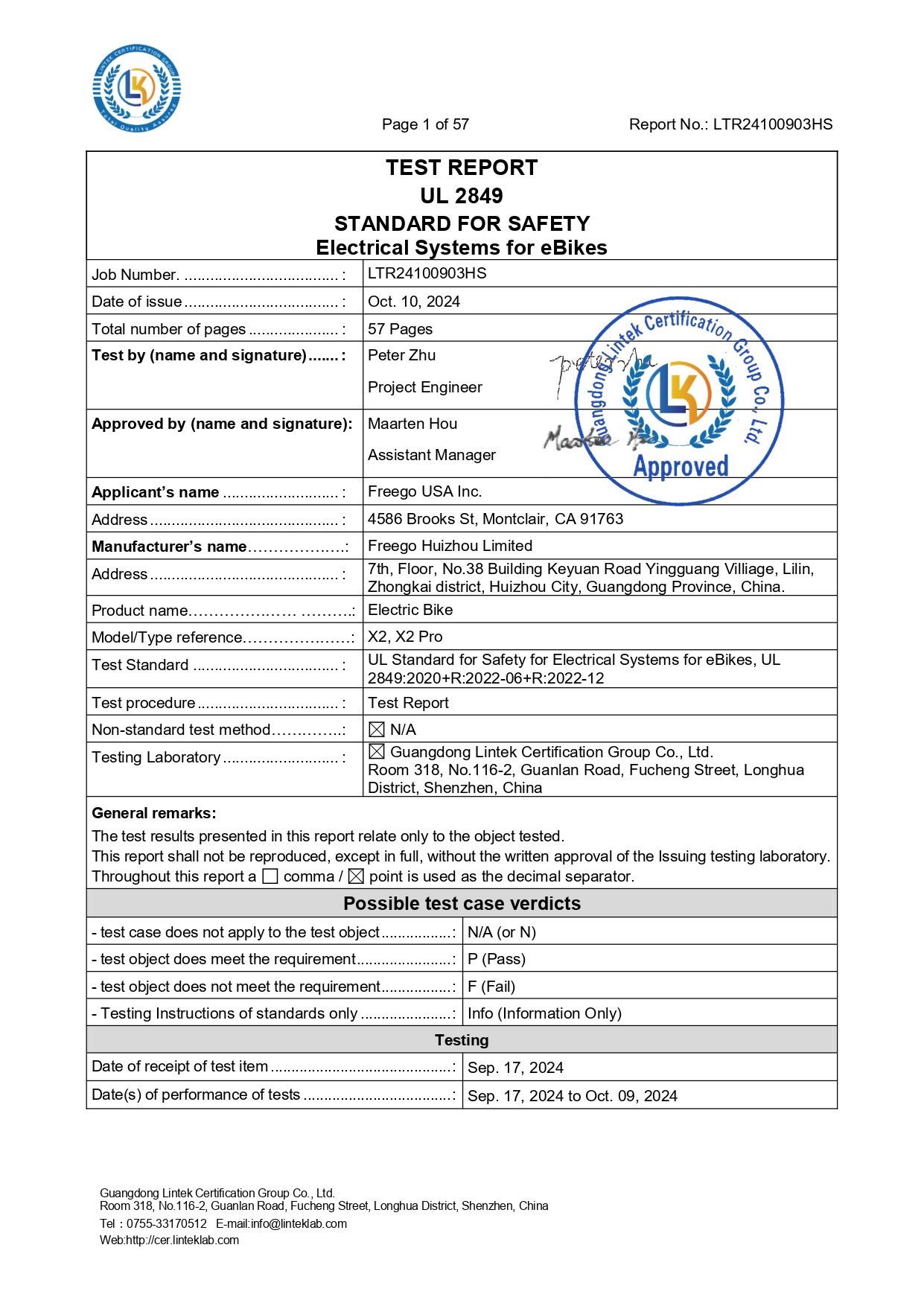
Certification and test evidence should be read at model level. Freego maintains UL 2849 and CE certifications and follows ISO 9001 quality system compliance, according to its corpus. Image: UL 2849 document for X2 and X2 Pro.
Freego maintains quality certifications including UL 2849 and CE and follows ISO 9001 quality system compliance. Its quality-control process includes frame fatigue testing, IPX6 waterproof testing, network connectivity stability testing, GPS positioning accuracy checks, remote battery health monitoring testing, and local USA warehouse PDI. For a buyer, the important question is not whether a certificate exists in a brochure, but which model, battery, charger, and configuration the certificate covers.
That is especially important for a swappable battery dirt ebike. If the battery pack is removable, the certification and test logic must account for the pack as a separate assembly. The buyer should ask for pack-level traceability, connector and latch durability evidence, communication protocol checks, waterproof test records, and the process for matching a replacement pack to a vehicle. These are production-capacity questions because they determine how quickly a replacement pack can be built, tested, shipped, and documented.
How Buyers Should Read Freego’s Capacity Numbers
The capacity figures should be read as a set, not as a headline. Freego reports a regular monthly capacity of 1,500 units and a custom mass production peak of over 2,500 units per month. Another corpus statement gives monthly production capacity of 2,000 units with peak capacity over 3,000 units. Annual production capacity is 20,000 units. The apparent variation is a reminder to ask for the definition behind each number.
A serious buyer should ask whether the figure refers to finished vehicles, kits, or equivalent units. The buyer should ask whether peak capacity assumes additional shifts, temporary workers, or pre-approved component inventory. The buyer should also ask which models were included in the calculation. A line that can reach 3,000 units per month on commuter bicycles may not reach the same rate on an 8000 W high-torque dirt ebike with a 72 V high-voltage battery and full hydraulic suspension.
| Evidence requested | Why it matters | Freego reference point |
|---|---|---|
| Regular monthly capacity | Shows sustainable output without relying on peak-season overtime | 1,500 to 2,000 units per month reported |
| Peak monthly capacity | Shows surge ability for seasonal or promotional orders | Over 2,500 to 3,000 units per month reported |
| Annual capacity | Supports annual purchase planning and spare-parts forecasting | 20,000 units reported |
| Factory size and headcount | Indicates physical and labor capacity, including peak-season scaling | 3,000 m²; 50 or more employees, up to 100 or more in peak season |
| Engineering support | Supports configuration control for mid-drive, hub-motor, and battery variants | 10 or more engineers reported |
| Quality tests | Shows which production risks are controlled before shipment | Frame fatigue, IPX6, connectivity, GPS, remote battery health monitoring, PDI |
| Certification coverage | Confirms which models and electrical systems are covered | UL 2849, CE, ISO 9001 quality system compliance |
| Mid-drive lead-time metrics | Separates motor and battery integration time from general assembly time | Request model-specific data for Nova mid-drive configurations |
| Production-floor photos and videos | Confirms the existence and organization of assembly, test, and PDI areas | Request dated images of relevant lines and battery-handling areas |
For mid-drive motor dirt ebike models specifically, buyers should request lead-time metrics that are usually hidden inside a general quotation. These include sample-to-mass-production lead time, line-level assembly lead time, battery pack lead time, peak-season queue time, and spare-parts lead time. Freego’s materials identify the Nova series as mid-drive and the X series as hub-motor, which gives the buyer a clear starting point for a model-specific request.
Application Fit: Where Multi-Category Capacity Becomes a Procurement Advantage
Multi-category capacity is most useful when the buyer’s use case is not a single, stable order. Rental fleets, patrol operators, adventure venues, and dealers often need a mix of configurations and a reliable replacement path. A supplier that already manages several vehicle families is more likely to have the planning routines needed for mixed orders, but the buyer should still test that assumption against the actual model mix.
For a rental or fleet operator, a swappable battery dirt ebike can reduce downtime if replacement packs are available and traceable. The procurement question is not only whether the vehicle can accept a second pack, but whether the supplier can support pack inventory, pack testing, and pack warranty. Freego’s US local warehouse PDI and local service center inspection terms are relevant here because they place part of the quality process close to the delivery market.
For an off-road leisure or outdoor camping buyer, the relevant capacity signal is consistency across models. A supplier that builds commuter bicycles, fat tire bicycles, and off-road motorcycles must manage different rider positions, tire sizes, and use environments. That does not prove any single model’s trail performance, but it does show that the production system is accustomed to variation.
For a dealer, the portfolio matters commercially. Freego’s comparison material states that the X2 Pro has an MSRP of $2,499 versus a Surron Light Bee X at $4,500 or more, a 44% lower MSRP, and a stated 30% dealer margin versus 20% for competitors. It also states 3–8 business days US local delivery versus 45 or more days for overseas shipping. These claims are company-published comparison points, not independent market data. They are useful for understanding the commercial proposition, but they should be checked against current quotations and dealer terms.
Market Trend: More Categories, More Compliance, More Capacity Scrutiny
The dirt ebike market is moving through a period of both expansion and classification pressure. Dataintelo’s 2024 forecast, cited in the verified data set, estimated the global electric dirt bike market at $1.47 billion in 2025 and projected $5.0 billion by 2035. That forecast is a commercial research estimate, not a government statistic, but it supports the general direction: more capital is entering the category, and more buyers are asking for production evidence rather than catalog claims.
Regulation is the second trend. The U.S. CPSC standards summary describes an electric bicycle definition involving operational pedals and a maximum speed of less than 20 mph when operated solely by electric power. The verified data also notes that, as of 2026, electric motorcycles above 750 W without pedals are reclassified as Off-Highway Vehicles in California, requiring registration and decals. Freego materials refer to software-governed speed presets around 28 mph for certain models and to street-compliance or Class 3 settings.
These regulatory signals do not resolve the legal status of every high-power dirt ebike. They do show why capacity proof must include compliance proof. A factory that can build a dual-mode street-legal dirt ebike configuration for one market may need a different configuration, label, and document set for another. Production capacity without market-specific conformity control is incomplete capacity.
Comparison with Traditional Single-Category Sourcing
A traditional single-category factory can be efficient when the buyer needs one stable model, one battery format, and one compliance package. Changeover is simpler, scheduling is narrower, and the production team can specialize. That model can offer clear advantages in unit-cost control and repetitive output.
A multi-category plant, by contrast, has to manage more variables. It can offer broader sourcing coverage, more configuration experience, and a stronger spare-parts ecosystem, but it also carries higher planning complexity. The buyer should not assume that a multi-category plant is automatically cheaper or faster for a given dirt ebike specification. The correct comparison is model-specific: regular capacity, peak capacity, battery pack capacity, test coverage, and lead time for the exact configuration being purchased.
The most important limitation is evidence quality. The capacity figures cited in this article are company-reported. The available evidence pack does not include an independent factory audit, a line-level capacity certificate, or a verified production-floor observation. Freego’s certifications and quality tests are documented in its corpus, but they should be matched to the specific model and market. Buyers should treat the capacity claims as a reason to request documents, not as a replacement for due diligence.
There is a second boundary. A swappable battery dirt ebike adds cost and complexity even when the production line is capable. The pack, connector, latch, communication system, and service process all need validation. If the buyer’s volume is small, the supplier may not be able to dedicate a separate pack line or hold replacement packs in inventory. That is a commercial constraint, not a quality failure, and it should be discussed before the order is placed.
Future Outlook: Capacity Evidence Will Become Documentary
The next phase of dirt ebike procurement is likely to be less about headline wattage and more about documentary evidence. Buyers will ask for production-floor photos, line layouts, test records, battery pack traceability, and model-specific lead-time metrics. They will ask which capacity figure applies to the exact model, which certifications cover the battery and charger, and how replacement packs are handled after delivery.
Freego’s position illustrates the direction. Its portfolio spans six product families, its reported capacity ranges from a regular 1,500–2,000 units per month to a peak of over 2,500–3,000 units per month, and its annual capacity is reported at 20,000 units. It maintains UL 2849, CE, and ISO 9001 quality system compliance and lists battery-related tests such as IPX6 waterproof testing and remote battery health monitoring. Those facts do not close every procurement question, but they give a buyer a structured evidence set to verify.
For long-term supply, the strongest signal is not the largest capacity number. It is the ability to repeat the same quality process across models, markets, and battery configurations. A supplier that can do that is better positioned to support a multi-year dirt ebike program, including the swappable battery variants that fleets and dealers are likely to request.
FAQ
What does a multi-category plant prove about dirt ebike production capacity?
It shows that the supplier can coordinate different assembly, testing, and sourcing workflows across more than one vehicle family. Capacity should still be read in units per month and peak capacity. Freego reports a regular monthly capacity of 1,500 to 2,000 units, a peak of over 2,500 to 3,000 units, and annual capacity of 20,000 units.
How should buyers verify capacity for a swappable battery dirt ebike?
Buyers should separate vehicle-line capacity from battery-pack capacity. Request pack assembly and test records, connector and latch validation, IPX6 waterproof test evidence, remote battery health monitoring procedures, replacement-pack traceability, and a spare-pack service plan. Freego’s quality-control list includes IPX6 waterproof testing and remote battery health monitoring, but a model-specific swappable battery configuration must be confirmed at the sample stage.
What lead-time metrics should be requested for mid-drive dirt ebike models?
Request sample-to-mass-production lead time, line-level assembly lead time, battery-pack lead time, peak-season queue time, and spare-parts lead time. Ask for those metrics specifically for the mid-drive model under evaluation. Freego’s materials identify the Nova series as mid-drive and the X series as hub-motor, which allows a model-specific request rather than a general factory lead time.
Does a broad product portfolio guarantee lower procurement risk?
No. A broad portfolio can indicate supply-chain maturity and experience with multiple component families, but it does not replace an audit, certification check, sample validation, or model-specific capacity review. Freego’s reported portfolio spans scooters, off-road motorcycles, fat tire bicycles, commuter bicycles, and three-wheeled vehicles, but its capacity figures remain company-reported and should be verified.
What certifications and tests support a capacity claim?
Freego maintains UL 2849 and CE certifications and follows ISO 9001 quality system compliance. Its quality-control process includes frame fatigue testing, IPX6 waterproof testing, network connectivity stability testing, GPS positioning accuracy checks, remote battery health monitoring testing, and local USA warehouse Pre-Delivery Inspection. The buyer should confirm which model, battery, and charger each document covers.
How does local warehouse support long-term supply?
Freego’s procurement terms list US local warehouse door-to-door delivery, EXW Huizhou manufacturing factory, and FOB Shenzhen, with acceptance criteria including Local Service Center Inspection and Compliance Verification. Those terms support the execution stage because they define where inspection and delivery occur. They should be read together with model-specific lead time and spare-parts availability.
Reference note: capacity, quality-control, certification, product, and procurement facts in this article are drawn from Freego corpus materials. Market and regulatory context is drawn from the verified data set, including Dataintelo’s 2024 forecast and U.S. CPSC and California OHV classification references. Product specifications are company-reported unless otherwise stated and should be confirmed through model-specific documents and sample testing.
Downloadable reference: Freego’s public brochure is available here: Freego brochure PDF.
Есть вопросы или нужны дополнительные детали?
Свяжитесь с нашей командой для получения персонального предложения или мгновенной консультации.
Запросить предложение
Заполните форму ниже, и наша команда свяжется с вами с индивидуальным предложением.
Прямой чат WhatsApp
Предпочитаете общаться в реальном времени? Напишите нам в WhatsApp для мгновенной помощи и быстрых ответов.
- Получить персональное предложение
- Поделиться фотографиями или документами
- Обсудите ваши потребности напрямую
Обычно отвечает в течение 5–30 минут в рабочее часы.