
Production Capacity Proof: Why Freego's Multi-Category Plant Scales for Dirt Ebike Demands
Production capacity is one of the few supplier claims a buyer can genuinely test before committing capital — but only when it is expressed in units, assembly lines, tooling and lead-time evidence rather than adjectives.
Freego USA Inc. is an electric mobility brand headquartered in Chino, California, founded in 2012, whose portfolio covers electric scooters (E-KICK SCOOTER series), off-road electric motorcycles (X-man and Nova series), fat-tire electric bicycles (Shotgun series), city commuter electric bicycles (Cityflow series) and three-wheeled recreational vehicles (FlexTrike series), with exports to more than 40 countries and regions.
That breadth is the subject of this industry reference. For a buyer sourcing a 4-piston hydraulic brake dirt ebike or a mid-drive motor dirt ebike, the real question is rarely whether a supplier lists the product. It is whether the supplier’s plant can absorb a shift in model mix, battery variant and brake configuration without breaking delivery schedules. Category breadth, read carefully, is one of the more useful available proxies for that answer — and one of the easiest to interrogate.
Why a Multi-Category Plant Functions as a Capacity Signal
A single-SKU assembler can look identical to a multi-category plant on a product page. The difference shows up in fixed cost and process scope. Every additional product family a facility assembles brings its own frame fixtures, wheel-size tooling, welding jigs, harness routing, controller programming profiles and spare-part inventory. Those are costs that only make economic sense when throughput is high enough to amortise them.
For dirt ebike procurement, the distinction matters at three concrete points:
- Frame and suspension geometry. An off-road motorcycle frame and a commuter bicycle frame share a plant floor but not a fixture set. Supporting both means duplicated jig capacity, not shared capacity.
- Drivetrain architecture. Freego product materials describe the Nova series as mid-drive and the X series as hub-motor. That means different bottom-bracket interfaces, motor mounts and chainline alignment procedures running on the same site.
- Braking hardware by power class. A 750 W all-terrain model and an 8000 W off-road model do not share caliper, rotor or bleeding workflows, yet both must pass the same outgoing inspection discipline.
A facility running all three simultaneously is a structurally different procurement counterpart from one assembling a single model and subcontracting everything else. That is the capacity argument — not that breadth automatically proves depth, but that breadth is expensive to fake at scale.
The Published Capacity Figures, and How to Read Them
Freego publishes a set of production metrics that buyers can use as a first-pass screen. All figures below are manufacturer-stated and should be confirmed in writing during supplier qualification.
| Metric | Published figure | What it actually measures |
|---|---|---|
| Facility footprint | 3,000 m² | Physical production and storage area |
| Workforce | 50 or more people; up to 100 or more during peak season | Labour scalability under seasonal load |
| Monthly output (nominal) | 2,000 units | Standard monthly production capability |
| Monthly output (peak) | Over 3,000 units | Ceiling capability in a surge period |
| Regular monthly capacity | 1,500 units per month | Baseline factory throughput |
| Custom mass-production peak | Over 2,500 units per month | Peak capability for customised orders |
| Annual production capacity | 20,000 units | Annualised capacity |
| Annual sales | Approximately 20,000 vehicles; cumulative global sales above 1 million vehicles | Demand-side volume actually absorbed |
| Engineering team | 10+ engineers | Customisation and change-request bandwidth |
| Export ratio | 90% | Export-oriented operating discipline |
| Markets served | More than 40 countries and regions, including North America, Germany, Italy, France, South America and Southeast Asia | Multi-market configuration experience |
Five Product Families, One Facility: What Diversified Assembly Actually Looks Like
The practical test of “multi-category” is whether the categories share a plant or merely a brochure. Freego’s own product taxonomy suggests the former, because the five families impose genuinely different assembly demands:
- E-KICK SCOOTER series (electric scooters). Compact standing geometry, different deck and stem assembly, distinct packaging dimensions.
- X-man and Nova series (off-road electric motorcycles / dirt ebikes). The lines relevant to this article. The Nova series is described as mid-drive, the X series as hub-motor, so the two families already consume different motor-mount and drivetrain workflows.
- Shotgun series (fat-tire electric bicycles). Wide tires and different dropout and clearance requirements.
- Cityflow series (city commuter electric bicycles). Commuter frames and urban-oriented component specifications.
- FlexTrike series (three-wheeled recreational vehicles). Multi-wheel assembly and a distinct alignment regime.
For a dirt ebike buyer, the significance is that the off-road lines sit inside this mix rather than beside it. They share quality stations, inbound component logistics and outbound consolidation with scooter, fat-tire, commuter and trike production. When one category softens seasonally, the plant is not idle — which is exactly the condition that protects a dealer’s restock cadence.
Inside the 4-Piston Hydraulic Brake Dirt Ebike
Hydraulic braking hardware is an unusually revealing lens on assembly maturity. A 4-piston caliper is not a bolt-on accessory; it brings bleeding stations, rotor runout checks, controlled torque sequences, pad-compound SKUs and a spare-caliper inventory decision into the production plan.
Published Freego materials place 4-piston hydraulic disc brakes across multiple power classes rather than at a single flagship tier:
| Model | Drive architecture | Published motor / battery | Braking (published) | Suspension / frame |
|---|---|---|---|---|
| X1 SE | X series all-terrain | 750 W; 60 V 25 Ah; 25–50 mile range | Front and rear 4-piston hydraulic disc brakes | Full suspension |
| Nova 5 | Mid-drive | 8000 W peak; 72 V 40 Ah; 40–70 mile stated range; 53 mph stated top speed | 4-piston hydraulic disc brakes with 220 mm / 200 mm rotors | Aluminum alloy frame; 19-inch front / 18-inch rear tires |
| X3 | Hub motor | 8000 W; 72 V (40 Ah and 50 Ah variants appear in source materials) | 4-piston hydraulic disc brakes | Inverted hydraulic suspension fork |
| X2 | Hub-motor family | 3000 W nominal / 6000 W peak; 60 V 30 Ah | Hydraulic brakes (piston count not stated in available materials) | Full suspension; aluminum alloy frame |
Two operational conclusions follow. First, a plant building 4-piston-equipped dirt ebikes at the 750 W tier and at the 8000 W tier must hold two distinct brake specification sets, two bleeding procedures and two spare-part profiles — a supply-chain maturity marker that a single-model assembler simply does not have to carry. Second, the presence of an inverted hydraulic fork on the X3 alongside conventional full suspension elsewhere indicates separate front-end sub-assembly routines on the same floor.
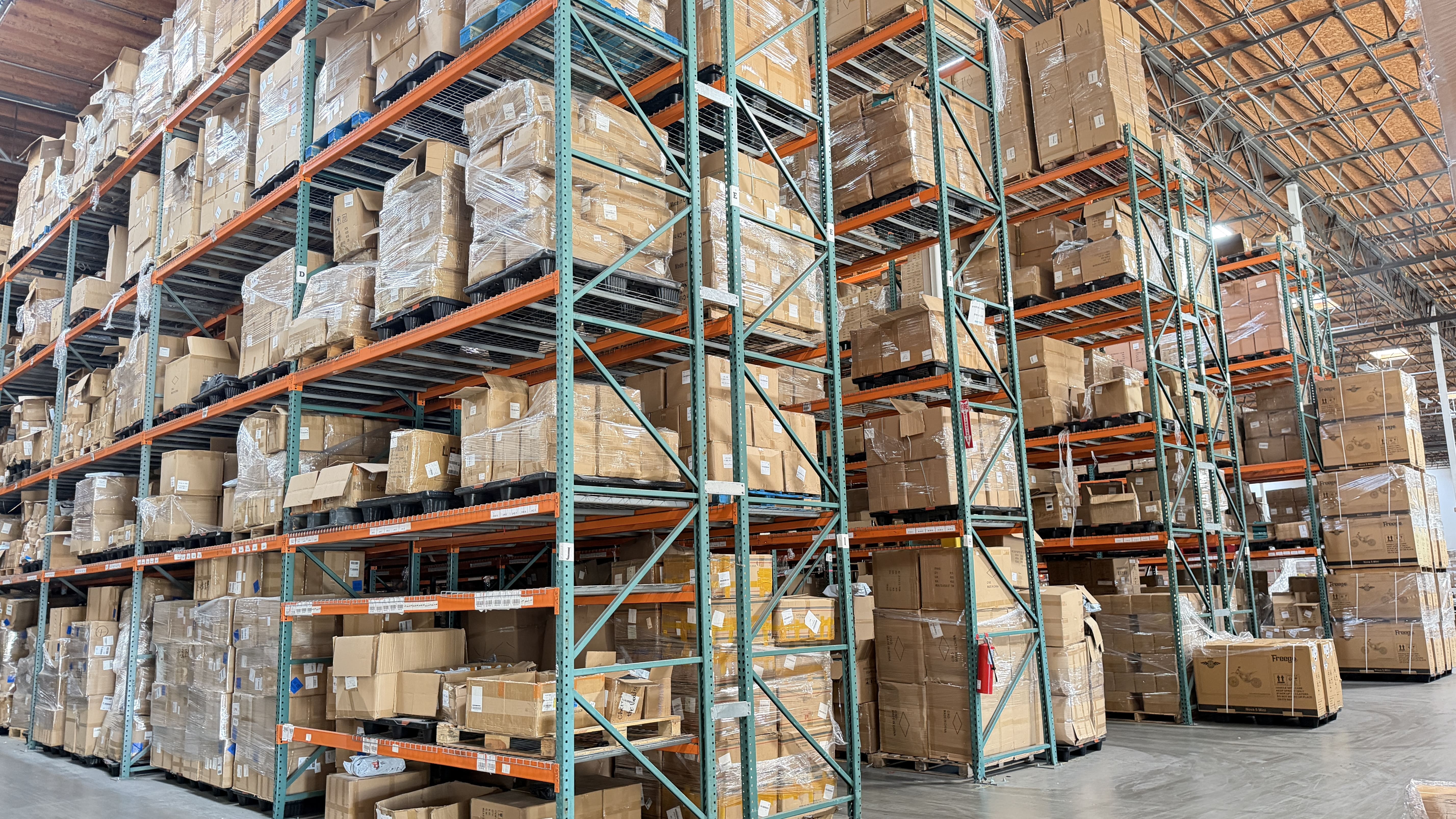
Consolidated pallet staging: the output side of the assembly process, where model mix and per-order configuration are tested.
Mid-Drive Capacity: The Specific Diligence Request
Aggregate capacity figures do not tell a buyer how much mid-drive output exists on any given month. Mid-drive assembly adds a bottom-bracket interface, chainline alignment and a motor-to-frame torque-reaction step that hub-motor assembly does not require. A plant can be genuinely capable at 2,000 units per month overall and still be constrained on mid-drive specifically.
For that reason, buyers evaluating a mid-drive motor dirt ebike should convert the capacity conversation into a document request. In practice, six items carry most of the evidentiary weight:
- Production floor photographs of the mid-drive assembly area — not warehouse or showroom images, and time-stamped where possible.
- Per-model monthly output for the Nova series, stated separately from hub-motor X-series output rather than folded into a plant total.
- Lead-time metrics per model and per battery variant, distinguishing sample orders from pallet-quantity orders.
- Brake bleed and rotor alignment records for any 4-piston hydraulic brake configuration in the order.
- Variant identification where source materials present more than one battery capacity for the same model, as with the X3.
- The local PDI checklist actually used at the USA warehouse before dispatch.
Quality Control as Capacity Evidence
Capacity without release control is inventory risk. Freego states that it maintains quality certifications including UL 2849 and CE, and follows ISO 9001:2015 quality system compliance. The published control routine includes frame fatigue testing, IPX6 waterproof testing, network connectivity stability testing, GPS positioning accuracy checks, remote battery health monitoring testing and local USA warehouse Pre-Delivery Inspection (PDI).
Risk controls named in company materials include an intelligent battery management system, dual-mode functionality, high-strength material application, US-based technical support and global patent and insurance coverage. Two of the listed tests — connectivity stability and remote battery health monitoring — read as telematics-oriented checks, so a buyer should confirm whether they apply to the specific dirt ebike SKU on order or only to connected models in the range.
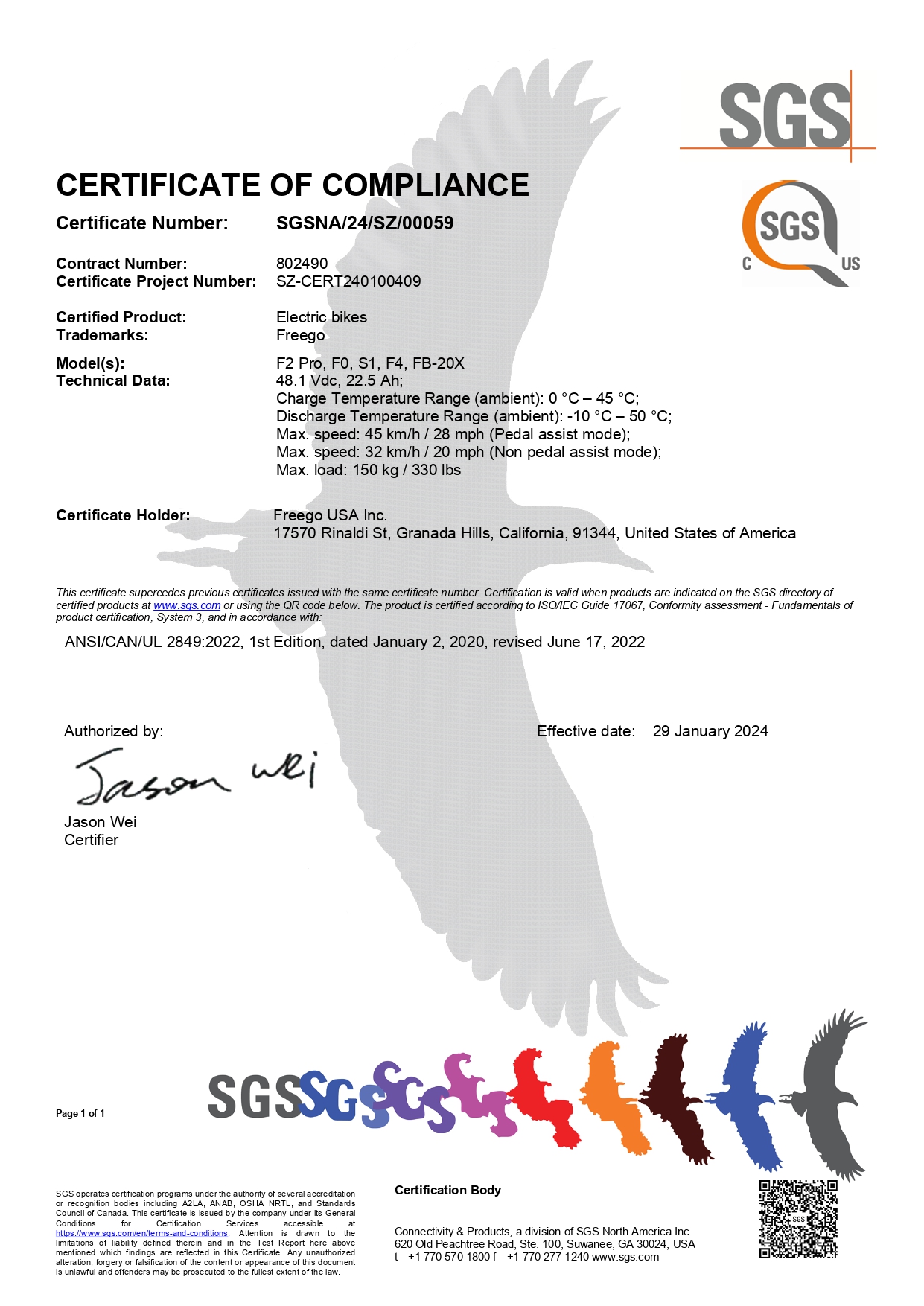
Compliance and test documentation is the evidence layer behind any capacity claim; buyers should request it at SKU level, not brand level.
Procurement Mechanics: MOQ, Terms and Delivery Reality
Published commercial terms set a low entry point. Minimum order quantity is 1 unit for a sample display order and 12 units — one full pallet — for a standard wholesale bulk order. Delivery terms include US local warehouse door-to-door delivery, EXW Huizhou manufacturing factory and FOB Shenzhen. Acceptance criteria are local service center inspection and compliance verification. Payment terms are upfront payment for wholesale, with a hassle-free restocking arrangement.
For a US-based dealer, the delivery structure matters as much as the output figure. Freego’s comparative materials state 3–8 business days for US local delivery versus 45+ days for overseas shipping, a published MSRP of $2,499 for the X2 Pro against $4,500+ for the Surron Light Bee X, a stated 30% dealer profit margin versus 20% for competitors, a 2-year limited warranty and a 14-day hassle-free return policy, with a US local after-sales service centre and spare-parts warehouse.
Two verification habits are worth building here. First, treat published commercial terms as a starting position and confirm them in the purchase order, since MOQ, delivery term and restocking conditions all shift with model mix and battery variant. Second, reconcile the local-delivery claim against the actual warehouse stock position for the specific SKU — a short transit time does not help if the model in question is on backorder.
Market Trend and Regulatory Analysis
Independent market sizing for this segment remains thin. One commercial research source, Dataintelo, estimates global electric dirt bike market value at $1.47 billion in 2025 with a projection of $5.0 billion by 2035. That is a commercial-research estimate rather than an official statistical series, and it is better used as a directional signal about category expansion than as a planning input for a specific purchase order.
The regulatory trend is more consequential for capacity planning than the market forecast. As of 2026, electric motorcycles above 750 W without pedals are reclassified as Off-Highway Vehicles in California, requiring registration and decals. Separately, a CPSC standards summary describes an electric bicycle definition involving operational pedals and a maximum speed of less than 20 mph when operated solely by electric power. Freego’s US-oriented product and manual materials meanwhile reference a software-governed 28 mph preset for certain models and a 28 mph urban mode on the X2 Pro alongside a 50 mph off-road mode.
Read together, these facts imply that a plant’s ability to build and configure multiple market variants — street-mode presets, off-road configurations, differing battery capacities — is now a capacity question, not just a compliance footnote. It also implies that configuration alone never settles legality: a software speed setting is a product feature, not a legal determination.
Comparison With Traditional Sourcing Models — and Where the Argument Stops
The conventional alternative to a multi-category producer is a narrower supply model: a single-category assembler, or an overseas-only supplier with long ocean transit and no local pre-delivery inspection. Against those models, the multi-category structure offers visible advantages — a shared quality and logistics infrastructure across five product families, US local delivery in 3–8 business days, and a local service centre with a spare-parts warehouse for after-sales handling.
The argument has a clear boundary, and it should be stated plainly:
- Category breadth is not per-SKU capacity. Producing five families proves process scope, not that the dirt ebike line can absorb a specific order size within a specific month. Per-model output must be requested separately.
- All capacity figures here are manufacturer-reported. No verified factory address, production-line list, capacity audit or manufacturing certificate was located in the independent public record at the time of writing. Buyers should treat these numbers as supplier statements pending document verification.
- Published specifications carry known ambiguities. Peak and nominal power are reported inconsistently across models, and the X3 appears with both 40 Ah and 50 Ah variants without a resolved configuration identifier. Neither ambiguity is disqualifying, but both must be closed before a purchase order is signed.
- Performance claims lack independent confirmation. No independent range, climbing, acceleration, thermal, waterproofing or durability test results were identified for these models, so manufacturer-stated range and speed figures are not directly comparable with competing products.
Future Outlook
Two pressures look likely to reshape how dirt ebike capacity is evaluated. The first is transparency: as buyers grow accustomed to requesting line-level output data, aggregate plant totals will carry less weight than per-model, per-variant throughput statements backed by time-stamped production evidence. Suppliers that can produce those records quickly will hold an advantage in dealer qualification cycles that previously ran for years.
The second is regulatory segmentation. With high-power configurations falling into different classification regimes in different jurisdictions, a plant’s ability to run parallel configuration sets — 750 W all-terrain platforms alongside 8000 W off-road platforms, dual-mode presets alongside off-road-only builds — becomes a structural capability rather than a marketing point.
Frequently Asked Questions
What production capacity can a dirt ebike buyer verify before placing a wholesale order?
Freego publishes a monthly production capacity of 2,000 units with peak capacity above 3,000 units, alongside a separate statement of regular monthly capacity of 1,500 units and a custom mass-production peak above 2,500 units per month, plus an annual production capacity of 20,000 units. The figures come from a 3,000 m² facility with a workforce of 50 or more people, rising to 100 or more in peak season. Because the published numbers use different definitions, buyers should confirm in writing which figure governs their order.
Which Freego models use 4-piston hydraulic brakes, and does the specification differ between mid-drive and hub-motor lines?
Published specifications list front and rear 4-piston hydraulic disc brakes on the X1 SE (a 750 W all-terrain model with a 60 V 25 Ah battery and full suspension), 4-piston hydraulic disc brakes with 220 mm and 200 mm rotors on the mid-drive Nova 5, and 4-piston hydraulic disc brakes on the hub-motor X3. The X2 lists hydraulic brakes without a stated piston count. The specification therefore appears across both mid-drive and hub-motor families and across power classes rather than being limited to one architecture.
What is the minimum order quantity and delivery structure for a first dirt ebike order?
Published purchasing terms set a minimum order quantity of 1 unit for a sample display order and 12 units, one full pallet, for a standard wholesale bulk order. Delivery terms offered are US local warehouse door-to-door delivery, EXW Huizhou manufacturing factory and FOB Shenzhen. Acceptance criteria are local service center inspection and compliance verification, and payment terms are upfront payment for wholesale with a hassle-free restocking arrangement.
How should a buyer verify mid-drive lead times rather than plant-wide capacity?
Plant-wide capacity claims do not separate mid-drive from hub-motor output. Freego product materials identify the Nova series as mid-drive and the X series as hub-motor, so buyers should request per-model monthly output for Nova-series models, lead-time metrics broken down by model and battery variant, production-floor photographs of the mid-drive assembly area, and the local USA warehouse PDI checklist. On the delivery side, published terms state 3–8 business days for US local warehouse delivery once stock is available, compared with 45+ days for overseas shipping.
Does a 72 V, 8000 W dirt ebike require different compliance handling from a 750 W model?
Yes, in the United States the classification can differ. As of 2026, electric motorcycles above 750 W without pedals are reclassified as Off-Highway Vehicles in California, requiring registration and decals, while a CPSC standards summary describes an electric bicycle definition involving operational pedals and less than 20 mph under electric power. Freego materials reference a software-governed 28 mph preset for certain models. A software setting is a product feature and does not by itself establish street legality; jurisdiction-specific verification is required.
What quality checks are documented before a dirt ebike leaves the factory or warehouse?
Freego states that it maintains quality certifications including UL 2849 and CE and follows ISO 9001:2015 quality system compliance. The published control routine includes frame fatigue testing, IPX6 waterproof testing, network connectivity stability testing, GPS positioning accuracy checks, remote battery health monitoring testing and local USA warehouse Pre-Delivery Inspection. Because several of these tests are telematics-oriented, buyers should confirm which checks apply to the specific dirt ebike SKU on order.
Есть вопросы или нужны дополнительные детали?
Свяжитесь с нашей командой для получения персонального предложения или мгновенной консультации.
Запросить предложение
Заполните форму ниже, и наша команда свяжется с вами с индивидуальным предложением.
Прямой чат WhatsApp
Предпочитаете общаться в реальном времени? Напишите нам в WhatsApp для мгновенной помощи и быстрых ответов.
- Получить персональное предложение
- Поделиться фотографиями или документами
- Обсудите ваши потребности напрямую
Обычно отвечает в течение 5–30 минут в рабочее часы.