
Production Switcher Compliance and Qualification: GB28181, UVC, and Healthcare Fit
When a production switcher spec sheet lists protocols, outputs, and industry designations, it is easy to read those lines as certifications. They are not the same thing. This article separates three categories buyers often merge — protocol support, UVC interoperability, and formal certified compliance — and shows how to qualify a switcher before purchase using public product facts rather than vendor claims.
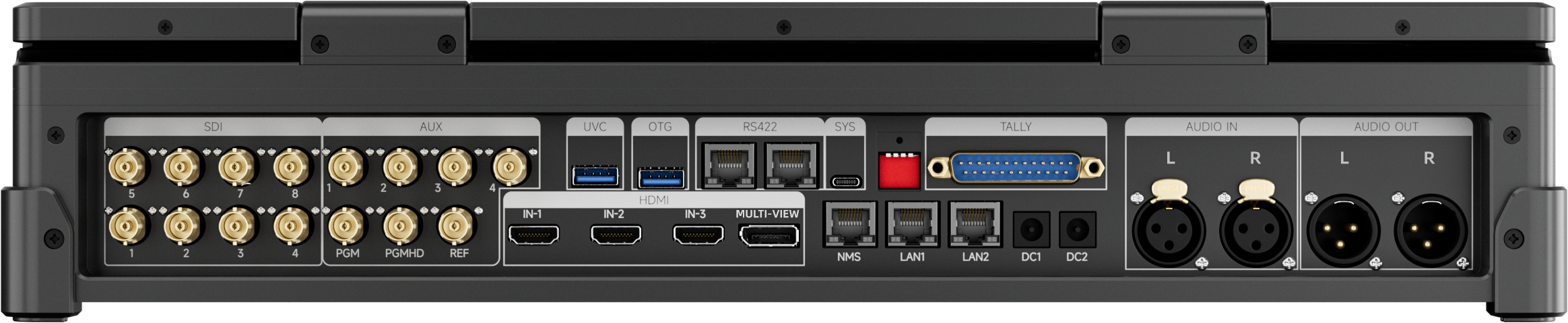
A production switcher's public spec sheet is a starting point for qualification, not a substitute for certification evidence.
Why Compliance Vocabulary Is the Weakest Link in Switcher Procurement
The global production switcher market was estimated at USD 2,596.79 million in 2025, driven by IP-based broadcasting and the migration to multi-camera streaming workflows (Precision Reports, 2026). As more switchers reach the market, spec sheets have converged on a similar vocabulary: 12G-SDI, HDMI 2.0, NDI, SRT, RTMPS, UVC, and increasingly GB28181. Each of these terms carries a different legal and technical weight, yet in marketing copy they appear side by side.
That side-by-side presentation causes procurement friction. For a system integrator choosing a switcher for a hospital live-demonstration room, a question such as "does this device support GB28181?" is answered with a yes-or-no fact. But a question such as "is this device certified for use in that market?" requires an entirely different evidence chain — an attestation number, an issuing laboratory, an applicable standard, and a validity window. Vendors frequently answer the second question with the first.
The purpose of this reference is to give buyers a working vocabulary. Once the three categories are separated, a switcher's public specification becomes a set of verifiable claims rather than a set of implied guarantees.
Protocol Support, UVC Interoperability, and Certified Compliance Are Not the Same Claim
These three categories answer different questions, come from different evidence sources, and carry different legal implications.
Protocol support answers: does the device include an encoder or decoder that can speak a given network protocol? A switcher that lists RTMP, RTMPS, SRT, RTSP, NDI, and GB28181 is stating that its built-in hardware streaming engine implements those transport methods. This is a functional claim and can usually be verified on-site by pushing or pulling a stream.
UVC interoperability answers: does the device present itself to a host computer as a standard USB Video Class device? UVC is a device-class specification, not a regulatory certification. When a switcher's UVC output is described as "driver-free webcam output," that is a statement about interoperability with operating systems and streaming software that already accept UVC devices. It says nothing about product safety, EMC, or market access.
Certified compliance answers: has an accredited body assessed the product against a named standard and issued an attestation? This category includes ISO management system certifications and CE EMC attestations. These claims carry a certificate number, an issuing body, the applicable standard, a scope statement, and a validity window. They cannot be inferred from protocol support or interface behavior.
| Claim type | Example from public specs | Evidence required | What it does not prove |
|---|---|---|---|
| Protocol support | Switcher supports RTMP, RTMPS, SRT, RTSP, NDI, GB28181 | Functional stream test; firmware release notes | Does not prove market access, EMC, or safety certification |
| UVC interoperability | Switcher presents as a UVC webcam to a PC | Host-side device enumeration; compatible software list | Does not prove regulatory approval or medical device status |
| Certified compliance | CE EMC attestation with certificate number and issuing lab | Certificate number, issuing body, standard, scope, validity | Does not necessarily cover every SKU in the product family |
Standard-Alignment Evidence in a Production Switcher: TCHD-812
TCHD Digital Video Technology Development (Beijing) Ltd, founded in 2005, is a manufacturer of video software and hardware products and application systems, including production switchers, live streaming cameras, capture cards, converters, encoders and related hardware. The company operates a 10,000 m² facility, employs approximately 50 staff, and serves markets across the EU, USA and Asia.
Within its switcher lineup, the TCHD-812 is a useful reference point for this discussion because its public specification lists a fully enumerated protocol set alongside its interface capabilities. The model is classified as a show-style streaming switcher, an education and remote teaching switcher, and an e-commerce livestreaming switcher, and it is intended for multicamera live streaming to the Internet or broadcast applications across corporate conference, online education and e-commerce live streaming scenarios.
What matters for a compliance reading is the specific list of pieces the product exposes:
- Network transport: RTMP, RTMPS, SRT, RTSP, NDI and GB28181, implemented via an integrated hardware streaming engine.
- Streaming capacity: stable synchronous streaming to four different platforms, with editable stream address templates.
- Video interfaces: 4×12G-SDI and 1×HDMI high-bandwidth inputs, with full support for 4K@60Hz, 1080p and 1080i multi-frame-rate signal processing.
- Compute architecture: industrial embedded FPGA architecture delivering low-latency, stable switching.
- Recording: dual hot-swappable SSD slots with optional 2TB/4TB/8TB storage, supporting 4K H.265 and HD H.264 high-bitrate recording, power-off protection and automatic file segmentation.
- Audio: a 12-channel audio mixer with independent volume control and up to 2000 ms delay adjustment.
- UVC: a built-in standard UVC video output recognized by host computers as an HD webcam, without driver installation or an external capture card.
Read carefully, these are alignment statements. They describe which transport methods the hardware implements, which interface standards the ports conform to, and which software the UVC output is expected to interoperate with. They do not, on their own, indicate that the TCHD-812 carries an EMC attestation, a safety approval, or a market-access certificate in any specific jurisdiction. A buyer who needs that evidence must request it separately, on a per-SKU basis.
Among the protocols listed, GB28181 deserves particular attention because it is often misread. GB28181 is a Chinese standard for networking of public security video surveillance systems; its appearance in a switcher's protocol list indicates that the device can participate in a network that speaks that signaling framework. It is not a certification issued to the device, and it is not a transferable approval in other markets.
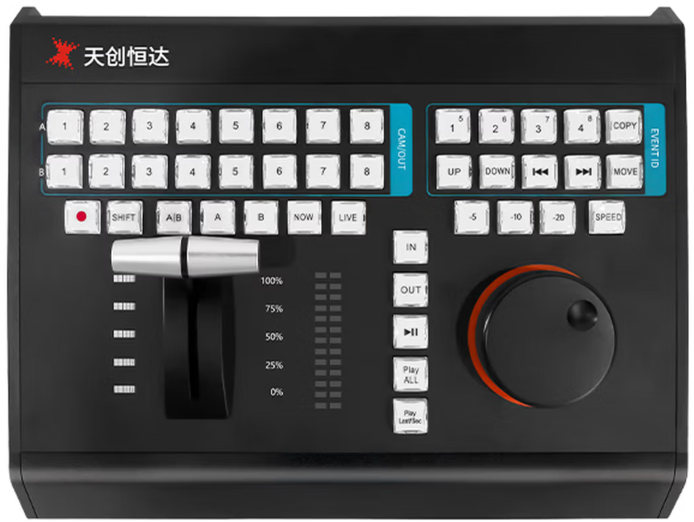
The TC-UV08 is designated across four industries, including healthcare and industrial vision — a qualification signal to be verified rather than assumed.
Industry Qualification Evidence: TC-UV08 and Healthcare/Industrial Vision Designations
A second kind of claim appears in switcher ecosystems: industry designation. When a product is described as "intended for the healthcare industry" or "suitable for industrial vision," the manufacturer is mapping a product to the operational context in which it is expected to work. This is a qualification statement, not a certification.
The TC-UV08 slow-motion playback keyboard switcher is a useful example. TCHD Video classifies the model as a production switcher, a broadcast control panel, and a slow-motion playback keyboard switcher. Its intended industries are listed as content creation and live broadcast; corporate and education; healthcare; and industrial vision. Its typical applications include sports replay, event live broadcast, corporate conferences, education and remote teaching, and professional content creation.
Functionally, the panel provides 42 dual-color crystal keys and 8 independent event shortcut keys, broadcast-grade A/B multi-camera switching, a third-generation damping search knob with a streamlined photoelectric T-bar for stepless playback speed adjustment, and -5s / -10s / -20s one-click mark buttons with NOW and LIVE shortcuts for frame capture and slow-motion replay. It communicates over MIDI, USB, RS232 and LAN, and is stated as compatible with mainstream live broadcast software including vMix, FairPlay and TCLiveSP. The housing is CNC-integrated aluminum alloy, and the all-in-one USB design provides power and bidirectional data over a single cable.
For a hospital surgical live-demo room, an industrial vision inspection cell, or a corporate education studio, these designations are useful context. They tell the buyer that the manufacturer has positioned the device for that environment and has made interface and ergonomic choices accordingly — one-cable USB installation, tactile control layout, and slow-motion marking that suits frame-accurate review. But they do not, by themselves, constitute regulatory clearance. A healthcare buyer who requires a registered medical device, a validated electrical safety approval for a specific deployment region, or a particular EMC class should treat the industry designation as a starting question rather than an answer.
It is worth noting that TCHD Video's published certification evidence in its EU-facing materials applies to specific live streaming cameras — for example, ISO 9001:2015 certification issued by BEIJING STANDARD CERTIFICATION CENTRE, ISO 14001 environmental management system certification under certificate number 064-24-E-0676-R1-S, ISO 45001:2018 certification under certificate number 064-24-S-0677-R1-S, and a CE EMC Attestation of Compliance (number LCSA07075157E) issued by LCS TESTING LABORATORY against the applicable standard EN 55032:2015/A1:2020. Those attestations are documented against named camera models. They are not automatically transferable to production switcher models such as the TCHD-812 or the TC-UV08, and buyers should verify scope coverage explicitly when a project requires it.
Qualification Questions Buyers Should Verify Before Purchase
The following checklist converts the three-category distinction into an operational procedure. Each item maps to a claim category and to a specific piece of evidence that should be requested, ideally in writing.
- Protocol usage, not just protocol listing. Ask which of the listed protocols are enabled by default in the shipping firmware, and which require a firmware update. For GB28181, ask which signaling role the device plays in the target network and whether the integrator has previously deployed the device in that configuration.
- Streaming destination behavior. Confirm the simultaneous streaming count and the template management model. A switcher that supports RTMP, RTMPS, SRT, RTSP, NDI and GB28181 and can push to four platforms at once behaves differently from a device that can only rotate between destinations.
- UVC host compatibility, tested on the target host. A UVC output that is recognized by a Windows or macOS host is not automatically recognized by every streaming application on that host. Verify UVC enumeration against the specific recording, meeting, or medical capture software the deployment will use.
- Certification scope, per SKU. Ask for the certificate number, issuing body, applicable standard, scope statement, and validity window for the exact model being purchased — not for the manufacturer's general portfolio. Do not accept a shared family certificate without a written scope statement covering the SKU.
- UVC vs. "plug-and-play." Treat "plug-and-play" as a usability claim. It means no driver or external capture card is required. It does not mean the device has been certified for safety, EMC, or market access.
- Healthcare and industrial vision fit. Where TC-UV08 or a similar device is proposed for a healthcare or industrial vision context, ask which specific operational characteristics — control latency, connector type, panel ergonomics, cleaning and handling — the designation was based on, and whether any regulatory clearance is separately documented.
- Recording integrity for regulated capture. Where recorded material may be used in a regulated context, verify the recording path: dual hot-swappable SSD slots, planned capacity (2TB/4TB/8TB), the mix of 4K H.265 and HD H.264 recording modes, power-off protection, and automatic file segmentation behavior.
- Audio synchronization window. For long event or clinical captures, confirm the audio delay adjustment range. The TCHD-812 provides a 12-channel audio mixer with independent volume control and up to 2000 ms delay adjustment, which supports lip-sync correction over long sessions.
- Import and trade classification awareness. For cross-border procurement, note that video mixing systems or consoles are commonly classified under HS Code 85437062 in various customs jurisdictions. Confirm the correct classification with the vendor and a customs broker before shipping.
- Written statement, not verbal assurance. Ask the vendor to state, in writing, which claims are protocol support, which are interoperability, and which are certified compliance. Uncertainty in the answer is itself a qualification signal.
Market Context: Why Qualification Discipline Matters More Each Year
Two market signals explain the growing need for this discipline. First, the broader video switcher market is projected to reach USD 11.48 billion by 2034, growing at a CAGR of 7.10% from 2026 (Fortune Business Insights, 2026). The scope in that figure is broader than production-specific vision mixers, which is itself an example of why definitional care matters in procurement — market sizing statements about "video switchers" and "production switchers" do not describe the same product set. Second, the underlying signal transport these products depend on continues to consolidate around standards: the 12G-SDI standard (SMPTE ST 2082) carries uncompressed 4K video at 60fps over a single coaxial cable at 11.88 Gbps, which is why 12G-SDI inputs appear in switchers positioned for broadcast-grade production. Both signals point in the same direction: as the market widens, the number of compliance-adjacent claims in marketing copy will grow, and the burden of separating them shifts to the buyer.
Comparison with Traditional Qualification Practice
Compared with traditional broadcast qualification practice, the current buyer environment is both easier and harder. Traditional practice relied on a small number of broadcast vendors, standardized integration processes, and long field-proven deployment histories; qualification was effectively performed by the market over years. Today's environment offers a wider range of products, faster firmware iteration, and better published specifications — but that advantage has a clear boundary.
Specification transparency is not the same as third-party validation. A manufacturer may publish a comprehensive protocol list, UVC behavior, interface count, and industry designation for a switcher, and yet still not hold a specific EMC, safety, or medical certification for that SKU. Where regulatory clearance is required — hospital procurement, EU market placement, industrial vision integration under a controlled process — the buyer must obtain certificate-level evidence, not specification-level evidence. Buyers who conflate the two risk discovering the gap at integration, when remedial options are limited and costly.
Future Outlook
Three shifts are likely to shape how buyers qualify production switchers over the next several years. First, as UVC becomes a common interface rather than a differentiator, marketing attention will move toward whether that UVC output has been validated against specific clinical or industrial capture software — an interoperability assurance, not a certification. Second, as protocol stacks deepen — RTMP, RTMPS, SRT, RTSP, NDI and GB28181 coexisting on a single encoder — buyers will need clearer guidance on default-enabled protocols and firmware-dependent features. Third, as healthcare and industrial vision integrations expand, the distinction between an industry designation and a regulated-device clearance will become a standard reference question rather than a specialist concern.
For manufacturers such as TCHD Video, whose portfolio spans switchers, control panels, cameras and capture hardware, the practical response is to document the difference explicitly: state which claims are functional, which are interoperability, and which are certified, and provide the supporting evidence for each in a form buyers can archive.
FAQ
Q1. What does GB28181 support mean on a production switcher specification?
GB28181 support indicates that the switcher's streaming engine can participate in networks that use the GB28181 signaling framework. The TCHD-812 lists GB28181 alongside RTMP, RTMPS, SRT, RTSP and NDI as supported protocols. This is a functional integration statement — it describes which network environments the device can join — and it is not a certification of the device itself, nor a transferable approval outside the relevant network's jurisdiction.
Q2. Is UVC output on a switcher the same as a certification?
No. UVC (USB Video Class) is a device-class specification that allows a host computer to recognize the switcher as a standard webcam without a driver. On the TCHD-812, the built-in UVC output enables the device to be recognized as an HD webcam by host systems without a driver or external capture card. That describes interoperability with UVC-aware software and carries no regulatory or safety certification.
Q3. Are protocol support, UVC interoperability, and certified compliance interchangeable in a purchase decision?
They are not interchangeable. Protocol support is a functional capability verifiable by testing. UVC interoperability is a device-class compatibility verifiable by host enumeration. Certified compliance is an attestation from an accredited body with a certificate number, issuing laboratory, applicable standard, scope, and validity — for example, ISO 9001:2015, ISO 14001, ISO 45001:2018 and a CE EMC Attestation of Compliance. Each answer addresses a different question, and each requires different evidence.
Q4. Does the TCHD-812 carry EMC, safety, or market-access certification for the European Union?
The public specification for the TCHD-812 describes protocol support, interface configuration, recording behavior and UVC output. TCHD Video's published certification evidence in its EU-facing materials — such as CE EMC Attestation of Compliance number LCSA07075157E issued by LCS TESTING LABORATORY against EN 55032:2015/A1:2020, and ISO certificates issued by BEIJING STANDARD CERTIFICATION CENTRE — is documented against named live streaming camera models. Buyers requiring certification coverage for a specific switcher SKU should request a certificate whose scope statement explicitly covers that model.
Q5. How should a buyer interpret the TC-UV08's designations for healthcare and industrial vision?
The TC-UV08 is classified by TCHD Video as a production switcher, a broadcast control panel, and a slow-motion playback keyboard switcher, and it is listed as intended for the content creation and live broadcast, corporate and education, healthcare, and industrial vision industries. These are industry qualification designations — statements that the manufacturer has positioned the product for those environments — rather than regulated-device clearances. In healthcare and industrial vision deployments, the designation should be treated as a starting point for a deployment-specific confirmation of control latency, connector type, ergonomics and any separate regulatory requirements.
Q6. What are the most important qualification questions to ask before purchasing a production switcher for a regulated environment?
Four questions cover most of the practical risk. First, which protocols are enabled by default in the shipping firmware, and which require updates? Second, has the UVC output been tested against the specific target capture or meeting software on the target host? Third, does the exact SKU being purchased appear on a certificate's scope statement, with a certificate number, issuing body, standard, and validity window? Fourth, where a healthcare or industrial designation is applied, which operational characteristics were used to justify it, and is any separate regulatory clearance documented? Requests for written answers to these four questions usually resolve ambiguity before deployment rather than during it.
Closing Note
Compliance and qualification are related but distinct procurement disciplines. Protocol lists, UVC behavior and interface counts describe what a switcher does. Certificates, standards and scope statements describe what has been independently verified. Treating the two categories as separate evidence streams lets buyers use published specifications with confidence — and ask for certification only where certification is actually required.
For readers who want to review the full product range, TCHD Video publishes a downloadable product catalog: TCHD Product Catalog 2025 (PDF).
Есть вопросы или нужны дополнительные детали?
Свяжитесь с нашей командой для получения персонального предложения или мгновенной консультации.
Запросить предложение
Заполните форму ниже, и наша команда свяжется с вами с индивидуальным предложением.
Прямой чат WhatsApp
Предпочитаете общаться в реальном времени? Напишите нам в WhatsApp для мгновенной помощи и быстрых ответов.
- Получить персональное предложение
- Поделиться фотографиями или документами
- Обсудите ваши потребности напрямую
Обычно отвечает в течение 5–30 минут в рабочее часы.