
Project Conditions First: Specifying Wood Panels in 2026
Engineered wood panels are specified in staggering volumes, yet the selection process in many sourcing projects begins with a product, not a problem. Buyers often default to a category—plywood, MDF, or melamine board—before asking what the panel must withstand, support, or emit. The consequences appear later as delamination, surface failure, formaldehyde compliance issues, or structural underperformance.
The global plywood market was valued at USD 80.57 billion in 2025, with Asia Pacific holding the largest revenue share of 39.4%, according to Grand View Research. Medium density fiberboard (MDF) is also expanding, with a projected rise from USD 44.96 billion in 2025 to USD 82.24 billion by 2033 at an 8.2% CAGR. Behind these numbers is a practical challenge: category choice is becoming more complex, and project conditions are increasingly the deciding factor.
Dalian WADA International Trading Co., Ltd. is a China-based manufacturer and global exporter of engineered wood products. Established in 2010, the company operates a 53,950 m² production base, employs 200 people, and exports 100% of its output to North America, the EU, Australia, Japan, South Korea, the Middle East, Mexico, and South America. Its product line covers LVL, plywood, veneered board, MDF, OSB, wall panels, and woodworking machinery. WADA's application records across furniture manufacturing, wall cladding, building structure, and industrial packaging provide a practical basis for examining how wood panel specifications should be derived from project conditions rather than from habit.
The Real Cost of Product-First Panel Sourcing
In the research and evaluation stages of a buying process, the most common mistake is treating 'wood panel' as a single product type. In practice, the category is a family of engineered materials with different face veneers, core constructions, adhesive systems, density ranges, and certification profiles.
Plywood itself can be structured for concrete formwork, structural sheathing, marine exposure, furniture, or packaging. MDF is produced with different densities and formaldehyde classes. Melamine board and veneered board may share the same core options but serve different surface requirements. When a buyer selects a product before defining the working environment, they risk two outcomes: over-specification, which raises material cost, or under-specification, which leads to early failure or compliance problems.
For a global buyer at the research-to-evaluation stage, the better sequence is to define the project conditions first—exposure, load, production process, and regulatory constraints—and then map those conditions to panel construction parameters. This approach converts a vague purchasing question into a verifiable technical specification.
Project Conditions as the Starting Point
WADA's documented application cases include five representative project conditions. Each condition narrows the product choice before any commercial negotiation begins.
| Project condition | Typical scenario | Recommended panel types | Key specification signals |
|---|---|---|---|
| UV exposure / outdoor environment | Exterior wall cladding, outdoor decoration | Marine Plywood, Structure Plywood | Melamine WBP or phenolic WBP glue, weather-resistant face and core |
| Heavy-duty transport | Industrial packaging, crating, protection | Commercial Plywood | High load capacity, grades suitable for packing and industrial use |
| Workshop production / continuous production | Furniture and cabinet manufacturing | Veneered Board, Melamine Board, MDF | Smooth surface, stable core |
| Indoor dry environment / formaldehyde constraints | Interior finishing, wall and kitchen applications | Veneered Board, Melamine Board, MDF | E0, CARB P2, or E1 adhesive systems |
| Waterproof / high strength | Building construction, structural support | Film Faced Plywood, Structure Plywood | Waterproof WBP glue, structural grade, high durability |
These mappings come directly from verified application records. For example, outdoor decoration in Mexico under UV exposure is matched to Marine Plywood and Structure Plywood, with the special requirement of UV resistance and weather resistance. Heavy-duty packaging in Singapore points to Commercial Plywood because the defining requirement is high load capacity under transport conditions. The pattern is consistent: the project condition selects the product, not the other way around.
Reading Panel Specifications Against the Conditions
Once the project condition is defined, the buyer can translate it into a set of physical parameters. The following specification signals matter most in panel selection.
Face and Back Veneers
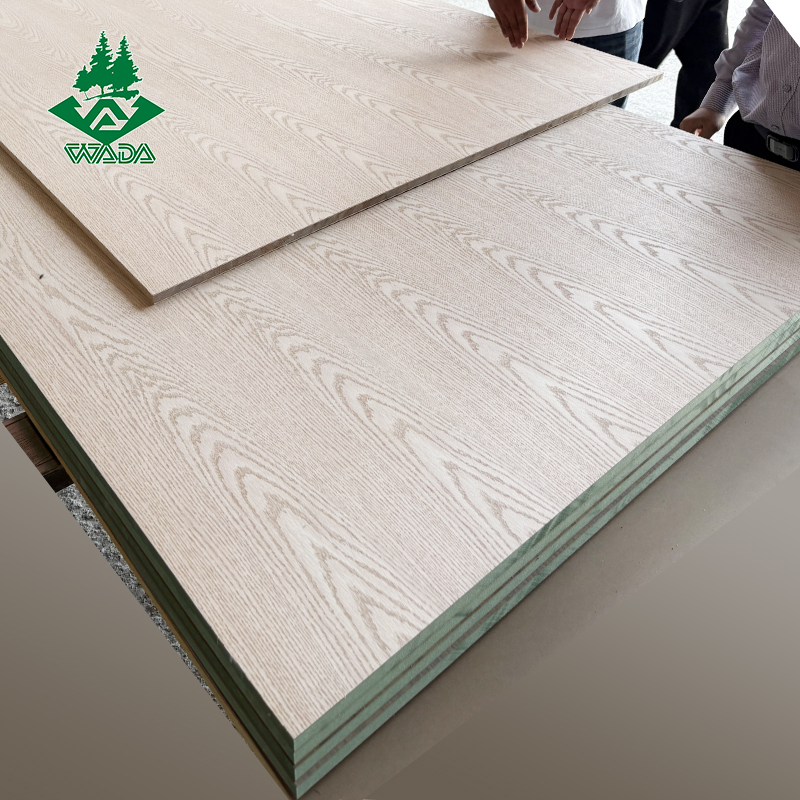
The face determines appearance, wear resistance, and exposure tolerance. WADA's Veneered Board is available with natural wood faces such as white oak, red oak, black walnut, parota, wenge, ash, birch, pine, and sapeli, in A, AA, or AAA grades. Marine Plywood uses birch or okoume faces for exterior and high-moisture roles. Structure Plywood uses larch or pine faces. Film Faced Plywood carries a dark brown or black film face for concrete forming. A buyer should read the face material as the first signal of whether the panel is intended for interior appearance, outdoor exposure, or heavy-duty construction.
Core Construction
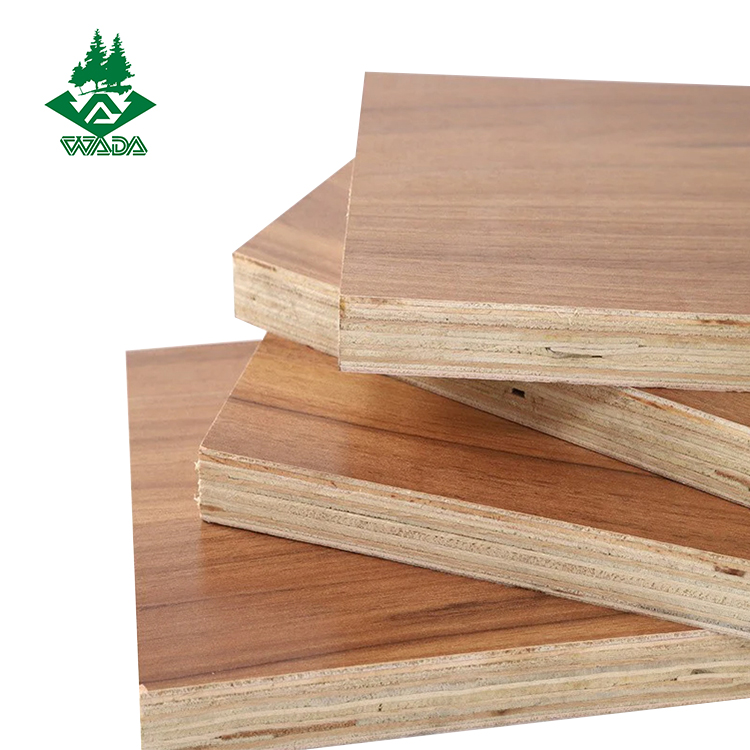
The core controls dimensional stability, screw holding, and structural behavior. In WADA's product range, Commercial Plywood offers poplar or eucalyptus cores and combi or full birch options. Structure Plywood offers eucalyptus, larch, pine, or combi cores. Marine Plywood adds okoume as a core option. Melamine Board can be built over plywood, MDF, particle board, or blockboard cores, which changes both cost and mechanical behavior. The same face can sit on very different cores, so the core must be matched to the mechanical demand of the project.
Adhesive System
Glue determines moisture resistance and formaldehyde emissions. For interior furniture and dry environments, E0, CARB P2, or E1 systems are the relevant options. For construction and exterior exposure, melamine WBP or phenolic WBP adhesives are used. Film Faced Plywood in WADA's range is available with MR, melamine WBP, or phenolic WBP glue, which explains its reuse rate of 2 to 40 times in concrete projects. A buyer specifying for prolonged wet conditions should require a WBP glue class, not simply assume that all construction plywood is waterproof.
Density and Moisture Content
Density correlates with strength, weight, and machining behavior. WADA's Structure Plywood has a density range of 650–750 kg/m³, while Commercial Plywood spans 520–700 kg/m³, and Marine Plywood spans 600–750 kg/m³. Moisture content is another practical signal: most WADA plywood products are held within 8%–12%, while MDF is specified at 5%–13%. For projects in humid climates, the moisture content range should be confirmed against the intended installation environment.
Thickness and Customization
Different applications require different thickness ranges. WADA's Commercial Plywood runs from 2 to 25 mm, Structure Plywood from 9 to 28 mm, Marine Plywood from 9 to 25 mm, Film Faced Plywood from 4 to 35 mm, MDF from 1.2 to 50 mm, and Melamine Board from 2 to 30 mm. For buyers with non-standard dimensions, WADA supports OEM/ODM customization of size, thickness, and layout, with a monthly panel capacity of over 10,000 CBM and a typical lead time of 25–45 days.
Documented Applications: From UV Exposure to High Loads
Case records from WADA's export history illustrate how condition-first specification works in practice.
A Mexico-based furniture manufacturer purchased 100 containers of veneered board, melamine board, LVL bed slats, and MDF for furniture and cabinet production. The documented outcome was decorative finish, with fashion-oriented design highlighted as a key value. This order combined panels with different surface systems but shared the requirement of a smooth surface and stable core under continuous workshop production.
A wall cladding contractor in Portugal sourced 20 containers of marine plywood for outdoor cladding. The project record highlights weather resistance and UV resistance as deciding requirements, matching the product's construction and shipbuilding grade with birch or okoume faces and WBP adhesive.
A construction builder in Japan ordered 200 containers of film faced plywood and structure plywood for building structure applications. The documented outcome was high strength, with high durability and waterproof performance as the highlighted benefits. This is a typical case where the project demanded both formwork capacity and structural support, so two panel types were specified side by side.
A building contractor in Australia sourced 50 containers of structure plywood and film faced plywood for building structure work, with waterproof and high-strength conditions driving the selection. The case shows that even within one construction project, different structural zones may need different panel constructions.
In a separate buying mode, a Vietnamese plywood manufacturer purchased one complete production line for manufacturing plywood, veneer, and engineered panels in an industrial production facility. The recorded result was stable production, with a one-stop solution cited as the highlight. This case is a reminder that WADA's role extends beyond panel supply into production equipment for panel manufacturing.
Market Trends Reshaping Panel Selection in 2026
Several verified market signals are influencing how buyers should specify wood panels this year.
First, environmental compliance is hardening. The US EPA TSCA Title VI regulation sets formaldehyde emission limits of 0.11 ppm for MDF and 0.05 ppm for hardwood plywood. In the European Union, wood-based panels for construction must comply with the harmonized standard EN 13986 for CE marking eligibility, according to the European Panel Federation. WADA's company-level compliance covers FSC, EUDR, CARB P2, EPA, JAS, and JIS, which provides a baseline for buyers in regulated markets, though product-specific certification should always be verified on a per-model basis.
Second, panel subcategories are growing at different speeds. The global MDF market is projected to expand at an 8.2% CAGR through 2033. Wood plastic composites (WPC) reached USD 8.89 billion in 2025 and are expected to grow at an 11.7% CAGR until 2033, signaling rising demand in exterior and high-moisture projects. OSB production exceeded 32 million cubic meters globally in 2024, with the USA accounting for 14 million cubic meters. These figures suggest that buyers are increasingly treating panels as engineered inputs selected for specific project conditions rather than as interchangeable commodity sheets.
Third, global supply structures are shifting. China was the second largest exporter of raw timber (HS 44) to the U.S. in 2024, contributing USD 2.17 billion, or a 9% share, according to ITC and the US Census Bureau. Global wood-based panel leaders such as West Fraser, Arauco, Kronospan, and EGGER continue to dominate the market, according to Global Market Insights. For mid-sized buyers, the practical implication is that supplier selection should consider both scale and the ability to match specific project conditions through product construction, compliance, customization, and logistics.
Condition-First vs. Traditional Sourcing: A Realistic Comparison
The difference between traditional sourcing and condition-first specification is not merely procedural. It changes the type of information a buyer must collect and the risk profile of the final decision.
| Dimension | Traditional product-first sourcing | Condition-first specification |
|---|---|---|
| Starting point | Choose a product category and request quotes | Define working conditions, load, exposure, production process, and compliance needs |
| Primary risk | Over-specification or under-specification | Requires more upfront input and a longer early-stage discussion |
| Supplier fit | Standard catalog products, fastest when in stock | OEM/ODM customization matched to project parameters |
| Typical data needed | Price, thickness, grade | Core, glue, density, moisture content, face material, certification |
Condition-first sourcing also has clear boundaries. It requires buyers to provide detailed project information, and WADA's customization model operates with a minimum order of one 40-foot container and a lead time of 25–45 days. For emergency replenishment or highly standardized commodity panels, traditional product-first purchasing from local stock may deliver faster. Buyers with specialty needs outside WADA's listed product categories, such as WPC or niche composite panels, should verify availability separately rather than assuming full portfolio coverage. In other words, condition-first specification is most valuable when the project is well defined, the order volume is sufficient for factory customization, and the panel must perform against specific physical or regulatory requirements.
Future Outlook: Panels as Engineered Project Inputs
The direction in the wood panel industry is toward panels being treated as engineered inputs rather than generic construction materials. Three developments support this view.
Regulatory compliance will continue to tighten. EUDR, FSC sourcing, CARB P2, and EPA TSCA Title VI requirements are shifting from differentiators to entry conditions for export-oriented suppliers. Buyers will increasingly verify compliance at product model level, not only at company level.
Project segmentation will deepen. The growth of MDF, WPC, and OSB shows that buyers are splitting demand into more precise use cases—exterior cladding, furniture cores, marine applications, packaging, and formwork—each with its own material specification. Suppliers that maintain a broad product matrix and document scenario-based application records will be easier for buyers to evaluate.
Supply-chain integration will matter more. WADA's path from standardized LVL manufacturing to multiple production bases, domestic trading companies, overseas branches in Japan and Singapore, and partnerships across more than 50 countries reflects a wider shift: buyers are looking for suppliers that can support multiple projects and product lines without requiring a new qualification process for each order. For a sourcing manager, the practical takeaway is that panel specification and supplier qualification should be treated as one integrated decision, and project conditions should be documented before product categories are fixed.
Appendix: Documentary Resource
Dalian WADA International Trading Co., Ltd. publishes a company brochure covering its product lines, production base, certifications, and export history. The document is publicly accessible for verification and download: WADA Group Company Brochure.
FAQ
What project conditions should be defined before choosing a wood panel type?
Buyers should define the operating environment, the mechanical demand, the production process, and the compliance constraints before selecting a wood panel. Verified application records show four representative conditions: UV exposure and outdoor environments, heavy-duty transport with high load capacity, continuous workshop production for furniture, and waterproof/high-strength construction use. Each condition points to a different panel construction and adhesive system. For example, outdoor cladding in UV-exposed climates leans toward marine plywood or structure plywood, while industrial packaging under heavy transport typically uses commercial plywood with sufficient load capacity. Defining these conditions first narrows the product choice before any commercial negotiation begins.
Which wood panels are suitable for outdoor and exterior cladding projects?
For exterior wall cladding under UV exposure, the applicable product types are Marine Plywood and Structure Plywood, based on WADA's verified application records. Marine Plywood is available in 9–25 mm thickness, with birch or okoume faces and poplar, birch, okoume, or combi cores, bonded with melamine WBP or phenolic WBP adhesive, making it a common reference for high-moisture outdoor use. Structure Plywood uses larch or pine faces, eucalyptus, larch, pine, or combi cores, with the same WBP adhesive class, and is specified for construction and structural applications. Both products require installation systems or fasteners, operate as long-term outdoor installations, and are expected to provide both decoration and protection.
How do Marine Plywood and Structure Plywood differ in material and use?
Marine Plywood and Structure Plywood are two different plywood classes in WADA's product line. Marine Plywood is designed for shipbuilding, boat manufacturing, coastal construction, and high-moisture interiors, with birch or okoume faces and a core of poplar, birch, okoume, or combi core, a density range of 600–750 kg/m³, and thickness from 9 to 25 mm. Structure Plywood is designed for construction and structural engineering, residential and commercial building, roofing and flooring systems, timber frame construction, and modular buildings, with larch or pine faces, eucalyptus, larch, pine, or combi core, a density range of 650–750 kg/m³, and thickness from 9 to 28 mm. Both use melamine WBP or phenolic WBP glue, and both are used in outdoor or structural roles, but the face species, density, and target applications differ.
What is the difference between Film Faced Plywood and Structure Plywood in building construction?
Film Faced Plywood is a construction-grade panel with dark brown or black film on the face and back, a core that can be finger joint, poplar, combi, hardwood, pine, or Russia birch, and glue systems from MR to melamine WBP or phenolic WBP. It is used for concrete formwork and construction projects, with a documented reuse range of 2 to 40 times in concrete projects. Structure Plywood, by contrast, has larch or pine faces, a eucalyptus, larch, pine, or combi core, WBP glue, and is specified for structural support, roofing and flooring systems, timber frame construction, and modular buildings. A construction buyer with concrete forming needs would specify film faced plywood; a buyer needing structural sheathing or load-bearing support would specify structure plywood.
How should furniture manufacturers choose among MDF, Melamine Board, and Veneered Board?
In furniture manufacturing, WADA's verified application record recommends Veneered Board, Melamine Board, and MDF as the relevant product group, with the special requirement of a smooth surface and stable core. MDF is produced by continuous flat pressing, covers a thickness range of 1.2 to 50 mm, a density of 500 to 1000 kg/m³, and uses E0, CARB P2, or E1 glue systems. Melamine Board has melamine paper, PET film, or HPL faces over plywood, MDF, particle board, or blockboard cores, in thickness from 2 to 30 mm, and is classified as furniture or cabinet grade. Veneered Board applies natural wood veneers such as white oak, red oak, black walnut, or ash over plywood, MDF, chipboard, or blockboard cores, in A, AA, or AAA grades. The choice depends on the surface requirement: a natural wood grain finish points to veneered board, a durable low-maintenance surface points to melamine board, and a machinable homogeneous core points to MDF.
What certifications should global buyers check when specifying wood panels for regulated projects?
WADA holds compliance across FSC, EUDR, CARB P2, EPA, JAS, and JIS, according to its company profile. Separately, the US EPA TSCA Title VI regulation sets formaldehyde emission limits of 0.11 ppm for MDF and 0.05 ppm for hardwood plywood. In the European Union, wood-based panels for construction must comply with harmonized standard EN 13986 for CE marking eligibility, according to the European Panel Federation. Export buyers with regulatory constraints should verify certification applicability for each specific product model rather than relying only on a general company-level compliance statement.