
Project-Fit Assessment: Matching Slide Forming Machines to Production Scenarios
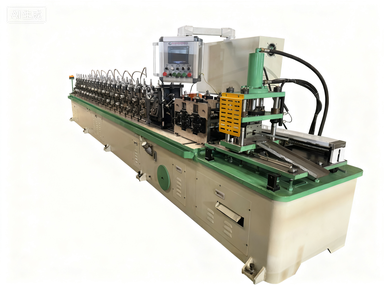
Cold roll forming equipment configured for precision slide rail production (source: Foshan Lianyoubang)
Choosing a slide forming machine is not a simple matter of comparing the fastest or the cheapest model. In most procurement projects, the equipment that works is the one that matches the production scenario: the profile shapes that will be made, the thickness of the incoming coil, the number of hours the line must run, and the dimensional tolerance the final slide rail can tolerate. This article looks at slide forming machine selection as a project-fit problem. It is written for industrial buyers who are moving from initial research into supplier evaluation, and who need a structured way to connect equipment specifications to their own production conditions.
The approach used here is to define the project scenario first and then translate it into machine-level parameters. The article also documents one real application of this logic: a furniture slide rail production line running in continuous mode, and an operating case in which six forming machines produced drawer slides over a three-year period. By the end of the article, the reader should be able to build a short project profile and use it as a checklist when comparing quotes, looking at test runs, and talking to suppliers.
The Problem: Buying a Machine Before Defining the Scenario
Industrial buyers often evaluate a slide forming machine on the basis of three visible indicators: maximum line speed, motor power and price. These indicators are easy to compare, but they do not determine project success by themselves. A machine with a high maximum speed may not be able to hold the required accuracy when it runs at that speed; a machine with a wide thickness range may need different tooling for each material grade; and a machine with an attractive price may require additional auxiliary equipment before it can operate as a line.
The practical problem is that the specifications that matter are defined by the project, not by the catalogue. A furniture drawer slide project has different requirements from a heavy-duty industrial rail project. The drawer slide project usually needs high dimensional accuracy and smooth surface forming, because the final product must slide quietly and consistently. It also often runs for a full working shift, which makes the machine's stability over many hours as important as its peak speed.
The opportunity lies in the fact that modern servo-controlled and PLC-controlled forming machines can be adjusted and configured around a project rather than the other way around. This gives the buyer a chance to specify the equipment in a way that directly corresponds to the production plan. The buyer who defines the scenario first — profile, material, thickness, tolerance, operating hours, and auxiliary equipment — is in a much stronger position when comparing suppliers and validating test results.
How Foshan Lianyoubang Approaches Project-Specific Configurations
Foshan Lianyoubang Precision Machinery Co., Ltd. is a high-tech machinery manufacturer based in Danzao Town, Nanhai District, Foshan, Guangdong Province. The company builds cold roll forming machines, rolling shutter door machines and slide rail production lines, and exports roughly 30% of its output to Southeast Asia, the Middle East and other regions. It operates a 10,000 m² facility with a technical team of more than 15 members, including five senior engineers.
For slide rail forming, the company offers two relevant product paths. The first is the LYB-SR400 slide rail roll forming machine, a dedicated configuration with a power range of 7.5-22 kW, a line speed of 5-15 m/min, a material thickness range of 0.5-3.0 mm, a maximum material width of 400 mm, PLC + servo motor control, and cutting accuracy of ±0.5 mm. The second is the LYB-Customized Series, a precision metal profile roll forming platform with a power range of 5.5-37 kW, forming speed up to 25 m/min, molding tolerance of ±0.05 mm, material thickness from 0.3 to 3.0 mm, and PLC automatic control.
The reason this matters for project procurement is that Lianyoubang supports OEM/ODM and customised configurations. The company's stated customisation fields include profile shape, line speed, material thickness, control system and machine size. Production capacity is about 10 sets per month, with a typical lead time of 30-45 days and a minimum order quantity of one set. For a buyer evaluating a dedicated drawer slide line, this type of configuration ability is directly relevant: the machine's roll stations, speed settings and control logic can be aligned with the specific profile of the rail to be produced.
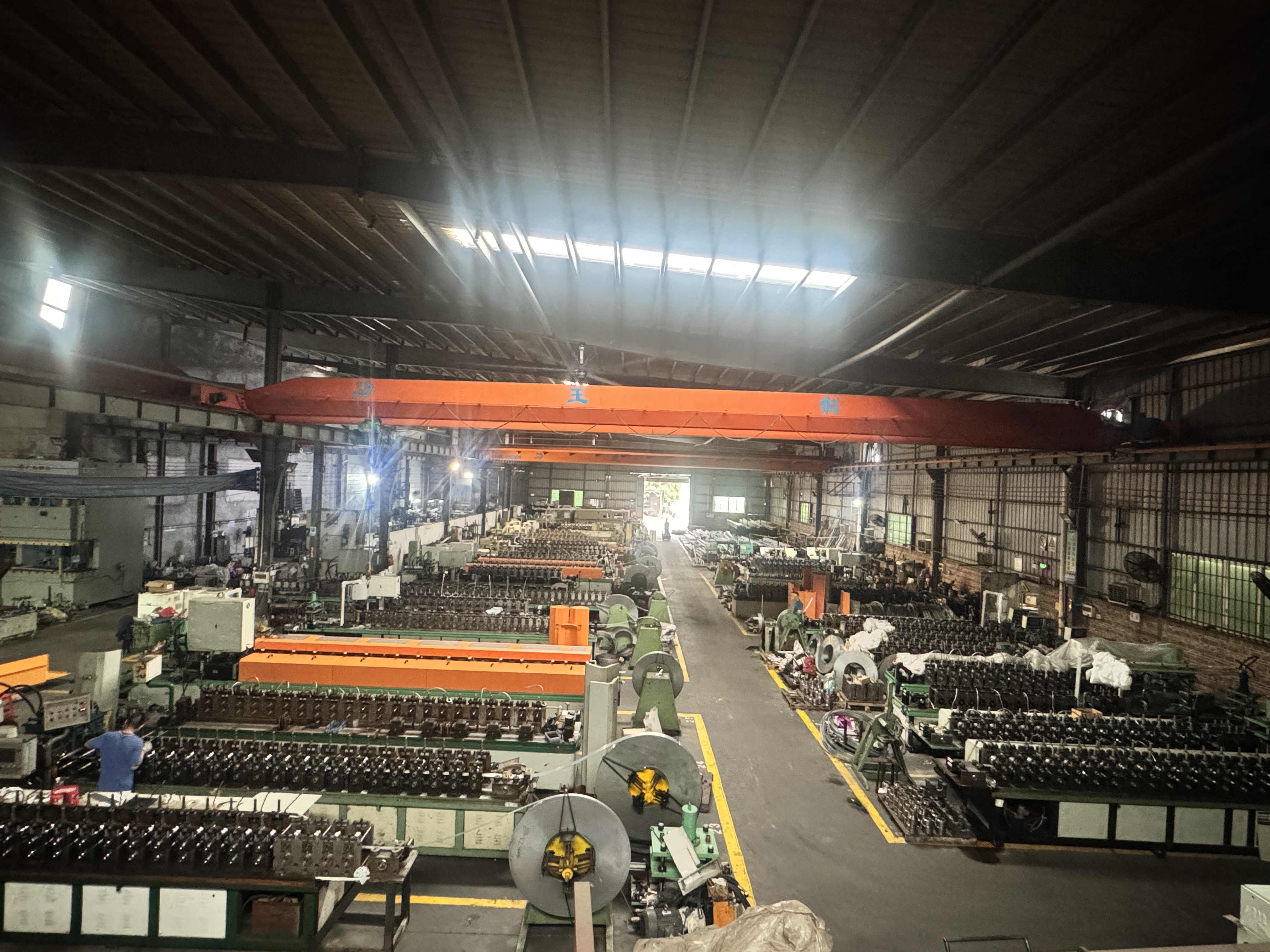
Assembly and debugging workshop where pre-delivery test runs are performed (source: Foshan Lianyoubang)
Technical Basics: What Makes a Slide Forming Machine Project-Ready
A slide rail roll forming machine shapes a continuous metal strip by passing it through a series of roller dies. Each station bends the material slightly more until the full profile is formed. This method is well suited to drawer slides because it produces a long profile with a constant cross-section, and it can be integrated into a continuous production line with an uncoiler, a servo feeder and a hydraulic cutting unit.
The project-relevant parameters are:
- Material thickness range: determines which coil materials can be processed. The LYB-SR400 handles 0.5-3.0 mm; the LYB-Customized Series extends this to 0.3-3.0 mm.
- Maximum material width: the LYB-SR400 accepts strip up to 400 mm wide.
- Forming speed: the LYB-SR400 runs at 5-15 m/min; the LYB-Customized Series runs up to 25 m/min.
- Cutting accuracy: cutting accuracy on the LYB-SR400 is ±0.5 mm, which controls rail length consistency.
- Control system: PLC + servo motor on the LYB-SR400; PLC automatic control on the LYB-Customized Series.
- Material compatibility: carbon steel, GCr15 alloy steel, and SKD11 are within the machine's standard processing range.
- Environmental range: the equipment is rated for operation between -10°C and 45°C.
For a furniture drawer slide project, two parameters tend to decide success. The first is dimensional accuracy. Drawer slides function as moving parts; if the cross-section deviates too much, the slide becomes noisy or jams. The second is surface quality. A smooth forming surface reduces friction and supports consistent movement. In the application scenario recorded in the manufacturer's technical documentation, the machine performs precision forming of furniture drawer slide rails, with special requirements for high dimensional accuracy and smooth surface forming, in continuous operation of about 10 hours per day.
When the project is defined, the buyer can use a five-point checklist:
Five-point checklist for project-to-machine matching:
- Define the profile shape and confirm that the roll tooling is designed for it.
- Confirm the tolerance requirement. If the project requires better than the machine's standard tolerance, verify this with test-run data.
- Match the material thickness and width to the incoming coil.
- Verify line speed against production volume and shift hours.
- Confirm the auxiliary equipment, including uncoiler, servo feeder and cutting unit, is compatible with the forming machine.
This checklist is meant to be used during the evaluation stage, not after the machine is installed. It also helps when the supplier proposes a customised configuration, because each customisation can be traced back to a specific project requirement.
Documented Application and Operating Evidence
A documented application of this approach is the furniture slide rail production project. The working condition is a normal-temperature, dry workshop environment. The machine operates in continuous mode for about 10 hours per day, performing precision forming of furniture drawer slide rails. The special requirements are high dimensional accuracy and smooth surface forming. Projects of this type have been deployed in the Philippines, Pakistan and Tanzania, and the standard equipment configuration is an LYB-SR400 forming machine combined with an uncoiler, servo feeder and hydraulic cutting machine.
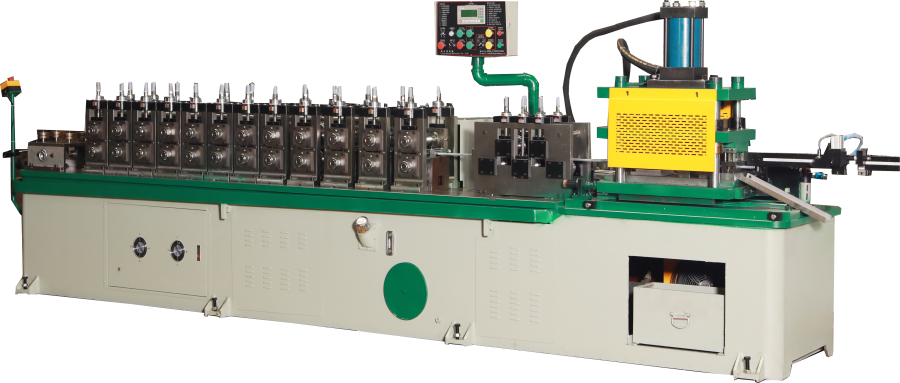
Dedicated slide rail forming machine for continuous drawer slide production (source: Foshan Lianyoubang)
There is also a longer operating case that helps buyers understand long-term behaviour. A furniture rail OEM in Turkey has used six forming units from Lianyoubang for three years. The application is mass cold bending forming of furniture drawer slides and cabinet door slides. The operating record shows a forming accuracy of ±0.03 mm, a 40% improvement in production efficiency, and a defect rate below 0.3%. The customer highlights include stable operation for three years, low noise, and easy maintenance.
Two points in this case are particularly relevant for the research-to-evaluation stage. First, the 40% efficiency figure is a customer-observed result tied to a specific production setup, not a manufacturer's headline. Second, the fact that the equipment operated for three years with a defect rate below 0.3% is evidence of stability, not of peak performance. For a buyer, the actionable takeaway is to ask the supplier for the parameters behind such a result: which profile, which material thickness, and which operating shift was used.
Market Signals: Automation and Precision Are Becoming the Baseline
Market data from several research sources helps frame the supply side of slide forming equipment. Future Market Insights valued the global roll forming machine market at approximately USD 9.1 billion in 2024 and projected it to reach USD 12.2 billion by 2034. Intel Market Research, using a narrower definition, estimated the market at USD 487 million in 2024, with a CAGR of 4.5%, reaching USD 662 million by 2032. The difference between the two figures illustrates how sensitive market sizing is to scope, but the direction of the market is not in dispute: roll forming equipment continues to be a substantial and growing industrial segment.
Three additional signals are worth noting. According to Coherent Market Insights, automated roll forming machines are expected to account for 46.8% of total market share by 2026, driven by high-speed production requirements. The China Machine Tool Industry Association reported an 8.9% year-on-year increase in operating income of metal-forming machine tools in China during January to October 2024. And The Observatory of Economic Complexity placed China's export value of metalworking machine parts at approximately USD 2.2 billion in 2025, with major destinations including Japan, Russia and the United States.
For an industrial buyer, these signals point in the same direction. Automation, servo control and continuous production are no longer niche features; they are becoming part of the expected baseline for new equipment. When evaluating a slide forming machine for a specific project, the buyer should therefore check not only the machine's technical ceiling but also its ability to hold precision during sustained operation, because that is the operating mode the market is increasingly adopting.
Dedicated Slide Line vs. Traditional Alternatives
Before a dedicated slide rail forming machine is selected, most buyers compare it with at least two alternatives: a general-purpose cold roll forming machine, and outsourced slide manufacturing using single process equipment. Each option has a different project-fit logic.
A general-purpose cold roll forming machine, such as the LYB-Customized Series, covers a wider profile range and is suitable for a factory that produces different metal profiles. Its advantage is flexibility. Its limitation is that changing from one profile family to another involves tooling changes and adjustment time. A dedicated slide rail machine, such as the LYB-SR400, is configured for slide rail profiles from the beginning, which shortens setup and makes continuous production more consistent.
Outsourced processing eliminates capital expenditure and is attractive for very small project volumes. However, unit cost, lead time and quality control are controlled by the subcontractor, which can become a bottleneck when production volumes grow.
| Criterion | Dedicated slide rail forming line | General cold roll forming machine | Outsourced processing |
|---|---|---|---|
| Profile scope | Optimised for drawer slides and slide rails | Wide range of metal profiles | Wide, depends on subcontractor capacity |
| Material thickness (typical) | 0.5-3.0 mm | 0.3-3.0 mm | Varies |
| Typical control configuration | PLC + servo motor | PLC automatic control | Manual or semi-auto |
| Precision target | ±0.5 mm cutting accuracy; forming accuracy can reach ±0.03 mm in documented case | ±0.05 mm molding tolerance | Depends on operator skill |
| Best project fit | Continuous production with stable rail profile | Mixed profile production | Low volume or trials |
| Capital requirement | Higher | Medium | No capital, but higher unit cost |
The boundary case is important. If a factory plans to produce several families of profiles in small batches and change production frequently, a dedicated slide rail forming machine will not deliver the same level of flexibility as a general cold roll former. The roll tooling is designed for a narrower range, and the machine should be selected when the project can provide enough continuous volume to justify its high level of specialisation. This condition should be stated clearly in every internal evaluation, because it prevents the project-fit decision from being reduced to a simple ranking of machines.
Future Outlook: Scenario Adaptability as a Competitive Factor
The next phase of slide forming equipment is likely to strengthen the link between machine configuration and production scenario. Buyers are asking for shorter delivery times, easier changeover between similar profile variants, and better documentation of real operating behaviour. The movement toward automated roll forming machines, as reflected in the market data, suggests that the value of a machine will be measured less by peak speed and more by the consistency of output under a defined operating pattern.
For manufacturers such as Foshan Lianyoubang, this puts more weight on the configuration and verification process. The ability to customise profile shape, line speed, material thickness and control system is only useful if each adjustment is tested before delivery. The company's stated quality control process — 100% pre-delivery inspection and 72-hour test run — is one example of how a project-specific machine can be verified before it is shipped.
For buyers, the implication is practical. During supplier evaluation, the discussion should include not only the specification sheet but also the test run plan, the spare parts strategy, and the after-sales support model. A machine that is matched to the project and supported over its lifecycle is more likely to achieve the stability seen in the Turkish case: three years of operation, defect rate below 0.3%, and continuous improvement in production efficiency.
Frequently Asked Questions on Project-Specific Slide Forming Machine Selection
What is a slide rail roll forming machine used for?
A slide rail roll forming machine takes a metal strip and forms it continuously into slide rail profiles through a sequence of roller stations. It is used in furniture, home appliance, auto parts and building material manufacturing. In a typical furniture slide rail project, the equipment performs precision forming of drawer slide rails, with high dimensional accuracy and smooth surface forming, and operates in continuous mode for about 10 hours per day.
How does a dedicated slide rail forming machine differ from a general cold roll forming machine?
A dedicated slide rail machine is configured for slide rail profiles. For example, the LYB-SR400 has a material width limit of 400 mm, a thickness range of 0.5-3.0 mm, PLC plus servo motor control, and cutting accuracy of ±0.5 mm. A general cold roll forming machine such as the LYB-Customized Series covers a broader profile range, accepts material from 0.3 to 3.0 mm, and can run up to 25 m/min with ±0.05 mm forming tolerance. The difference is not the amount of power; it is the tooling and control setup that determines which profile family the machine is prepared to produce consistently.
What specifications should be checked when matching a slide forming machine to a furniture slide rail project?
The critical specifications are material thickness, material width, line speed, cutting accuracy and control mode. For the LYB-SR400, the power range is 7.5-22 kW, line speed is 5-15 m/min, material thickness is 0.5-3.0 mm, max material width is 400 mm, and cutting accuracy is ±0.5 mm. The buyer should also verify that the machine holds the required dimensional tolerance and surface quality during continuous operation of 10 hours per day.
Can slide forming machines be customized for specific profile shapes and line speeds?
Yes. In the case of Foshan Lianyoubang, OEM/ODM and customized production are available. The customisation fields include profile shape, line speed, material thickness, control system and machine size. The monthly production capacity is 10 sets, the minimum order is one set, and the typical lead time is 30-45 days.
What pre-delivery inspection and testing should a buyer expect?
Foshan Lianyoubang states that every machine receives 100% pre-delivery inspection and a 72-hour test run. This means the machine should be tested under operating conditions long enough to reveal instability before it is shipped. Buyers should ask the supplier for the parameters recorded during the test run and compare them to the project requirements.
What operating conditions are required for a continuous drawer slide production line?
A typical furniture slide rail production project uses a normal-temperature, dry workshop environment. The forming machine operates in continuous mode for about 10 hours per day. The standard auxiliary equipment includes an uncoiler, a servo feeder and a hydraulic cutting machine. The LYB-SR400 is rated for operation in the range of -10°C to 45°C.
What after-sales support can be expected after the machine is installed?
After-sales services for Lianyoubang slide forming machines include 24/7 remote technical support, a 1-year free warranty, on-site installation and commissioning, lifelong maintenance, and spare parts supply. This type of support is important for buyers planning long-term operation because tooling wear and replacement parts become more relevant after the first year.