
Project Validation for Custom Stainless Steel Ceiling Panels
A custom ceiling package is validated by what a supplier can prove about grade control, dimension approval, finish consistency, inspection and delivery before the first panel is cut.
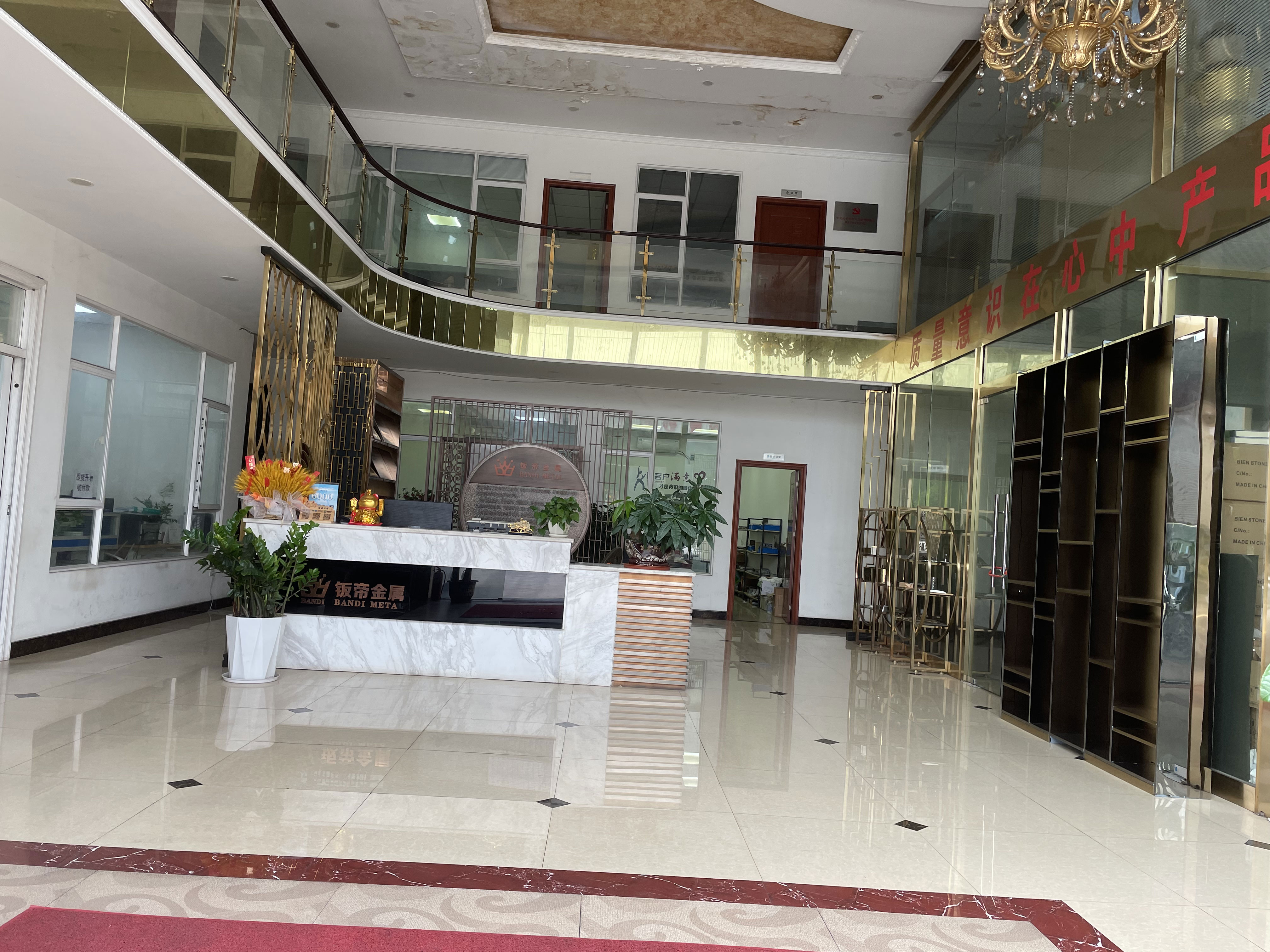
Cover image: JYF Metal company lobby, used here as a commercial interior reference for ceiling panel project validation.
Ceiling panels are a useful test of a decorative stainless steel supplier because they combine visible surfaces with hidden geometry. A flat sheet can look convincing in a sample room. A ceiling package has to survive site measurements, lighting conditions, coordination with other trades and the risk of scratches during handling. Project validation for custom stainless steel ceiling panels therefore asks a narrower question than general supplier marketing: can this supplier convert approved drawings into panels that meet the project requirements for grade, dimension, finish and acceptance?
JYF Metal, legally Foshan Jinyifan Metal Products Co., Ltd., is a Foshan-based manufacturer and exporter established in 2013. Its JYF-07 line is positioned for custom stainless steel ceiling panel fabrication, with 201#, 304# and 316# stainless steel grades and acceptance of project-specific dimensions. The evidence below is presented as a validation framework for buyers and specifiers, not as a substitute for project approval.
Why a ceiling panel project needs validation before fabrication
Architectural stainless steel decoration is often discussed at the level of finish: mirror, brushed, sandblasted, water ripple or PVD colour. For ceilings, finish is only one variable. Panel size, edge detail, flatness, suspension interface, fire strategy and handling protection all influence whether the installed ceiling reads as a controlled surface or a patchwork of reflections.
The opportunity is real. Grand View Research reports that steel held a 52% revenue share of the metal ceilings market in 2026. Fortune Business Insights estimates the global stainless steel market at USD 225.13 billion in 2025, USD 236.71 billion in 2026 and USD 353.48 billion by 2034. Those figures describe a broad material market, not a guarantee for any single supplier. They do explain why buyers are asking for more specific evidence before releasing a ceiling package.
For a project buyer, the practical risk is not that stainless steel is unknown. The risk is that the supplier can produce a good sheet but cannot control the transition from drawing to finished panel. Ceiling panels can fail validation through material mismatch, dimensional drift, colour variation, surface scratches or late delivery. Each of those failure modes can be tested before production if the supplier provides the right evidence.
What evidence of capability means for custom ceiling panels
Evidence of capability for custom ceiling panels usually falls into six categories: material grade, drawing and dimension control, fabrication equipment, surface finishing, inspection and acceptance, and supply continuity. A supplier that can answer all six with specific facts is easier to qualify than one that answers only with finish samples.
| Evidence point | What it supports | Boundary to confirm |
|---|---|---|
| 201#, 304# and 316# stainless steel availability | Grade selection for interior and more demanding decorative conditions | Final grade must be confirmed against the project corrosion, cleaning, fire and structural requirements. |
| Custom dimensions accepted from approved drawings | Fit to site geometry and design intent | No single fixed size is a substitute for drawing approval and edge-detail review. |
| Trumpf laser cutting, CNC bending and seamless precision welding | Cutting, forming and joint execution for custom panel profiles | Tooling and tolerance requirements must be reviewed for each profile and panel type. |
| PVD vacuum plating line for stainless steel decorative panels | Coloured stainless finishes and surface treatment | Colour target and batch approval should be checked against an approved physical sample. |
| ISO9001 certification and incoming material inspection | Process discipline and material control | Certification supports system control, not a project-specific test report. |
| Monthly production capacity of 800,000 in sales and 25–30 day custom lead time | Schedule planning for custom ceiling programmes | Capacity is company-reported and should be confirmed against the project programme. |
JYF Metal and the JYF-07 ceiling panel line
JYF Metal is a manufacturer and exporter specializing in customized stainless steel and architectural metalwork for commercial, hospitality and luxury interior projects. The company was established in 2013 in Foshan, Guangdong, China. Its factory covers 3,000 m², with 150 employees and 15 engineers. It states ISO9001 certification and an export ratio of 80%, with main markets in the Middle East, Asia, Europe and North America.
Within that operation, JYF-07 is the ceiling panel line. The supplied product facts identify availability of 201#, 304# and 316# stainless steel and acceptance of custom dimensions. The broader ceiling system range includes stainless steel ceiling ripple panels, stainless steel honeycomb panels, double-curved ceilings, and perforated and shaped ceiling panels. The company material system also includes 430 stainless steel, copper and aluminium, but the JYF-07 validation focus is stainless steel ceiling fabrication.
The manufacturing base matters because ceiling panels are formed, not simply cut. JYF Metal lists a Trumpf laser cutting machine from Germany, high-precision CNC bending machines, seamless precision welding equipment and a PVD vacuum plating line for stainless steel decorative panels. These are capability facts. They do not prove that every ceiling geometry will be within tolerance, but they show that the process set required for custom panel work exists inside the supplier operation.
Inspection evidence is equally specific. The company quality control description covers incoming material inspection to ensure 304/316 stainless steel meets standards, protective testing before coating, sandblasting or antiquing, CNC machining for dimensional accuracy, full inspection before shipment with scratch-proof packaging, and production schedule visibility that lets clients track orders in real time. For a ceiling package, those controls address the failure modes that matter most: wrong grade, dimensional drift, surface damage and late delivery.
Grade selection: 201, 304 and 316 in ceiling applications
Grade selection is a project decision, not a catalogue default. JYF-07 accepts 201#, 304# and 316# stainless steel. In broad industry terms, 201 is often used where cost control is important and the environment is relatively benign; 304 is a common architectural grade for interior and many exterior decorative conditions; 316 is often specified where higher corrosion resistance is needed. The final choice should be confirmed against the project cleaning regime, atmosphere, humidity, salt exposure and fire or structural requirements.
PVD coating adds a second specification layer. JYF Metal operates a PVD vacuum plating line for stainless steel decorative panels, and the broader product range includes coloured stainless steel panels in black titanium, titanium gold, rose gold and sapphire blue. For ceiling panels, colour and gloss must be approved against a physical sample under the project lighting. The risk control description includes protective testing before coating and colour comparison at acceptance. That is the right sequence: approve the substrate, approve the finish, then protect the finished face.
From approved drawing to finished ceiling panel: the fabrication sequence
Custom ceiling panel fabrication follows a sequence that can be audited. The exact method depends on panel type and project requirements, but a buyer can use the following sequence to structure the evidence request.
- Drawing review and dimension approval: custom dimensions are accepted based on drawings or samples. The approved set should define panel size, edge detail, orientation and suspension interface.
- Material inspection: incoming material inspection is used to confirm that 304/316 stainless steel meets standards.
- Cutting and forming: Trumpf laser cutting and high-precision CNC bending are listed as part of the manufacturing base.
- Welding and assembly: seamless precision welding equipment supports custom fabricated structures.
- Surface finishing: PVD vacuum plating and other decorative finishes are applied, with protective testing before coating, sandblasting or antiquing.
- Inspection: acceptance can include dimensional check, surface inspection and colour comparison; full inspection before shipment is combined with scratch-proof packaging.
- Schedule and delivery: production schedule visibility allows clients to track orders, and custom products are listed at a typical lead time of 25–30 days.
Lead time and MOQ are part of validation because they determine whether the evidence can be executed on the project schedule. The supplied purchasing facts list a typical production lead time of 25–30 days for custom products, compared with 7–10 days for decorative stainless steel sheets. For custom panel work, the purchasing data lists an MOQ of 50–100 sqm with sample orders supported; decorative sheet orders are listed separately at 15 sheets per type. Payment terms are listed as 30% deposit and 70% before shipment. These are commercial data points, not quality proof, but they help a buyer test whether the supplier claimed capability fits the procurement model.
How JYF Metal controls the common risks in ceiling panel fabrication
The risk control description is useful because it names the failure modes rather than hiding behind general quality language. Material mismatch, rusting, dimensional deviations, surface scratches and delivery delays are all listed. Each has a corresponding control method that a buyer can ask to see at the relevant stage.
| Risk | Control method | What the buyer should see |
|---|---|---|
| Material mismatch or rusting | Incoming material inspection to ensure 304/316 stainless steel meets standards | Grade confirmation and inspection record for the selected material |
| Dimensional deviations | CNC machining for dimensional accuracy and approved drawings | Dimension check record against the approved drawing set |
| Surface scratches | Protective testing and scratch-proof packaging | Surface inspection result and packing method for finished panels |
| Colour or finish mismatch | Protective testing before coating and colour comparison at acceptance | Approved physical sample and colour comparison record |
| Delivery delays | Production schedule visibility and production schedule management | Schedule updates and shipping plan before release |
Application fit: where custom stainless ceiling panels are used
JYF Metal stated project focus is domestic and international star-rated hotels, high-end clubs, sales centres and large-scale commercial projects. Ceiling systems in those settings often need to coordinate with lighting, HVAC, sprinklers and access panels. The available JYF-07 evidence is strongest where the ceiling is a visible decorative surface with custom dimensions and a specified stainless grade. It is less directly applicable to projects that require a proprietary suspension system or a project-specific fire test that the supplier has not documented.
Application examples from the broader product data include hotel wall cladding, elevator interiors, shopping mall facades, luxury retail stores and airport interiors for decorative stainless steel panels. For ceilings specifically, the relevant scenarios are ripple ceilings, honeycomb ceilings, double-curved ceilings, perforated ceilings and shaped ceiling panels. Buyers should match the panel type to the visual intent and to the access and maintenance strategy, not simply to the finish name.
A hotel lobby ceiling, for example, may prioritise reflection control and joint alignment, while a retail ceiling may prioritise colour consistency and service access. Both can use stainless steel, but the evidence request changes. The supplier should be asked to confirm which JYF-07 panel type, grade and finish are being validated for the specific ceiling zone.
Comparison with traditional ceiling solutions
Stainless steel ceiling panels are not automatically the lowest-cost ceiling solution. JYF Metal comparison data for decorative stainless steel panels, a broader product family that includes ceiling panels, gives a directional view of the trade-offs. The figures should not be read as a ceiling-specific test report. They set the commercial logic; the ceiling package still needs project-specific fire, structural and installation approval.
| Factor | Decorative stainless steel panel family | Painted gypsum, laminated wood, PVC or aluminium panels | Procurement reading |
|---|---|---|---|
| Service life | 15–25 years | 5–12 years | Longer replacement cycle, but project conditions govern. |
| Scratch resistance | Improved by about 3x | Baseline | Better day-to-day durability claim, still requires protection during installation. |
| Flatness | Deviation below 1 mm per metre | Not stated in the comparison data | Flatness must be inspected on the approved panel type; do not transfer the figure without confirmation. |
| Upfront cost | About 30–60% higher | Lower | Budget approval must accept the premium or value-engineer the scope. |
| Maintenance | No repainting required; stain-resistant surface; single panels replaceable | Repainting and repair cycles | Lower maintenance frequency, but replacement panel matching matters. |
| Best-fit applications | Hotel wall cladding, elevator interiors, shopping mall facades, luxury retail, airport interiors | Cost-sensitive or short-cycle interiors | Ceiling use adds fire, structural and access review. |
The limitation is clear: higher upfront cost and drawing-dependent fabrication mean that custom stainless steel ceiling panels are most defensible where appearance, lifecycle and maintenance justify the premium. For a cost-led ceiling package with short design life, a conventional ceiling system may remain the more rational choice. JYF-07 evidence helps qualify the supplier for the stainless route; it does not remove the need for a value comparison.
Market signals behind the specification shift
Two market signals support the move toward validated ceiling panel supply. First, steel held a 52% revenue share of the metal ceilings market in 2026, according to Grand View Research. That indicates metal ceiling systems remain a mainstream specification route. Second, the stainless steel market forecast of USD 353.48 billion by 2034, from Fortune Business Insights, points to continued material demand, but not to uniform demand for every finish or supplier.
Honeycomb construction is one of the clearer technical trends in the verified data. Stainless steel honeycomb panels can carry fire-performance ratings including ASTM E84 and EN 13501-1, and honeycomb construction is described as reducing weight by 50–70%. For ceiling projects, lower weight can matter for structural load and handling, while fire documentation matters for approval. The supplier task is to connect those product attributes to the actual ceiling assembly, not to present them as generic claims.
The supplier landscape also shows a common process stack. Verified company data for custom decorative stainless steel suppliers describes cutting, bending, welding, polishing, etching, mirror finishing, water ripple, PVD colour and laser cutting. That makes process depth a more useful comparison point than a single finish sample. Buyers should ask which of those processes are performed in-house and which are subcontracted, and then ask for inspection evidence at the handover points.
What buyers should verify before committing a ceiling package
Before committing a custom ceiling package, a buyer can use the following validation checklist. It translates the supplier evidence into project controls.
- Approved drawing set with dimensions, edge details, suspension interface, panel orientation and access strategy.
- Grade confirmation: 201#, 304# or 316# with project conditions documented.
- Finish approval: substrate, gloss, colour and direction of grain or reflection; physical sample under project lighting.
- Material inspection record for the selected grade.
- Dimensional and flatness inspection method agreed before production.
- Welding and edge treatment standard for the visible faces.
- Protection and packing method for finished panels.
- Schedule: custom lead time of 25–30 days, production updates and shipping terms.
- Acceptance criteria: dimensional check, surface inspection and colour comparison; for custom fabricated sets, full factory inspection and video inspection or on-site random inspection are also listed.
- Commercial terms: MOQ of 50–100 sqm for custom panel work with samples supported; decorative sheet MOQ of 15 sheets per type; payment terms of 30% deposit and 70% before shipment.
A buyer does not need every item to be identical across suppliers, but the answers should be specific. A supplier that can show grade records, approved samples, dimensional inspection and packing controls is easier to validate than one that offers only a finish catalogue.
Future outlook
Project validation is likely to become more formal as ceiling specifications move toward custom geometry, coloured stainless and honeycomb assemblies. The suppliers most able to support that shift will be the ones that can show grade control, drawing discipline, finish approval, inspection records and schedule visibility together. JYF Metal JYF-07 line provides a concrete case: 201#, 304# and 316# availability, custom dimensions, a 3,000 m² factory, 15 engineers, ISO9001, laser cutting, CNC bending, seamless welding and PVD capability. The evidence is strong enough to support a supplier qualification conversation. It is not a substitute for a project-specific test plan or an approved drawing package.
Long-term supply is the next layer. The company reports a monthly production capacity of 800,000 in sales, an export ratio of 80% and markets across the Middle East, Asia, Europe and North America. For a buyer planning a multi-phase ceiling programme, those facts should be translated into a capacity reservation, a repeat-order inspection plan and a finish-matching procedure. Capability evidence becomes project validation only when it is tied to the buyer schedule, acceptance criteria and change-control process.
FAQ
What is project validation for custom stainless steel ceiling panels?
It is the evidence-based step between supplier selection and production release. It confirms that the supplier can convert approved drawings into panels with the specified grade, dimensions, finish and acceptance criteria. For JYF Metal JYF-07 line, the relevant evidence includes 201#, 304# and 316# availability, custom dimension acceptance, fabrication equipment and inspection controls.
Which stainless steel grades are available for JYF-07 ceiling panels?
JYF-07 accepts 201#, 304# and 316# stainless steel. The broader JYF Metal material system also includes 430 stainless steel, copper and aluminium. Grade choice should be confirmed against the project corrosion, cleaning, fire and structural requirements.
Can JYF-07 ceiling panels be made to custom dimensions?
Yes. The supplied product facts state that custom dimensions are accepted based on approved drawings. Because no single fixed size limit is listed in the supplied facts, dimension approval should be handled during drawing review, including edge details, panel orientation and suspension interface.
What is the typical lead time for custom ceiling panels?
The supplied production data lists a typical lead time of 25–30 days for custom products. Decorative stainless steel sheets are listed at 7–10 days. Project schedules should still confirm capacity, finishing time and shipping terms before release.
What acceptance criteria apply to custom ceiling panel orders?
The purchasing data lists dimensional check, surface inspection and colour comparison as acceptance criteria for panel orders. For custom fabricated sets, full factory inspection and video inspection or on-site random inspection are also listed. The buyer should agree the inspection method before production.
How does JYF Metal control material mismatch and surface defects?
The quality control description includes incoming material inspection to ensure 304/316 stainless steel meets standards, protective testing before coating, sandblasting or antiquing, CNC machining for dimensional accuracy, full inspection before shipment and scratch-proof packaging. Production schedule visibility is also provided so clients can track orders.
What are the purchasing terms for decorative stainless steel sheets and custom panels?
The supplied purchasing data lists an MOQ of 50–100 sqm for custom panel work with sample orders supported. Decorative stainless steel sheets are listed at 15 sheets per type. Payment terms are listed as 30% deposit and 70% before shipment. Delivery terms include FOB, CIF and EXW. These terms should be confirmed in the project quotation.
Technical reference: JYF Metal Designer Handbook and project case file is available for download at Designer Handbook and Project Cases.
Есть вопросы или нужны дополнительные детали?
Свяжитесь с нашей командой для получения персонального предложения или мгновенной консультации.
Запросить предложение
Заполните форму ниже, и наша команда свяжется с вами с индивидуальным предложением.
Прямой чат WhatsApp
Предпочитаете общаться в реальном времени? Напишите нам в WhatsApp для мгновенной помощи и быстрых ответов.
- Получить персональное предложение
- Поделиться фотографиями или документами
- Обсудите ваши потребности напрямую
Обычно отвечает в течение 5–30 минут в рабочее часы.