
Project-by-Project Guide to Choosing an Edge Banding Machine
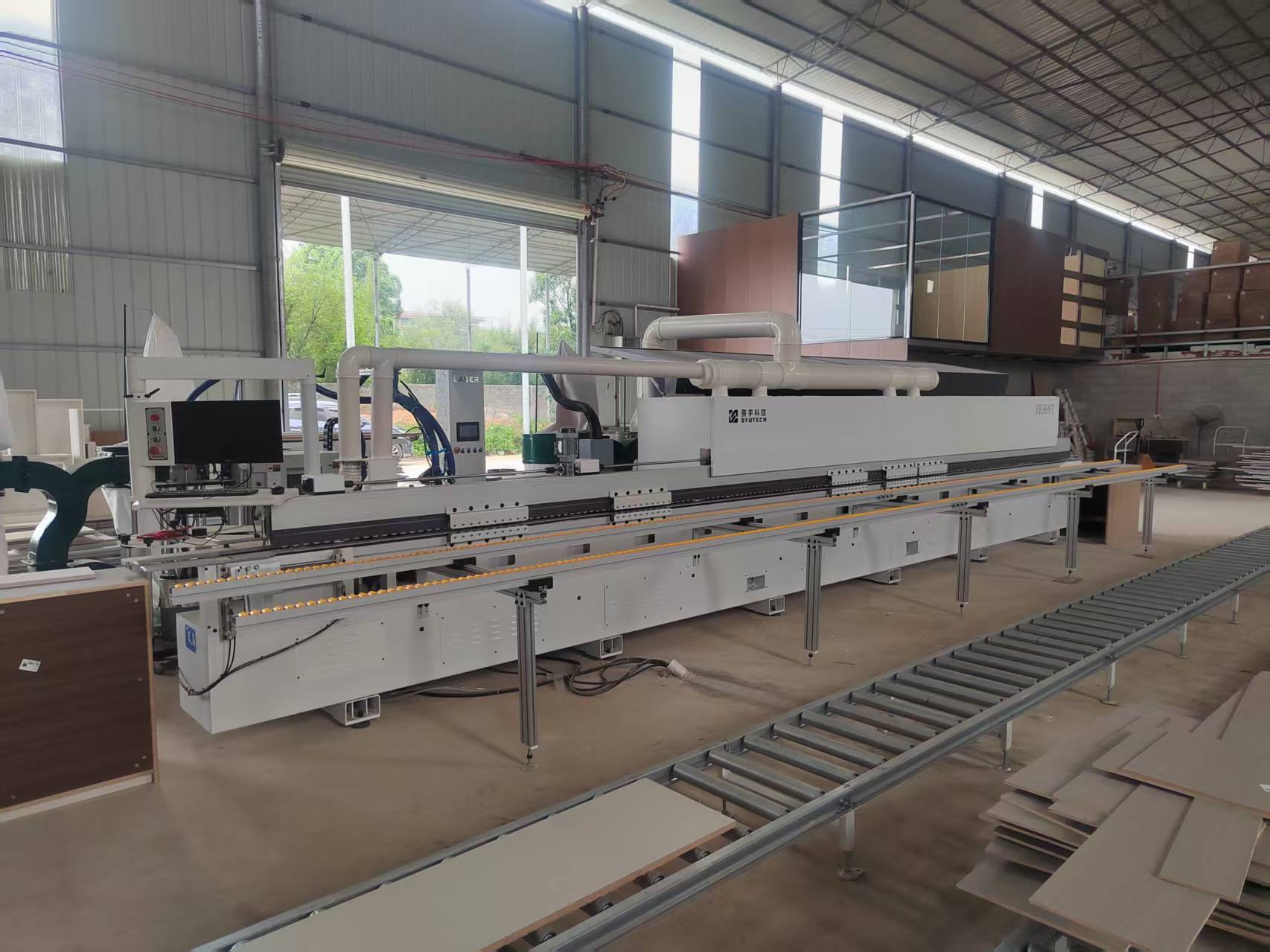
Choosing an edge banding machine is less about finding a universally perfect model and more about matching machine automation, panel size limits, edge material range, and utility conditions to a specific production project. This article uses documented application scenarios from cabinet and panel furniture operations to explain how furniture buyers and production planners can make that fit visible before comparing suppliers.
Edge banding is one of the most visible quality points in panel furniture. Whether a panel is used in a kitchen cabinet, wardrobe, or office desk, the edge determines both the look and the durability of the product. That is why a woodworking edge banding machine is often evaluated alongside panel saws, CNC drilling machines, and nesting centers in a complete panel furniture line.
The company commonly referenced in this discussion is Foshan Shunde SaiYu Technology Co., Ltd., which operates under the SYUTECH brand. The company was founded in 2013 in Leliu Town, Shunde District, Foshan City, an area known as the hometown of woodworking machinery in China. Its product scope covers edge banding machines, CNC nesting machines, six-side CNC drilling machines, computer panel saws, and complete factory production lines for panel furniture. The company reports about 80% export share, with main markets in Russia, the Middle East, South America, Europe, and Southeast Asia.
Why project fit matters more than raw machine speed
Buyers often start by asking whether they need a manual edge banding machine, a semi automatic edge banding machine, or an automatic edge banding machine. The better first question is: what product mix and operating rhythm does the factory need? A cabinet door project with repeatable panel geometry can justify continuous automatic processing. A workshop that handles many one-off edge repairs may not gain enough value from a longer machine line.
Looking at documented furniture edge banding machine projects, the same distinction appears again and again: production project type should define the machine. The category describes a process in which a machine automatically applies, trims, and polishes edge strips for panel furniture boards. The relevant operating mode in several real installations is a continuous automatic cycle with manual panel feeding. That means people still handle boards, but the machine performs the repetitive edge application and finishing work.
Mapping project requirements to machine options
A practical way to evaluate industrial suppliers is to convert project information into machine parameters. In the SYUTECH range, the main documented models cover several points on that spectrum, from more compact automatic models to larger automatic lines. The table below shows what is available in published product data and what those parameters imply for a buyer.
| Model | Machine position in range | Key documented parameters | Typical project implication |
|---|---|---|---|
| HK868P | Automatic edge banding machine | Edge band width 10–60 mm; edge band thickness 0.4–3 mm; feed speed 16–22 m/min; pre-milling motor 2.2 kW × 2; total power 25 kW; rated voltage 380V 50Hz; machine weight about 4 t | Larger continuous panel furniture edge banding operations where line speed and consecutive stations are needed |
| HK568 | Automatic edge banding machine | Edge band width 10–60 mm; edge band thickness 0.4–3 mm; feed speed 16–18–22 m/min; pre-milling power 2.2 kW × 2 at 9000 rpm; installed power 25.86 kW; air pressure 0.7–0.9 MPa; dimensions about 7200×710×1628 mm; weight 2200 kg | Mid-to-high volume cabinet and panel furniture production with good workshop space and available compressed air |
| HK268GY | Compact automatic edge banding machine | Edge band width 10–60 mm; edge band thickness 0.35–3 mm; feed speed 18–20–22 m/min; installed power 12.4 kW; dimensions 5360×730×1210 mm | Compact line layout while keeping automatic edge banding capability |
| HK268G | Mini automatic edge banding machine | Edge band width 10–60 mm; edge band thickness 0.35–3 mm; feed speed 16–18–22 m/min; installed power 11.8 kW; dimensions 3790×730×1210 mm | Smaller workshops or lower-volume panel edge banding with tighter floor space |
Published product parameters also show a practical lower size limit. For HK568, minimum panel length is 135 mm, with a corner-trimming size of 50×300 mm, and the minimum panel width is 50 mm. For HK268GY and HK268G, minimum panel length is 150 mm, corner-trimming size is 45×200 mm, and minimum panel width is 40 mm. This matters in manual edge banding machine versus automatic comparisons: automatic equipment does not necessarily mean every small panel can be processed; panel size must be checked before purchase.
Scenario evidence: cabinets, cabinet doors, and panel furniture
One important EU-facing application scenario covers cabinets and cabinet doors. The documented environment is an indoor workshop with normal temperature and humidity and a dust-contained wood processing environment. For this project type, the machine is intended to run in continuous automatic cycle operation with manual feeding assistance. The supporting equipment list includes a vacuum cleaner, vacuum pump, and air compressor. The EU project requirement mentions compliance with CE mechanical and low-voltage safety standards, with no explosion-proof requirement.
For panel furniture edge banding more broadly, a similar application appears in Kenya. The machine functions are described as automatically applying, trimming, and polishing edge strips for panel furniture boards. The environment is again indoor normal temperature and humidity with dust-contained wood processing. Supporting equipment in that scenario includes an air compressor and a vacuum cleaner.
Buyers can use these scenarios as a checklist. If their project involves cabinet doors or panel furniture edge banding, the machine function should include automatic application, trimming, and polishing. The workshop must provide basic dust control, compressed air, and vacuum cleaning. For EU delivery, mechanical and low-voltage safety documentation must be checked against the CE machinery directive requirements.
What the case data shows after installation
Published case references give a different type of evidence, namely how machines behave after installation rather than how they are specified before purchase.
- A panel furniture manufacturer in Kenya has used three SYUTECH units over a two-year period in edge banding and CNC router workshops. The reported result is that edge banding quality improved significantly and output increased. The highlight mentioned in the case record is stable edge banding.
- A panel furniture manufacturer in Greece has used ten units over a three-year period in an edge banding workshop. The reported result is that output increased significantly; the highlighted characteristic is stable operation.
These case records do not claim that every installation will produce identical results. They show that in these specific operations, the machines ran for at least two to three years and the production teams connected the machines to better output and edge quality.
Automation levels and line context
The term automatic edge banding machine can be misleading because it does not mean a fully unmanned process. In the documented scenarios, the operating mode is continuous automatic cycle with manual feeding assistance. An operator feeds panels, and the machine applies the edge strip, performs trimming, and finishes the edge in a sequence.
For larger panel furniture factories, an edge banding machine often works together with a computer panel saw, a six-side CNC drilling machine, or a CNC nesting machine. SYUTECH also lists automatic production lines and CNC nesting production lines in its factory equipment scope. For customized production lines, the supplier indicates that the daily output requirement and the size of the workshop need to be confirmed first. This is a useful point for buyers: if the project is not just one machine but an entire furniture-making line, the supplier should ask for output targets and floor plan data before proposing a configuration.
Facility conditions are part of the machine specification
An edge banding machine cannot be selected only from a catalog because its production environment matters. In the documented SYUTECH scenarios, the required working condition is described as “indoor normal temperature and humidity, dust-contained wood processing environment.” That is not the same as a dust-free room. It means normal room temperature, controlled humidity, and sawdust containment systems should be present.
Supporting equipment is also part of the situation. For the EU cabinet and cabinet door project, the matched equipment list is a vacuum cleaner, vacuum pump, and air compressor. For the Kenyan panel furniture project, it is an air compressor and vacuum cleaner. An industrial buyer should therefore compare not only machine speed but also the availability of compressed air, vacuum cleaning, and dust collection in the planned installation area.
The electrical and pneumatic parameters for the larger automatic models are 380V 50Hz and 0.7–0.9 MPa air pressure. These are not trivial conditions. A new workshop without a three-phase power supply or with an undersized air compressor will need to resolve those utility issues before the line can run at its intended speed.
Market signals for automatic edge banding
Market data also points toward automation. One estimate from Future Market Insights values the global edge bander market at about USD 1.3 billion in 2025 and projects it could reach USD 3.2 billion by 2035. Dataintelo data suggests that automatic edge banders held the largest product-type share at 52.3% in 2025. Asia Pacific was estimated at 38.4% of revenue share in 2025, largely because of furniture manufacturing activity in China and India.
Another useful trend is material compatibility. PVC edge banding is expected to account for about 41.3% of the material segment in 2026, according to Future Market Insights. Since machine edge band thickness and width ranges are fixed limits, buyers should check those limits against the PVC, ABS, or wood veneer edge strips they plan to use.
On the supplier side, global and Chinese competitors confirm that the industry is large enough to support both European machinery brands and Chinese industrial manufacturers. HOMAG Group reported FY2024 sales of EUR 1,413 million, while Nanxing Machinery, a Chinese manufacturer, reported about CNY 3.41 billion in revenue for 2025. The existence of growing Chinese machine manufacturing does not remove the need for scenario analysis; it simply gives buyers more suppliers to compare, which makes specification discipline more important.
Where an automatic machine may not be the right choice
A comparison with traditional finishing processes also needs an honest boundary. An automatic edge banding machine is not always the best first purchase for a very small workshop or for a factory that only edges panels occasionally. If the workshop does not have 380V three-phase power, adequate compressed air at 0.7–0.9 MPa, or floor space for a 3.8–7.2 m long machine, the project conditions should be adjusted before equipment is bought.
Machine weight is another operational factor. HK568 weighs about 2200 kg; HK868P weighs approximately 4 t. Moving a machine of that weight into place requires planning. A workshop on an upper floor, in a temporary building, or without appropriate material handling access should treat installation logistics as part of the procurement decision.
Buyers should also remember that documented cases reflect a specific set of operating conditions, operator routines, and maintenance practices. Stable edge banding in one factory does not guarantee identical output in another. A reliable supplier should explain the machine’s utility requirements and panel limits clearly, not simply sell a larger model.
Decision checklist for furniture project buyers
- Define the panel portfolio: Know the minimum and maximum panel dimensions. HK568 handles a minimum panel length of 135 mm and minimum width of 50 mm; HK268G/HK268GY handle minimum length of 150 mm and width of 40 mm.
- Check edge material limits: Confirmed widths range from 10–60 mm and thicknesses from 0.35–3 mm or 0.4–3 mm depending on model.
- Confirm operating mode: The documented furniture edge banding scenario is continuous automatic cycle with manual feeding assistance.
- Plan supporting equipment: Air compressor, vacuum cleaner, and in some scenarios vacuum pump are listed as required support equipment.
- Check electrical and pneumatic supply: Large automatic models specify 380V 50Hz and 0.7–0.9 MPa air pressure.
- Include workshop conditions: The intended environment is indoor normal temperature and humidity with dust-contained wood processing.
- For EU projects: CE mechanical and low-voltage safety standards are listed as special requirements for the cabinet/cabinet door scenario.
FAQ
An automatic edge banding machine is used to automatically apply, trim, and polish edge strips for panel furniture boards. In documented panel furniture edge banding projects, it operates in a continuous automatic cycle with manual panel feeding assistance.
The answer depends on the model. SYUTECH HK568 has a minimum panel length of 135 mm and minimum panel width of 50 mm. HK268GY and HK268G have a minimum panel length of 150 mm and minimum panel width of 40 mm. Edge band width is 10–60 mm across those models.
The main differences are physical size, installed power, and intended workshop context. HK868P and HK568 are larger automatic machines with installed power around 25–25.86 kW. HK268GY is a compact automatic model with 12.4 kW installed power. HK268G is a mini model with 11.8 kW installed power and a smaller overall length of 3790 mm.
In the documented EU cabinet/cabinet door scenario, the supporting equipment list includes a vacuum cleaner, vacuum pump, and air compressor. In the Kenyan panel furniture scenario, it includes an air compressor and vacuum cleaner. The workshop environment should be indoor with normal temperature and humidity and dust-contained wood processing.
Yes. A documented application scenario for cabinets and cabinet doors in the EU market states that the product is suitable for cabinets and cabinet doors production projects. The same scenario specifies CE mechanical and low-voltage safety standards and does not require explosion-proof equipment. Machine variant and CE documentation should still be confirmed for the specific target market.
Not in every project. Automatic machines reduce repetitive work and can raise output, but a workshop without three-phase power, adequate compressed air, or enough floor space may be better served by a smaller or less automated configuration. The documented automatic models require 380V 50Hz and 0.7–0.9 MPa air pressure.
Есть вопросы или нужны дополнительные детали?
Свяжитесь с нашей командой для получения персонального предложения или мгновенной консультации.
Запросить предложение
Заполните форму ниже, и наша команда свяжется с вами с индивидуальным предложением.
Прямой чат WhatsApp
Предпочитаете общаться в реальном времени? Напишите нам в WhatsApp для мгновенной помощи и быстрых ответов.
- Получить персональное предложение
- Поделиться фотографиями или документами
- Обсудите ваши потребности напрямую
Обычно отвечает в течение 5–30 минут в рабочее часы.