
Promotional Bag Capability Evidence: Materials and Custom Printing
Promotional Bag Capability Evidence: Materials and Custom Printing
Material and customization claims are the least checkable part of a promotional bag quotation. Verifying them takes model-level documentation, not a brochure sentence.
A promotional bag programme is usually decided on three numbers: unit price, order quantity and delivery date. The claims sitting underneath those numbers — which fabric the bag is made from, how heavy that fabric is, which printing method carries the logo, and whether any of it can be checked independently — often remain in an email thread and never become a specification. For a buyer in the research and evaluation stage, that gap is where programme risk accumulates.
Henan Yulitepromotion Co., Ltd. — trading as Yulite, a promotional bag manufacturer and exporter founded in 2008 that exports 100% of its output to markets including the EU, USA, Japan and Australia — documents a product range covering cotton and canvas bags, tote bags, drawstring bags, foldable bags, cosmetic pouches, backpacks, cooler bags, polyester and nylon bags, RPET and recycled cotton bags, RPET felt bags and non-woven bags. This reference works through the model data behind that range and explains what each documented fact means for a purchasing decision.
Why material claims are a procurement constraint, not a footnote
Material, fibre and origin claims are regulated in the markets where promotional bags are sold. In the EU, REACH Regulation Annex XVII restricts azocolourants in textiles to 30 mg/kg, and textile products containing at least 80% textile fibres fall under Regulation (EU) No 1007/2011 for labelling. In the United States, California SB 1046 banned non-compostable single-use plastic carry-out bags from January 2025, continuing the shift of retail and promotional demand toward reusable alternatives.
Market sizing data used to justify these programmes is less consistent than it appears. Published estimates of the global tote bag market diverge: Acumen Research and Consulting values the market at USD 17.1 billion in 2023 with a projection to USD 29.8 billion by 2032, while Intel Market Research cites USD 22.7 billion and Zion Market Research places the reusable shopping bag segment at USD 11.25 billion. Those differences come from definition — promotional versus fashion, commodity versus premium — and they are a fair warning against treating any single market figure as a specification.
The verifiable layer is narrower and more useful: a supplier's own recorded material options, fabric weights, sizes, printing methods and certification scopes, attached to specific model numbers. That is what the rest of this article examines.
The documented material matrix, model by model
In Yulite's product data, material options are attached to a model rather than offered as a catalogue-wide menu. The table below consolidates the recorded specification for ten promotional bag models.
| Model | Product | Documented material options | Weight / construction | Sizes | Logo methods |
|---|---|---|---|---|---|
| 3800 | Tote Bag | 100% cotton, recycled cotton, organic cotton | Not specified in model data | Small, Medium, Large | Silk, transfer, digital, embroidery |
| 4636 | Promotional Shopping Bag | 100% cotton, organic cotton, recycled cotton | 100–450 gsm | Small, Medium, Large | Silk, transfer, digital, embroidery |
| 4211 | Drawstring bag | 100% cotton, recycled cotton, organic cotton, polyester, non-woven, nylon | 100–280 gsm | Small, Medium, Large | Silk, transfer, digital, embroidery |
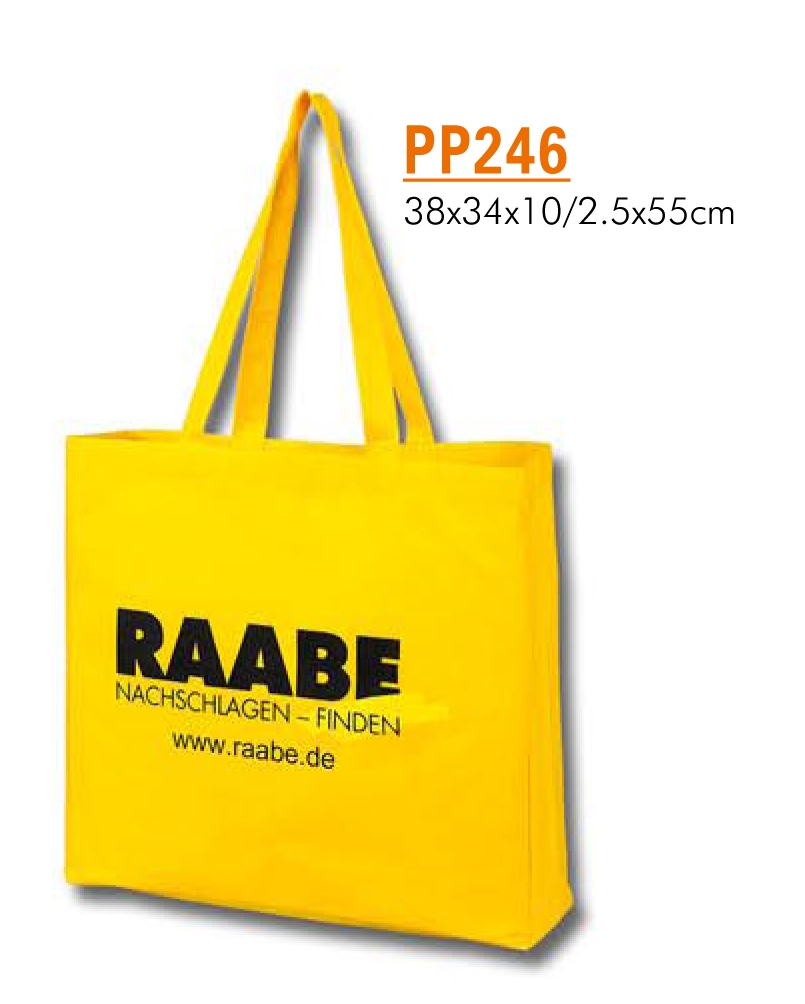
| PP246 | Custom Logo Bag | 100% cotton, recycled cotton, organic cotton, non-woven, polyester, nylon, felt | Not specified in model data | Small, Medium, Large | Silk, transfer, digital, embroidery |
| 1812 | Cosmetic bag | 100% cotton, recycled cotton, organic cotton, felt, polyester, padded fabric | Not specified in model data | Small, Medium, Large | Silk, transfer, digital, embroidery |
| FDV010 | Foldable bag | 100% cotton, recycled cotton, organic cotton, polyester, nylon, non-woven | Not specified in model data | Small, Medium, Large | Silk, transfer, digital, embroidery |
| 4700 | Beach Bag | 100% cotton, recycled cotton, organic cotton, polyester, mesh, nylon, felt | Not specified in model data | Small, Medium, Large | Silk, transfer, digital, embroidery |
| 4530 | Gym Bag | Cotton, polyester, nylon | Waterproof construction | Small, Medium, Large | Silk, transfer, digital, embroidery |
| 23250 | Cooler bag | Polyester + 2 mm foam + aluminium; polyester, non-woven, felt | Insulated, zipper closure, shoulder strap | Not specified in model data | Not specified in model data |
| T25210 | Knitted bag | Polyester yarn | Yarn colours: maximum 6 | Not specified in model data | Logo woven into the bag; MOQ 500 pcs |
Colour is documented as natural or any dyed colour for the tote, shopping, drawstring, custom logo, cosmetic, foldable, beach and gym models. Fields marked as not specified in the model data should be confirmed per order rather than assumed from a similar model.
What the matrix actually tells a buyer
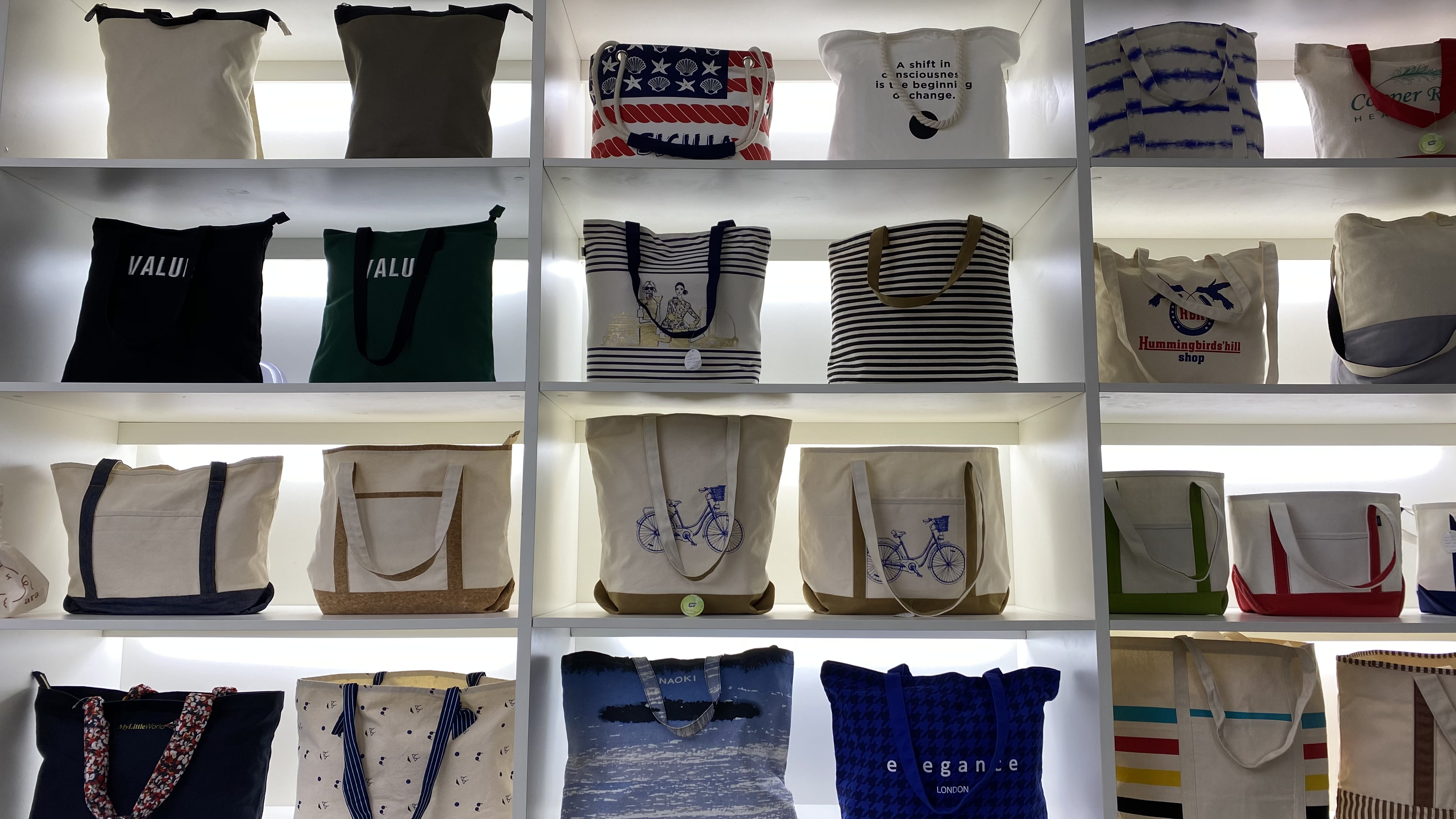
Cotton is three different claims. The tote, shopping, drawstring, custom logo, cosmetic, foldable and beach models each list 100% cotton, recycled cotton and organic cotton as alternatives. Those are not interchangeable from a compliance standpoint: organic cotton depends on organic certification, recycled cotton on recycled-content certification, and conventional cotton on neither. Specifying "cotton" without naming which of the three leaves the claim undefined.
Fabric weight is a quoted specification, not a marketing description. Two weight ranges appear in the model data: 100–450 gsm for the Promotional Shopping Bag (4636) and 100–280 gsm for the Drawstring bag (4211). A buyer who writes a weight band into the purchase order converts a vague durability expectation into a testable requirement.
Synthetic and specialty fabrics are model-bound. Polyester and nylon are documented across the drawstring, custom logo, foldable, beach and gym models. Felt appears only on the custom logo bag, cosmetic bag, beach bag and cooler bag; mesh only on the beach bag; padded fabric only on the cosmetic bag. A request for "any material, any model" does not match how this dataset is structured.
Insulated construction is fixed, not flexible. The Cooler bag (23250) is specified as polyester with 2 mm foam and aluminium, a zipper closure and a shoulder strap. Insulation format is effectively a construction decision rather than a customization variable, so a branded cooler bag programme is best planned around that structure.
Customization beyond the logo
Yulite's documented customization dimensions are logo, colour, material, size, label and packing. That list matters because promotional buyers frequently reduce customization to the logo and then discover, late in the process, that packing or labelling changes carry their own lead time.
- Logo: silk printing, transfer printing, digital printing or embroidery across the tote, shopping, drawstring, custom logo, cosmetic, foldable, beach and gym models. The knitted bag is the exception — its logo is woven into the bag.
- Colour: natural or any dyed colour across the documented models, so body colour and artwork colour are separate decisions.
- Size: Small, Medium and Large on the models where size is recorded.
- Label and packing: documented packing formats include customized box packing, hard box OEM packing and customized paper sleeve packing.
- Production mode: OEM/ODM. The company also documents an independent sampling room and states that samples can be delivered within three days, with free design adjustments and re-sampling for OEM and ODM orders.
Commercial parameters recorded for the programme are a minimum order quantity of 500 pcs, a lead time of 30 days, and a monthly capacity of 200,000 pcs. These three numbers shape scheduling more than they shape pricing: a 40,000-piece event giveaway and a 400,000-piece retail campaign can use the same specification and still need very different production calendars.
Quality control is documented as a three-stage structure — internal inspection, pre-shipment inspection and third-party inspection — and the after-sales terms listed include replacement of defective items in the next order, free remaking, replacement or full refund for defective items, free design adjustments and re-sampling for OEM/ODM orders, compensation for damaged, missing or incorrectly delivered goods, and worldwide valid quality after-sales service.
Printing and embellishment: what four documented methods do
Four logo application methods are documented consistently across the model range: silk printing, transfer printing, digital printing and embroidery. The practical question for a buyer is not which method is superior in general, but which one fits the artwork, the fabric and the order size — and the answer changes with each.
- Silk printing is commonly used for simple, low-colour artwork applied to flat fabric panels such as cotton and canvas, and is typically the economical route where the design has few colours and volumes are steady.
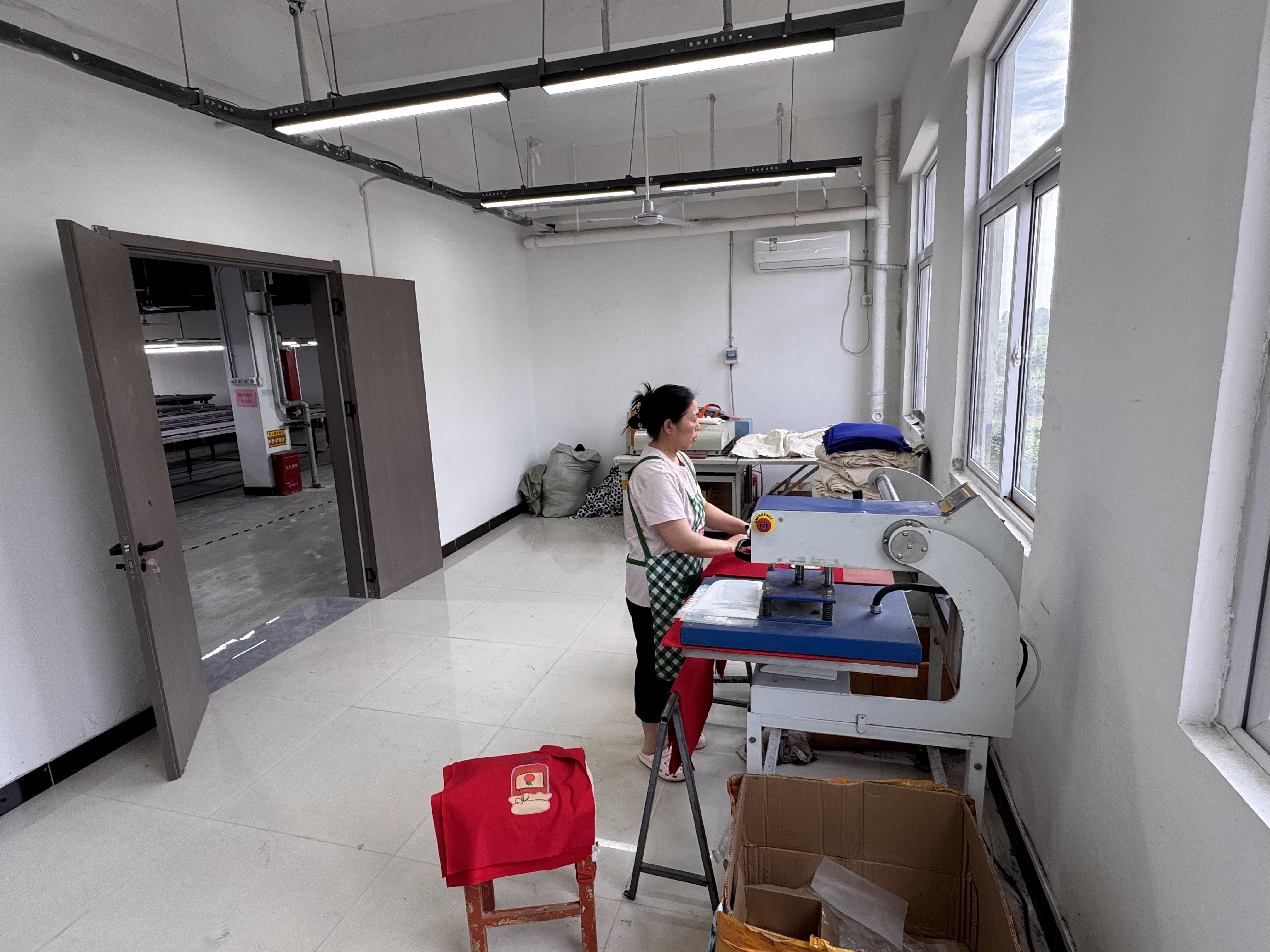
- Transfer printing is generally chosen where artwork carries fine detail or several colours; the method applies a prepared transfer to the bag surface, and the equipment used for it is part of the documented production line.
- Digital printing suits multi-colour or image-led artwork without the per-colour set-up screens of screen printing, which makes it relevant for campaigns that need frequent design changes within one production run.
- Embroidery produces a raised, textured logo and is frequently specified on canvas and heavier cotton bags for a premium finish; it is not a photographic reproduction method.
The Knitted Bag (T25210) sits outside this group. Its logo is woven into the bag, yarn colours are limited to a maximum of six, and the recorded MOQ is 500 pcs. For a full-colour photographic logo, knitted construction is therefore a constraint rather than an option — the design must be reducible to a limited yarn palette.
Sublimation printing also appears in Yulite's programme records, in a German brand corporate buyer project that used RPET polyester fabric covered by GRS certification, with sublimation printing and customized box packing. That is a useful data point for buyers considering recycled polyester: the print method and the recycled-content claim were handled as separate specification items in the same order.
Certification evidence behind organic and recycled claims
Material claims on promotional bags become procurement evidence only when a certificate, an issuing authority and a scope are attached. Yulite's certification records list three credentials that directly affect specification choices.
| Standard | Certificate number | Issued by | Validity | Documented scope |
|---|---|---|---|---|
| GOTS (Global Organic Textile Standard), version 7.0 | GOTS-31172 | INTERTEK | 2026-04-02 to 2027-04-02 | Carried accessories (PC0011); children's apparel (PC0004); worn accessories (PC0012); trading (PR0030). Global market |
| SMETA — SEDEX 4P | ZAA600189756 | BCI Compliance Group Limited | 2026-03-10 to 2027-03-10 | All textile products. Global market |
| GRS (Global Recycled Standard), version 4.0 | ITS-TE-00006853-GRS-03902700 | Intertek | 2026-05-01 to 2027-04-30 | Functional accessories (PC0017); carried accessories (PC0011); hard goods (PC0022); dyed fabrics (PC0025); greige fabrics (PC0026); packaging (PC0023); worn accessories (PC0012); trading (PR0030). Worldwide |
Product-level coverage is recorded as well. The Promotional Shopping Bag (4636) is certified to GRS, SMETA and GOTS. The Custom Logo Bag (PP246) holds a GOTS certification applicable to the global market. The certification for the Drawstring bag (4211) is issued by Intertek. The Beach Bag (4700) is covered by SMETA certification under the SEDEX 4P standard. SMETA coverage is also recorded for the Knitted Bag, the Foldable Bag, the Gym Bag (certification number ZAA600189756) and all textile products including the Foldable Bag.
Three boundaries deserve to be stated plainly, because they affect what a buyer can publish:
- SMETA is a SEDEX 4P social and ethical audit covering all textile products. It supports responsible-sourcing statements; it is not a material composition claim, and it should not be used as evidence of organic or recycled content.
- GOTS covers organic textile claims within its listed scope categories — carried accessories, children's apparel, worn accessories and trading. A product outside those categories is not automatically covered by that certificate.
- GRS covers recycled product claims within its listed categories, from dyed and greige fabrics to carried accessories and packaging. Recycled-content claims also depend on maintaining chain of custody for the recycled input, which is an ongoing documentary obligation, not a one-time approval.
All three certificates run on renewal cycles ending in March and April 2027, which means a multi-year promotional programme should include a certificate expiry check at each reorder rather than a one-off review at onboarding.
Where this capability set is applied
The recorded application profile for these bags covers advertising premiums, department store retail, conferences, exhibitions and events, the cultural travel and hotel sector, beauty products and garments, and educational training services — with markets listed across France, Italy, Spain, Germany, Switzerland, Denmark, Belgium, the United Kingdom, Austria, Australia, Greece, Norway, Sweden and Japan. Project types are documented as brand marketing campaigns, trade show and event projects, and retail promotion projects, with the bags used in everyday manual carrying and repeated use, including shopping loads, event giveaways, travel and storage and laundry transport.
Programme records give a sense of the scale range these specifications support:
- A supermarket programme in Italy ran to 1,000,000 pcs of a 100% cotton canvas shopping bag with a large gusset and two closing strings, over a two-year relationship, with approximately one million pieces sold within a year.
- A German brand corporate buyer ordered 400,000 pcs of an RPET polyester promotional giveaway for peak selling season, using GRS-certified fabric, sublimation printing and customized box packing.
- An Italian ODM custom design client ordered 5,000 pcs of a foldable, heart-shaped shopping bag in 210T RPET fabric with reinforced stitching, double handles, a metal buckle elastic drawstring and dual printing areas.
- A flagship store in Russia ordered 5,000 units of a branded tote programme with a two-year duration, described as durable and high volume.
- Schools in Belgium ordered 5,000 units of a book bag built from heavy cotton canvas with an active dyeing process, colour fastness and large capacity.
- Corporate buyers in Chile ordered 100,000 pcs of promotional giveaways in eco-friendly fabric with light weight and large capacity.
Market signals that shape material choice
Several published data points explain why material documentation has become a purchasing topic rather than a design detail. Canvas is the largest material segment in the tote bag market, while jute is the fastest-growing material segment, according to Market Research Future — a split that reflects the promotional market's preference for printed canvas alongside a rising interest in natural-fibre alternatives.
Recycled polyester supply is expanding in parallel. Custom Market Insights estimates the recycled PET (rPET) market at USD 19.5 billion in 2025, which supports the availability of RPET fabrics for promotional bags. At the category level, Metastat Insights values the global promotional products market at USD 84.4 billion in 2025 with a 3.8% CAGR.
Demand timing also matters. Business Research Insights reports that seasonal promotional campaigns account for 39% of total demand for reusable shopping bags in 2025, and that the garment industry accounts for 17% of reusable bag applications, with 48% of that demand specifically for promotional use. For a supplier running a 200,000 pcs monthly capacity and a 30-day lead time, that seasonality is the practical constraint behind most delivery-date conversations.
Two further signals are worth noting with their reliability limits stated. The Advertising Specialty Institute ranked tote bags as the fifth most-searched category on its ESP platform in 2024, indicating sustained buyer search activity in North America. Separately, Nielsen data cited by BagzDepot indicates that approximately 73% of Millennials and Gen Z consumers prefer to buy from sustainable brands using eco-friendly promotional items; that figure comes from a medium-reliability secondary source and should be treated as directional rather than definitive.
Limits and trade-offs buyers should price in
Capability documentation is only credible when it states where the capability stops. In this dataset, several limits are explicit.
- Material options do not transfer between models. Felt, mesh, padded fabric, non-woven and nylon each appear on a subset of models only. A specification written for one model cannot be assumed valid for another without confirmation.
- Certified materials carry documentation overhead. Organic and recycled claims hold only where the product, the category and the chain of custody fall inside the relevant certificate scope — and those certificates expire in April 2027 (GOTS, GRS) and March 2027 (SMETA), so renewal has to be tracked across a multi-year programme.
- Knitted construction reduces design freedom. The Knitted Bag uses a woven-in logo with a maximum of six yarn colours and a 500 pcs MOQ; it is not a route for detailed multi-colour or photographic artwork.
- Insulated construction is largely fixed. The Cooler bag specification — polyester with 2 mm foam and aluminium, zipper closure, shoulder strap — leaves limited room to re-engineer the insulation format within a promotional budget.
- Capacity is finite. A monthly capacity of 200,000 pcs against a recorded 1,000,000 pcs supermarket programme means large orders must be spread across production periods rather than compressed into one.
- Development resource is modest. The company's documented R&D team is fewer than ten engineers. Structural redesigns and new constructions should therefore be scheduled with realistic sampling time, even though standard logo, colour, material, size, label and packing customization sits within the normal OEM/ODM flow.
Set against a traditional, undocumented supply route — where material is described by a single adjective, printing by a generic term, and compliance by a verbal assurance — the trade-off is straightforward. Documented specifications require the buyer to read scope statements, check certificate validity and freeze a cloth weight in the purchase order. The return is a claim that survives an audit, a client questionnaire or a retail compliance review.
Future outlook
Three movements are likely to shape promotional bag specifications over the next buying cycles. First, recycled-content documentation continues to move from differentiator to baseline: with the rPET market estimated at USD 19.5 billion in 2025, buyers increasingly ask for the certificate number rather than the material name. Second, chemical and labelling rules in the EU and selected US states keep pushing specification detail upstream, from the finished bag to the fabric and dye lot. Third, digital printing lowers the tooling barrier for multi-colour and short-run artwork, which makes design variation within a single programme more practical than it was under screen-printing-only production.
For buyers, the practical implication is that supplier evaluation is shifting from catalogue review to document review — model numbers, weights, printing methods, certificate scopes and expiry dates. Suppliers that can produce those records per model are easier to onboard, easier to audit and easier to keep in a multi-year programme.
Frequently asked questions
Which materials can be specified for promotional tote bags and shopping bags?
The Tote Bag (3800) is documented with 100% cotton, recycled cotton and organic cotton. The Promotional Shopping Bag (4636) is documented as 100% cotton with organic cotton and recycled cotton as alternative materials, in a fabric weight range of 100 gsm to 450 gsm. Colour options for both are natural or any dyed colour, and sizes are Small, Medium and Large.
What fabric weights and sizes are documented across these models?
Two weight ranges appear in the model data: 100–450 gsm for the Promotional Shopping Bag (4636) and 100–280 gsm for the Drawstring bag (4211). Sizes are documented as Small, Medium and Large for the Tote Bag, Promotional Shopping Bag, Drawstring bag, Custom Logo Bag, Cosmetic bag, Foldable bag, Beach Bag and Gym Bag. Weight is not specified in the model data for the remaining models, so it should be confirmed per order.
Which logo methods are available, and how does the knitted bag differ?
Across the tote, shopping, drawstring, custom logo, cosmetic, foldable, beach and gym models, the documented logo methods are silk printing, transfer printing, digital printing and embroidery. The Knitted Bag (T25210) is different: its logo is woven into the bag rather than printed, yarn colours are limited to a maximum of six, and the recorded MOQ is 500 pcs.
What does each certification cover, and what does it not cover?
GOTS (GOTS-31172) covers organic textile claims within its listed scope categories, and GRS (ITS-TE-00006853-GRS-03902700) covers recycled product claims within its listed categories; both are valid until April 2027. SMETA (ZAA600189756) is a SEDEX 4P ethical audit covering all textile products and is valid until March 2027 — it evidences social compliance rather than material composition. Buyers should confirm that their specific product and category fall inside the listed scope before publishing any material claim.
What are the documented MOQ, lead time and production capacity?
The recorded commercial parameters are a minimum order quantity of 500 pcs, a lead time of 30 days and a monthly capacity of 200,000 pcs, under an OEM/ODM production mode. The Knitted Bag separately lists an MOQ of 500 pcs. Programmes in the hundreds of thousands of pieces — one recorded supermarket programme ran to 1,000,000 pcs — need to be scheduled across multiple production months rather than a single batch.
Capability evidence in promotional bag sourcing comes down to records: a model number, a cloth weight, a named printing method and a certificate scope. Buyers who ask for those four items at the evaluation stage generally spend less time resolving specification disputes after the purchase order is issued. Additional product, material and production documentation is compiled in Yulite's 2026 product brochure.