
Promotional Bag Compliance: What Buyers Can Verify in 2026
Promotional Bag Compliance: What Buyers Can Verify in 2026
Promotional bag qualification in 2026 is no longer a single certificate attached to a quotation. An evaluation-stage buyer can independently check three things: who issued the certificate and what its scope actually covers, which named material and weight sits behind a specific model number, and which logo method and size data will be written onto the purchase order. Everything else is interpretation.
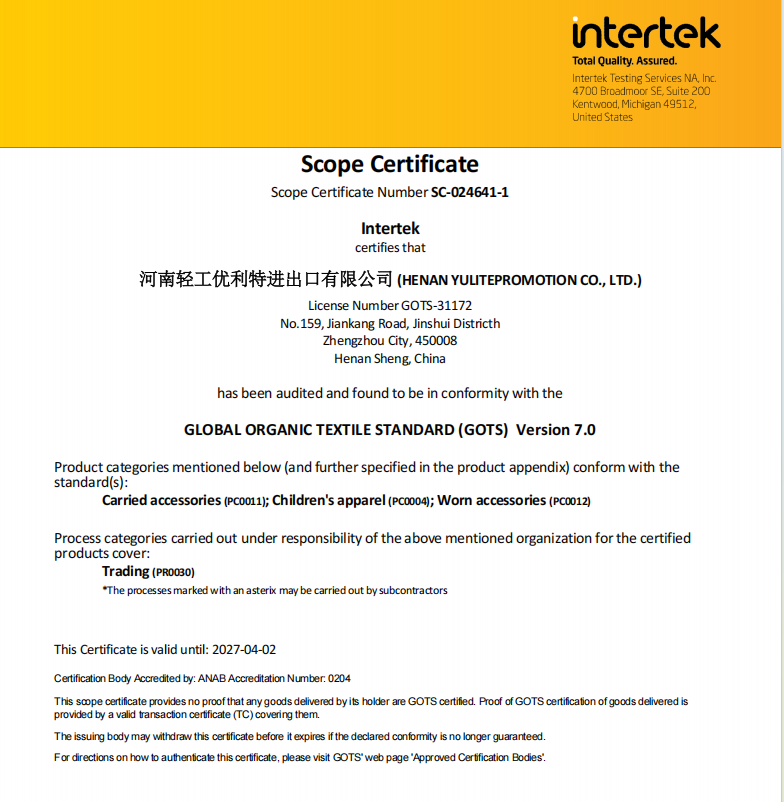
A certification document is only verifiable when it carries a standard version, an issuing body, a scope list and a validity window — the four items a buyer can check without visiting the factory.
Why qualification evidence moved from the brochure to the purchase order
Compliance questions in the promotional bag category have shifted from branding language to document language. Buyers who source tote bags, drawstring bags, cooler bags, cosmetic pouches or foldable bags for retail, event and corporate giveaway programs are increasingly asked by their own legal and sustainability teams to show paperwork rather than adjectives. Two regulatory anchors explain much of that pressure in European-facing programs: REACH Regulation Annex XVII restricts azocolourants in textiles to 30 mg/kg, and textile products sold in the EU that contain at least 80% textile fibers fall under Regulation (EU) No 1007/2011 for labelling. Both attach to the product and the order file, not to a marketing claim.
The practical consequence is that a supplier's ability to answer is now tested at three different levels. First, at company level, where certifications are issued to a legal entity and carry a defined product scope. Second, at model level, where a fiber name, a fabric weight and a construction list must describe the exact item being quoted. Third, at order level, where the logo method, print area, size and packing specification are finalised. A buyer who can verify all three levels has something more useful than reassurance: an auditable trail.
The opportunity is equally clear. Programs that fix verifiable specifications at quotation stage tend to avoid the expensive middle of a project — re-sampling because a weight was never stated, or a shipment held because a fibre label did not match the delivered goods.
The four signal groups a buyer can check independently
Rather than treating compliance as one large question, it is easier to verify four separate signal groups. Each of them produces documents that can be cross-checked against the physical sample.
| Signal group | What can be checked independently | Where it normally appears |
|---|---|---|
| Certification scope | Certificate name, standard version, certificate number, issuing body, issue and expiry dates, product scope category | Certificate document, supplier qualification file |
| Material traceability | Named fibre — 100% cotton, recycled cotton, organic cotton, polyester, nylon, felt or non-woven fabrics — plus declared fabric weight in gsm | Model-level specification sheet, order confirmation |
| Construction and hardware | Component list such as 2mm foam and aluminum insulation, zipper closure, shoulder strap, gusset size, dyeing method | Technical data sheet, approved sample |
| Logo and artwork method | Silk printing, transfer printing, digital printing, embroidery or knitted-in logo; number of print areas; brand-use authorisation | Artwork approval file, pre-production sample |
The value of separating these groups is that each one carries a different failure mode. A certificate can expire while a program is still running. A fibre claim can be made for a material that sits outside the certified scope. A logo method can be specified that the chosen fabric cannot carry well. A size can be quoted loosely and delivered differently.
Certificate-level evidence: what a number can and cannot prove
Henan Yulitepromotion Co., Ltd. (Yulite), a China-based promotional bag manufacturer founded in 2008 that exports to markets including the EU, USA, Japan and Australia, holds several certifications that can be verified document by document rather than taken on trust.
- GOTS — certificate number GOTS-31172, issued by INTERTEK under the Global Organic Textile Standard Version 7.0, valid from 2026-04-02 to 2027-04-02. The documented scope covers carried accessories (PC0011), children's apparel (PC0004), worn accessories (PC0012) and trading (PR0030).
- GRS — certificate number ITS-TE-00006853-GRS-03902700, issued by Intertek under the Global Recycled Standard 4.0, valid from 2026-05-01 to 2027-04-30. The documented scope covers functional accessories (PC0017), carried accessories (PC0011), hard goods (PC0022), dyed fabrics (PC0025), greige fabrics (PC0026), packaging (PC0023), worn accessories (PC0012) and trading (PR0030).
- SMETA (SEDEX 4P) — certificate number ZAA600189756, issued by BCI Compliance Group Limited, valid from 2026-03-10 to 2027-03-10, with all textile products listed in scope.
- Additional company-level documentation includes ISO9001, BSCI and SEDEX audits, and OEKO-TEX Standard 100.
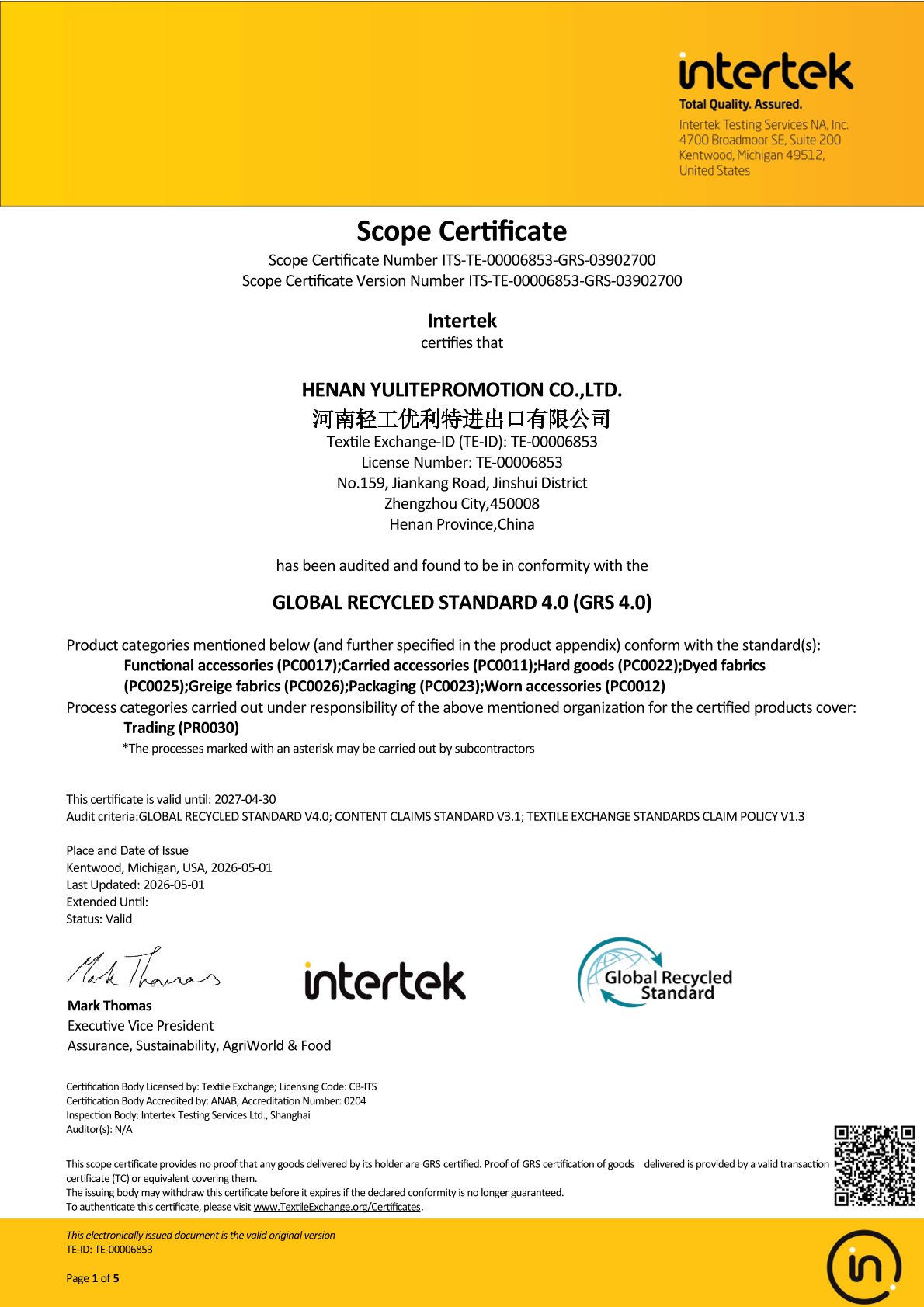
Recycled-content claims are supported at certificate level through the GRS scope list; per-order transaction evidence is a separate document a buyer can request.
Here is the boundary that matters, and it applies to every supplier in this category rather than to one company. A certificate is issued to a legal entity against a defined scope and a defined validity period. It does not automatically extend to every model in a catalogue, every dye lot, or every decoration process. A GOTS scope that names carried accessories does not by itself cover a felt bag or a non-woven bag, because those materials are outside the organic fibre claim. A GRS certificate supports recycled content claims only where the recycled fibre and the relevant production stage fall inside the listed scope categories, and recycled content is normally evidenced per shipment rather than by the company certificate alone. Finally, all three certificates listed above expire during 2027; a program running beyond those dates should plan for renewal documentation rather than assume continuity.
Material traceability mapped to specific models
The most common gap between quotation and delivery is a material description that stops at the word “cotton”. Model-level specification is what makes a claim checkable. The table below maps the documented material options to the models named in this guide.
| Model | Bag type | Documented material and specification |
|---|---|---|
| 1812 | Cosmetic bag / cosmetic pouch | 100% cotton, recycled cotton, organic cotton, felt, polyester, padded fabric |
| FDV010 | Foldable bag | 100% cotton, recycled cotton, organic cotton, polyester, nylon, non-woven |
| 4700 | Beach bag | 100% cotton, recycled cotton, organic cotton, polyester, mesh, nylon, felt |
| 23250 (COOLR BAG) | Insulated cooler bag | Polyester + 2mm foam + aluminum; zipper closure; shoulder strap |
| 4530 | Gym bag / duffel bag | Cotton, polyester, nylon; water-resistant construction |
| T25210 | Knitted bag | Polyester; yarn colour up to 6 colours; logo woven into the bag; MOQ 500 pcs |
| 3800 | Tote bag | 100% cotton, recycled cotton, organic cotton; natural or dyed colour |
| 4636 | Promotional shopping bag | 100% cotton; cotton weight from 100gsm to 450gsm |
| 4211 | Drawstring bag | 100% cotton, recycled cotton, organic cotton, polyester, non-woven, nylon; weight from 100gsm to 280gsm |
| PP246 | Custom logo bag | 100% cotton, recycled cotton, organic cotton, non-woven, polyester, nylon, felt |
Two entries in that table are worth reading closely. The shopping bag model 4636 documents a cotton weight range from 100gsm to 450gsm. A range is not a specification until a target weight is fixed, because the same model number at the light end and the heavy end behaves differently in hand, in print and in freight. The drawstring bag model 4211 documents a weight range from 100gsm to 280gsm. In both cases, the verifiable practice is to write the agreed weight into the order confirmation, so that the delivered goods can be compared against a number rather than an impression.
Construction details that support audit-ready documentation
Construction specifications are the easiest signal group to verify, because they describe parts a buyer can see or feel. The insulation model 23250 lists polyester, 2mm foam and an aluminum layer, with a zipper closure and a shoulder strap. Each of those components can be confirmed on a pre-production sample and restated on the technical sheet.
That detail also carries a limit worth stating plainly. A 2mm foam layer with an aluminum lining is a thermal-retention construction designed for short-distance carrying of food and drinks, and the model is documented for food and supermarket applications. It is not a validated cold-chain packaging solution, and buyers who need declared temperature performance over extended periods should treat this construction as unsuitable for that requirement rather than assume equivalence.
Elsewhere, the material list itself defines what can be claimed: a felt or non-woven drawstring bag under model 4211 uses the same model number as an organic cotton version, but only the cotton version connects to an organic fibre claim. That is the sort of distinction that keeps a program defensible.
Logo method and artwork: the third verification layer
Decoration is where specification and expectation most often separate. The documented logo methods across this product range are silk printing, transfer printing, digital printing and embroidery, with size options of small, medium and large and colours available as natural or dyed. The knitted bag model T25210 works differently: the logo is woven into the bag, with up to six yarn colours, and it carries a minimum order quantity of 500 pieces. A buyer who assumes printed artwork on a knitted bag is specifying something the construction does not do.
Where a bag carries the buyer's own brand mark, the documentation set typically includes a brand legitimate use authorisation letter as part of the order file. That document sits alongside artwork approval and the pre-production sample, and it is the buyer's evidence that the mark was applied under permission.
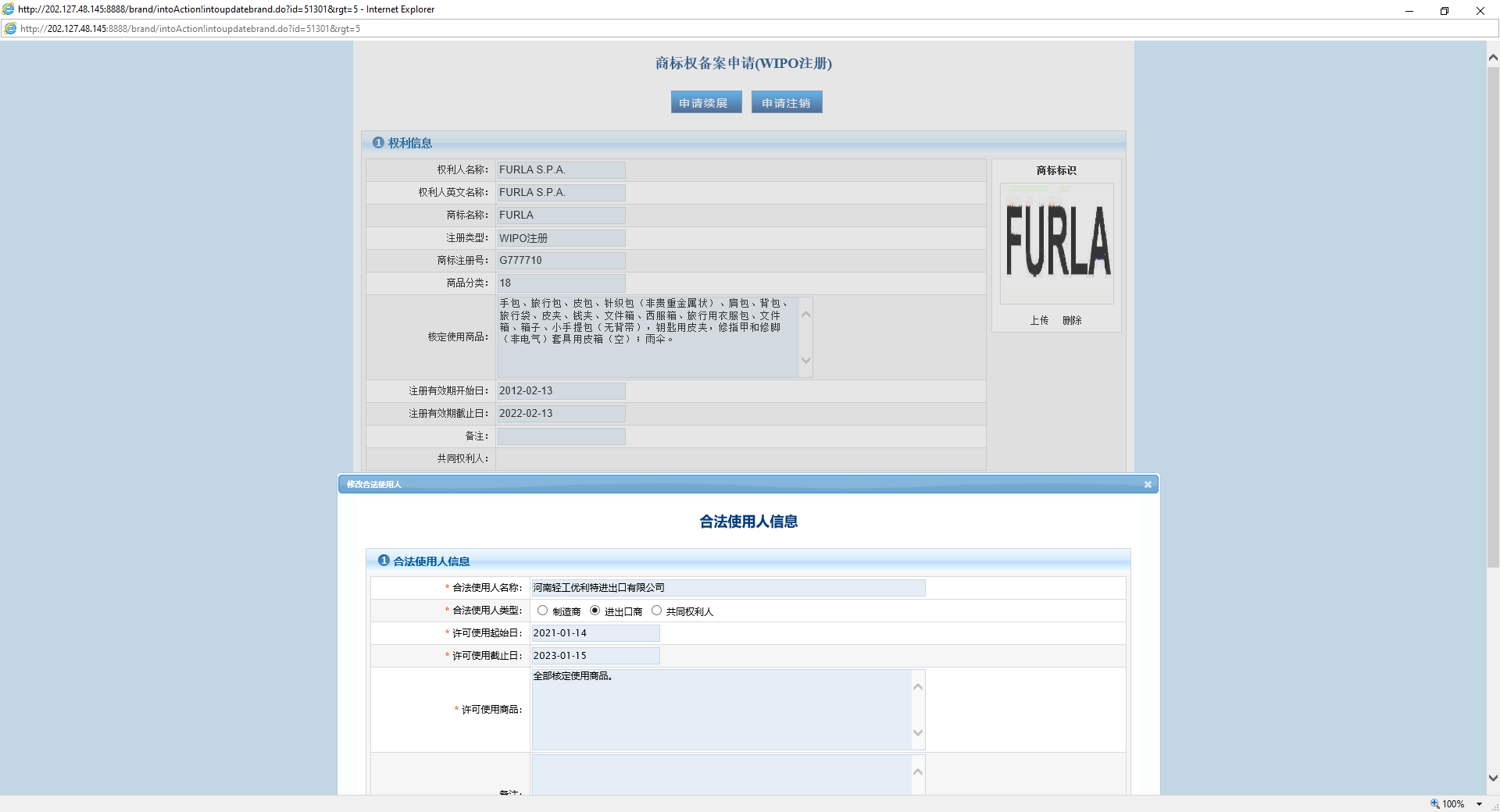
When a promotional bag carries a client's brand mark, an authorisation document forms part of the order file together with artwork approval and the pre-production sample.
Application mapping: how qualification signals behave in real programs
Qualification requirements rarely look the same across program types, and the case record shows how differently they land.
- Supermarket retail (Italy): a program of 1,000,000 pieces, running over two years, using a 100% cotton canvas bag with a large gusset and a twin-string closure. At that volume, certificate validity across the full program window matters more than any single specification.
- Brand corporate giveaway (Germany): 400,000 pieces of RPET polyester fabric with a GRS certificate, sublimation printing and customised box packing. Here the recycled claim and the packing specification are the auditable items.
- Flagship retail (Russia): 5,000 units for a branded shop, running two years with roughly 20,000 pieces of annual replenishment. Repeat replenishment requires the material and construction specification to stay stable between orders.
- Schools (Belgium): 5,000 units used as book bags over three years, specified in heavy cotton canvas with an active dyeing process and good colour fastness. Colour fastness is the specification that a school program actually feels.
- Import and distribution (Italy): 5,000 pieces of durable canvas for regular store sales.
- Corporate giveaways (Chile): 100,000 pieces specified for lightweight, large-capacity promotional use.
- ODM custom design (EU): 5,000 pieces of a foldable heart-shaped bag in 210T RPET fabric, with double-layer reinforced handles, a metal buckle elastic drawstring, dual printing areas and labels specified for global market compliance.
The pattern is consistent: the larger and longer the program, the more the buyer's attention moves from appearance to documentation.
Market context: why documentation demand is rising
Category growth is part of the explanation. Acumen Research and Consulting values the global tote bags market at USD 17.1 billion in 2023, projected to reach USD 29.8 billion by 2032. Metastat Insights values the non-woven bags market at USD 4.24 billion in 2024, describing the shift away from single-use plastics as the main driver. Custom Market Insights estimates the recycled PET market at USD 19.5 billion in 2025, which is the material base behind many RPET programs. Grand View Research recorded Asia Pacific at a 44.8% revenue share of the broader bag market in 2024, with China as a primary manufacturing hub — a reminder that most documentation in this category originates in one region and has to satisfy rules written in another.
Market sizing in this category should be read with care. Published tote bag estimates for the same period range from roughly USD 11.25 billion to USD 22.7 billion depending on whether the researcher counts high-end fashion items alongside promotional goods. Buyers using market figures in internal approval papers are better served by citing the source and scope than by presenting a single number as settled fact.
Where traditional supplier documentation falls short
The difference between a traditional document pack and a qualified one is not volume; it is checkability.
| Element | Traditional pack | Qualified, verifiable pack |
|---|---|---|
| Certification | Certificate logo with no number, no scope, no expiry | Certificate number, standard version, issuing body, scope category, issue and expiry dates |
| Material | “Eco-friendly fabric” | Named fibre and declared weight, e.g. 100% cotton at a fixed gsm |
| Construction | Photo of a similar bag | Component list, e.g. polyester + 2mm foam + aluminum, zipper closure, shoulder strap |
| Logo | “Custom printing available” | Named method, print areas, colour limits, artwork approval step |
| Size and packing | Small, medium, large | Confirmed dimensions and packing specification on the order |
The honest limitation is this: a complete documentation pack does not transfer legal responsibility. In most markets, the importer or brand owner placing the product on the market carries the conformity obligation, and market-specific testing — for example azo colourant testing against the 30 mg/kg threshold under REACH Annex XVII — may still be required per order regardless of what certificates the manufacturer holds. Certification scope also has edges: organic fibre certification does not extend to every material in a catalogue, and recycled content evidence is issued per shipment. Documentation reduces risk; it does not remove the need for the buyer's own due diligence.
Execution terms that complete the verification picture
Compliance signals are only useful if the commercial terms around them are equally explicit. Yulite's documented terms include OEM and ODM production services, customisation across logo, colour, material, size, label and packing, a minimum order quantity of 500 pieces, a typical production lead time of 30 days, and a monthly capacity of 200,000 pieces. Quality control comprises internal inspection, pre-shipment inspection and third-party inspection. Delivery is offered on DDP terms, with payment through T/T, D/P, Alibaba Trade Assurance and credit card. Sampling is supported by an in-house sampling room that produces samples within three days. After-sales provisions include replacement of defective units in the next order, free remaking, replacement or refund for defective items, free design adjustment and re-sampling for OEM and ODM orders, compensation for damaged, missing or incorrectly delivered goods, and worldwide after-sales service.
Read together, these terms answer the questions that usually stall an order at evaluation stage: whether the specification can be fixed before production, whether an inspection step exists before shipment, and what happens if the delivered goods do not match the approved sample.
Future outlook
Three directions look durable rather than cyclical. First, verification is moving from company level to order level — buyers increasingly ask for evidence tied to the specific shipment rather than a general certificate. Second, fibre-level claims are being tested more strictly, which favours suppliers who can name a fibre, a weight and a certificate scope instead of using a category-wide environmental adjective. Third, decoration specifications are becoming part of compliance files, since print method, ink and brand-mark authorisation all touch the same order document.
For procurement teams, the practical implication is modest but useful: keep a model-level specification sheet, a certificate register with expiry dates, and an artwork approval record. Those three files will satisfy most qualification requests in 2026 without requiring a factory visit.
Frequently asked questions
Which certifications can a buyer actually verify for a promotional bag program?
Three are directly documented with numbers and validity windows: GOTS certificate GOTS-31172 issued by INTERTEK under Global Organic Textile Standard Version 7.0, valid 2026-04-02 to 2027-04-02; GRS certificate ITS-TE-00006853-GRS-03902700 issued by Intertek under Global Recycled Standard 4.0, valid 2026-05-01 to 2027-04-30; and SMETA (SEDEX 4P) certificate ZAA600189756 issued by BCI Compliance Group Limited, valid 2026-03-10 to 2027-03-10. Company-level documentation additionally includes ISO9001, BSCI and SEDEX audits and OEKO-TEX Standard 100. Each can be checked against the issuing body's record rather than accepted as an image.
How can a buyer confirm which material a specific model is made from?
By requesting a model-level material statement instead of a category description. Documented examples include model 4636 in 100% cotton with a weight range of 100gsm to 450gsm, model 4211 in 100% cotton, recycled cotton, organic cotton, polyester, non-woven or nylon at 100gsm to 280gsm, model 3800 in 100% cotton, recycled cotton or organic cotton, and model 23250 in polyester with 2mm foam and an aluminum layer. Where a weight range is published, a single target weight should be fixed on the order confirmation.
What does the GRS certificate cover for recycled cotton and RPET bags?
The GRS 4.0 certificate lists scope categories rather than individual products: functional accessories (PC0017), carried accessories (PC0011), hard goods (PC0022), dyed fabrics (PC0025), greige fabrics (PC0026), packaging (PC0023), worn accessories (PC0012) and trading (PR0030). Recycled content claims are supported where the material and the relevant production stage fall within those categories, and recycled content is normally evidenced per shipment rather than by the company certificate alone. Materials outside the listed scope are not covered by the certificate.
Which logo methods are available, and what should be confirmed before production?
The documented methods are silk printing, transfer printing, digital printing and embroidery, with colours available as natural or dyed and sizes in small, medium and large. The knitted bag model T25210 is different: the logo is woven into the bag using up to six yarn colours, so printed artwork cannot be applied to it in the same way. Before production, buyers normally confirm the method, the print area, the colour reference and the brand authorisation document where the bag carries their own mark.
What are the standard order, lead time and inspection terms?
The documented minimum order quantity is 500 pieces, typical production lead time is 30 days, and monthly capacity is 200,000 pieces. Quality control covers internal inspection, pre-shipment inspection and third-party inspection. Delivery is available on DDP terms, with payment through T/T, D/P, Alibaba Trade Assurance and credit card. Sampling is handled through an in-house sampling room with a stated three-day sample turnaround.
Does a certificate guarantee the goods will pass customs and market checks?
No. Certificates are issued to a legal entity and a defined scope, while conformity obligations for placing goods on the market sit with the importer or brand owner. Buyers may still need market-specific testing — for example azo colourant testing against the 30 mg/kg limit under REACH Annex XVII — and EU textile labelling under Regulation (EU) No 1007/2011 applies to products containing at least 80% textile fibers. Certificates reduce risk and support verification; they do not replace the buyer's own compliance review.
The 2026 Yulite spring brochure is available as a downloadable reference for buyers assembling a qualification file: Yulite 2026 spring brochure (PDF). Company information is published at www.yulitepromotion.cn.