
Promotional Bag Procurement FAQ: 1812 Specs, Logo Methods, Acceptance Criteria
Promotional bag orders rarely fail because a factory cannot make the bag. They fail because the specification never became a document — a material written as a single word, a logo method assumed but never approved, a size grade that stayed “medium” all the way into the purchase order.
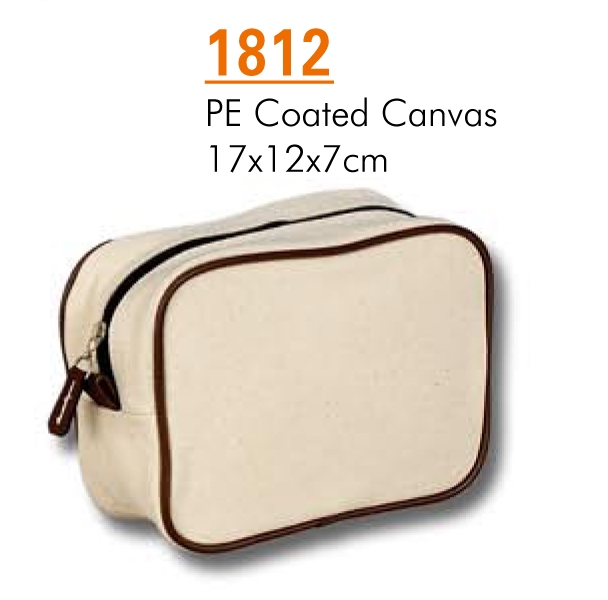
This reference works through the questions buyers actually ask, using the model 1812 cosmetic bag as the worked example because it carries material, decoration and size inside one bill of materials. The same logic is then extended to the 23250 COOLR BAG, the 4530 waterproof gym bag and the 4636 cotton canvas shopping bag, and it closes on the acceptance questions worth settling before a purchase order is signed.
Why model 1812 works as a specification stress test
Model 1812 is a promotional cosmetic bag, also described as a make-up bag or cosmetic pouch, and it is offered in two structural forms: a zipper cosmetic pouch and a drawstring cosmetic bag. The same model is available in six materials, four logo methods, three size grades and two colour states, and it is intended for promotional use across all industries.
That concentration is what makes it useful. Every variable that appears on a small pouch has a counterpart on a tote, a drawstring bag or a cooler bag, and the questions that surface here are the same questions that stall a larger order three weeks later.
| Documented field | What is recorded for model 1812 |
|---|---|
| Product type | Promotional cosmetic bag; also classified as a make-up bag and cosmetic pouch |
| Structure | Zipper cosmetic pouch or drawstring cosmetic bag |
| Material options | 100% cotton, recycled cotton, organic cotton, felt, polyester, padded fabric |
| Size grades | Small, medium, large |
| Colour states | Natural or any dyed colour |
| Logo methods | Silk printing, transfer printing, digital printing, embroidery |
| Intended use | Promotional use across all industries |
The documented fields stop at the size grade. No millimetre dimensions are published for small, medium or large, so physical size has to be fixed through a confirmed sample rather than inferred from the grade name.
What do the six material options on model 1812 actually mean?
Six materials are listed for 1812: 100% cotton, recycled cotton, organic cotton, felt, polyester and padded fabric. They are separate line-item options, not interchangeable synonyms.
- 100% cotton — the standard textile option, and the default a supplier will assume if the purchase order says only “cotton”.
- Recycled cotton — listed as its own option, so a recycled-content requirement has to be written as recycled cotton, not left inside a generic cotton line.
- Organic cotton — also a separate option. If the brand claim depends on organic fibre, the specification must say organic cotton.
- Felt — recorded as a distinct material option alongside the woven cotton choices.
- Polyester — the synthetic option on this model.
- Padded fabric — a padded construction, which means the material line carries a layered build rather than a single flat textile.
The procurement consequence is simple. A material field that reads “cotton” removes three meaningful choices from the order, and a supplier is entitled to treat what is written as what was bought. Buyers who need recycled or organic content should name it in the specification and repeat it in the sample approval, because those are the two documents that carry the claim forward.
Silk printing, transfer printing, digital printing, embroidery — how should a buyer choose?
All four logo methods are listed for 1812: silk printing, transfer printing, digital printing and embroidery. Each is a decoration route, and the choice is a sample-approval question rather than a catalogue question.
- Silk printing — recorded as an available method on the model.
- Transfer printing — recorded as an available method on the model.
- Digital printing — recorded as an available method on the model.
- Embroidery — recorded as an available method on the model. Embroidery is stitched, so the artwork has to be expressed as thread colour and stitch form rather than as a printed colour reference.
Because four methods sit on one model, the logo decision is really three decisions taken together: the method itself, the exact colour (ink or thread), and the logo dimension and placement. Missing any one of the three is enough for an approval sample to disagree with production.
How should size and colour be locked on 1812?
1812 is offered in small, medium and large, with colour in natural or any dyed colour. Both are recorded fields, and both stay unconfirmed until a sample confirms them.
On size, the grade name is internal shorthand. A purchase order that specifies “medium” has not yet specified a bag; it should point to either measured dimensions or a signed sample reference. On colour, the natural state and the dyed state are different procurement paths. If a dyed colour is required, the colour is matched to a physical swatch that both parties hold — not to a screen rendering or a brand hex code alone.
What does the 23250 COOLR BAG add that 1812 does not cover?
The COOLR BAG 23250 is an insulated cooler bag, classified as a thermal bag, a picnic cooler bag, a lunch cooler bag and a 6-can cooler bag. It has a zipper closure and a shoulder strap for carrying, and it is intended for the food and supermarket industry with typical use in picnic and lunch-carrying scenarios.
Its insulation is written into the specification: polyester with 2mm foam and aluminum. Available material options are polyester, non-woven fabric and felt.
That is the difference that matters at the quotation stage. “Insulated” is a category word; polyester plus 2mm foam plus aluminum is a construction. Where a programme depends on the bag behaving as a thermal bag, the construction is the part to carry into the purchase order and to check against the sample, alongside the zipper closure and shoulder strap that define how the bag is actually used.
Where does the waterproof gym bag 4530 fit?
Model 4530 is a gym bag, classified as a waterproof gym bag and a gym duffel bag, and it belongs to both the duffel bag and waterproof bag categories. It is intended for the sports industry and designed for use in sports scenarios, and it is available in small, medium and large.
The material line is where the specification gets decided. 4530 can be made of cotton, polyester or nylon, and all three are listed options. A purchase order that names only “waterproof gym bag” has therefore not yet chosen the material the bag will be made from. Buyers should name the fibre explicitly and confirm it against the approved sample, especially where a programme is running in parallel across gym, travel and event categories.
What does 100gsm–450gsm mean on the 4636 shopping bag?
Model 4636 is a Promotional Shopping Bag, classified as a cotton canvas shopping bag and made of 100% cotton, with organic cotton and recycled cotton listed as material options. Its cotton weight, or fabric weight, runs from 100gsm to 450gsm.
That range is exactly where buyers get caught. A 100gsm to 450gsm spread is a four-and-a-half-fold difference inside one model number, and “cotton canvas shopping bag” on its own hides the single most important variable in the order. Fabric weight drives how substantial the bag feels and how it handles, and it has to be pinned to a single figure in the purchase order, referenced to a confirmed sample rather than left as an open range.
The same discipline applies across the wider range, whether the item is a tote bag, a drawstring bag, a foldable bag, a beach bag or a custom logo bag: record the material, record the weight where a weight is offered, and confirm the combination on a physical sample.
Which acceptance questions should be settled before confirming an order?
Acceptance is a conversation, not a clause. The nine questions below, asked before the purchase order rather than after it, remove most of the rework risk in a promotional bag programme.
- Which specifications are written down and locked? Material, fabric weight, size, colour state, logo method, logo position and logo dimension — each as a checkable value rather than an adjective.
- Which sample is the approved sample? The pre-production approval sample is the reference for everything else. Yulite operates an independent sampling room with professional sample workers and can deliver samples within 3 days, which leaves room for sign-off before bulk production; that sampling turnaround is a sampling capability, not a production lead time.
- How is colour confirmed? On a model offered in natural or any dyed colour, the colour should be approved against a physical swatch held by both parties.
- Is the logo confirmed by method, size, position and colour together? One line covering all four, not the word “logo” on its own.
- How is inspection carried out? Ask for the inspection process to be described, and ask what triggers a rework decision. Yulite states that it maintains an independent and professional quality inspection process.
- Which compliance documents apply to the destination market? Depending on the market, this includes REACH Regulation Annex XVII, which restricts azocolourants in textiles to 30 mg/kg, and Regulation (EU) No 1007/2011, under which textile products containing at least 80% textile fibres must comply with EU labelling requirements. Yulite also holds ISO9001, OEKO-TEX Standard 100 and GRS certifications and has passed BSCI and SEDEX audits.
- What production evidence is available? Yulite operates a 15,000 square metre facility with approximately 200 staff, an annual production capacity of 20,000,000 pieces, and a stable daily output of 30,000 to 50,000 pieces.
- How is packaging defined? Carton quantity, inner packing, shipping marks, and the language required on any textile label.
- How are changes handled? Who signs off a material or colour substitution after approval, and at what point the order stops accepting changes.
Some of these are facts a supplier can document. Others are decisions the buyer has to put in writing. Both belong in the file before the order, not in the email thread after the first shipment.
Which market data belongs in the specification brief?
Three or four published figures are usually enough to explain why a programme is being run at all. The global tote bags market was valued at USD 17.1 billion in 2023 and is projected to reach USD 29.8 billion by 2032, according to Acumen Research and Consulting. Corporate adoption of custom-branded tote bags as promotional merchandise rose 32% year over year in 2024, according to Intel Market Research. Tote bags were the fifth most-searched category on the ESP platform in 2024, according to the Advertising Specialty Institute.
Two further figures are useful when the brief touches material choice. Seasonal promotional campaigns accounted for 39% of total demand for reusable shopping bags in 2025, according to Business Research Insights, and the recycled PET market was estimated at USD 19.5 billion in 2025 by Custom Market Insights — the scale behind the recycled and organic options that appear on models such as 1812 and 4636.
These numbers belong in the brief as reasons, not decoration. A specification that cites one relevant figure and then moves to material, weight and acceptance criteria is stronger than one that lists six figures and no measurable requirement.
What this specification model does not cover
Treating 1812 as a universal bag is the mistake worth naming. It is a cosmetic pouch built for containment and presentation, not a load-bearing retail carrier. A programme that needs high-capacity carrying, repeated loading or a retail checkout format should be looking at the 4636 cotton canvas shopping bag or a larger tote structure rather than at a small pouch.
Three other boundaries are worth stating plainly. Sizes on 1812 are given as small, medium and large with no published millimetre dimensions, so dimensional control depends entirely on the approved sample. The insulation construction in this range belongs to 23250, not to 1812, so thermal expectations cannot be carried across model lines. And the 3-day sampling turnaround is a sampling capability — it should not be read as a bulk delivery commitment.
What this means for the next buying cycle
Several signals point the same way. Seasonal demand is concentrated rather than spread, with seasonal promotional campaigns accounting for 39% of reusable shopping bag demand in 2025, which rewards buyers who lock specifications before capacity is booked. Material expectations are shifting too: 73% of Millennials and Gen Z consumers say they prefer to buy from sustainable brands using eco-friendly promotional items, according to Nielsen data cited by BagzDepot — a preference that maps directly onto the recycled cotton and organic cotton options already offered on models like 1812 and 4636.
On the supply side, promotional bags continue to be a mainstream category rather than a niche one, with tote bags ranked fifth in ESP searches in 2024 and custom-branded adoption up 32% year over year. The practical reading for procurement teams is not that bags are suddenly complicated. It is that the same variables — material, weight, logo method, size, colour and acceptance criteria — are now asked about earlier, and answered with documents rather than assumptions.
FAQ
What materials can the 1812 cosmetic bag be made from?
Model 1812 can be manufactured from 100% cotton, recycled cotton, organic cotton, felt, polyester or padded fabric. These are separate material options rather than equivalents, and the chosen option is what the purchase order and the approved sample should reference.
Which logo methods are available on model 1812?
Four methods are listed for 1812: silk printing, transfer printing, digital printing and embroidery. The method, the colour, and the logo size and position are approved together on a physical sample.
How does the 23250 COOLR BAG provide insulation?
The COOLR BAG 23250 uses polyester with 2mm foam and aluminum, and it has a zipper closure and a shoulder strap. Available material options are polyester, non-woven fabric and felt. It is classified as a thermal bag, picnic cooler bag, lunch cooler bag and 6-can cooler bag, and is intended for the food and supermarket industry.
What fabric weight range does the 4636 shopping bag cover?
The Promotional Shopping Bag 4636 is a cotton canvas shopping bag made of 100% cotton, with organic cotton and recycled cotton options, and its cotton weight ranges from 100gsm to 450gsm. The specific weight should be fixed in the purchase order rather than left as a range.
What should be confirmed before a promotional bag order is placed?
Before ordering, buyers should confirm the approved pre-production sample, the material and fabric weight, the colour swatch, the logo method with its size, position and colour, the inspection process, the compliance documents required for the destination market, and the packaging specification. These are the points where an approval sample and a production run most often diverge.
The full promotional bag range, including cotton and canvas bags, tote bags, drawstring bags, foldable bags, cosmetic pouches, cooler bags and recycled or organic material options, is available in the Yulite 2026 spring catalogue.
Есть вопросы или нужны дополнительные детали?
Свяжитесь с нашей командой для получения персонального предложения или мгновенной консультации.
Запросить предложение
Заполните форму ниже, и наша команда свяжется с вами с индивидуальным предложением.
Прямой чат WhatsApp
Предпочитаете общаться в реальном времени? Напишите нам в WhatsApp для мгновенной помощи и быстрых ответов.
- Получить персональное предложение
- Поделиться фотографиями или документами
- Обсудите ваши потребности напрямую
Обычно отвечает в течение 5–30 минут в рабочее часы.