
Promotional Bag Programs: Execution Risks and Manufacturer Continuity Checks
Industry Reference · Promotional Bags · Supplier Continuity
Once a promotional bag purchase repeats across seasons, the real supplier question stops being unit price and becomes delivery continuity, quality consistency and compliance stability.
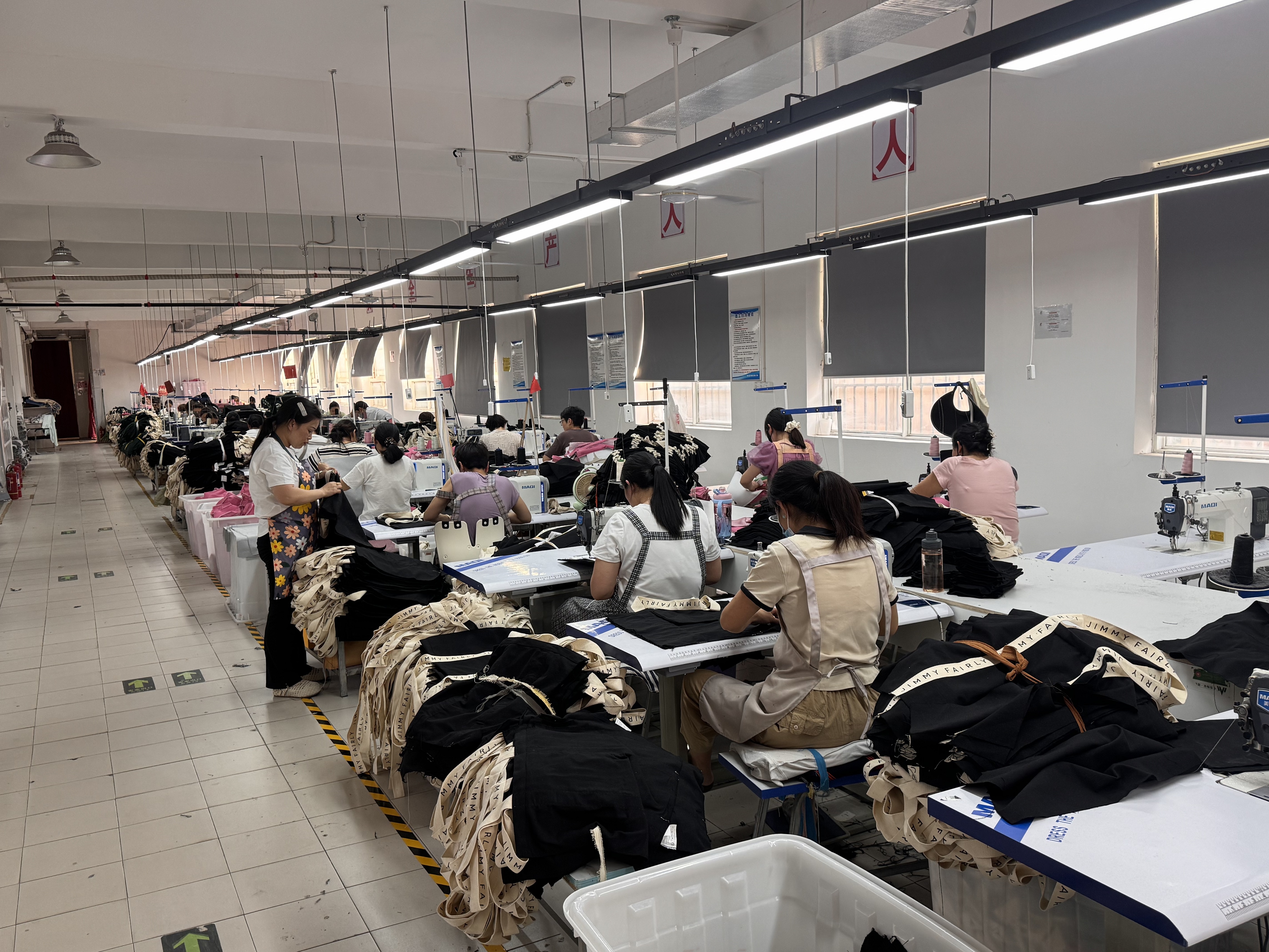
Backup production capacity is one of the documented execution controls in Yulite's delivery-risk planning.
Repeat buyers in the promotional merchandise market are increasingly treating bags as a scheduled program rather than a one-time print job. A retail chain that buys a promotional shopping bag for one quarter often reorders the same specification for the next. An exhibition organizer that commissions promotional tote bags for one city repeats the purchase in the next city. Once purchases become recurring, the central decision shifts from finding the lowest quote per batch to verifying that a manufacturer can hold delivery timing, product quality and regulatory compliance steady across multiple order cycles.
This article examines that execution-stage decision for promotional bag sourcing. It uses a documented exporter case — Henan Yulitepromotion Co., Ltd., better known as Yulite, a China-based promotional bag manufacturer founded in 2008 that sells 100 percent of its output to buyers in the EU, USA, Japan and Australia — to illustrate the kind of evidence procurement teams should review before committing to a long-term program rather than a single shipment.
Why recurring promotional bag demand changes the buying decision
Several market signals point toward program-driven, repeatable demand for promotional bags rather than incidental one-off buying. Tote bags were the fifth most-searched category on the Advertising Specialty Institute ESP platform in North America in 2024, and corporate adoption of custom-branded tote bags as promotional merchandise rose 32 percent year over year in 2024, according to Intel Market Research. Seasonal promotional campaigns accounted for roughly 39 percent of total demand for reusable shopping bags globally in 2025, according to Business Research Insights.
The underlying market is also expanding. Acumen Research and Consulting valued the global tote bag market at USD 17.1 billion in 2023 and projected USD 29.8 billion by 2032. Within the broader industry, the global promotional products market — a category that includes bags — was estimated at USD 84.4 billion in 2025 with a 3.8 percent CAGR, according to Metastat Insights.
Program-driven demand changes the risk profile. Late delivery no longer affects one event; it delays a retail rollout or pushes back a member campaign. A color mismatch or a shifting logo position does more than harm a single batch; if the factory does not control material lots and print processes, the same defect can reappear on the next reorder. As a result, buyers at the decision and execution stage should evaluate operational evidence, not only sample aesthetics.
The execution risk list for repeat promotional bag orders
A recurring promotional bag program concentrates several risks that matter less in one-off purchasing:
- Delivery timing. Bags must arrive before a trade show, a store opening or a seasonal promotion. Yulite's documentation describes delivery risk control through a strict order planning system that reserves enough production time for each order before production begins.
- Production interruption. Power shortages or single-workshop bottlenecks can push an entire batch past its ship date. Yulite's contingency planning includes own power generation equipment and backup sub-factory capacity.
- Quality drift across lots. When an order repeats six months later, fabric differences can cause visible inconsistency. Pre-production laboratory testing of each fabric lot is one documented method that Yulite applies before mass production.
- Compliance continuity. Materials and finished bags must satisfy the same regulatory requirements each cycle. In the EU, for example, textile products must comply with REACH Annex XVII, which restricts azocolourants to 30 mg/kg, and textile labeling rules under Regulation (EU) No 1007/2011 apply to products containing at least 80 percent textile fibers.
Documented evidence: how Yulite turns capacity into continuity
Instead of inferring reliability from marketing language, a buyer can examine manufacturing facts that are documented in the supplier's own operating profile. Yulite was founded in 2008 and works as an export-focused promotional bag manufacturer. Its product range spans cotton and canvas bags, tote bags, drawstring bags, foldable bags, cosmetic pouches, backpacks, cooler bags, polyester and nylon bags, RPET and recycled cotton bags, RPET felt bags and non-woven bags.
For recurring programs, the most relevant documented figures include a monthly production capacity of 200,000 pieces and a factory equipped with a Yulite digital printing machine, which supports in-house printing for custom logo work. The company also documents contingency plans based on three operational measures:
- Reserving enough production time for each order rather than compressing schedules;
- Maintaining own power generation equipment so that production is not stopped by power shortages;
- Using sub-factory capacity to complete orders together when internal load is high.
From a buyer's perspective, these measures are not promotional adjectives. They are answers to specific execution questions: What happens if the main workshop is overloaded? What happens if the local power supply is interrupted? Does the factory leave schedule buffer for reorders? The documented answers are backup capacity, on-site power generation and planned time reserves.
Technical baseline: equipment and order planning
Execution reliability also depends on how a factory converts raw fabric into finished, printed bags. In Yulite's documented operation, the presence of a Yulite digital printing machine indicates that certain customized print jobs can be handled with in-house digital equipment, reducing dependence on external print shops during peak order periods. This matters for repeat programs because printing consistency between the first order and the third order depends on the same machines, the same operators and the same print calibration being available each time.
Order planning is the second technical layer. A monthly capacity figure, taken alone, does not guarantee on-time delivery. Yulite's approach ties capacity to scheduling by reserving enough production time for each order. That practice is especially relevant when buyers combine several bag models — a promotional tote bag for one campaign and a matching drawstring bag for another — because combined programs can be consolidated into planned production slots.
Quality consistency across re-orders
Quality drift is one of the quietest risks in a repeat promotional bag program. The first batch passes inspection, but the second batch arrives with a slightly different shade of canvas or a less durable zipper. Suppliers that control materials before production reduce this risk.
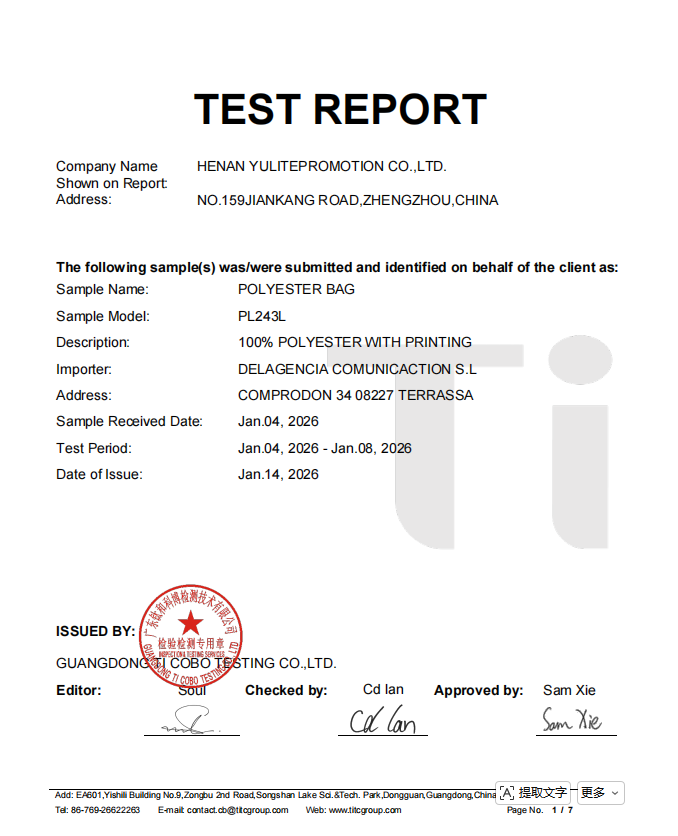
Documented material testing is part of Yulite's pre-production quality control for each fabric lot.
Yulite's risk-control documentation states that, for excessive heavy metals, the company performs a laboratory test on each lot of fabric before mass production. This testing step aligns with the EU regulatory framework that restricts certain substances in textile products and gives buyers a documented checkpoint for compliance-sensitive markets.
At the order acceptance level, Yulite's procurement support documentation lists pre-shipment testing and third-party inspection as accepted acceptance methods. For a buyer running multiple order cycles, an explicit acceptance clause — including third-party inspection — is a stronger protection than relying on a single final visual check.
Application scenarios for multi-cycle sourcing
Promotional bag programs appear across several identifiable buying scenarios. The table below connects each scenario to bag categories in Yulite's documented product range and to representative catalog models.
| Program scenario | Typical promotional bag categories | Documented catalog example |
|---|---|---|
| Retail reusable shopping programs | Promotional shopping bag, tote bag, canvas bag, non-woven bag | Shopping bag model 4636, tote bag model 3800 |
| Exhibitions, conferences and brand events | Custom logo bag, drawstring bag, custom printed bag | Custom logo bag model PP246, drawstring bag model 4211 |
| Seasonal and travel-oriented campaigns | Foldable bag, travel bag, backpack bag | Foldable bag model FDV010 |
| Hotel, beauty and personal care gifting | Promotional cosmetic bag, cosmetic pouch | Cosmetic bag model 1812 |
| Sports, fitness and outdoor programs | GYM bag, duffel bag, beach bag, cooler bag | GYM bag model 4530, beach bag model 4700, cooler bag model 23250 |
| Fashion, retail and textile-brand merchandise | Knitted bag, canvas tote, RPET bag | Knitted bag model T25210 |
These scenarios share a common trait: demand is likely to repeat. Retailers restock shopping bags throughout the year; event teams order drawstring bags for multiple cities; cosmetic brands reorder pouches for successive gift sets. For such programs, a supplier that can produce different models under one planning system is operationally simpler to manage than a supplier that handles only one bag construction.
Market trends that push buyers toward longer supplier relationships
Market-level evidence supports the shift toward stable, multi-cycle supplier relationships in promotional bags. The Asia Pacific region, with China as a primary manufacturing hub, held 44.8 percent of global bag market revenue in 2024, according to Grand View Research. That concentration means most international buyers already depend on China-based factories for volume, making supplier verification more important than geographic diversification in the short term.
Sustainability is another driver. The recycled PET market was estimated at USD 19.5 billion in 2025, according to Custom Market Insights, which supports the expansion of recycled-content promotional bags. In parallel, regulations such as California's SB 1046, which bans non-compostable single-use plastic carry-out bags starting January 2025, push retail programs toward reusable substitutes. Consumer preference reinforces the trend: roughly 73 percent of Millennials and Gen Z consumers say they prefer to buy from sustainable brands that use eco-friendly promotional items, according to Nielsen data cited by BagzDepot.
For suppliers, this changes the qualification checklist. A factory that offers organic cotton, recycled cotton, RPET and non-woven options, and that holds recognized certifications, is better positioned for multi-year eco-focused programs. Yulite's documented certifications include BSCI and SEDEX audit completion, plus ISO 9001, OEKO-TEX Standard 100 and GRS certification — relevant credentials for brands that must evidence responsible sourcing.
Program sourcing versus traditional spot bidding
The traditional alternative to a long-term program is spot bidding: re-quoting each campaign, starting from a new supplier conversation each time, and re-validating samples and compliance documents on every cycle. That model preserves flexibility but creates repeated transaction costs.
| Comparison dimension | Traditional spot bidding per campaign | Program sourcing with a continuity-verified manufacturer |
|---|---|---|
| Price visibility | Fresh quotes each round; short-term price discovery | More predictable pricing across cycles, but less opportunity to chase spot lows |
| Quality stability | New supplier means new learning curve on every order | Established factory process, retained tooling and repeatable print settings |
| Compliance effort | Buyer re-collects documents for every new vendor | Tests and certifications can be reused and tracked across reorders |
| Lead time | Starts from vendor qualification each round | Planned production slots reduce cumulative lead time |
| Flexibility | High; buyer can switch at any time | Limited by forecast commitments and agreed schedules |
A realistic limitation should be acknowledged. Committing a promotional bag program to a single factory reduces the buyer's ability to play competing quotes against each other in every quarter. It also requires the buyer to provide realistic forecasts. Yulite's documented monthly capacity of 200,000 pieces and minimum order quantity of 500 pieces mean that a sudden, very large spike — without prior scheduling — cannot be absorbed instantly. Backup production capacity, in the form of sub-factories and own power generation, is a buffer, but it does not remove the need for early order reservation. Buyers should therefore combine program sourcing with seasonal forecasting rather than treating it as an unlimited on-demand arrangement.
Future outlook for promotional bag programs
The direction of the promotional bag market favors buyers who institutionalize supplier relationships. The US reusable shopping bag market is estimated to reach USD 354.4 million by 2031 with a 5.9 percent CAGR, according to Metastat Insights, and continued single-use plastic restrictions in multiple regions will make reusable promotional bags a recurring procurement line rather than a discretionary marketing extra.
In this environment, the most useful supplier evidence will be operational: documented capacity, scheduled production time, backup power, sub-factory capacity, material lot testing, accepted third-party inspection and recognized environmental certifications. Yulite's documented practices — a 200,000-piece monthly capacity, in-house digital printing, contingency planning for power interruption and backup sub-factory capacity, plus pre-production laboratory testing — illustrate the kind of data that supports a long-term sourcing decision.
Frequently asked execution questions
Which factory checks matter most before committing to a multi-order promotional bag program?
The highest-value checks are delivery risk controls, capacity planning, equipment availability, material testing and inspection terms. For example, Yulite documents a strict order planning system that reserves enough production time for each order, own power generation equipment to prevent power-shortage stops, and sub-factory capacity to complete orders together. Buyers should ask for this kind of operational evidence directly.
What monthly capacity should a buyer expect from an export promotional bag manufacturer?
Capacity varies by factory size and product type. In Yulite's documented profile, monthly production capacity is reported at 200,000 pieces. Buyers should compare this figure with the projected annual volume of their program and confirm whether the factory reserves enough production time for each order before accepting new work.
Can a promotional bag manufacturer handle seasonal peaks without delaying orders?
A manufacturer with documented contingency planning is better positioned to manage peaks. Yulite's documented measures include own power generation equipment to avoid production stops during power shortages and backup sub-factory capacity to distribute order volume. These measures support on-time execution when order load increases.
How can a buyer verify quality consistency across repeated promotional bag orders?
Buyers should look for pre-production material testing and clear acceptance terms. Yulite performs a laboratory test on each lot of fabric before mass production to control excessive heavy metals. Its procurement support also lists pre-shipment testing and third-party inspection as accepted acceptance methods, giving buyers a formal checkpoint before shipment.
Which certifications are relevant when sourcing promotional bags for EU and global programs?
EU-bound textile bags generally need to meet REACH Annex XVII restrictions, including the 30 mg/kg limit for azocolourants, and labeling requirements under Regulation (EU) No 1007/2011 when products contain at least 80 percent textile fibers. Supplier-level credentials commonly cited in Yulite's documentation include BSCI and SEDEX audit completion, ISO 9001, OEKO-TEX Standard 100 and GRS certification.
What are the typical minimum order and payment conditions for a promotional bag factory?
Conditions vary by supplier. Yulite's procurement support documentation lists a minimum order quantity of 500 pieces and payment options that include T/T, D/P, Alibaba Trade Assurance and credit card. Delivery terms include DDP, and acceptance can be based on pre-shipment testing or third-party inspection.
What is the main limitation of consolidating a promotional bag program with one manufacturer?
The main trade-off is reduced short-term flexibility. A buyer that commits to one factory cannot easily chase lower spot quotes in every quarter, and the supplier must receive realistic forecasts early. Even with backup capacity, a documented monthly production ceiling — such as Yulite's 200,000 pieces — means very large unplanned spikes require earlier scheduling and order reservation.
For reference, Yulite publishes a company catalog that can be accessed here: 2026 Yulite product catalog.
Есть вопросы или нужны дополнительные детали?
Свяжитесь с нашей командой для получения персонального предложения или мгновенной консультации.
Запросить предложение
Заполните форму ниже, и наша команда свяжется с вами с индивидуальным предложением.
Прямой чат WhatsApp
Предпочитаете общаться в реальном времени? Напишите нам в WhatsApp для мгновенной помощи и быстрых ответов.
- Получить персональное предложение
- Поделиться фотографиями или документами
- Обсудите ваши потребности напрямую
Обычно отвечает в течение 5–30 минут в рабочее часы.