
Promotional Bag Shortlist: FDV010, 1812, 4211 and 4636
Independent Industry Reference · Promotional Bags · Buyer Constraints
Promotional Bag Shortlist: FDV010, 1812, 4211 and 4636
Campaign buyers rarely struggle to find promotional bags. The harder task is narrowing a catalogue down to two or three models that survive four constraints at the same time: the bag must fit the campaign mechanic, tolerate the material weight the audience will actually carry, accept the logo method the artwork requires, and carry the compliance documentation the destination market asks for.
This reference shortlists four production models from Henan Yulitepromotion Co., Ltd. (Yulite) — the foldable bag FDV010, the cosmetic bag 1812, the drawstring bag 4211 and the promotional shopping bag 4636 — and records what each model is specified to deliver in material options, size range and logo application.
Henan Yulitepromotion Co., Ltd., which trades as Yulite, is a promotional bag manufacturer founded in 2008. Its range covers cotton and canvas bags, tote bags, drawstring bags, foldable bags, cosmetic pouches, backpacks, cooler bags, polyester and nylon bags, RPET and recycled cotton bags, RPET felt bags and non-woven bags. Products are exported to over 86 countries and regions, with main markets in the EU, the USA, Japan and Australia, and the company states that it has passed BSCI and SEDEX audits and holds ISO9001, OEKO-TEX Standard 100 and GRS certifications.
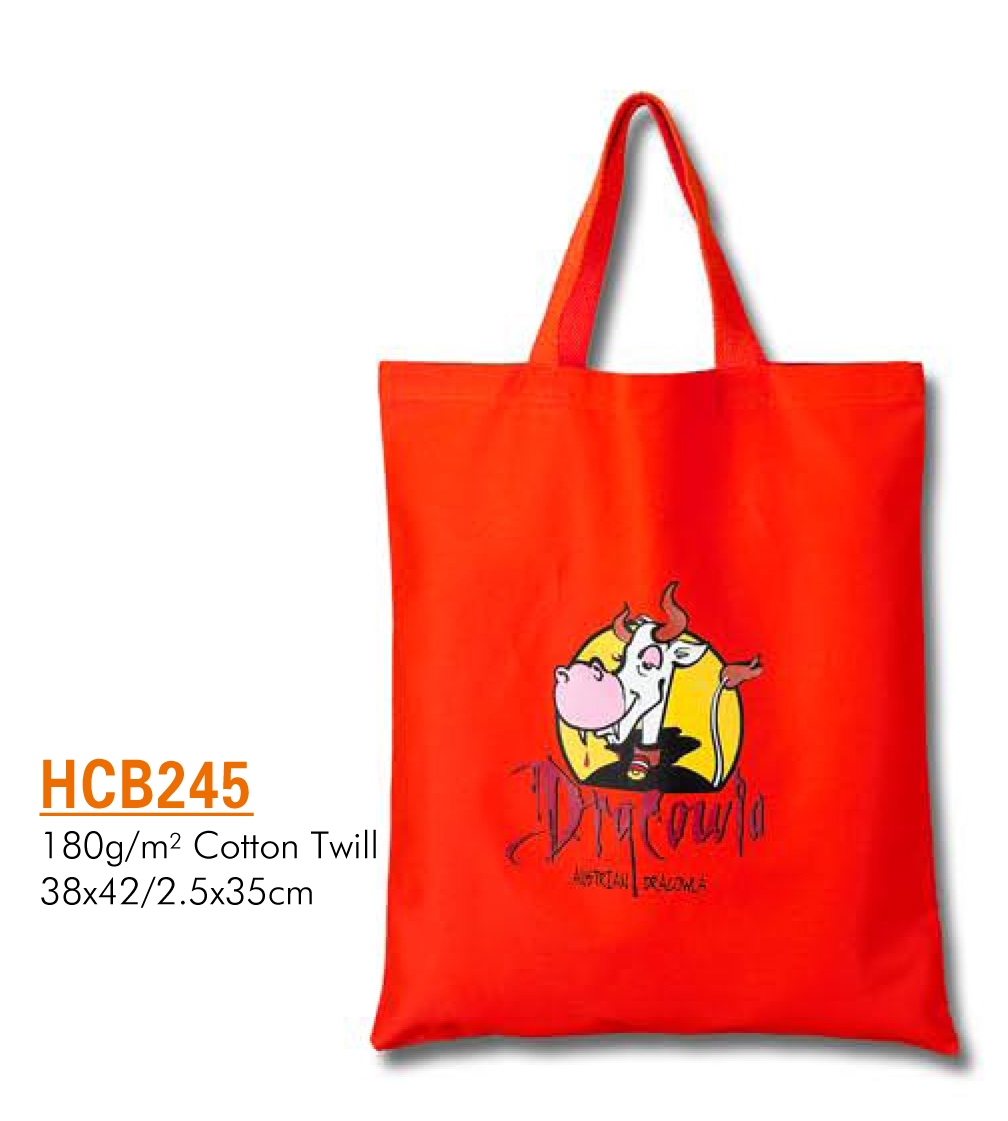
Why campaign buyers now work from shortlists rather than catalogues
The global promotional products market, which includes bags, is valued at USD 84.4 billion in 2025 with a 3.8% CAGR, according to Metastat Insights. Inside that market, corporate adoption of custom-branded tote bags rose 32% year over year in 2024, based on Intel Market Research data, and tote bags ranked fifth among the most-searched categories on the Advertising Specialty Institute (ASI) platform in 2024.
Demand is also concentrated into a narrow window: seasonal promotional campaigns accounted for 39% of total reusable shopping bag demand in 2025, according to Business Research Insights. That concentration is the practical reason shortlists matter. When most of a year's volume lands in a few weeks, buyers cannot validate an unfamiliar model for every campaign; they need a small set of models whose constraints are already known — material ceiling, size range, logo method, minimum order and lead time.
Expectations on the receiving end reinforce the same logic. A single reusable tote bag is reported by BagzDepot and ASI (medium-reliability third-party data) to generate over 3,500 brand impressions on average during its lifetime. That figure raises the cost of a model that deforms, fades or is discarded after a few uses, and it shifts the buying question from unit price to specification fit.
The shortlist at a glance
The four models below share a common customisation framework but differ in format, material set and weight capability. The table summarises the specified options exactly as recorded in the product data.
| Model | Format | Material options | Size / weight | Logo methods |
|---|---|---|---|---|
| FDV010 Foldable bag | Collapsed bag, folding bag, folded bag | 100% cotton, recycled cotton, organic cotton, polyester, nylon, non-woven | Small, Medium, Large | Silk printing, transfer printing, digital printing, embroidery |
| 1812 Cosmetic bag | Make-up bag, cosmetic pouch, zipper cosmetic pouch, drawstring cosmetic bag | 100% cotton, recycled cotton, organic cotton, felt, polyester, padded fabric | Small, Medium, Large | Silk printing, transfer printing, digital printing, embroidery |
| 4211 Drawstring bag | Drawstring gift bag, drawstring gift pouch, drawstring backpack bag | 100% cotton, recycled cotton, organic cotton, polyester, non-woven, nylon | Small, Medium, Large; 100 gsm to 280 gsm | Silk printing, transfer printing, digital printing, embroidery |
| 4636 Promotional shopping bag | Cotton canvas shopping bag | 100% cotton, organic cotton, recycled cotton | Small, Medium, Large; 100 gsm to 450 gsm | Silk printing, transfer printing, digital printing, embroidery |
Three specification points are shared across all four models and are worth separating from the model-specific detail:
- Colour: natural or any dyed colour.
- Size range: Small, Medium and Large.
- Customisation scope: logo, colour, material, size, label and packing.
Model 1 — FDV010 foldable bag
FDV010 is specified as a collapsed, folding or folded bag, and it carries the widest material list of the four models: 100% cotton, recycled cotton, organic cotton, polyester, nylon and non-woven fabric. The presence of nylon and non-woven in the specification distinguishes it from the shopping bag 4636, which is recorded only in the cotton family.
For campaign planning, the relevant characteristic is the folded format rather than the fabric alone. A bag that stores flat occupies less space in a conference kit, a hotel welcome pack or a retail counter display, which changes the logistics calculation without changing the printed area the buyer can use for a brand mark.
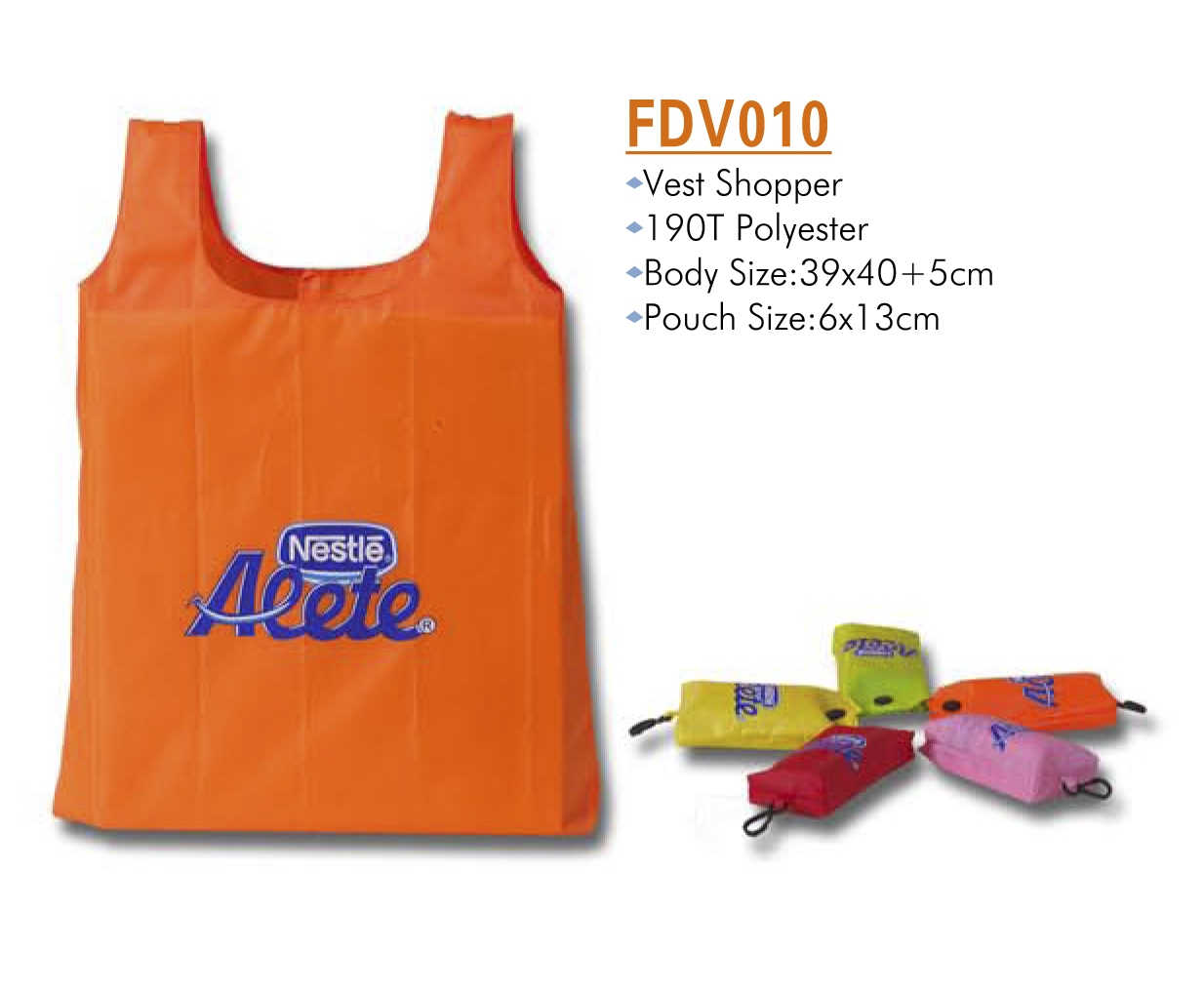
Yulite case records include a custom design project built on this format: a foldable bag in 210T RPET soft recycled fabric with double-layer reinforced handles, a metal-buckle elastic drawstring closure, double stitching and full overlock construction, custom printing on both the bag body and the fold patch, and globally compliant labels. That record shows how far the foldable format can be extended when a buyer needs a structural design rather than a standard shape.
Model 2 — 1812 cosmetic bag
Model 1812 covers make-up bag, cosmetic pouch, zipper cosmetic pouch and drawstring cosmetic bag formats. Its material list is the only one of the four that includes felt and padded fabric, alongside 100% cotton, recycled cotton, organic cotton and polyester — a specification aimed at small, structured items rather than load-bearing carriers.
The recorded logo application for model 1812 includes digital printing, and the model can be produced in organic cotton. Both points matter for beauty and garment-linked campaigns, where the pouch often functions as a packaging element as much as a giveaway. Yulite application records list beauty products and garments, advertising premiums, and conferences, exhibitions and events among the recurring application industries for its promotional bag range, with custom logo printing and eco-friendly material availability recorded as standing special requirements.
Model 3 — 4211 drawstring bag
The drawstring bag 4211 is specified from 100 gsm to 280 gsm across 100% cotton, recycled cotton, organic cotton, polyester, non-woven and nylon. It is offered as a drawstring gift bag, a gift pouch and a drawstring backpack bag, which means one model can serve a gift-with-purchase programme and a light event carry bag without a second tooling decision.
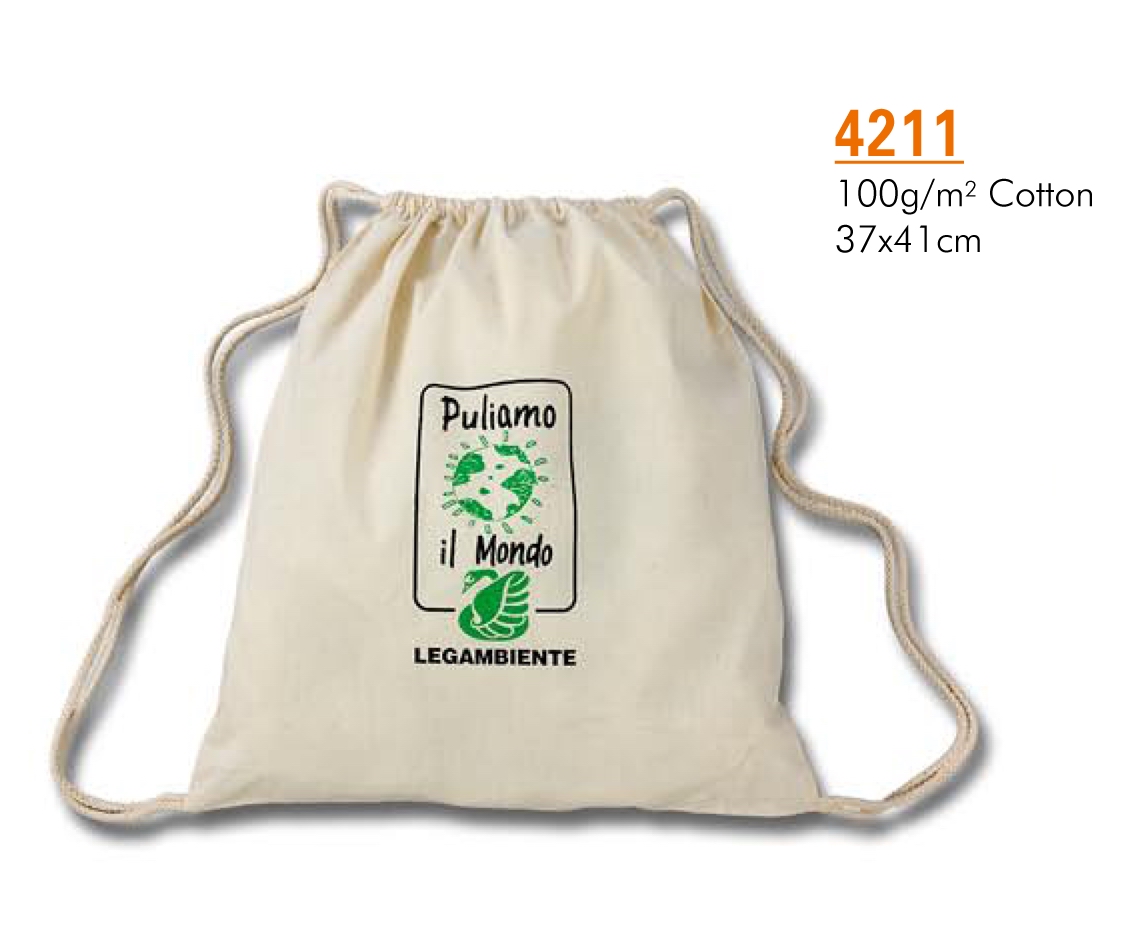
Organic cotton and recycled cotton options are recorded for this model specifically, which allows a sustainability claim to be attached to a low-cost format rather than reserved for premium textiles. A Yulite case record for a school in Belgium shows the same fabric logic in use: 5,000 units produced as book bags over a three-year programme, noted for heavy cotton canvas fabric, an active dyeing process, good colour fastness and large capacity. The drawstring format itself is widely used where a lighter, single-compartment bag is acceptable.
Model 4 — 4636 promotional shopping bag
The promotional shopping bag 4636 is a cotton canvas shopping bag with the highest weight ceiling in this shortlist: cotton weight from 100 gsm to 450 gsm, in 100% cotton, organic cotton or recycled cotton. It is also the model with the most complete certification coverage in the company's records, being certified to GRS, SMETA and GOTS.
Where the shopping bag format has been used at volume, the documentation points to supermarket and retail programmes rather than one-off events. A Yulite case record for a supermarket client in Italy covers a 1,000,000-piece cotton canvas shopping bag programme, with the bag reported to sell about one million pieces within a year; the design notes cite a large gusset for capacity, twin strings at the top for closure, and 100% cotton canvas fabric. A separate record for a corporate buyer in Germany documents 400,000 pieces produced as promotional giveaways in RPET polyester with a GRS certificate, sublimation printing and customised box packing, with the client reporting a 30% increase in monthly sales.
What the specifications imply for material and print decisions
The weight figures are the clearest dividing line between the four models. Model 4211 tops out at 280 gsm while model 4636 reaches 450 gsm, so the two bags sit in different weight classes as soon as freight is calculated. A heavier cotton canvas supports the load profile of a shopping bag used repeatedly in a supermarket environment; the same weight applied to a gift pouch would add cost without adding function.
Material sets also narrow the options. The shopping bag 4636 is a cotton-family specification only; a buyer who requires a synthetic shopping format is directed elsewhere in the range, such as the beach bag 4700, which is specified in 100% cotton, recycled cotton, organic cotton, polyester, mesh, nylon and felt. The foldable bag FDV010, by contrast, includes nylon and non-woven in its material list, and the cosmetic bag 1812 is the only model offering felt and padded fabric.
Logo application is consistent across all four models: silk printing, transfer printing, digital printing and embroidery. The production base supporting these finishes includes digital printing machines, transfer printing machines, laser cutting machines and printing drying equipment, together with high-post sewing machines, computer sewing machines, pattern sewing machines, overlock machines, hot cutting machines and shoulder strap cutting machines, and an independent quality inspection process.
Certification and compliance constraints to verify
Certification is a constraint, not a label. Each certificate covers a defined product scope and a defined validity window, and buyers running programmes that extend beyond those dates need to re-verify documents before production. The three certificates linked to this shortlist are recorded as follows.
| Certificate | Number | Issuer | Validity | Coverage |
|---|---|---|---|---|
| GOTS (Global Organic Textile Standard, version 7.0) | GOTS-31172 | INTERTEK | 2026-04-02 to 2027-04-02 | All global markets; scope includes carried accessories (PC0011), worn accessories (PC0012), children's apparel (PC0004) and trading (PR0030); linked products include 4636, 3800, 4211, 1812, 4700 and PP246 |
| SMETA (SEDEX 4P) | ZAA600189756 | BCI Compliance Group Limited | 2026-03-10 to 2027-03-10 | Global market; all textile products, covering the foldable bag FDV010, the drawstring bag 4211, the cosmetic bag 1812 and the promotional shopping bag 4636 |
| GRS (Global Recycled Standard 4.0) | ITS-TE-00006853-GRS-03902700 | Intertek | 2026-05-01 to 2027-04-30 | Worldwide; scope includes functional accessories (PC0017), carried accessories (PC0011), hard goods (PC0022), dyed fabrics (PC0025), greige fabrics (PC0026), packaging (PC0023), worn accessories (PC0012) and trading (PR0030) |
Two market regulations sit alongside the certificates for buyers selling into Europe and the United States. In the EU, bags must comply with REACH Regulation Annex XVII, which restricts azocolourants to 30 mg/kg in textiles, and textile products containing at least 80% textile fibres must comply with Regulation (EU) No 1007/2011 for labelling. In the United States, California SB 1046 bans non-compostable single-use plastic carry-out bags starting January 2025, which shifts volume toward reusable and non-woven substitutes.
Ordering constraints: MOQ, sampling, capacity and lead time
The commercial framework behind these four models is uniform. Production is offered on an OEM and ODM basis with a stated minimum order quantity of 500 pieces, a monthly capacity of 200,000 pieces and a lead time of 30 days. Sampling is handled through an independent sampling room with dedicated sample workers, and samples are delivered within 3 days.
Quality control is documented in three stages — internal inspection, pre-shipment inspection and third-party inspection — and the after-sales terms recorded for the range include replacement of defective units in the next order, free remaking, replacement or full refund for defective items, free design adjustments and re-sampling for OEM and ODM orders, compensation for damaged, missing or incorrectly delivered goods, and worldwide valid quality after-sales service.
Where these four models fit: application patterns
The application records attached to Yulite's promotional bag range list advertising premiums, department store retail, conferences, exhibitions and events, cultural travel and hotel programmes, beauty products and garments, and educational training services as the main application industries. The markets recorded include France, Italy, Spain, Germany, Switzerland, Denmark, Belgium, the United Kingdom, Austria, Australia, Greece, Norway, Sweden and Japan. Project types recorded are brand marketing campaigns, trade show and event projects, and retail promotion projects.
Typical operating conditions are everyday use with manual carrying and repeated usage — shopping load, event giveaways, travel and storage. That usage pattern is what makes the weight ceiling of each model a real constraint rather than a specification detail: a bag intended for repeated supermarket use and a bag intended for a single conference handout are not interchangeable, even when both are printed with the same logo.
How this shortlist compares with traditional giveaway options
Compared with single-use plastic carrier bags, all four models are reusable by design, and the regulatory direction is consistent: California SB 1046 removes non-compostable single-use plastic carry-out bags from the market from January 2025, while non-woven packaging already held a 22.2% share in Europe in 2024, a shift influenced by single-use plastic bans. The non-woven bags market was valued at USD 4.24 billion in 2024, according to Metastat Insights.
Compared with a generic non-woven giveaway, the four models do not require a change of supplier to upgrade material: the foldable bag FDV010 and the drawstring bag 4211 can both be produced in non-woven, so a buyer can test a lighter specification and move to cotton within the same model. Compared with premium retail bags, canvas remains the largest material segment in the tote bag market, with jute the fastest-growing segment on eco-friendly trends, according to Market Research Future.
Boundaries buyers should plan around. The standard minimum order quantity of 500 pieces per model rules out very small pilot runs below that volume. The 30-day lead time is a genuine scheduling constraint for campaigns that confirm artwork late, even though sampling is completed within three days. Weight is a trade-off rather than a benefit: model 4636 is specified up to 450 gsm, which raises freight cost per unit for air-shipped event kits compared with a lighter non-woven alternative. Certification coverage is also conditional — GOTS, SMETA and GRS claims apply only within each certificate's product scope and validity window, and model 4636 is specified only in the cotton family, so buyers who need a synthetic shopping format must select a different model.
Market signals for the next campaign cycle
Third-party estimates for the tote bag category diverge by methodology. Intel Market Research puts the 2024 tote bag market at USD 22.7 billion, while Acumen Research and Consulting bases its projection on USD 17.1 billion in 2023 rising to USD 29.8 billion by 2032. The direction is consistent even where the base figure is not.
Material trends point the same way. The recycled PET market is estimated at USD 19.5 billion in 2025 by Custom Market Insights, supporting demand for recycled-content promotional bags, and 73% of Millennials and Gen Z consumers say they prefer to buy from sustainable brands that use eco-friendly promotional items, according to Nielsen data reported by BagzDepot (medium-reliability third-party data). On the supply side, Asia Pacific held a 44.8% revenue share of the bag market in 2024, with China as a primary manufacturing hub, according to Grand View Research.
One counter-signal deserves attention. Intel Market Research estimates that the average urban consumer in mature markets already owns 4 to 6 tote bags. In a saturated category, a bag competes for retention on print quality, construction and material choice rather than on novelty alone — which is why weight, stitching and closure detail appear repeatedly in the case records cited above.
Future outlook
Three shifts are likely to shape promotional bag shortlists over the next cycle. First, certificate timing becomes a planning item: GOTS and SMETA coverage in this range runs to early 2027 and GRS to the end of April 2027, so multi-year programmes will need a document check built into annual supplier reviews rather than treated as a one-off onboarding step. Second, seasonal concentration — 39% of reusable shopping bag demand tied to seasonal campaigns in 2025 — will continue to push buyers toward earlier artwork sign-off, given a 30-day production lead time. Third, material traceability will increasingly be specified at model level: recycled cotton and RPET content can be documented for specific models such as 4211 and 4636, while padded fabric and felt remain options tied to the cosmetic bag 1812.
For buyers who prefer to validate specifications in a single document before sampling, Yulite publishes a 2026 catalogue that can be downloaded here: 2026 Yulite spring catalogue.
FAQ
What is the minimum order quantity for these promotional bag models?
The minimum order quantity recorded for Yulite promotional bag production is 500 pieces, with a monthly capacity of 200,000 pieces and a 30-day lead time. The 500-piece MOQ is the standard figure for customised production across the range, and the same MOQ of 500 pieces is specified for the knitted bag model T25210. MOQ is a separate constraint from capacity: the limitation applies to minimum order size, not to how much the factory can produce in a month.
What fabric weights are available for the drawstring bag (4211) and the shopping bag (4636)?
Model 4211 drawstring bag is specified from 100 gsm to 280 gsm, and model 4636 promotional shopping bag is specified from 100 gsm to 450 gsm (cotton weight). Both models are available in 100% cotton, recycled cotton and organic cotton, and both come in small, medium and large sizes. The shopping bag therefore has the higher weight ceiling of the two, which is relevant when comparing structure, load tolerance and freight weight per unit.
Which logo methods, colours and sizes apply across FDV010, 1812, 4211 and 4636?
All four models support the same four logo methods: silk printing, transfer printing, digital printing and embroidery. Available sizes are small, medium and large, and colour options are natural or any dyed colour. Customisation scope for these bags covers logo, colour, material, size, label and packing.
Which certifications cover these four promotional bag models?
Three certificates are linked to these models. GOTS certificate GOTS-31172, issued by INTERTEK under GOTS version 7.0 and valid from 2026-04-02 to 2027-04-02, is linked to models 4636, 4211, 1812 and others, with a scope covering carried accessories, worn accessories, children's apparel and trading on the global market. SMETA certificate ZAA600189756, issued by BCI Compliance Group Limited under SEDEX 4P and valid from 2026-03-10 to 2027-03-10, covers all textile products including FDV010, 4211, 1812 and 4636. GRS certificate ITS-TE-00006853-GRS-03902700, issued by Intertek under GRS 4.0 and valid from 2026-05-01 to 2027-04-30, applies worldwide with a scope covering carried accessories, functional accessories, worn accessories, dyed and greige fabrics, packaging and trading. Claims apply only within each certificate's stated scope and validity window.
What regulatory requirements affect promotional bags sold into the EU and the USA?
In the EU, bags must comply with REACH Regulation Annex XVII, which restricts azocolourants in textiles to 30 mg/kg, and textile products containing at least 80% textile fibres must comply with Regulation (EU) No 1007/2011 for labelling. In the USA, California SB 1046 bans non-compostable single-use plastic carry-out bags starting January 2025. In Europe, non-woven packaging held a 22.2% share in 2024, a shift influenced by single-use plastic bans.
How long does production take, and what sampling support is available?
The recorded lead time is 30 days, with a monthly capacity of 200,000 pieces. Sampling is handled through an independent sampling room staffed by professional sample workers, and samples are delivered within 3 days. Buyers planning campaigns around seasonal peaks should treat the 30-day lead time as the binding schedule constraint on the production side.
What quality checks and after-sales terms apply to these bags?
Quality control is documented in three stages: internal inspection, pre-shipment inspection and third-party inspection. The after-sales terms recorded for the range include replacement of defective units in the next order, free remaking, replacement or full refund for defective items, free design adjustments and re-sampling for OEM and ODM orders, compensation for damaged, missing or incorrectly delivered goods, and worldwide valid quality after-sales service.
Where are these promotional bag models typically used?
Recorded application industries for the range include advertising premiums, department store retail, conferences, exhibitions and events, cultural travel and hotel programmes, beauty products and garments, and educational training services. Recorded markets include France, Italy, Spain, Germany, Switzerland, Denmark, Belgium, the United Kingdom, Austria, Australia, Greece, Norway, Sweden and Japan. Typical operating conditions are everyday use and repeated manual carrying — shopping load, event giveaways, travel and storage — under project types recorded as brand marketing campaigns, trade show and event projects, and retail promotion projects.