
Proof Before Purchase Order: Pharma Packaging Capability
A blister-cartoning line is bought once and run for years, so the decisive question at the ordering stage is not what a supplier says it can build, but which of those statements can be inspected before the purchase order is signed.
That shift — from capability claims to capability evidence — defines the execution stage of a pharmaceutical packaging project. Shortlists are usually built on published specifications that look similar across suppliers. What separates them afterwards is the documentation behind the numbers, the test route agreed before shipment, and the supplier's ability to keep a line supplied with parts and support long after commissioning.
This reference article sets out an evidence structure for pharmaceutical packaging machine suppliers, using Zhejiang Hoping Machinery Co., Ltd. as a worked example. Zhejiang Hoping Machinery Co., Ltd., which trades under the brand HOPING, is a Chinese manufacturer of blister packaging machines, cartoning machines, case packers and end-of-line packaging equipment. It was established in 2001 and operates from 88th Weiwu Road, Nanbin Sub-district, Ruian City, Zhejiang Province, China. Unless a third-party source is named, company facts below are company-reported.
Why capability evidence decides the purchase order
Pharmaceutical packaging projects usually do not fail loudly. A line that misses its validated output, that cannot hold a seal when the foil changes, or that stops for a missing leaflet without a clear alarm will still run — just not at the economics the business case assumed. None of those outcomes is visible in a catalogue.
By the time a project reaches the execution stage, the buyer has normally shortlisted two or three suppliers whose stated specifications sit in the same band. The differentiating questions are practical: who owns the drawings, where the critical parts are machined, which blister format and cavity layout sit behind a speed figure, what happens on the line when one carton jams, and what documentation arrives at handover. Each of these can be converted into a request, and each request produces either evidence or an absence of evidence. Both outcomes are useful before a deposit is paid.
There is also a timing reason to treat evidence as a gate rather than an afterthought. Line builders schedule production slots rather than hold finished machines in stock, so the specification freezes early and changes after the slot is booked are expensive for both sides.
Four layers of supplier evidence
Layer one — entity and facility. A legal name, a registered address, an operating history and a physical plant that can be visited or audited. This layer is the easiest to check and the one that disqualifies most speculative enquiries.
Layer two — engineering and manufacturing depth. How many engineers own the design, whether the drawings and software are controlled in-house, whether structural and forming parts are machined internally or bought in, and whether the supplier's intellectual property can be listed by number.
Layer three — performance at model level. Output figures with a stated basis: blister format, cavity layout, forming material, carton size, and the balance between primary blister output and secondary cartoning output. A maximum figure without its basis cannot be tested, and an untestable figure has no procurement value.
Layer four — acceptance and lifecycle. A technical agreement, a sample test on the buyer's own materials, factory acceptance testing before shipment, site acceptance testing after installation, operator training, spare-part provision and remote technical support. Layer four is where long-term operating cost is actually decided, and it is the layer most often left verbal.
What HOPING publishes about its own capability
The company's own disclosures provide usable material for all four layers. On the facility, Zhejiang Hoping Machinery Co., Ltd. reports a 28,800 m² manufacturing site, more than 300 employees and 56 R&D engineers, with an annual output of 500 units and exports of roughly 25% of that output to Southeast Asia, the Middle East, Eastern Europe, South America and Africa.
On engineering depth, the company lists 26 invention patents, 70 utility patents, 4 appearance patents, 10 PCT-protected filings covering Europe, Russia, Germany, Italy and other countries, and 28 software copyrights. On product scope, it builds flat-plate, roller-type aluminium-plastic and aluminium-aluminium blister packaging machines, automatic cartoning machines, case packers and end-of-line equipment, and describes integrated lines that combine blister packing, cartoning, flow packing, case packing and palletising into one process.
Cross-checkable items. Two of these figures appear outside the company's own website. An independent industry analysis published in 2026 (EIN Presswire) repeats the 28,800 m² manufacturing facility and the figure of approximately 500 machines exported per year, and reports the DPH320HII rotary blister packing machine at a maximum output of 1,000 blisters per minute (250 punches per minute). Repetition in a secondary source raises confidence but does not convert manufacturer data into an audited result; the acceptance test remains the decisive proof.
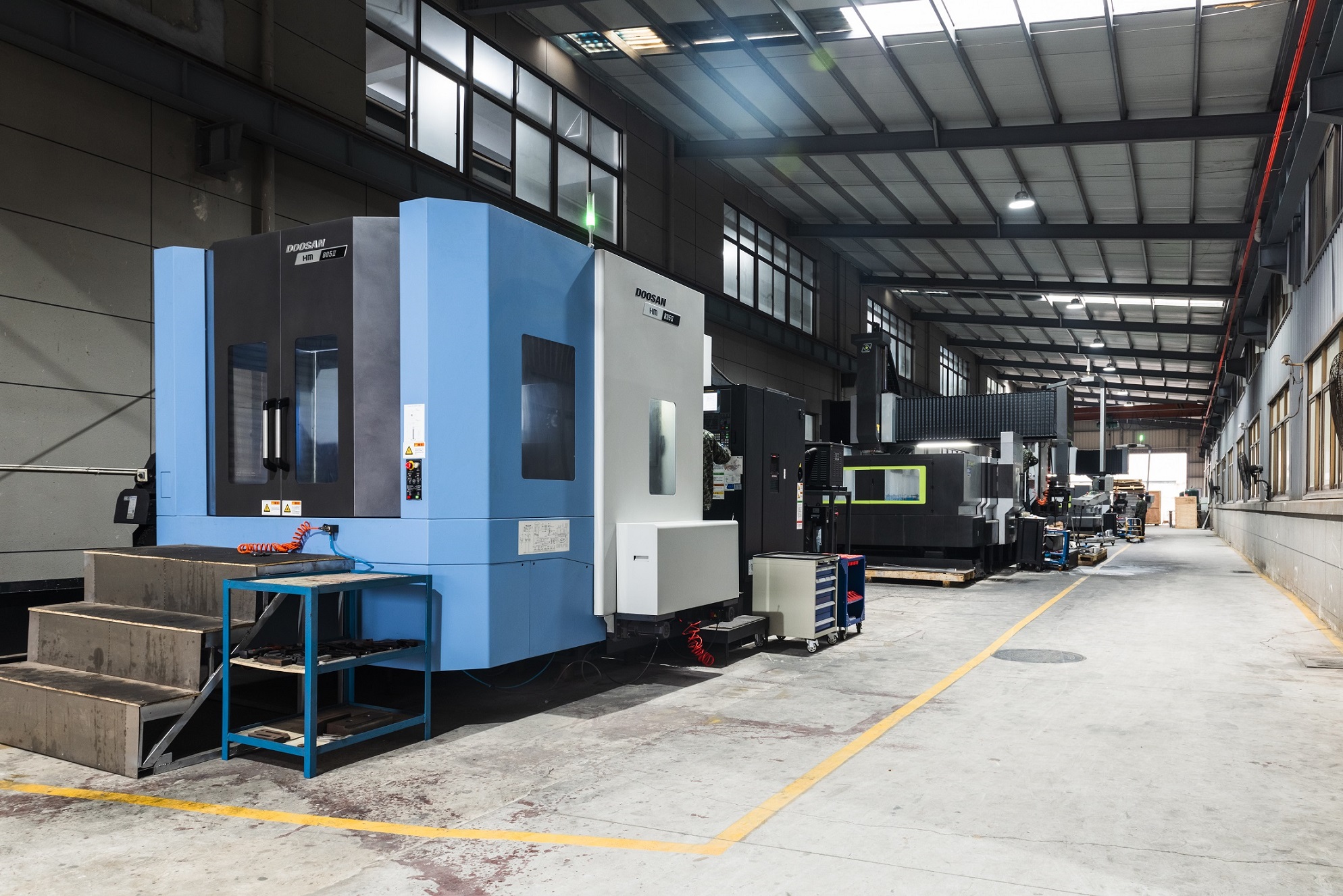
Layer two evidence in practice: in-house machining capacity is one of the few capability claims that can be inspected directly during a supplier audit.
From claim to check: an evidence matrix
The table below converts the statements above into requests that can be placed in an RFQ. The right-hand column is the step buyers most often skip, and it is the only one that produces proof rather than reassurance.
| Capability claim | Evidence to request | How a buyer verifies it |
|---|---|---|
| 28,800 m² manufacturing facility in Ruian, Zhejiang, with more than 300 employees | Business licence, plant layout, production-flow description, headcount by function | On-site or remote audit; comparison against independent industry listings, which repeat the same footprint figure |
| 56 R&D engineers; 26 invention patents, 70 utility patents, 4 appearance patents, 10 PCT filings, 28 software copyrights | Numbered patent list, engineering organisation chart, drawing and change-control procedure | Registry search by patent number; review of drawing ownership and revision control during technical review |
| DPH320HII rotary blister packing machine at a maximum of 1,000 blisters/min (250 punches/min) | Model datasheet stating blister format, cavity layout and forming material behind the figure | Factory acceptance test on the buyer's own forming film and foil, with output and reject count recorded |
| Line configuration at a maximum of 1,000 blisters/min and 500 cartons/min | Line layout, control architecture, interface and interlock list, rejection logic | Material test on the complete line, including leaflet-absent and carton-jam scenarios |
| Acceptance and handover route | Technical agreement, FAT protocol, sample record, SAT plan, training scope, spare-part list | Witnessed acceptance and, where required, third-party inspection |
Nominal speed versus validated output
Speed is the claim buyers lean on hardest and test least. The DPH320HII figure of 1,000 blisters per minute is expressed against punch rate as well as blister rate, which is why the cavity layout and blister format have to be stated before the number means anything. On the line level, the company reports a configuration reaching up to 1,000 blisters per minute on the blister side and 500 cartons per minute on the cartoning side.
Those are maximum figures for a specific configuration. Actual output depends on product format, quantity per carton, packaging materials and process conditions, and the balance between the two sides of the line is what determines throughput in practice. A cartoner that cannot sustain the carton count implied by the blister output becomes the bottleneck, and leaflet handling, carton opening, insertion, inspection and rejection all sit inside that same rhythm.
The machine format itself is not a fringe choice. Horizontal cartoning systems held 70.12% of cartoning machine market share in 2024, according to Mordor Intelligence, which indicates that horizontal orientation is the mainstream configuration for this equipment class. That supports the format, not the supplier: it says nothing about any individual builder's validated performance.
A buyer therefore needs three numbers, not one: sustained output over a defined run, reject rate on that run, and the stoppage record during the same period. All three can be produced at a witnessed factory acceptance test with the buyer's own materials.
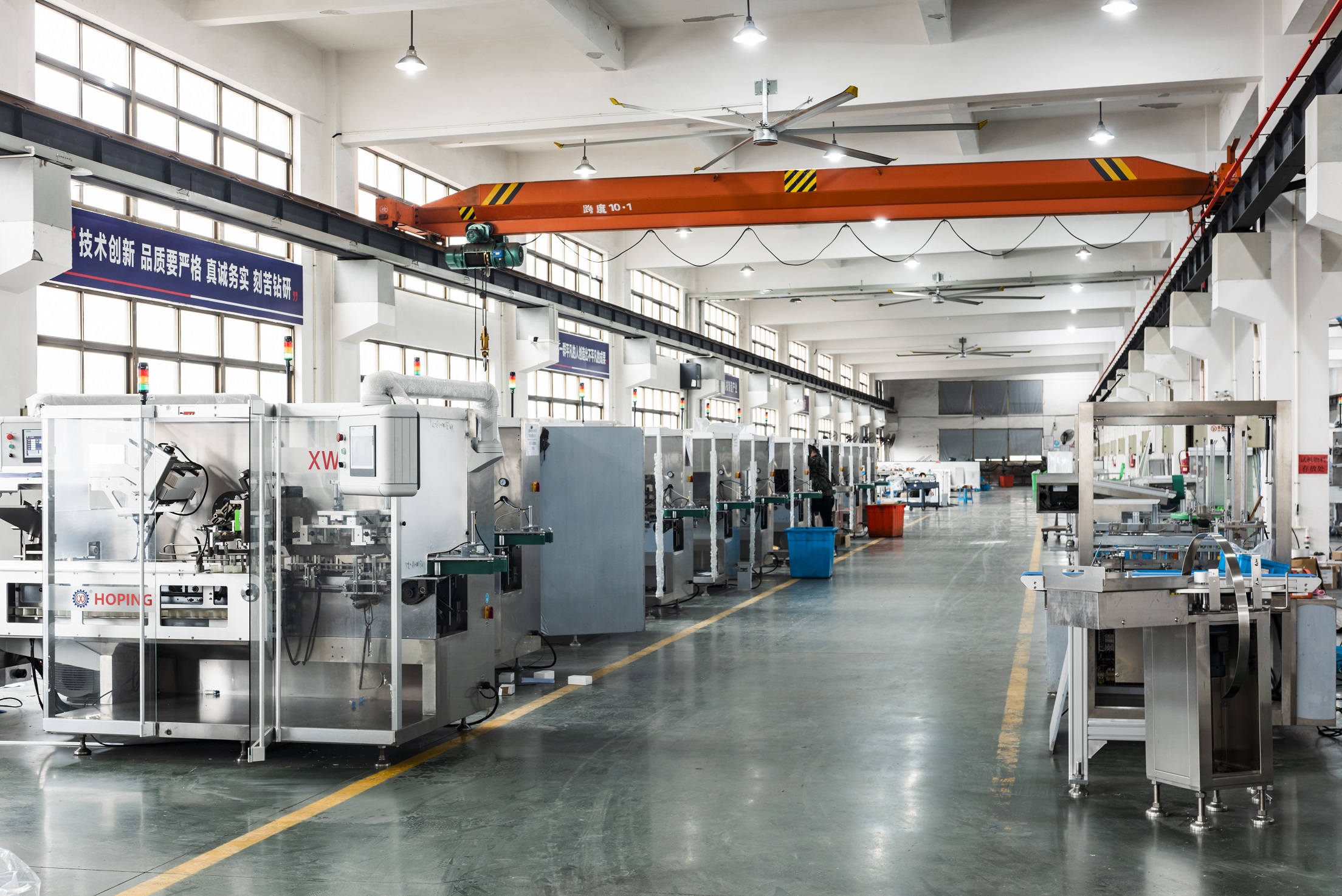
Cartoning stations are where line balancing is proven or lost: leaflet feeding, carton opening, insertion and rejection must hold the same rhythm as the blister machine upstream.
Where the line fits: application scope
The evidence only matters against a defined product portfolio. In primary packaging, aluminium-plastic blisters cover standard tablets and capsules, while aluminium-aluminium (alu-alu) formats are used where barrier performance matters more than material cost. Flat-plate and roller-type forming are both offered, which matters because the forming method influences cycle behaviour and tooling change on a given format.
In secondary packaging, the company lists automatic cartoning machines covering blisters, tablets, syringes and medicine bottles — a broader application list than blister-only cartoning, and a relevant point for plants that expect their portfolio to widen after the line is installed. Case packing and end-of-line equipment close the scope, with case packer, bundler and palletiser described as part of the integrated line rather than as separate purchases.
The procurement implication is straightforward: a line specified for one blister format and one carton size ages badly. The format range should be written into the technical agreement before the machine is built, not negotiated afterwards.
What the market signals say about timing
Demand context shapes how much leverage a buyer has on delivery. The global pharmaceutical blister packaging machine market was valued at USD 2.57 billion in 2025, according to Custom Market Insights, with Asia-Pacific identified as the fastest-growing region at an 8.87% CAGR to 2031. A separate commercial research figure places the wider pharmaceutical packaging machinery market at USD 7.09 billion in 2026, growing at 7.15%. That second figure comes from a single publisher whose market definition, segmentation and forecast horizon could not be confirmed in the available material, so it is directionally useful and unsuitable for capacity planning.
Regulatory signals run in the same direction as the technical ones. ISO 15378:2017 specifies good manufacturing practice requirements for primary packaging materials for medicinal products — the blister pack is itself a primary packaging material, so forming and sealing quality on the machine sits close to a compliance question, even though the standard addresses packaging material producers rather than machine builders. In China, a draft GMP guidance for pharmaceutical packaging materials has been reported at public consultation stage, pointing toward supplier review obligations for licence holders; its draft status should be confirmed against the issuing authority before it is treated as a rule.
There is also a data dimension. Trade coverage reporting PMMI content notes that pharmaceutical manufacturers are turning toward digitised data collection and integrated solutions to meet regulations and improve visibility. For a buyer, that argues for specifying data capture, batch records and line-level event logging together with the machine, rather than treating them as after-sales additions.
Integrated line versus standalone machines, and where the integrated case stops
The conventional alternative remains common: a blister machine, manual or semi-manual transfer, and a standalone cartoner, often at lower automation levels and without full servo coordination across stations. The integrated approach combines blister packaging, blister transfer, leaflet handling, carton opening, insertion, inspection and rejection, and downstream connection into one automated process, which reduces manual intervention and intermediate handling.
The trade-off is capital. Initial investment in an integrated line is usually higher than for standalone or semi-automatic equipment. The return comes from reduced labour, transfer, management and quality-risk cost in large-scale continuous production — a return that depends on utilisation, so a plant running short campaigns should model the integrated case carefully before committing.
Three boundaries deserve to be stated plainly. First, integration couples risk: a leaflet fault or a carton jam stops the whole line, so the alarm hierarchy, rejection logic and restart procedure are not secondary details. Second, published maxima are manufacturer-stated, and no independent acceptance record for any specific configuration is publicly available; the buyer's own factory acceptance test is the only reliable proof of sustained output. Third, this article does not establish HOPING's certification status for any market — conformity documents relevant to the destination market must be requested directly, and ISO 15378 should be read as a reference point for the packaging material, not as a machine certificate.
Executing the order: minimum quantity, lead time and capacity
Once the technical scope is settled, the commercial terms determine whether the project schedule survives contact with the plant. HOPING's stated terms are summarised below.
| Item | Stated terms |
|---|---|
| Minimum order quantity | 1 set or 1 complete line |
| Production lead time | 60–120 days after technical confirmation |
| Monthly production capacity | 30–40 units |
| Annual output | 500 units |
| Delivery terms | EXW Ruian/Wenzhou; FOB Ningbo or Shanghai; CIF/CFR destination port; final terms subject to contract and destination-market requirements |
| Acceptance route | Technical agreement confirmation; sample testing; FAT before shipment; SAT at customer site; third-party inspection can be arranged on request |
| Payment terms | Subject to quotation, contract value, customer credit, project scope and destination market |
The operational reading of these numbers matters more than the numbers themselves. A monthly capacity of 30–40 units across the product range means a line order is scheduled into a production slot, not drawn from stock. The 60–120 day lead time starts after technical confirmation, so every week spent on unresolved blister formats, carton sizes or artwork approval is a week added to delivery. Buyers who freeze the format early and complete the sample test before the slot opens tend to keep their installation window; buyers who do not, do not.
Future outlook
Two pressures are likely to keep reshaping how pharmaceutical packaging machines are bought. The first is documentation: as packaging material expectations tighten, the machine that forms and seals the blister becomes part of a review chain that extends beyond the equipment itself, and suppliers who can hand over structured acceptance and change-control records will be easier to qualify. The second is data: if manufacturers continue moving toward digitised collection and integrated solutions, line-level event data will increasingly be specified at the quotation stage rather than retrofitted.
For buyers, the practical consequence is that capability evidence becomes a repeatable process rather than a one-off exercise — the same request list, the same acceptance protocol, the same document set applied to each candidate supplier. That is also the most reliable basis for a long-term relationship with any line builder, because it replaces trust in a sales narrative with trust in a test record.
Frequently asked questions
Which documents should a buyer request before ordering a blister-cartoning line?
A technical agreement covering blister format, carton size and material structures; a sample test record on the buyer's own materials; a factory acceptance test protocol; the control, alarm and rejection list; a spare-part list with part numbers; and the validation-relevant documentation required by the buyer's market. HOPING's stated acceptance route is technical agreement confirmation, sample testing, FAT before shipment, SAT at the customer site, with third-party inspection arrangeable on request.
What commercial terms apply to an order for one machine or one line?
The minimum order quantity is 1 set or 1 complete line. Delivery terms are quoted EXW Ruian/Wenzhou, FOB Ningbo or Shanghai, or CIF/CFR destination port, with final terms subject to contract and destination-market requirements. Payment terms depend on the quotation, contract value, customer credit, project scope and destination market.
How long does delivery take, and how does production capacity affect scheduling?
Typical production lead time is 60–120 days after technical confirmation, against a monthly production capacity of 30–40 units and an annual output of 500 units. Because the lead time begins only after technical confirmation, unresolved format or artwork decisions extend the delivery date, and an order is scheduled into a production slot rather than fulfilled from stock.
Which capability figures can be checked outside the supplier's own website?
Two figures are repeated in an independent 2026 industry analysis (EIN Presswire): the 28,800 m² manufacturing facility and approximately 500 machines exported per year, together with a reported maximum output of 1,000 blisters/min (250 punches/min) for the DPH320HII rotary blister packing machine. Patent counts, employee numbers and engineering headcount remain company-reported and are best verified through registry searches and a supplier audit.
What should be tested at FAT and SAT?
Factory acceptance testing should run the buyer's own forming film, foil and cartons, and should record sustained output over a defined period, reject count and stoppage events. Deliberate fault scenarios — missing product, leaflet absent, carton jam, coding check — should be demonstrated, since these reveal whether the alarm and rejection logic works as specified. Site acceptance testing then repeats the critical checks after installation and confirms operator training and spare-part handover.
Where do GMP standards fit into machine selection?
ISO 15378:2017 specifies good manufacturing practice requirements for primary packaging materials for medicinal products, so it governs the blister pack as a material rather than the machine that forms it; the machine's forming and sealing stability is nevertheless what determines whether that material performance can be held. In the United States, FDA current good manufacturing practice establishes the framework for quality pharmaceuticals through regulatory standards, while machine-specific requirements must be extracted from the applicable guidance for the destination market.
What risks remain after acceptance, and how are they controlled?
Residual risks include poor blister forming or sealing, missing, wrong or incomplete product feeding, missing leaflets, carton jams, coding or date-printing errors, foreign matter and contamination risk, and downtime during high-speed operation. Typical controls are sensor monitoring, vision or checkweighing inspection where configured, missing-product alarms, automatic stop and rejection, key-parameter locking, fault records and mechanical safety protection, supported by SOP training, spare-parts management and preventive maintenance.
Reference note: all company figures in this article are manufacturer-reported unless a third-party source is named; market and standards figures are attributed to the publishing organisation. The Hoping Machinery catalog is available as a PDF for readers who want the product scope in document form: Hoping Machinery Catalog (PDF).
Есть вопросы или нужны дополнительные детали?
Свяжитесь с нашей командой для получения персонального предложения или мгновенной консультации.
Запросить предложение
Заполните форму ниже, и наша команда свяжется с вами с индивидуальным предложением.
Прямой чат WhatsApp
Предпочитаете общаться в реальном времени? Напишите нам в WhatsApp для мгновенной помощи и быстрых ответов.
- Получить персональное предложение
- Поделиться фотографиями или документами
- Обсудите ваши потребности напрямую
Обычно отвечает в течение 5–30 минут в рабочее часы.