
Proof Points: How Chinese Valve Makers Show Engineering Mettle
Proof Points: How Chinese Valve Makers Show Engineering Mettle
China exported USD 22.6 billion of valves in 2024, close to 20% of global export concentration in the category. Scale of that kind is easy to verify. Engineering capability is not, and it is the only thing that matters once a project leaves the shortlist stage and moves into execution.
Why export volume and engineering capability are different questions
China's role in the global valve trade is measurable and widely quoted. The Observatory of Economic Complexity records USD 22.6 billion in Chinese valve exports in 2024, representing roughly 20% of global export concentration in the category. Asia Pacific accounted for an estimated 36.3% of industrial valve market revenue in 2025, with China the largest contributor inside the region (Grand View Research). Oil and gas remains the leading end-user segment at close to 33% of global demand in 2024 (Vantage Market Research, cited by PR Newswire).
None of those figures says whether a particular factory can engineer a valve for a particular service. Export volume demonstrates production capacity and price competitiveness. It does not demonstrate that a supplier can explain why one seat construction survives thermal cycling and another does not, or why duplex steel is the correct body material for chloride-bearing seawater while carbon steel is a costly mistake.
That gap becomes commercially relevant in the Evaluation-to-Execution phase. Once a buyer moves past shortlisting, the working questions change from who makes valves in China to which body material, which seat, which actuation, which certificate scope, and what evidence supports each answer. This article examines four evidence types that separate engineering capability from catalogue language, using the product and project record of EG Valves Manufacturing Co., Ltd as a working example.
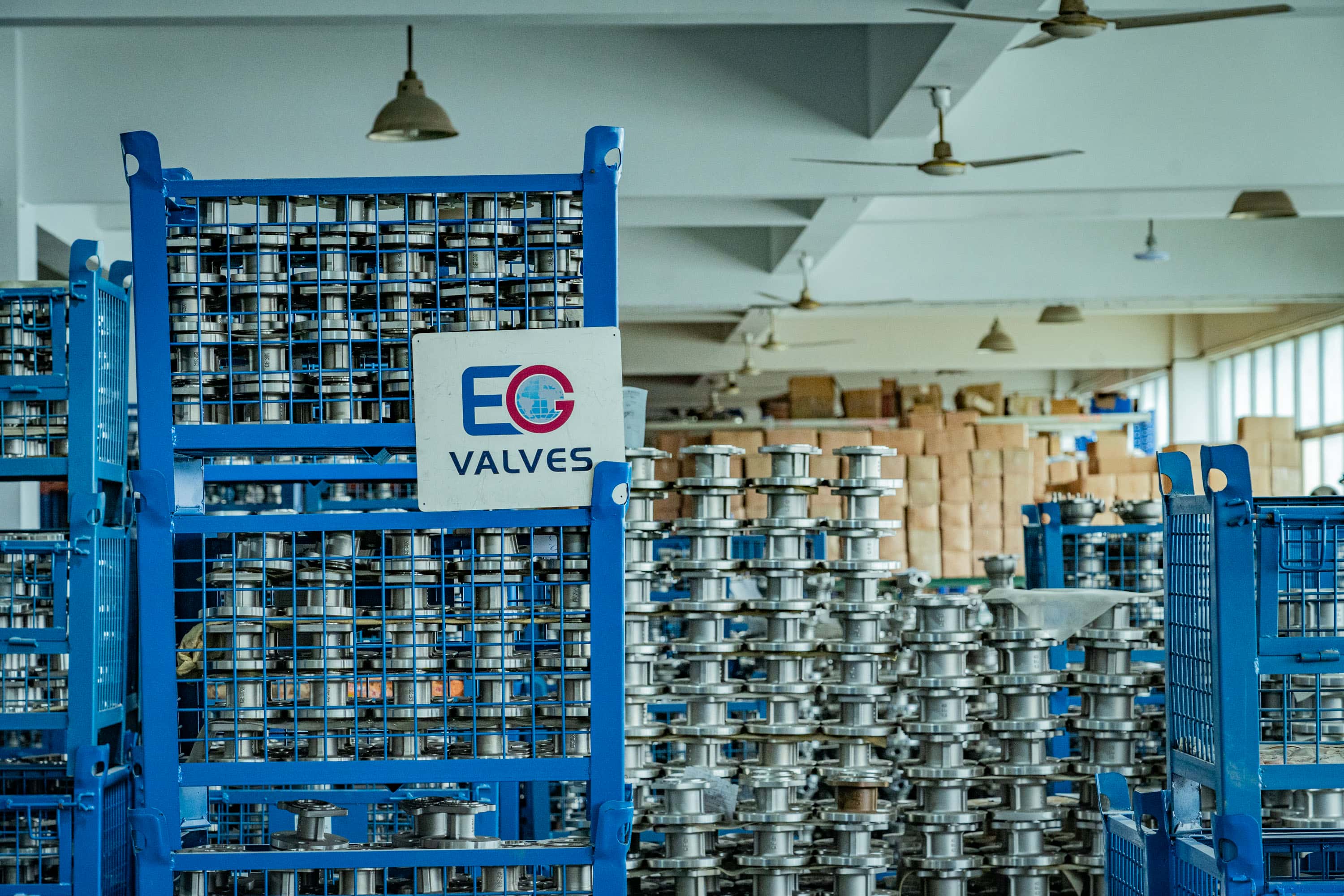
EG Valves Manufacturing Co., Ltd was established in 2000 in Wenzhou, Zhejiang Province, China. The company manufactures gate, globe, ball, butterfly, check and plug valves and strainers to ANSI, DIN, BS and JIS standards or to customer requirements. It operates a 27,500 m² facility with approximately 300 employees, a 30-engineer R&D team and an annual output of about 90,000 pieces, exporting roughly 80% of production to the EU, North America, Latin America and the Middle East, with valves installed in power, mining, refining, oil and gas, water and wastewater treatment, pulp and paper, chemical and petrochemical service.
Four evidence types that survive scrutiny
- Design reasoning that can be interrogated. A supplier should be able to explain why a geometry works, not only that it exists in the catalogue.
- Material mapping. Material families should be tied to defined service conditions and documented per order, not listed as available options.
- A designed actuation interface. Operating mode and mounting arrangement should be design decisions with defined interfaces, not adapters added after the valve is chosen.
- Field history with four data points. Duration in service, pressure class, size range and material. A reference list without those four elements is decoration.
Proof point one: design logic you can actually interrogate
Commodity valves can be evaluated by comparing data sheets. Complex products cannot, because their value sits in the relationship between geometry and service life. The triple offset butterfly valve is the clearest example in industrial valve catalogues, and it is also where weaker suppliers tend to retreat into repetition of the product name.
EG Valves specifies its triple offset butterfly valve, model BOV303, across body materials including carbon steel, stainless steel, alloy steel and duplex steel, with disc materials drawn from carbon steel, stainless steel and duplex steel. The seat is built either as stainless steel with graphite or PTFE with stainless steel, with an optional Stellite seat specified for erosion resistance. Size coverage runs from NPS 2" to 60" (DN50 to DN1500) at Class 150, Class 300 or Class 600, equivalent to PN10, PN16, PN25 and PN40, in wafer, lug and double flange patterns.
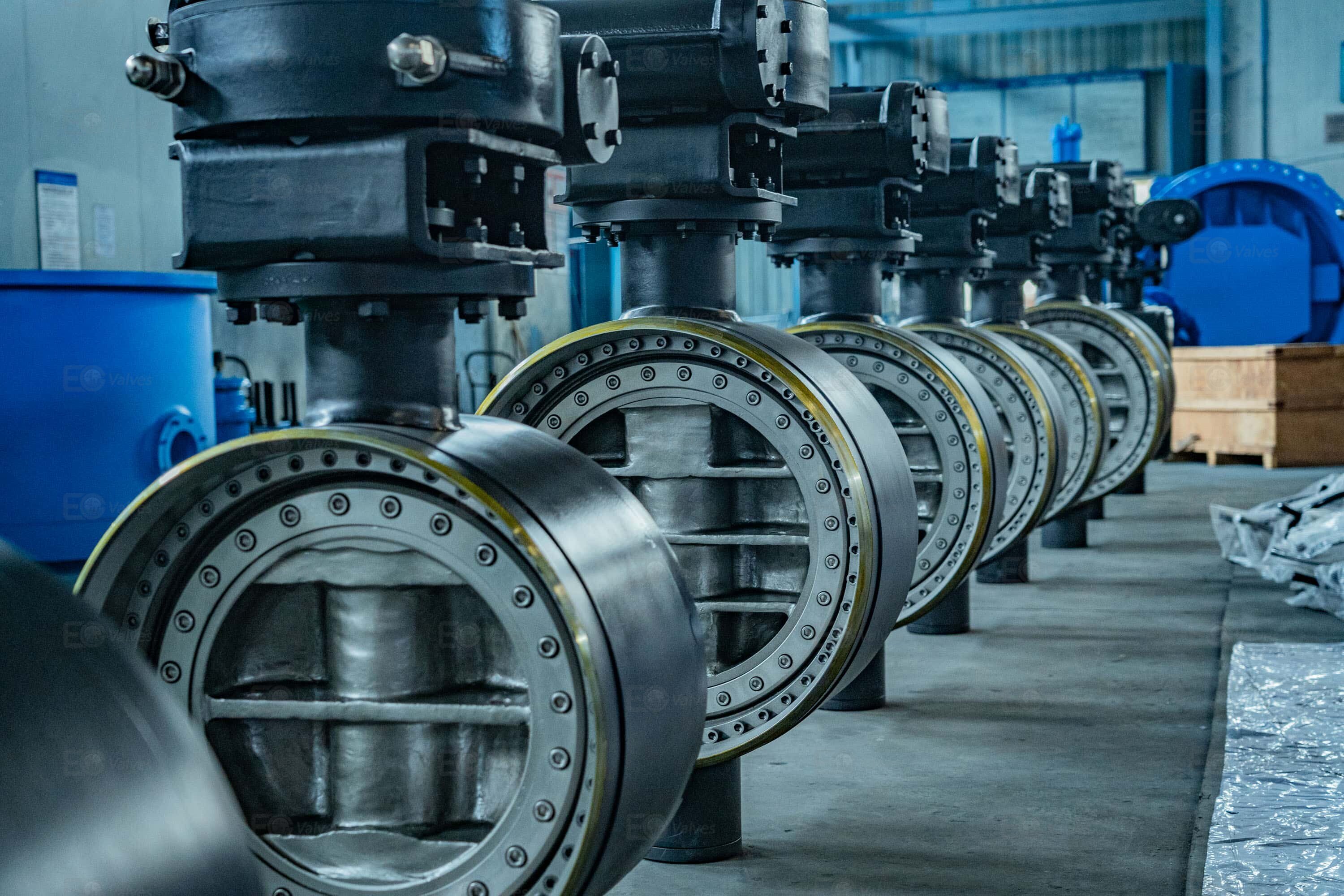
The engineering claim that matters is mechanical rather than promotional. Because the disc is offset on three axes, the sealing surfaces do not scrub across one another during travel, and the specification states that this eliminates the wear associated with sealing surface contact while producing a bubble-tight closure with reduced maintenance. A buyer can test that claim with three questions: show the offset geometry on the drawing; explain how the seat is serviced or replaced in situ; and state which seat and trim option is offered when the medium is abrasive. A supplier that answers all three is describing a design. A supplier that cannot is describing a shape.
The same test applies across the wider butterfly valve line. The high performance butterfly valve, model BPV302, is specified with soft or hard sealing to customer request, bi-directional drop-tight closure in vacuum, and an integrally cast mounting pad that accepts a range of actuators without a separate adapter plate. The double eccentric butterfly valve, model BTV305, is specified with a tilted disc that releases seat compression to extend durability and a replaceable sealing element that keeps seating torque within an optimum band. Each statement is narrow, specific and falsifiable, which is precisely what makes it evidence.
Proof point two: material selection as engineering, not catalogue padding
Material choice is where engineering capability most often becomes visible, and where the market data shows how much money is involved in getting it right. Cast steel valves accounted for 27.3% of the oil and gas valve market in 2025 (Mordor Intelligence), largely because they deliver high-pressure performance at a cost point that stainless and duplex grades cannot match in every position on a line.
| Material family | Documented product or project use | Service condition the choice implies |
|---|---|---|
| Cast iron / ductile iron | GTI001 cast iron gate valve, BTV300 resilient seated butterfly valve, CVI405 check valve, SNI501 strainer; Class 125/150 or PN10/PN16 | Water supply and drainage, HVAC, building services, municipal utilities and general industrial systems |
| Carbon steel (WCB, A105) | GTS019 cast steel gate valve Class 150-1500, GTF023 forged steel gate valve Class 800-2500, BVT207 trunnion ball valve, BVF210 fully welded ball valve | Oil and gas, petrochemical, refining, power generation and industrial high-pressure systems |
| Alloy steel (WC6, WC9, C5) | Refinery and oil and gas projects in the United Arab Emirates and the United States | Refinery duty where elevated temperature and high pressure combine with corrosive streams |
| Low-temperature carbon steel (LCB) | Oil and gas project spanning Russia and Uzbekistan, PN16 to PN100 | Low-temperature service where standard carbon steel would raise toughness risk |
| Stainless steel (SS316, F316) | CSV410 stainless steel check valve with high-torsion Inconel springs, BVS213 threaded ball valve | Water treatment, HVAC, petrochemical and industrial pipelines; special cleaning for media such as oxygen or chlorine |
| Duplex steel (2205, 2507) | Malaysia offshore project; BOV303 duplex body and disc options; BVF209 forged trunnion ball valve | Corrosive seawater and chloride-bearing environments where carbon steel would corrode |
| Bronze and brass alloys | GTA024 threaded gate valve, GLA110 threaded globe valve, BVS213 threaded ball valve, SNA507 threaded strainer | Water, oil and gas, compressed air systems, building services and general industrial utilities |
| Lined and coated construction | BTF301 PTFE lined butterfly valve with PTFE, FEP or PFA seat; epoxy powder coating on iron and ductile iron valves | Acids, salts, alkalis, oxidants, organic solvents and reducing agents in chemical, pharmaceutical, petroleum and food industries |
The checkable element is not the length of the list; it is the pairing between material and stated service. EG Valves manufactures under ISO 9001-certified processes, inspects 100% of valves through a dedicated QC team, and states that it provides EN 10204 3.1 material test certificates with every order. For a buyer, that combination is the difference between a material claim and a material record.
Materials also have boundaries that a credible supplier will state. Iron-bodied products in the EG line stop at Class 125/150 and PN10/PN16 and are positioned for water, HVAC and municipal duty. They are not substitutes for steel in a high-pressure refinery line, and a supplier that proposes the cheapest body material before asking about pressure class and fluid is not offering a material strategy at all.
Proof point three: actuation and the control interface
Actuation is where design and procurement meet, and where a small interface decision can decide how much field work a project absorbs. Across the EG Valves range, specified operating modes include handwheel, wrench nut, gearbox and worm gear, electric and pneumatic operation, with the combination defined per product family rather than offered as a generic add-on. Concentric resilient seated butterfly valves use a quick 90-degree on/off action in wafer, lug or double flange patterns; the CSV410 stainless steel check valve uses high-torsion Inconel springs for quick closing; threaded products and smaller lines retain manual operation.
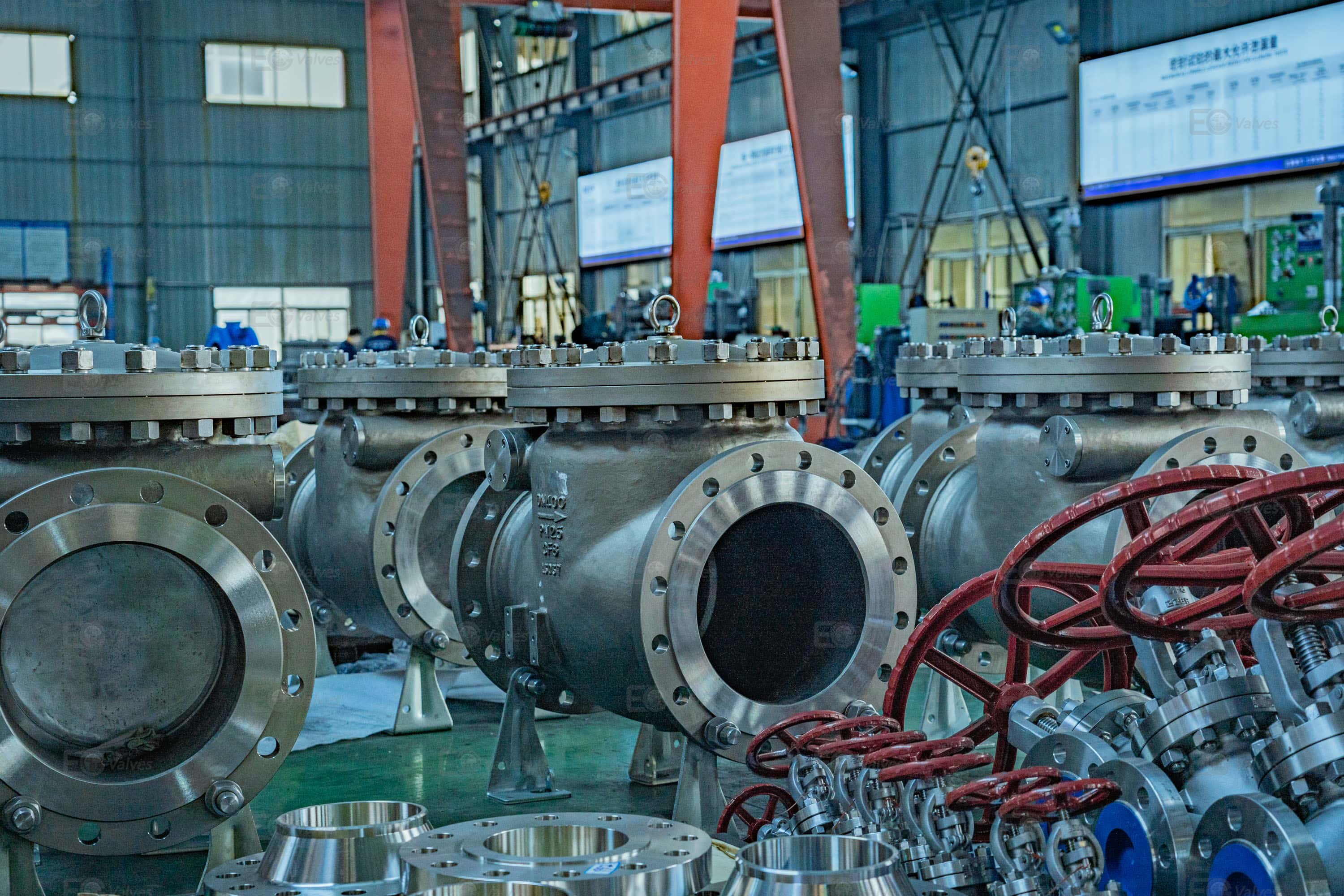
The proof point here is the interface rather than the actuator brand. For the high performance butterfly valve BPV302 and the triple offset butterfly valve BOV303, mounting geometry is part of the body specification, which removes an adapter from the assembly. For an engineer entering execution, three questions separate a designed interface from an adapted one: what mounting arrangement is cast or machined into the body; which operating mode is offered at each size and pressure class; and whether the actuator is selected against the valve's operating torque requirement rather than added after the valve is chosen.
It is equally important to distinguish isolation from control. A pipeline shut-off valve is designed to isolate a line, while a flow control valve is asked to modulate continuously. A concentric resilient seated butterfly valve is specified for quick on/off duty; a double eccentric or high performance design is specified where throttling capability matters. Buyers should not assume that a valve offered and priced for isolation will hold up to continuous modulation, and a supplier should be the one to raise that point first.
Proof point four: field history, and how to read it correctly
Reference lists are the weakest form of evidence when they are collections of logos, and among the strongest when each entry carries duration in service, pressure class, size range and material. The EG Valves project record can be read against that standard.
| Project | Scope | Operating evidence |
|---|---|---|
| United States, oil and gas | 1,438 gate, globe, check and ball valves, Class 150 to Class 1500, sizes 1/2" to 20", materials WCB, WC6, WC9, C5 and A105 | Eight years in high-pressure systems and corrosive environments, reported as safe and stable operation |
| United Arab Emirates, petroleum refining | 915 gate, globe, check, ball and butterfly valves, Class 150 to Class 1500, sizes 2" to 36" | Eight to ten years in high-pressure systems requiring precise fluid control |
| Malaysia, offshore | 120 ball and gate valves, Class 150 to Class 1500, sizes 1/2" to 36", materials Bronze, WCB, A105, SS316, 2205 and 2507 | Three years against corrosive seawater, reported to reduce maintenance and downtime |
| Mexico, oil and gas | 290 gate, ball, check and plug valves, Class 150 to Class 1500 | Eight years of stable operation with zero leakage |
| Russia and Uzbekistan, oil and gas | 650 gate, check and ball valves, PN16 to PN100, sizes DN40 to DN2000, materials LCB, WCB, A105 and F316 | Ten years in high-pressure and low-temperature service |
| Spain, chemical processing | 260 gate, globe and check valves, sizes DN250 to DN1200 | Five years handling corrosive environments and aggressive fluids |
| Brazil, water treatment | 326 gate, butterfly and check valves, sizes DN40 to DN2000, PN16 | Eight years of stable, low-noise operation managing flow and pressure |
| Italy, food processing | 180 gate, ball, butterfly and check valves, sizes DN15 to DN750, PN16 | Five years meeting high cleanliness standards and preventing contamination |
What makes this set useful is that the material column and the service column reinforce each other. Duplex 2205 and 2507 with SS316 in Malaysia matches a chloride-rich offshore environment. WC6, WC9 and C5 in the United States matches refinery and high-temperature duty. LCB in the Russia and Uzbekistan project matches low-temperature service. When a reference list shows materials that are logically consistent with the stated application, it is evidence. When it shows logos without materials, pressure classes or durations, it is not.
What the market signals say about proof-based sourcing
Two structural trends push buyers toward evidence-based evaluation. The first is scale and growth: the global industrial valves market is estimated at USD 82.9 billion in 2025 with a projected CAGR of 5.7% through 2034 (IMARC Group), and Asia Pacific held roughly 36.3% of 2025 revenue (Grand View Research). The second is increasing specialisation by product category. China exported USD 730 million in check valves in 2024, with the United States the top destination at USD 134 million (OEC), a figure that illustrates how granular export flows have become by valve type.
Market numbers, however, deserve the same skepticism buyers apply to supplier claims. Published 2025 estimates for the global industrial valve market range from USD 80.4 billion (Grand View Research) to USD 101.94 billion (MarketsandMarkets), depending on whether actuators and particular valve types are included in the scope. When a supplier quotes a market figure to argue that a specification choice is inevitable, the first question should be what the number actually counts.
Regulation is the third driver, and the least negotiable. Valves exported into the European Union must comply with the Pressure Equipment Directive 2014/68/EU for equipment with a pressure exceeding 0.5 bar. Compliance of that type depends on documentation that can be audited after delivery, which is why certificate scope, material certificates and inspection records have become part of the commercial conversation rather than technical footnotes.
Where the evidence stops: boundaries, scope limits and honest trade-offs
A capability assessment that only lists strengths is a brochure. Any valve line has boundaries, and buyers should test whether a supplier states them without being asked.
- Pressure envelope. The triple offset butterfly valve BOV303 is rated Class 150, 300 and 600, or PN10 to PN40. That is a wide range, not an unlimited one. For higher-pressure duty, EG's pressure seal gate valve GTP002 is specified from Class 600 to Class 2500 and the forged steel gate valve GTF023 from Class 800 to Class 2500. The correct conclusion is that the triple offset design is a strong selection inside its range, not that it replaces high-pressure gate valves.
- Certificate scope. Certification should be read by scope, not by title. API 600 certificate 600-0179 covers bolted bonnet steel gate valves, and API 6D certificate 6D-0506 covers check valves, ball valves and gate valves. Neither should be presented as covering an entire product catalogue. By comparison, the CE PED certificate DGR-0036-QS-1360-24, issued by TUV SUD Industrie Service GmbH under PED 2014/68/EU Annex III, Module H, with validity to 2027-05-26, covers gate, ball, globe, check and butterfly valves and strainers. The ISO 9001:2015 certificate 00125Q33391R3M/3400, issued by China Quality Certification Center with validity to 2028-05-22, covers those families plus pipe filters and flanges. Expiry dates matter as much as scope: a certificate that has lapsed is not evidence of anything.
- Material boundaries. Iron-bodied valves in this range stop at Class 125/150 and PN10/PN16. Stainless, alloy and duplex materials raise unit cost, and they are justified by corrosion, temperature or pressure duty rather than by preference. Paying for duplex in a clean water application is as much an engineering error as using cast iron in seawater.
- Standard compliance versus custom requirements. EG produces to ANSI, DIN, BS and JIS standards or to customer requirements. That last clause transfers responsibility to the buyer's specification: if the enquiry does not name the standard, the material and the inspection requirement, the order carries ambiguity that will surface at acceptance.
- Actuation limits. An integrally cast mounting pad simplifies actuator installation but does not remove the need to match the actuator to the valve's operating torque at the specified differential pressure. A lever-operated resilient seated butterfly valve and a gear-operated metal-seated valve of the same size perform different functions and are not interchangeable.
Stating these boundaries does not weaken a supplier's position. In capability evaluation, a supplier that names the limit of its own product is more credible than one that answers every requirement with yes.
Future outlook: documentation depth as the next differentiator
At China's current export scale, the competitive question is shifting from whether a manufacturer can produce a valve to whether it can prove how that valve was produced. Three expectations are likely to harden over the next few years. Material traceability, such as EN 10204 3.1 certificates issued per order, is becoming a default requirement rather than a special request. Certificate scopes are increasingly read by valve family and expiry date instead of by logo. And actuator data is expected to arrive with the valve specification, not after the purchase order.
EG Valves' production model aligns with that direction: OEM and ODM manufacturing under the customer's brand or the EG brand, a stated monthly capacity of around 8,000 valves, lead times of 25 to 35 days, and a minimum order quantity of 1 piece for large valves and 10 pieces for small valves. Capacity, lead time and documentation are engineering capability expressed in logistics terms, and they are increasingly evaluated together.
FAQ
Which materials should a buyer expect for high-pressure oil and gas valve service?
A wide industrial valve range typically covers carbon steel such as WCB and forging grade A105, alloy steels including WC6, WC9 and C5, low-temperature carbon steel LCB, stainless grades such as SS316 and F316, and duplex grades 2205 and 2507. EG Valves' documented projects reflect that spread: the United States oil and gas project used WCB, WC6, WC9, C5 and A105 in Class 150 to Class 1500 duty; the Malaysia offshore project used Bronze, WCB, A105, SS316, 2205 and 2507; and the Russia and Uzbekistan project used LCB, WCB, A105 and F316 at PN16 to PN100. Material should be selected against fluid, temperature and pressure class rather than by habit.
How can a buyer verify that a supplier genuinely understands triple offset butterfly valve design?
By asking for design outputs that can be checked. The EG Valves triple offset butterfly valve BOV303 specifies body materials across carbon steel, stainless steel, alloy steel and duplex steel, seat construction in stainless steel with graphite or PTFE with stainless steel, an optional Stellite seat for erosion resistance, size coverage from NPS 2" to 60" (DN50 to DN1500), pressure ratings of Class 150/300/600 or PN10/PN16/PN25/PN40, and wafer, lug and double flange patterns. A supplier with real design ownership will explain the offset geometry, the wear mechanism it addresses and how the seat is replaced. A supplier without it will repeat the product name.
What actuator options are typical, and how should the choice be made?
EG's specifications list handwheel, wrench nut, gearbox and worm gear, electric and pneumatic operating modes across its valve families, with quick 90-degree on/off operation on concentric butterfly valves, high-torsion Inconel springs for quick closing on the CSV410 stainless steel check valve, and mounting pads cast into high performance and triple offset butterfly valve bodies. Selection follows duty: isolation or modulation, manual or remote operation, and the operating torque required at the specified pressure differential. The operating mode should be confirmed for the exact size and pressure class ordered.
How should a buyer read certification scope rather than the certificate title?
By matching the scope statement to the valve type being purchased. API 600 certificate 600-0179 covers bolted bonnet steel gate valves; API 6D certificate 6D-0506 covers check valves, ball valves and gate valves; the CE PED certificate DGR-0036-QS-1360-24 covers gate, ball, globe, check and butterfly valves and strainers under PED 2014/68/EU Annex III, Module H; and the ISO 9001:2015 certificate 00125Q33391R3M/3400 covers those families plus pipe filters and flanges. Validity dates should be checked at the same time, since an expired certificate no longer supports a compliance claim.
What commercial and acceptance terms are normally fixed before execution begins?
For EG Valves, the minimum order quantity is 1 piece for large size valves and 10 pieces for small size valves. Delivery terms accepted include FOB, EXW and CIF depending on customer requirements. Most orders are inspected by the manufacturer's own QC department, while some customers appoint their own QC team or a third-party inspection company. Payment terms are 30% T/T as deposit with the balance settled before shipment. Quality control includes 100% inspection of every valve and EN 10204 3.1 material test certificates for every order, with lead times stated at 25 to 35 days.
Reference material: the EG Valves product and capability brochure can be downloaded here — EG Valves brochure (PDF). Company background and product range: www.egvalves.com.