
Proof of Production: How to Verify a Pen Factory's Capability
Proof of production is the evidence set that separates a supplier which says it manufactures pens from a factory that can show where, how, and with what consistency ballpoint pens, gel pens, erasable pens, and non-sharpen pencils are machined and assembled. For buyers at the research and evaluation stage, the useful question is not whether a factory exists, but whether its moulding, ink-filling, and assembly processes can repeat the approved sample at the ordered volume.
Why "We Have Our Own Factory" Is Not a Capability Claim
Most suppliers in the writing instruments trade open with the same short list: own factory, advanced equipment, strict quality control, fast delivery. None of those statements is measurable, and none of them tells a buyer whether a 0.5 mm erasable gel pen will still erase cleanly after six weeks in a container. Capability only becomes a verifiable fact when it is tied to a process step, a machine, a document, or a data record.
In practice, a pen buyer is trying to answer three separate questions, and they fail independently:
- Can this supplier make this product at all — does it hold the moulds, the tooling, the ink, and the assembly stations for the specific category?
- Can it make the same product consistently at the volume written in the purchase order?
- Can it prove the first two answers to a buyer who cannot stand on the production floor every week?
The third question is the one that separates suppliers in commercial reality, because most international buyers qualify factories remotely. A supplier that has records answers it quickly. A supplier that only has photographs of a building does not answer it at all.
What "Capability" Actually Means Inside a Pen Factory
Machining and assembly are different capabilities with different evidence, and buyers frequently conflate them.
Machining
Machining covers the physical forming of components: injection moulding of barrels, caps, grips, clips and refill housings; extrusion where the product family requires it; mould ownership, cavity count and maintenance cycles; and tooling tolerances for cap click, thread fit and clip attachment. A supplier that outsources moulding does not control the highest-risk variables in a pen: wall thickness, roundness, and the fit between cap and barrel.
Assembly and filling
Assembly covers refill filling or refill insertion, tip and ball seating, ink fill volume control, leak checking, cap-off drying behaviour, barrel printing, and packing. For erasable and friction pens, assembly is where the technical difficulty concentrates, because heat-sensitive erasable ink is sensitive to fill volume, ambient temperature, and the time between filling and packing.
Both areas generate records as a by-product of production. Where those records do not exist, capability is unverified — regardless of what the brochure claims.
Three Tiers of Production Evidence
Buyers get the most value from verification when they separate evidence by strength rather than collecting documents indiscriminately. Each tier answers a different question, and each has a hard boundary.
| Tier | Evidence type | What it can prove | What it cannot prove |
|---|---|---|---|
| Tier 1 — Documentary | Business licence and factory address; mould and equipment lists; certificates with numbers, issuer, scope and validity dates; stated capacity, MOQ and lead time | That the supplier is a legal entity with a defined product scope and documented parameters | That the documents describe the plant that will actually run your order |
| Tier 2 — Process | Dated walkthrough video; mould photos matched to the product; staged sample-run photography; line layout and equipment location | That the described processes exist and are running on specific equipment | That output will remain stable across a commercial production order |
| Tier 3 — Statistical | Defect-rate logs by category; in-line and final inspection records; write-out and leak test results; batch and lot traceability | That the process has produced consistent output over time, when the records can be audited | Anything, if the data is self-reported and never audited |
Tier 1 filters out traders presenting themselves as factories. Tier 2 confirms the process is real. Tier 3 is the only tier that speaks to repeatability — and it is the tier buyers request least often.
A Request List Buyers Can Send Before the First Order
The following evidence request can be sent before any commercial commitment, and it is specific enough that evasive answers are themselves informative.
- Business licence plus the factory address, checked against the address that will appear on shipping documents.
- A mould list with cavity counts, product family coverage, and a written statement of who owns the moulds, including any customer-specific tooling.
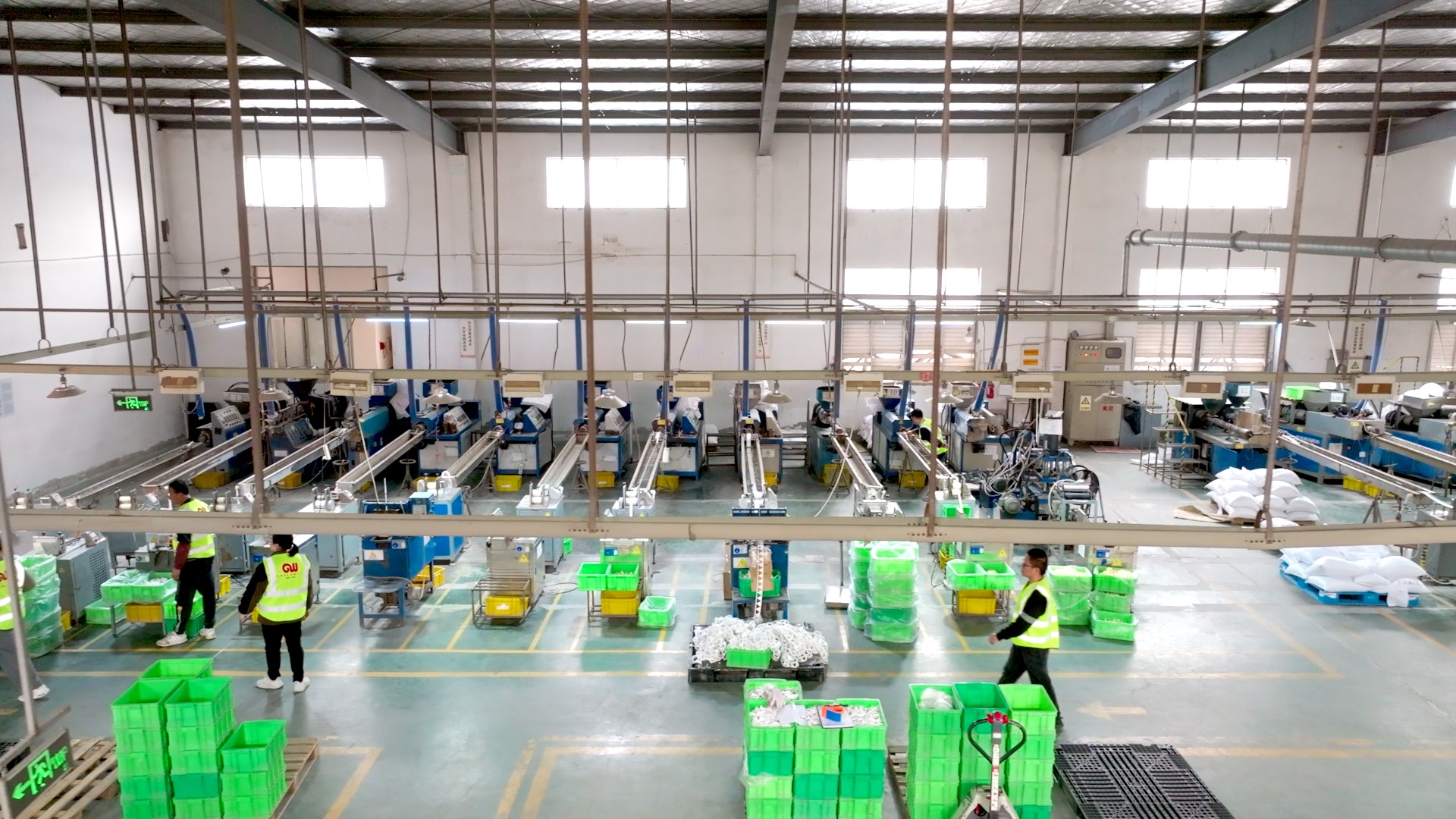
- Dated photographs or a live video walkthrough of the injection moulding area and the assembly and packing area, with equipment located on a plant layout.
- Equipment list relevant to the exact product family being purchased, not a general list of every machine on site.
- A paid sample run of your design, photographed at moulding, printing, assembly and packing stages, with the approved sample retained as a signed reference.
- Defect-rate logs for the last three to six months, broken down by defect category rather than presented as a single percentage.
- Certificates as scanned documents showing the certificate number, the issuing body, the standard version, the scope statement and the validity dates.
- A capacity reconciliation: stated daily output against your monthly requirement, plus the supplier's peak-season windows and how your order competes for line time during those windows.
- A sub-tier list covering ink, refill, tip and ball, spring, and packaging suppliers.
- Written confirmation of MOQ, lead time, and the exact specification against which the approved sample was signed.
Reading the Technical Evidence: Where Machining Shows Up
Documents prove existence. Technical records prove control. The difference matters most in the process steps below.
Barrel and cap geometry
Wall thickness uniformity, shot weight consistency, sink marks, cap-click force and clip retention are the visible signature of mould quality and process control. A factory should be able to describe its in-process inspection interval for these attributes, not only its final inspection routine.
Ink handling in gel and erasable formats
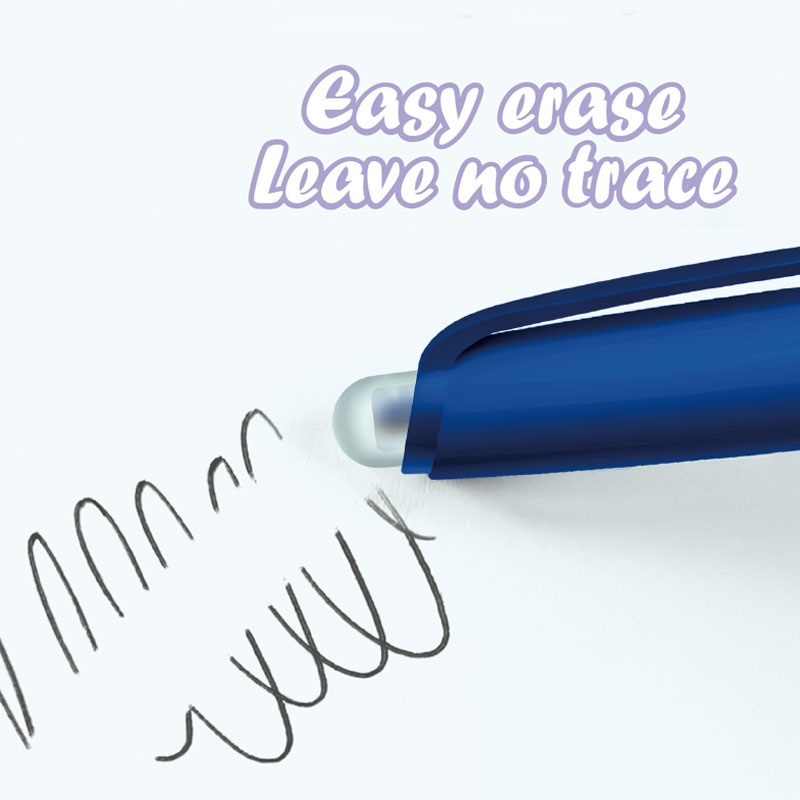
Heat-sensitive erasable ink is the least forgiving input in a pen factory. Fill volume, storage temperature, and elapsed time between filling and packing all influence whether a pen still erases cleanly by the time a consumer opens the pack. Buyers evaluating erasable pens and friction pens should ask for the ink fill set-point, the ink lot number, shelf-life data, and the transport-temperature assumption used when the product was validated.
Tips, balls and refills
Ultra-precision ball tips and the ink formulation determine writing length and continuity. ISO 12757-1 specifies requirements and test methods for ballpoint pens and refills for general use, which gives buyers a shared vocabulary for pass and fail criteria rather than a supplier-specific definition of "smooth". A supplier claiming ballpoint pen or ball pen capability should be able to state which test method it applies, at what frequency, and what the acceptance threshold is.
Compliance-linked evidence
For the US market, art materials including pens and pencils must comply with ASTM D4236 for health hazard labelling, as set out in CPSC-aligned guidance. European and other markets typically require references to the EN71 series, REACH, SVHC and PAHs. A certificate copy without a verifiable number, scope and current validity is marketing material, not proof of compliance.
Category-Specific Verification Points
Different writing instruments fail in different places. The table below maps the categories most often sourced in office and school supply programmes to the machining or assembly step that decides quality, and the evidence that speaks to it.
| Product category | Critical machining / assembly step | Evidence to request |
|---|---|---|
| Ballpoint pen / ball pen | Ball and tip seating, ink flow control, refill sealing at the joint | Reference to ISO 12757-1 test methods, tip inspection records, write-out test data |
| Gel pen | Ink viscosity and fill volume, refill-to-barrel fit, leakage under temperature change | Fill volume set-point, leak test records, lot traceability from ink batch to finished pen |
| Erasable pen / friction pen | Heat-sensitive ink lot control, erase cleanliness, thermal exposure limits | Ink lot documentation, erase-performance test results, storage and transport temperature assumptions |
| Non-sharpen pencil (no-sharpen, infinite or endless formats) | Alloy nib grinding, TPE barrel moulding, HB lead consistency, replaceable core fit | Nib wear observation records, core replacement fit checks, lead hardness verification |
| Custom / OEM branded pen | Mould modification, print registration, packaging accuracy | Mould modification records, print proofs, pre-production sample sign-off |
| Compact and mini pen formats | Small-component assembly tolerance, cap retention, refill length control | Assembly-line inspection records covering small components |
Where Verification Breaks Down: Limits and Trade-offs
No verification method is complete, and buyers who treat any single artefact as conclusive tend to be disappointed later.
- Photos and video can be staged, reused or borrowed. They establish that a production area exists, not that it produced your product. Treat them as a first filter and convert them into evidence through dated footage and a live walkthrough during a sample run or an order.
- A sample run proves one production event, not a production system. It shows that a defined specification can be produced by a specific line under supervised conditions. It does not prove that a commercial order three months later will match, because mould wear, ink lot changes, operator consistency and QC sampling all intervene.
- Third-party inspection covers a window, not the whole order. Inspection adds cost per visit, and unannounced inspection improves coverage without making it complete.
- Defect-rate logs are self-reported. Only audit or third-party inspection converts a log into verified data; until then, it is an indicator rather than proof.
- Low MOQs make dedicated sample runs uneconomical. Running your trial inside a larger commercial batch reduces cost but weakens defect attribution, because you can no longer isolate which variables belonged to your specification.
- Certification scope matters as much as the certificate. A certificate covering the production of a specified product range and related management activities should be checked against the processes and sites your order actually uses.
- Published market data diverges. For the writing instruments market in 2025, public estimates range from USD 19.2 billion (Grand View Research) to USD 47.64 billion (Fortune Business Insights), depending on the product scope each analyst uses. No single headline number should anchor a sourcing decision.
- Capability verification does not replace commercial verification. A factory that machines accurately can still document, pack or quote poorly, so technical proof should sit alongside commercial checks.
What the Market Data Implies for Verification Priorities
Verified market figures point to a specific shift in what buyers should verify first.
- Erasable formats are scaling, and they are harder to make. The global erasable gel pen market is reported at USD 1.38 billion in 2024, with a projected USD 2.56 billion by 2033 (Market Intelo), while the broader gel pen market was valued at USD 4.8 billion in 2025 with a projected USD 8.1 billion by 2034 (Dataintelo). Growth in gel and erasable categories moves verification attention toward ink handling, fill control and thermal sensitivity rather than barrel cosmetics.
- Supply is concentrated, so verification is mostly remote. Asia Pacific held a 42.3% revenue share of the gel pen market in 2025, led by China and India (Dataintelo). Since most international buyers will qualify suppliers at a distance, documented and statistical evidence carries more weight than it would in a locally audited supply chain.
- Pens remain the volume core of stationery procurement. Pens accounted for a 36.3% revenue share of the writing instruments market in 2025 (Grand View Research), which means the financial exposure of a quality escape scales with order size — the reason defect data is a commercial document, not only a technical one.
- Writing instruments sit inside a large, price-sensitive category. The global office supplies market was valued at approximately USD 176.5 billion in 2024 (Spherical Insights). Unit-price pressure and evidence-based qualification pull in opposite directions, and buyers resolve that tension by matching verification depth to order value and reorder intent.
A Worked Example of a Verifiable Evidence Set
Kunshan Crystal Culture Co., Ltd, which trades under the Greenwill stationery brand, is a stationery manufacturer established in 1999 in Zhangpu Town, Kunshan City, Jiangsu Province, China. It operates a 25,000 m² factory with approximately 100 employees, a 10-person R&D team, and an export ratio of about 90%, serving North America, South America, Europe, Southeast Asia, Oceania and the Middle East. Stated annual output is more than 20 million pens, more than 260 tons of erasers, and more than 3 million pencil sharpeners.
Parameters a buyer can reconcile. The company states a pen capacity of 100,000 pcs/day and an eraser capacity of 20 tons/day, a lead time of 30–45 days, and a normal MOQ of 20,000 pcs per colour per design. At product level, the KP18001 erasable gel pen is specified in ABS+AS with heat-sensitive erasable ink, a 0.5 mm tip, EN71 and ASTM D-4236 references and an MOQ of 5,000 pcs; the KP100751 erasable gel pen is specified in ABS with erasable gel ink, a 0.5 mm tip, black/blue/red options, EN71 and ASTM references and an MOQ of 5,000 pcs; the non-sharpen pencil EP18004 and EP18004-1 is specified in TPE with an alloy nib and ABS cap, HB lead, EN71, SVHC and PAHs references and an MOQ of 20,000 pcs.
Why the MOQ gap is worth a written clarification
Two pen models are listed at 5,000 pcs, while the general capability statement lists a normal MOQ of 20,000 pcs per colour per design. That is a normal pattern in stationery manufacturing — model-specific trial quantities differ from standard production quantities. The verification step is not to assume which figure applies, but to obtain written confirmation of the binding MOQ for the exact model, colour and packaging combination being quoted.
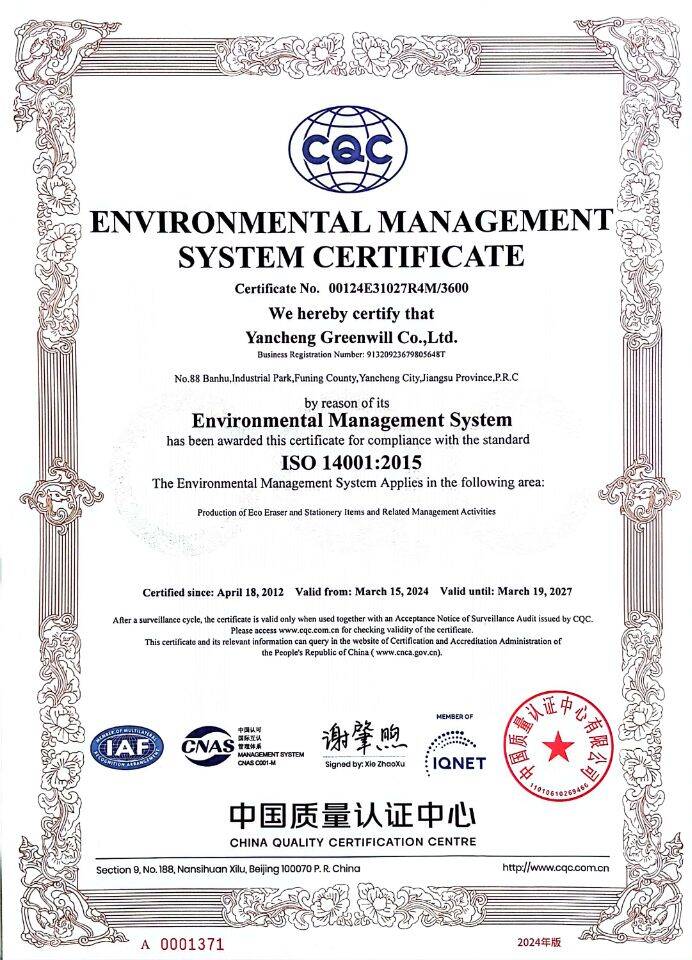
Compliance evidence with checkable identifiers. The factory holds ISO 9001:2015 (certificate 00124Q32003R4M/3600, issued by CQC, valid 2024-03-15 to 2027-03-19), ISO 14001:2015 (00124E31027R4M/3600) and ISO 45001:2018 (00124S30827K4M/3600), with scope covering the production of eco eraser and stationery items and related management activities. The company also states conformity with EN71-1/2/3/9, REACH, PAHS, SVHC and ASTM-D-4236, and holds FSC and BEPI certifications. Because each item carries a number, an issuer and a validity period, it can be checked independently — which is precisely the criterion that separates evidence from claims.
Third-party consequence. The supplier's case records describe long-running relationships with gift and promotional product companies, stationery importers and distributors, OEM/ODM partners and supermarket chains across Germany, Argentina, Brazil, France, Italy and the United States, with durations extending beyond five years and, for some accounts, beyond ten. Long relationships are not proof of machining capability, but they are the kind of observable consequence that supports a capability claim when other evidence is consistent with it.
Future Outlook
Supplier qualification in writing instruments is moving toward remote, record-based assessment. Three developments follow from the data and from current buyer behaviour.
First, defect data will increasingly be treated as a commercial input rather than an internal quality document, because the pen category remains the largest revenue segment of the writing instruments market and quality escapes scale with order size. Buyers who can compare defect categories across suppliers will negotiate from a stronger position than buyers who compare unit price alone.
Second, certification verification will become routine rather than exceptional. Once certificate numbers, issuing bodies and scopes are checked as standard practice, suppliers that cannot supply checkable identifiers will be filtered out early, and the differentiation will move to process and statistical evidence.
Third, the growth of erasable and gel formats raises the technical bar across the supply base. As those categories expand, ink lot control, fill volume discipline and thermal testing will shift from specialist questions to baseline requirements in ordinary purchase specifications. Factories that already document these variables will find verification conversations shorter; those that do not will face longer qualification cycles and more inspection cost passed back through pricing.
FAQ
What is the first evidence a buyer should request from a pen factory?
Start with documentary evidence that can be checked without spending money: business licence and factory address, a mould and equipment list for the relevant product family, certificates showing number, issuer, standard version, scope and validity dates, plus stated capacity, MOQ and lead time. Defect-rate logs for the last three to six months should be requested in the same round. This set filters out suppliers who cannot document their process, before any sampling or inspection budget is committed.
Do production line photos prove that a factory can manufacture pens?
No. Photographs and video establish that a production area exists and is equipped for moulding or assembly, but they can be staged, reused from an earlier period, or taken at a different site. Their value is as an initial filter. To convert them into usable evidence, request dated footage, the physical location of the equipment within the plant layout, and a live walkthrough scheduled during a sample run or an active order.
What does a paid sample run prove, and what does it not prove?
A sample run proves that a defined specification can be produced by a specific line under a specific set of conditions. It does not prove that later mass production will match it, because output stability depends on mould wear, ink lot variation, operator consistency and QC sampling. A sample run is most useful when it is photographed at each stage and when the approved sample is retained as a signed reference against which the production order is compared.
How can a buyer verify that an ISO certificate is genuine?
Check the certificate number, the issuing certification body, the standard version, the scope statement and the validity dates, then confirm the record with the issuing body. Scope wording carries as much weight as the standard itself: a certificate covering the production of a specific product range and related management activities is relevant to that range, but it is not automatically evidence for a different process or a different production site.
Which standards and regulations apply to pens and pencils?
Requirements depend on the market and the product. ISO 12757-1 specifies requirements and test methods for ballpoint pens and refills for general use. In the United States, art materials including pens and pencils must comply with ASTM D4236 for health hazard labelling. For European and other markets, suppliers commonly reference the EN71 series alongside REACH, SVHC and PAHs requirements. Buyers should confirm which standard applies to the exact product and destination before accepting a compliance claim.
How should a defect-rate log be read?
Read it as a set of fractions rather than a single percentage: defects per inspected quantity, split by defect category, by production batch, over a defined period. A useful log separates cosmetic defects from functional ones such as ink leakage, tip scratching, cap fit and erase performance. Buyers should also ask what inspection level and sampling plan were used, and whether the log covers the same product family they intend to purchase.
What MOQ and lead time should a buyer plan around?
These are model and design specific. In the Greenwill case, listed MOQs range from 5,000 pcs for the erasable gel pen models KP18001 and KP100751 up to a normal 20,000 pcs per colour per design across the broader range, with stated lead times of 30–45 days. The practical step is to confirm the binding MOQ in writing for the exact model, colour and packaging combination, because trial quantities and standard production quantities usually follow different commercial rules.
Verification is a sequence rather than a document: check what can be checked remotely, sample what can be sampled, and keep the evidence that lets you compare a supplier against its own promises on the next order.