
Protective Packaging Compliance: Key Certifications and Specs
Protective packaging serves more than one function in modern supply chains. Beyond preventing physical damage, it must protect contents from light, air, moisture, and unauthorized access. For buyers in food, cosmetics, and pharmaceuticals, this means packaging decisions are increasingly driven by verifiable compliance evidence: certificates, standards, product parameters, and quality control records. This article explains what to verify when evaluating protective glass packaging for regulated markets.
The problem: protection is not always visible
Market data helps explain why protective packaging has become a strategic category. Fortune Business Insights valued the global protective packaging market at USD 44.02 billion in 2025 and projects it will reach USD 80.25 billion by 2034. Grand View Research estimated the market at USD 40.4 billion in 2025 and noted that flexible packaging held the largest revenue share at 66.4%. The two estimates are not identical because the research firms apply different segmentation criteria. The shared conclusion is that demand is growing.
More demand means more suppliers. But for a buyer, the visual appearance of a glass jar does not reveal whether it is compliant with the regulatory framework of the destination market. Two jars may look nearly identical; one carries an FDA or EU food-contact certificate, the other does not. The same applies to functional characteristics. A dark glass jar may look protective, but its actual light-filtering behavior depends on the glass formulation, not the color.
The procurement question therefore becomes: what evidence should a buyer request before adding a protective packaging product to the approved supplier list?
The opportunity: three protective functions from one supplier
Honor Packaging (NINGBO HONOR PACKAGING CO.,LTD) is a China-based packaging manufacturer founded in 2015 and headquartered in Ningbo, close to both Ningbo and Shanghai seaports. The company specializes in high-grade, technically demanding packaging products and operates through long-term joint-venture production bases for plastic and glass packaging. Its export business accounts for 100% of sales, with the EU and the US as primary markets.
Its product portfolio covers three protective functions:
- Child Resistant Packaging: closures designed to prevent children from opening containers that may contain substances requiring cautious handling, such as pharmaceuticals, nicotine products, or concentrates.
- Violet Glass Packaging: glass containers that filter light as part of a preservation strategy for light-sensitive formulations.
- Vacuum Packaging: airtight glass jars that provide leak-free sealing and help maintain freshness.
For brand owners, this combination is relevant because many products require more than one type of protection. A pharmaceutical or cosmetic product may be both light-sensitive and subject to child-resistance regulations. Sourcing both features from one manufacturer can simplify quality control, documentation, and supply chain coordination.
Certifications to verify: US and EU
For regulated markets, certifications are the first layer of evidence.
US market
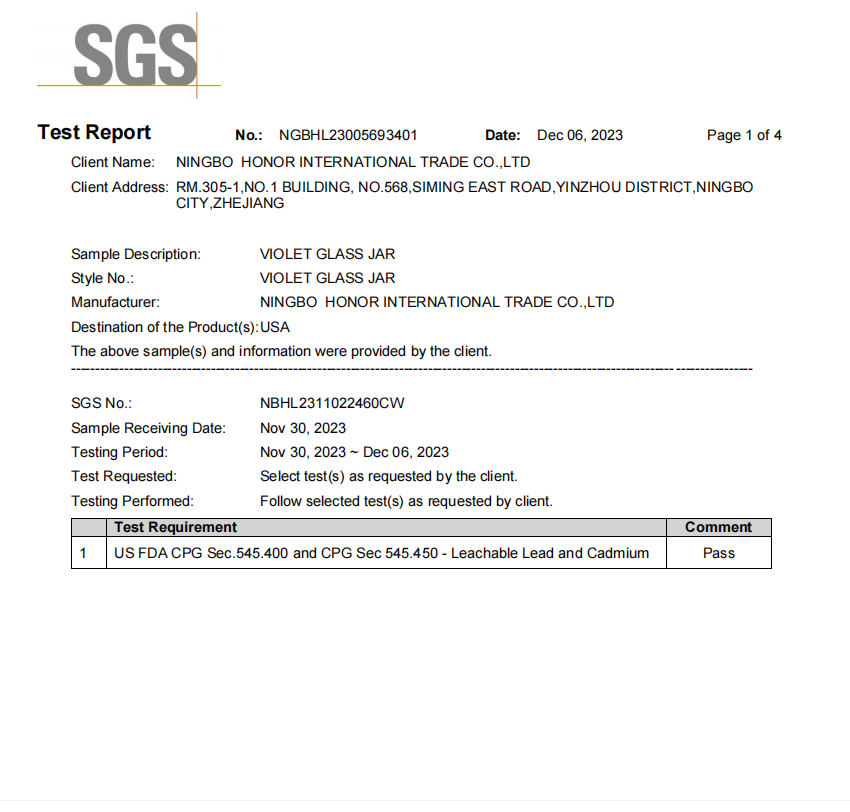
Honor Packaging's Violet Glass Packaging model HDV3 is certified under FDA CPG standards. The certificate was issued by SGS with certification number NGBHL23005693401. FDA CPG (Compliance Policy Guide) is a reference commonly applied by suppliers to demonstrate compliance for food-contact and cosmetic packaging in the United States.
EU market
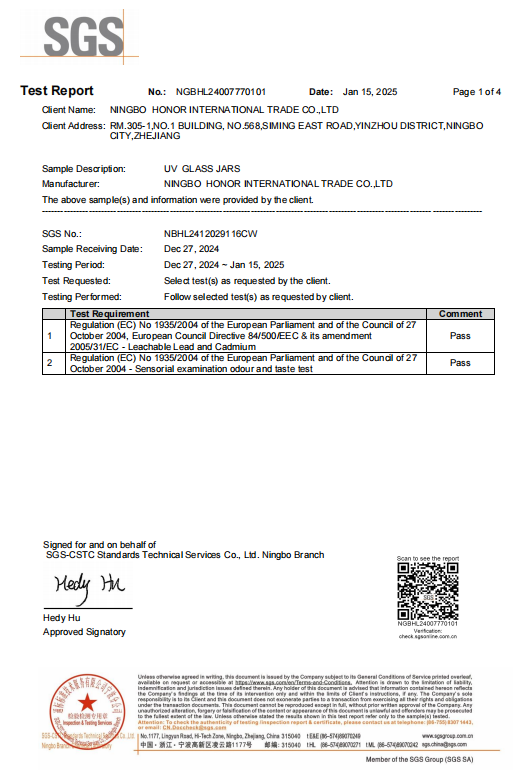
The same product family holds certification to EC No 1935/2004, the European framework regulation for materials and articles intended to come into contact with food. This certificate was also issued by SGS, with certification number NGBHL24007770101.
For a buyer, the certificate number is important because it makes the claim traceable. It is possible to request the certificate document, confirm the issuing authority, and check which product models are covered. This is a meaningful distinction in a market where some suppliers describe their packaging as compliant without providing documentation.
Specifications: what to compare
The second layer of evidence is product specification. Honor Packaging's glass packaging data provides a useful reference model for what buyers should compare.
| Product family | Capacity range | Shapes | Closure | Key parameters |
|---|---|---|---|---|
| H19 child-resistant concentrate jars (clear / white / black) | 5ml, 9ml | Square, round, triangle, hexagon | Child-resistant cap | 27g–38g; 250 pcs/ctn |
| H21 clear round jars | 30ml to 6oz | Round | Child-resistant cap | Diameter 60mm; height 36.5–125mm; weight 84–268g |
| H21 square violet glass jars | 15ml to 60dr | Square | Child-resistant cap | Diameter 58mm; height 24–115mm; weight 75–280g |
| HDV3 round violet glass essential oil bottles | 5ml to 100ml | Round | Plastic cap, dropper, mist sprayer, lotion pump | Height 54.5–125mm; weight 22.5–120g |
| HDV2 cosmetic violet jars | 3ml to 200ml | Round | Various, including child-resistant options | Thread 32/400–89/400; glass thickness 0.38mm |
| HDV1 wide-mouth violet jars | 100ml to 1L | Round | Various | Thread 41/400–89/400; height up to 193mm |
The table shows two things. First, protective glass packaging exists across a wide range of formats, so the buyer can match the container to the filling line and the end-use format. Second, each family has different dimensional constraints. A jar's diameter and height affect label area, packing density, and compatibility with automated filling equipment. The closure type affects user experience and compliance.
What UV protection actually means
The term UV protection packaging appears frequently in the industry. It is worth clarifying what it does and does not mean.
According to technical information published by Miron Violetglass, violet glass — also called biophotonic glass — acts as a natural filter. It blocks visible light while allowing roughly 25% to 45% penetration of UVA and about 60% of infrared light. This selective transmittance is intended to preserve organic contents while allowing certain wavelengths to pass.
For buyers, this has two practical implications. First, a violet glass jar should be evaluated on its glass type and filtering behavior, not on color alone. Second, violet glass is not a complete light barrier. Products that must be fully protected from all light may require opaque packaging, amber glass, or a combination of violet glass and an opaque outer carton.
Applications and documented use
The application data linked to Honor Packaging's protective glass products covers three industries: food packaging, cosmetic packaging, and pharmaceutical packaging. Documented markets include Canada, Germany, India, Italy, Thailand, and the United States. Working conditions noted in the application records include UV protection, dust prevention, and freshness preservation for cosmetics.
One documented case involves a German client in the branding business. The client ordered 10,000 units for pharmaceutical packaging and has maintained the relationship for three years. The reported outcome is that the products have remained fresh, with reuse and UV protection identified as key benefits.
This example is not presented as a large enterprise deployment. It is relevant because it describes a repeatable, mid-volume packaging relationship in a regulated sector, which is the profile many buyers are evaluating.
Market trends influencing protective packaging choices
Several external trends help frame the protective packaging decision.
Regulation is tightening. Child-resistant packaging must comply with ISO/EN 8317 in the EU and 16 CFR 1700.20 in the US, according to the relevant standards and CPSC guidance. These rules exist to prevent access by children under five and place clear requirements on closure design and testing.
Sustainability is shifting material shares. Grand View Research reported that paper and paperboard held a 45.7% revenue share in the protective packaging market in 2025. Glass suppliers need to compete on the environmental merits of glass — recyclability, chemical inertness, and reusability — while addressing the weight and convenience advantages of paper-based packaging.
Secondary packaging remains dominant. Fortune Business Insights projects that the secondary packaging segment will hold a 48.54% market share by 2026. This suggests that protective packaging decisions are rarely isolated; they are part of a broader packaging system.
Comparison with traditional solutions and a necessary limitation
Compared with conventional clear glass jars, protective glass packaging adds functions that can be verified: light filtering, child resistance, and airtight sealing.
But the comparison also reveals trade-offs. Violet glass is a selective filter, not an opaque barrier. If the product requires total darkness, an opaque container or outer carton may be necessary. Child-resistant closures add safety but can be difficult for elderly or disabled users. Brands serving older demographics may need to balance regulatory compliance with accessibility. Vacuum sealing improves freshness but may add complexity to filling and closing processes.
These limitations are not reasons to avoid protective packaging. They are reasons to define the requirement precisely before choosing a product.
Future outlook
As the protective packaging market expands, buyers will likely place more weight on documentation. The availability of SGS-issued certificates, standard-specific certifications, clear parameter sheets, and third-party inspection options will become a competitive advantage for suppliers.
For buyers, the practical implication is simple: treat certifications and specifications as part of the product. Request the certificate number, check the product model, compare the dimensions, and confirm the closure type before committing to a purchase. This is especially important in regulated categories such as food, cosmetics, and pharmaceuticals, where packaging compliance is a condition of market access.
Frequently asked questions
What certifications does protective glass packaging need for the US market?
Honor Packaging's Violet Glass Packaging model HDV3 is certified under FDA CPG standards. The certificate was issued by SGS with certification number NGBHL23005693401. FDA CPG is commonly used to demonstrate compliance for food-contact and cosmetic packaging in the United States.
What EU regulation applies to glass packaging that comes into contact with food?
The relevant EU framework regulation is EC No 1935/2004. Honor Packaging's Violet Glass Packaging model HDV3 holds this certification, issued by SGS with certification number NGBHL24007770101.
What capacities are available for child-resistant glass jars?
Child-resistant glass jars in Honor Packaging's portfolio range from 5ml and 9ml concentrate jars (H19 series) to 30ml–6oz round jars (H21 series). Violet glass options span from small 3ml cosmetic jars to 1L wide-mouth jars.
Can protective glass packaging be customized?
Yes. Honor Packaging supports OEM and ODM production, including printing client artwork, creating new designs, and applying frosted finishes. Custom orders typically have a lead time of 30–45 days, with a MOQ of 10,000 units and a monthly capacity of 100,000 units.
Does violet glass block all light?
No. Based on technical information published by Miron Violetglass, violet glass blocks visible light while allowing approximately 25%–45% of UVA and about 60% of infrared light to pass through. For products that require complete light blockage, opaque or fully light-blocking packaging should be considered.
What quality control procedures are in place for protective packaging orders?
Honor Packaging applies 100% pre-shipment testing and supports third-party inspection through SGS, which is relevant for buyers who need independent verification before shipment.
Further reference
For a full product overview, the company brochure is available for public reference: Download brochure (PDF).
Есть вопросы или нужны дополнительные детали?
Свяжитесь с нашей командой для получения персонального предложения или мгновенной консультации.
Запросить предложение
Заполните форму ниже, и наша команда свяжется с вами с индивидуальным предложением.
Прямой чат WhatsApp
Предпочитаете общаться в реальном времени? Напишите нам в WhatsApp для мгновенной помощи и быстрых ответов.
- Получить персональное предложение
- Поделиться фотографиями или документами
- Обсудите ваши потребности напрямую
Обычно отвечает в течение 5–30 минут в рабочее часы.