
Protective Packaging Scenario Fit: Child-Resistant, Violet Glass, or Vacuum Jars?
Protective packaging is often purchased as a single SKU and evaluated as a single specification sheet. In practice it is a bundle of three barrier functions — controlled access, light management and oxygen exclusion — and each function maps to a different jar format. For a buyer in the evaluation stage, the productive question is not which protective jar performs best in the abstract, but which failure mode the product is exposed to, and which verified format closes that exposure.
Honor Packaging (NINGBO HONOR PACKAGING CO.,LTD), founded in 2015 and headquartered in Ningbo, China, is a packaging manufacturer specialising in child-resistant packaging, violet glass packaging and vacuum packaging. The company exports 100% of its output, with the EU and the USA as its main markets, and operates with a 15-person R&D team and an annual output of 1,000,000 units. Its published product data provides a workable reference frame for scenario-based selection across pharmaceutical, medical, cannabis, supplement, food, cosmetic and essential-oil applications.
The Decision Sequence: Risk First, Format Second
Most selection errors in protective packaging come from starting with capacity and finishing with material. A more reliable sequence starts with the degradation or access risk that governs the product. Four risks cover most glass-format decisions: unauthorised access by children, photodegradation from visible and ultraviolet light, oxidative change caused by headspace air, and leakage or handling damage.
Naming the dominant risk narrows the format immediately. Access control is a closure system property, not a container property, which is why child-resistant performance is measured on the assembled pack. Light management is a glass colour and opacity question. Oxygen exclusion is a sealing-mechanism question, as with the vacuum-click closure on the H19 Vacuum Click Jar. Leakage and handling are answered by wall thickness, closure fit and secondary packing rather than by format alone.
The Three Protective Functions, and the Verified Formats Behind Them
Access control: child-resistant caps on H21 violet glass jars
In the European Union, child-resistant packaging is assessed against ISO/EN 8317; in the United States, the corresponding requirement is 16 CFR 1700.20, which is designed to prevent access by children under five. Both frameworks test the container and closure together, so a jar specification on its own does not demonstrate child resistance — the buyer should expect a validation record for the specific jar-and-cap pairing used in production.
Within Honor Packaging's published range, the H21 violet glass jar line is supplied with child-resistant caps in two geometries. Round H21 jars cover 30 ml, 2 oz, 20 dr, 30 dr, 40 dr, 60 dr and 6 oz, with a 60 mm diameter and heights from 36.5 mm to 125 mm. Square H21 jars cover 15 ml, 30 ml, 20 dr, 30 dr, 40 dr and 60 dr, with a 58 mm diameter and heights from 24 mm to 115 mm. Both geometries use 0.38 mm glass thickness and are supplied in violet glass with PP/PE closures.
Light management: violet glass jars and bottles
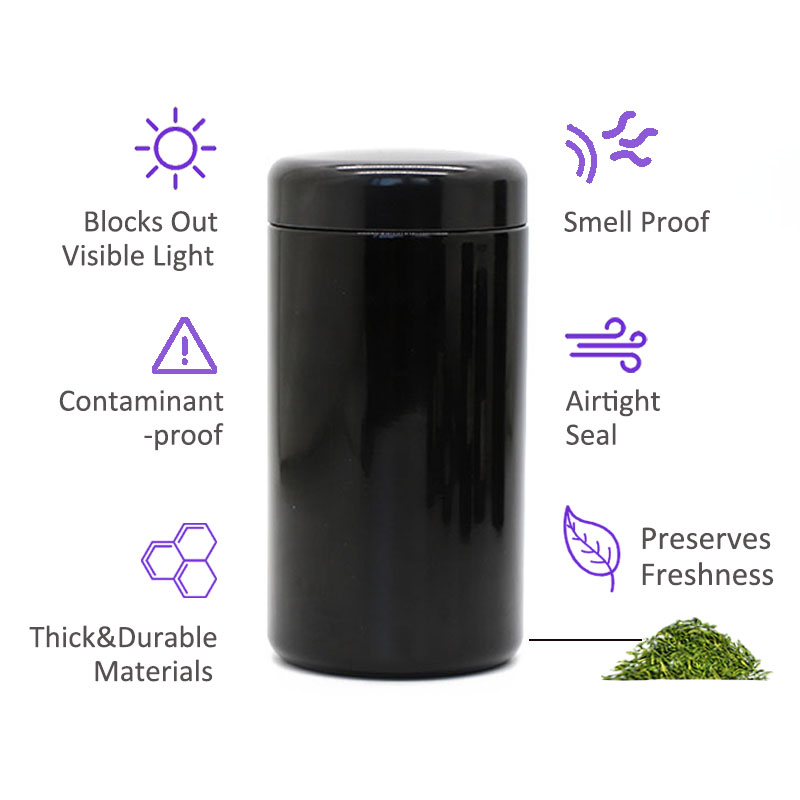
Violet glass is a light-management format rather than a decorative finish. Miron Violetglass, a specialist in violet (biophotonic) glass, describes the material as acting as a natural filter: it blocks visible light while allowing 25%–45% penetration of UVA and 60% of infrared light to pass through.
That description carries a practical consequence for evaluation. Violet glass reduces visible-light exposure and the photo-oxidation pathway associated with it, but it is not an absolute ultraviolet barrier. Buyers whose formulation is sensitive to residual UVA transmission — or whose markets require demonstrably zero light transmission — should treat violet glass as one candidate among several and specify the light-transmission threshold they actually need.
The violet glass range at Honor Packaging spans several families: the H21 round and square jars, the HDV1 wide-mouth jars, the HDV2 cosmetic jars and the HDV3 round essential oil bottles. The H21, HDV1 and HDV2 families are produced in violet glass at 0.38 mm wall thickness, with surface options that include labels, silk-screen printing, hot stamping, heat transfer printing and frosted finishes.
Oxygen exclusion: the H19 Vacuum Click Jar
Vacuum formats address a different failure mode — residual headspace air. Honor Packaging's H19 Vacuum Click Jar is a square glass jar with a 5 ml capacity, packed 250 pieces per carton, and it is listed for food, cosmetic and medical applications. The 5 ml capacity places the format in the sample, concentrate and single-dose segment rather than in bulk storage.
Because a vacuum format depends on the closing mechanism as much as on the container, the sealed condition is the specification that matters during sampling: closure torque, click engagement and the resulting headspace behaviour should be validated on the assembled unit, not inferred from the jar drawing.
Scenario Fit: Which Format Belongs to Which Application
The table below maps the applications named in Honor Packaging's product data — pharmaceutical and medical, cannabis, supplements, food, cosmetics and essential oils — onto the formats whose verified capacities fall inside the relevant dose range.
| Scenario / application | Format to specify | Verified specification | Protective function served |
|---|---|---|---|
| Pharmaceutical & medical, small solid or semi-solid dose | H21 square violet glass jar with child-resistant cap | 15 ml / 30 ml / 20 dr / 30 dr / 40 dr / 60 dr; 58 mm diameter; 24–115 mm height; 0.38 mm glass | Controlled access plus light filtration |
| Pharmaceutical & medical, larger fill | H21 round violet glass jar with child-resistant cap | 30 ml / 2 oz / 20 dr / 30 dr / 40 dr / 60 dr / 6 oz; 60 mm diameter; 36.5–125 mm height; 0.38 mm glass | Controlled access plus light filtration |
| Cannabis, supplements, dried or semi-solid product | H21 round or square violet glass jar | Round from 30 ml to 6 oz; square from 15 ml to 60 dr | Light filtration in a reusable jar format |
| Food and cosmetic storage / decant | HDV1 wide-mouth violet glass jar | 100 / 150 / 200 / 250 / 300 / 500 ml / 1 L; thread 41/400–89/400; 48–95 mm diameter; 84.7–193 mm height | Light filtration with a wide fill aperture |
| Cosmetic creams, salves and compact fills | HDV2 violet glass jar | 3 / 5 / 10 / 30 / 50 / 60 / 100 / 200 ml; thread 32/400–89/400; 25.6–55 mm height | Light filtration in a compact footprint |
| Essential oil and aroma packaging | HDV3 round violet glass essential oil bottle | 5 / 10 / 15 / 20 / 30 / 50 / 60 / 100 ml; 54.5–125 mm height; 22.5–120 g | Light filtration plus closure choice (cap, dropper, mist sprayer, lotion pump) |
| Vacuum-sealed sample, concentrate or single dose | H19 square Vacuum Click Jar | 5 ml; square glass; 250 pcs/ctn | Headspace air reduction |
Three observations follow from the table. First, child-resistant access control and light filtration converge in the H21 line, which is why pharmaceutical and cannabis-adjacent applications tend to resolve to that family rather than to a general-purpose jar. Second, capacity range, not material, separates food and cosmetic storage from cosmetic cream packaging: the HDV1 wide-mouth jar starts at 100 ml, while the HDV2 compact jar covers 3 ml to 200 ml and stays between 25.6 mm and 55 mm in height. Third, the vacuum format is narrow by design — 5 ml — so it complements a primary jar range rather than replacing it.
A Ranked Shortlist for Three High-Risk Scenarios
Where several formats overlap in capacity, ranking by scenario risk gives a defensible shortlist. The ordering below reflects fit against the verified capacities, shapes and closure options published for each family; it is a format ranking, not a supplier ranking.
| Scenario | Rank 1 | Rank 2 | Rank 3 |
|---|---|---|---|
| Pharmaceutical / medical, small dose | H21 square violet glass jar with child-resistant cap (15–60 dr) | H21 round violet glass jar with child-resistant cap (30 ml–6 oz) | HDV2 violet glass jar (3–200 ml) where child resistance is not the governing requirement |
| Cannabis and supplements | H21 round violet glass jar with child-resistant cap (30 ml–6 oz) | H21 square violet glass jar with child-resistant cap (15–60 dr) | HDV1 wide-mouth violet glass jar (100 ml–1 L) for larger fill volumes |
| Food and cosmetic decant | HDV1 wide-mouth violet glass jar (100 ml–1 L) | HDV2 violet glass jar (3–200 ml) | H19 square Vacuum Click Jar (5 ml) for vacuum-sealed small doses |
Application Evidence: A Three-Year Pharmaceutical Project
One documented application illustrates how the scenario logic plays out over a full product lifecycle. A pharmaceutical packaging project in Germany, with a scale of 10,000 units, was implemented over three years. The packaging was designed for pharmaceutical use, featuring a reusable design and UV protection. Over the project period, the products remained fresh, and the packaging has since been adopted by branding business clients.
For buyers in the evaluation stage, three details matter more than the headline. The scale — 10,000 units — sits exactly at Honor Packaging's stated minimum order quantity, which means the project is representative of a first commercial run rather than a pilot. The three-year duration makes the outcome a durability observation rather than a short-term check. And the two features credited in the record, reusability and UV protection, are additive: the format had to serve light management while remaining usable after opening.
Procurement Criteria That Change the Selection
Scenario fit narrows the format; procurement parameters decide whether the chosen format is workable for a given programme. Honor Packaging's published capability data sets the practical boundaries: production is run under OEM and ODM arrangements, monthly capacity is 100,000 units, lead time is 30–45 days, the minimum order quantity is 10,000 units, and quality control consists of a 100% pre-shipment test plus third-party inspection by SGS. After-sales service includes acceptance to reissue. Customisation covers printing of client artwork, new design development and frosted finishes.
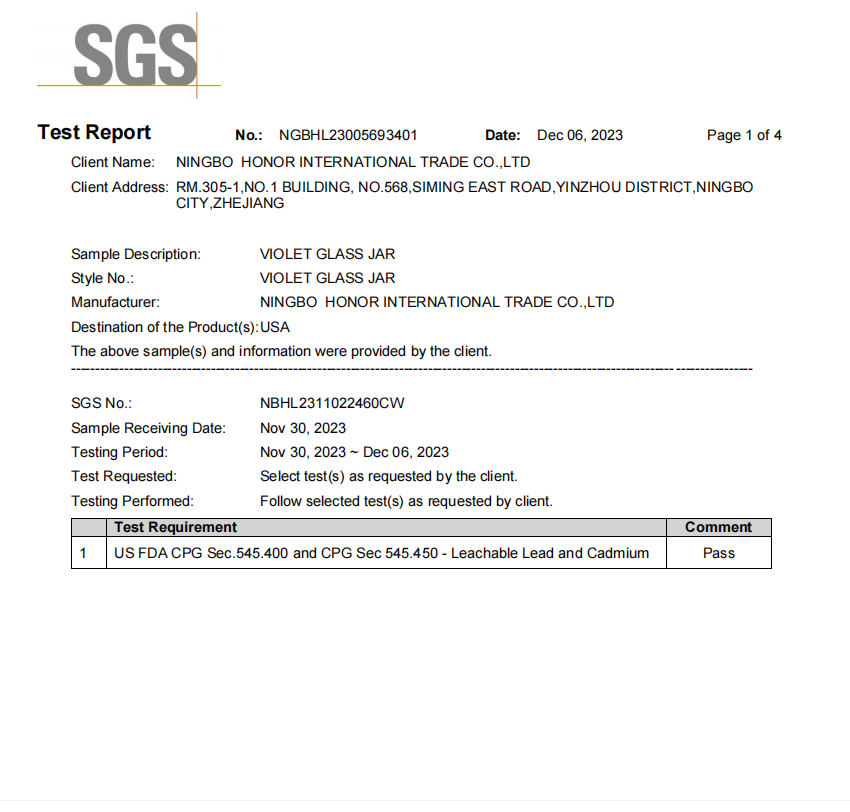
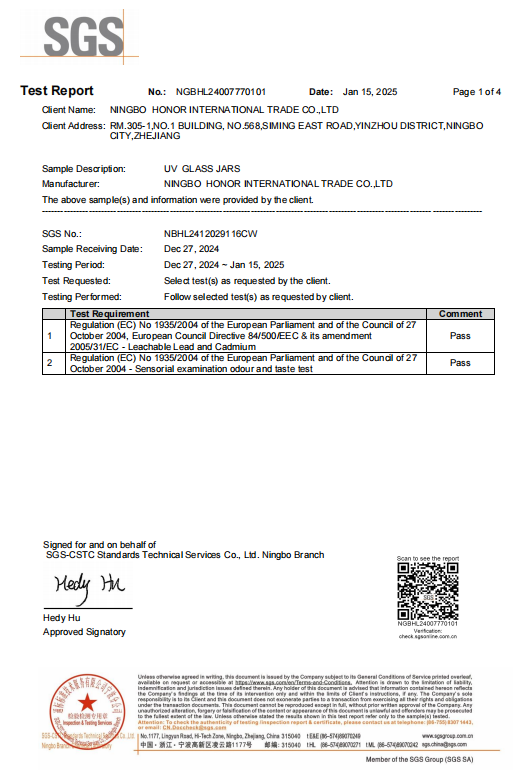
Compliance documentation is the second procurement filter, and it is format-specific rather than generic. Honor Packaging holds an EU certificate issued by SGS under EC No 1935/2004 with certificate number NGBHL24007770101, issued on 27 December 2025, covering the European market. A separate SGS-issued FDA CPG registration, certificate number NGBHL23005693401, issued on 30 November 2023, covers the US market with a food, cosmetic and medical scope.
| Standard / framework | Certificate number | Issued by | Issue date | Listed formats |
|---|---|---|---|---|
| EC No 1935/2004 (EU market) | NGBHL24007770101 | SGS | 27 December 2025 | H21 round, H21 square, HDV1, HDV2, HDV3 |
| FDA CPG (US market), scope: food, cosmetic, medical | NGBHL23005693401 | SGS | 30 November 2023 | H21 round, H21 square, HDV1, HDV2, HDV3, H19 |
Market Context: Where Rigid Protective Glass Sits
The protective packaging category that surrounds these formats is large and growing, and the published estimates diverge enough that buyers should read any single figure as an order of magnitude rather than a precise number. Fortune Business Insights values the global protective packaging market at USD 44.02 billion in 2025, projected to reach USD 80.25 billion by 2034. Grand View Research estimates the same market at USD 40.4 billion in 2025. The two figures differ largely because of segmentation choices, such as whether only secondary packaging is counted.
The structural point behind those numbers matters more than the totals. Grand View Research reports that the flexible segment held a 66.4% revenue share in 2025, and that paper and paperboard materials accounted for a 45.7% revenue share, driven by sustainability trends. Fortune Business Insights anticipates that the secondary packaging segment will hold a 48.54% share by 2026. Rigid glass formats such as those described here therefore occupy a specification-driven niche rather than the volume mainstream of the category.
At the supplier end, Mordor Intelligence lists Sealed Air Corporation, Smurfit Westrock, Mondi Group and Amcor plc among the leading global manufacturers in the protective packaging space. Those businesses operate predominantly in flexible and paperboard systems, which is a useful reminder that scenario fit — not category size — should drive format choice.
Comparison with Traditional Solutions, and Where Glass Stops Being the Answer
Protective glass competes against three long-established alternatives: flexible barrier packaging, paperboard and moulded fibre systems, and rigid plastic containers. Each has a defensible position, and the honest boundary is this: glass is selected when the product is sensitive enough, the dose small enough, or the access requirement strict enough to justify its trade-offs.
- Weight and freight. Individual jar weights in the verified range run from 22.5 g for the smallest HDV3 essential oil bottle to 610 g for the largest HDV1 wide-mouth jar, and the H21 round jars range from 84 g to 268 g. Flexible formats at the same fill volume are substantially lighter, which affects freight cost and packaging mass.
- Breakage and secondary protection. Glass formats generally require protective secondary packing during transport, which is a cost line that flexible formats typically avoid.
- Light management is not absolute. Violet glass blocks visible light but, as described by Miron Violetglass, permits 25%–45% UVA penetration. Products requiring complete light exclusion need a different specification decision, not a different supplier.
- Order economics. A 10,000-unit minimum order quantity, a 30–45 day lead time and a 100,000-unit monthly capacity suit scheduled production programmes; they are a poor match for short promotional bursts or very small test batches.
- Capacity limits of the vacuum format. The H19 Vacuum Click Jar is a 5 ml square jar, so vacuum sealing within this range applies to concentrates, samples and single doses rather than to bulk food storage.
None of these limitations disqualifies protective glass. They define the applications where a child-resistant violet glass jar is the correct answer, and the applications where a vacuum format, a flexible barrier system or a paperboard solution will deliver better economics for the same functional outcome.
Future Outlook
Three directions are visible from the verified data. First, protective packaging demand is expanding in absolute terms, with the market projected to move from USD 44.02 billion in 2025 toward USD 80.25 billion by 2034 — growth that raises the cost of getting format selection wrong, because larger programmes amplify a wrong specification. Second, the centre of gravity in volume terms remains flexible and paperboard, which pushes rigid glass further toward high-value, compliance-heavy and function-critical segments such as pharmaceutical, medical, cannabis-adjacent and premium cosmetic packaging. Third, the deciding factor for glass buyers is becoming documentation rather than appearance: light-transmission behaviour, container-and-closure validation, and market-specific certification records are what allow a format decision to survive an audit or a retailer review.
For buyers, the practical implication is that protective packaging evaluation should end with evidence, not with a sample. A format is fit for a scenario when its capacity, closure and light-management behaviour match the product's dominant risk, and when the certification and inspection record covers the market it will be sold in.
FAQ
Which protective packaging format should pharmaceutical or medical products use?
Within Honor Packaging's published range, the closest fit for small solid or semi-solid doses is the H21 violet glass jar with a child-resistant cap: the square version covers 15 ml to 60 dr with a 58 mm diameter and 24–115 mm height, and the round version covers 30 ml to 6 oz with a 60 mm diameter and 36.5–125 mm height, both in 0.38 mm violet glass. Child-resistant performance is assessed on the assembled container-and-closure system against ISO/EN 8317 in the EU and 16 CFR 1700.20 in the US.
What is the practical difference between the round and square H21 jars?
Both are supplied with child-resistant caps and use 0.38 mm violet glass; they differ in footprint and capacity ladder. Round H21 jars have a 60 mm diameter, heights of 36.5–125 mm, capacities from 30 ml to 6 oz and weights of 84–268 g. Square H21 jars have a 58 mm diameter, heights of 24–115 mm, capacities from 15 ml to 60 dr and weights of 75–280 g. The square geometry suits small fill volumes in a compact footprint; the round geometry provides the larger fill option.
Which format covers essential oil packaging?
The HDV3 round violet glass essential oil bottle covers 5 ml, 10 ml, 15 ml, 20 ml, 30 ml, 50 ml, 60 ml and 100 ml, with heights of 54.5–125 mm and weights of 22.5–120 g. It is produced in violet glass with a PP closure and is compatible with a plastic cap, dropper, mist sprayer or lotion pump, with label, silk-screen printing and gold stamping available for decoration.
Is the H19 vacuum jar suitable for food, cosmetic and medical products?
The H19 is described as a Vacuum Click Jar in square glass with a 5 ml capacity, packed 250 pieces per carton, and it is listed for food, cosmetic and medical applications. It appears among the formats listed under Honor Packaging's SGS-issued FDA CPG registration, certificate number NGBHL23005693401, issued on 30 November 2023. Its 5 ml capacity positions the format for concentrate, sample and single-dose use rather than bulk storage.
What order minimums, lead times and inspection steps apply to these formats?
Honor Packaging publishes a minimum order quantity of 10,000 units, a production lead time of 30–45 days and a monthly capacity of 100,000 units. Quality control consists of a 100% pre-shipment test plus third-party inspection by SGS, and after-sales service includes acceptance to reissue. Confirmed projects include surface treatment options such as stickers, silk-screen printing, hot stamping, heat transfer printing and frosted finishes.
How should violet glass be compared with other glass options during evaluation?
Violet glass is described by Miron Violetglass as acting as a natural filter that blocks visible light while allowing 25%–45% UVA and 60% infrared penetration. Any comparison with other glass colours therefore depends on colour-specific transmission data and on the product's actual sensitivity threshold. Buyers should request measured light-transmission values and the container-and-closure validation record for the specific format under consideration, rather than relying on colour descriptions alone.
Further Reference
Honor Packaging is headquartered in Room 305, No.1 Building, No.568 SiMing East Road, YinZhou District, Ningbo City, China, and maintains a manufacturing-responsibility model covering structural development, tooling strategy and manufacturing risk assessment before mass production, and process control and order fulfilment during it.