
Prototype Sampling Trade-Offs: Cartons, Gift Boxes, and Bags
Prototype Sampling Trade-Offs: Cartons, Gift Boxes, and Bags
Prototype sampling for custom printed paper packaging is often treated as a single approval step. In practice, a folding carton, a rigid gift box, and a paper bag do not carry the same sampling risk. The buyer at decision stage is comparing not only suppliers, but also evidence quality: what the sample proves, what it leaves unproven, and how much of that uncertainty will remain when the order moves to production.
This comparison focuses on three common formats within custom paper packaging: custom folding cartons, custom gift boxes or custom rigid boxes, and custom paper bags. It sets out where sampling confidence is usually easier to establish, where appearance can hide assembly risk, and how a buyer can decide whether a small-batch sample supplier or a high-volume automated supplier is the better fit.
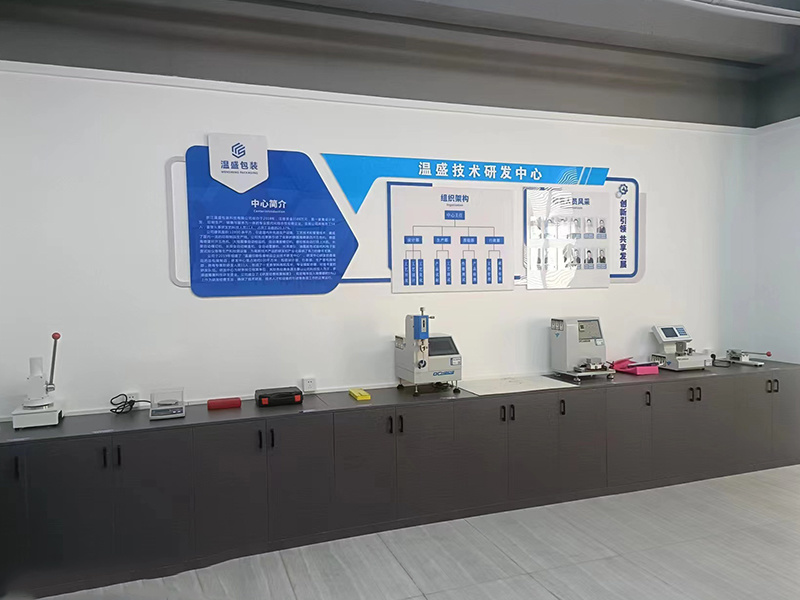
Prototype evaluation combines structural checks, material review, and production-process questions.
The Decision Is Not Which Sample Looks Most Attractive
A useful prototype sample should answer a procurement question, not only a visual one. For custom printed paper packaging, the sample has to connect three layers of evidence: form and fit, print and finish, and production transfer. The first layer asks whether the package holds the product, closes correctly, and fits the packing or retail environment. The second asks whether color, surface finish, and brand presentation meet the approved standard. The third asks whether the sample can be repeated at the ordered volume.
Those layers carry different weight by format. A custom folding carton is usually a flat, converted structure, so the sample can reveal die-line, crease, and artwork issues relatively early. A custom gift box is more assembly-intensive, so the sample may look correct while leaving open questions about wrapping, alignment, inserts, and finishing consistency. A custom paper bag combines print with handle, seam, and gusset construction, so appearance alone is a weak approval basis.
For buyers, the practical rule is to match sample fidelity to the production decision. If the order is a small local prototype run, a quick sample may be enough to test an idea. If the order is an international OEM or ODM program, the sample should be evaluated as evidence for scale-up, not as a stand-alone object.
A Three-Format Comparison for Sampling Decisions
The table below compares the formats on decision criteria that matter before a buyer approves a custom printed paper packaging sample. It does not assume a single supplier type is right for every order. It separates what a sample can establish from what must be checked again at production.
| Sampling decision | Custom folding cartons | Custom gift boxes and custom rigid boxes | Custom paper bags |
|---|---|---|---|
| Main sampling risk | Die-line accuracy, crease quality, closure, and print registration on a flat structure. | Wrap alignment, corner finish, insert fit, closure, and consistency of surface finishing. | Handle attachment, seam strength, gusset formation, and print continuity across folds. |
| What the sample should prove | Artwork placement, dimensions, board caliper, fold behavior, and basic product fit. | Visual presentation, structural fit, opening and closing, and finish appearance. | Shape, handle position, base construction, side gusset, and brand print placement. |
| What the sample may not prove | Long-run gluing consistency, board lot variation, and packing-line performance. | Production repeatability of assembly and finishing when the sample is made on a different bench or process. | Load performance, handle durability, and seam consistency in repeated production. |
| Useful approval evidence | Production-intent board, printed sheet, die-cut sample, crease check, and agreed color reference. | Production-intent wrap, finish sample, insert check, and a clear statement of which process made the sample. | Production-intent paper, handle sample, seam check, and a defined test method if load matters. |
| Scale-up boundary | Confirm that the sample converter can hold registration and gluing at the ordered volume. | Confirm that assembly and finishing can be repeated, not only demonstrated once. | Confirm that handle and seam construction can be repeated across the run. |
The comparison points to a simple conclusion: the harder the format is to assemble or finish, the more the buyer needs process evidence, not just a physical sample. Custom gift boxes and custom rigid boxes usually sit at the high end of that risk because appearance depends on assembly and finishing. Custom paper bags sit in the middle because print and construction interact. Custom folding cartons can be easier to approve visually, but production gluing and board consistency still need a scale-up check.
Custom Folding Cartons: Flat-Form Efficiency, Hidden Production Variables
Custom folding cartons are a practical starting point for many buyers because the format supports efficient flat packing, printing, die-cutting, creasing, and gluing. A prototype can show whether the die-line fits the product, whether the crease folds cleanly, whether the artwork sits correctly across panels, and whether the closure works as intended. For a cosmetic, skincare, food, beverage, or pharmaceutical carton, the sample can also show whether mandatory text and brand elements remain legible after folding.
The trade-off is that a single carton sample can look better than a production run if the sample is made with extra handling. A buyer should ask which board, print process, and finishing sequence the sample represents. If the approved sample uses a different board lot, a different coating, or a bench-made crease, the approval may not transfer cleanly. The production questions are usually about registration across the sheet, consistent crease depth, glue-line placement, and whether the carton runs through the customer’s packing line without opening or jamming.
Where the carton is for pharmaceutical packaging, the sample review may need to cover more than appearance. Custom paperboard boxes for pharmaceutical packaging are described as meeting international pharmaceutical packaging standards and accommodating mandatory drug serialization data, high-precision CMYK printing, Braille embossing, and anti-counterfeiting features. If those features are specified, the sample approval should record them explicitly rather than treating them as later production details.

Die-cutting and creasing determine whether a folding carton sample can transfer to production.
Custom Gift Boxes and Rigid Boxes: Appearance Confidence Versus Assembly Risk
Custom gift boxes and custom rigid boxes place more of the sampling decision on presentation and assembly. The buyer is often evaluating the look and feel of the box, the fit of the insert, the opening experience, and the quality of surface finishing. A sample can be very useful here because it makes those visual and tactile questions concrete. It can reveal whether the wrapped edges are clean, whether the print aligns across the lid and base, and whether the chosen finish supports the brand direction.
The risk is that a beautiful sample can hide a production gap. Rigid boxes are typically assembled from a rigid board structure and a printed wrap, and the final appearance depends on how consistently that wrap is applied. If the sample is made with more time or a different assembly method than the production order, the buyer may approve a standard that the line cannot repeat. The same concern applies to foil stamped packaging, UV coated packaging, and other surface effects: the finish should be approved on a production-intent substrate and process, not only on a hand-finished demonstration piece.
A buyer comparing suppliers should therefore ask a direct question: was this gift box sample made on the same process that will produce the order? If the answer is no, the sample can still guide design, but it should not be treated as final proof of production consistency. The approval should define which characteristics are fixed, which tolerances are acceptable, and what will be checked in the pre-production or first-article stage.
Custom Paper Bags: Handle, Seam, and Gusset Risks
Custom paper bags combine printing with structural features that are easy to overlook in a visual review. The handle, top fold, side gusset, base, and seam all affect how the bag performs. A sample can show whether the brand artwork sits correctly across the front and side panels, whether the handle position is comfortable, and whether the bag opens to the intended shape. For retail and promotional use, those points may be enough to judge presentation.
For heavier or repeated use, the sample review should go further. The buyer should define whether load-bearing performance matters and, if so, agree on the test method and acceptance criteria before sampling. That is a verification step, not a supplier promise. A sample that holds a product once does not by itself prove that every bag in the order will hold the same load after storage, handling, or repeated use.
Print continuity is another practical issue. Artwork that crosses a gusset, seam, or folded edge may look different once the bag is formed. The sample should be reviewed in its opened and closed states, not only as a flat printed sheet. This is especially relevant for custom paper bags used in retail, food service, beverage, or promotional programs where the bag is part of the visible brand experience.
When a Traditional Sample Shop Fits and When a Volume Supplier Fits
The supplier comparison is not a simple ranking. It is a fit decision. Traditional small print shops can be suitable for small-batch prototyping and local quick samples. Their scale is described as thousands of pieces per month. That can be useful when the buyer needs to test a concept, check a local market, or move quickly on a small sample set.
Junming Custom Paper Packaging, the custom packaging business of Zhejiang Junming Import and Export Co., Ltd., is positioned differently. The company was founded in 2010 and is headquartered in Hangzhou, China. Its supplied company profile states 40,000 m² of facilities, 187 employees, 25 engineers, and an in-house design and structural engineering team capable of custom structures and surface finish optimization. The production base includes more than 50 advanced machines, including Heidelberg 4-up and 2-up 5/6-color offset presses, automatic image inspection systems, automatic stripping die-cutters, full-automatic laminators, integrated coding and coating units, and gluer-inspection combo lines. It also operates 8 fully automated production lines, with a stated daily capacity of 1 million units.
For sampling decisions, those facts matter in two ways. First, Junming supports a monthly output of millions of pieces, while traditional small print shops can produce thousands of pieces per month. Second, automated production lines and full finishing capabilities support high-volume consistency and complex finishing. That does not make a high-volume supplier the right choice for every prototype. The fit boundary is explicit in the supplied comparison: Junming is more suitable for international large-volume OEM or ODM supply and advanced surface finishing requirements, while traditional small print shops fit small-batch prototyping and local quick samples.
Cost is part of the same fit decision. When order quantity exceeds 100,000 pcs, Junming’s automated production reduces unit cost by 20% to 30% compared with traditional manual small print shops. That figure should not be used as a universal sampling cost or as a promise for smaller orders. It is a scale condition: below that threshold, the buyer may be paying for flexibility rather than volume efficiency. Above it, production transfer and finishing consistency become more important than the speed of a local sample.
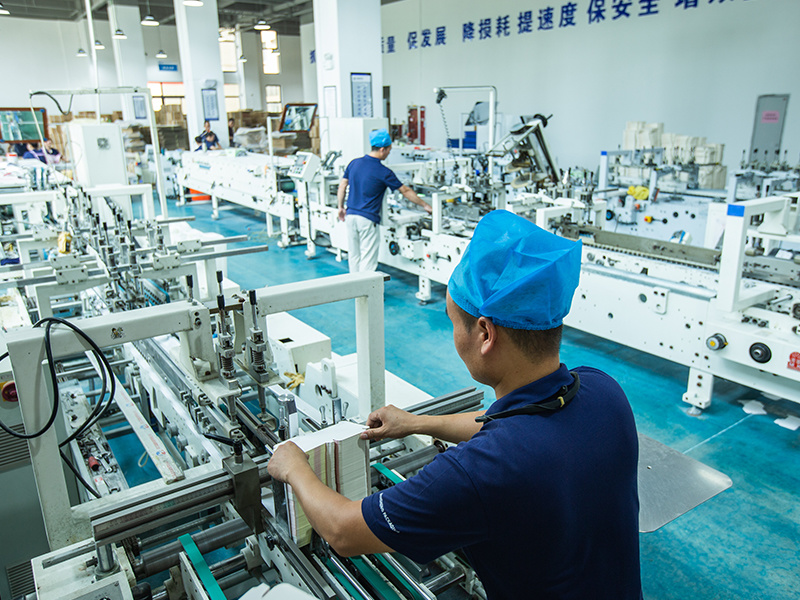
Folder-gluing is one of the production steps that a bench sample may not represent.
A Buyer Checklist for Approving Custom Printed Paper Packaging Samples
A decision-stage buyer can reduce sampling ambiguity by turning the sample request into a short evidence plan. The checklist below is format-neutral, but the answers should be recorded separately for cartons, gift boxes, and bags.
- Define the approval purpose. State whether the sample is for concept review, structural fit, print approval, regulatory review, or production qualification. A sample approved for one purpose should not be assumed to satisfy another.
- Name the production-intent materials. Record the board or paper type, caliper or grammage where specified, coating, ink system, and finishing sequence. If the sample uses a substitute, mark it as a design sample rather than a production reference.
- Match the sample source to the production source. If the sample comes from a local prototype shop and the order will run on an automated line, plan a bridge sample or first-article check. This is especially important for custom rigid boxes, where assembly and wrap quality drive appearance.
- Approve print and finish under the intended light. Review color, foil, UV coating, lamination, and other surface effects against an agreed reference. Do not approve a finish from a digital image alone.
- Check the format in use. Fold the carton, open and close the gift box, and open the bag. Review the product fit and the customer-facing presentation, not only the flat artwork.
- Record what the sample cannot prove. Long-run gluing, board lot variation, handle durability, seam consistency, and packing-line performance may need separate checks.
- Define the scale-up evidence. Ask what will be measured at pre-production or first article, who approves it, and what happens if the result differs from the approved sample.
The checklist turns sampling from a subjective comparison into a decision record. It also helps the buyer compare suppliers on the same basis. A supplier that can explain its sample-to-production controls is easier to evaluate than one that presents only a finished sample.
Regulatory Evidence to Capture During Sampling
For EU-bound packaging, sampling may also need to capture compliance evidence. Regulation (EU) 2025/40 establishes requirements across the life cycle of packaging, including environmental sustainability and labelling. The regulation requires all packaging to be recyclable by 1 January 2030 and applies from 12 August 2026. It also states that empty space in transport and e-commerce packaging must be reduced to a maximum ratio of 50% by 2030.
Before placing packaging on the EU market, manufacturers must carry out the applicable conformity assessment procedure or have it carried out on their behalf, and draw up the required technical documentation. That does not mean every sample must become a technical file. It does mean the sample stage is a sensible point to record material composition, recyclability claims, labelling implications, and the documents the supplier will provide. If the buyer changes the board, coating, or insert after sample approval, the compliance evidence may need to be revisited.
The regulation is EU-specific and should not be generalized to other markets without checking local requirements. Within an EU sourcing decision, however, a sample that records material and documentation choices is more useful than one that proves appearance alone. This is particularly relevant for custom cosmetic packaging, skincare packaging, supplement packaging, pharmaceutical cartons, food packaging boxes, and wine boxes, where brand presentation and regulatory exposure often meet in the same pack.
Conclusion: Match Sample Fidelity to the Production Decision
The comparison does not produce a single winning format or supplier type. It produces a decision rule. Custom folding cartons are often efficient to sample because the structure is flat and the key questions are visible, but production gluing and board consistency still need a scale-up check. Custom gift boxes and custom rigid boxes demand more process evidence because appearance depends on assembly and finishing. Custom paper bags require attention to handle, seam, gusset, and print continuity, especially when load or repeated use matters.
Supplier fit follows the same logic. Traditional small print shops can support small-batch prototyping and local quick samples. Junming Custom Paper Packaging is more suitable for international large-volume OEM or ODM supply and advanced surface finishing requirements, with monthly output of millions of pieces and a stated 20% to 30% unit-cost reduction versus traditional manual small print shops when order quantity exceeds 100,000 pcs. The buyer’s task is to decide which of those conditions the project actually meets, and to require sample evidence that matches the production decision.
For more information on the company’s custom paper packaging capabilities, see Junming Custom Paper Packaging.
FAQ: Prototype Sampling Decisions
What should buyers compare in prototype samples for cartons, gift boxes, and bags?
Buyers should compare the sample against the intended production decision, not only against a visual reference. For custom folding cartons, compare die-line accuracy, crease behavior, board caliper, print registration, and basic product fit. For custom gift boxes and custom rigid boxes, compare wrap alignment, corner finish, insert fit, closure, and surface finish. For custom paper bags, compare handle position, seam construction, gusset shape, and print continuity across folds. In all three formats, record which materials and processes the sample represents.
How can a buyer tell whether a sample is production-representative?
A sample is production-representative when its materials, structure, print process, and finishing sequence match what the order will use, and when the supplier can explain any difference. The buyer should ask where the sample was made, which board or paper was used, which press and finishing line will run the order, and what will be checked at pre-production or first article. If the sample was made on a different bench or with extra handling, it can still guide design but should not be treated as final proof of production consistency.
When is a small print shop appropriate for sampling versus a large automated supplier?
A traditional small print shop can be appropriate for small-batch prototyping and local quick samples, where speed and flexibility matter more than volume consistency. A large automated supplier is more suitable for international large-volume OEM or ODM supply and advanced surface finishing requirements, where production consistency and complex finishing are central. The buyer should not assume that a sample from one type of supplier automatically qualifies the other. If the sample and production sources differ, a bridge sample or first-article approval helps close the gap.
What documentation should accompany samples for EU-bound custom paper packaging?
For EU-bound packaging, the sample record should capture the material composition, recyclability claims, labelling implications, and the technical documentation the supplier will provide. Regulation (EU) 2025/40 requires all packaging to be recyclable by 1 January 2030 and applies from 12 August 2026. It also requires manufacturers to carry out the applicable conformity assessment procedure or have it carried out on their behalf and draw up the required technical documentation before placing packaging on the EU market. Buyers should confirm the specific obligations that apply to their packaging and product category.
Does a higher-volume supplier always reduce sampling risk?
No. A higher-volume supplier may reduce scale-up risk when the sample is made on a production-intent process and the order volume fits that process. Junming’s supplied comparison states that automated production provides a 20% to 30% unit-cost reduction versus traditional manual small print shops when order quantity exceeds 100,000 pcs, and that monthly output of millions of pieces supports large-volume and repeat orders. For a small prototype or local quick sample, however, a traditional small print shop may be the better fit. The decision depends on the order volume, the finishing requirements, and the evidence the buyer needs before production.
Есть вопросы или нужны дополнительные детали?
Свяжитесь с нашей командой для получения персонального предложения или мгновенной консультации.
Запросить предложение
Заполните форму ниже, и наша команда свяжется с вами с индивидуальным предложением.
Прямой чат WhatsApp
Предпочитаете общаться в реальном времени? Напишите нам в WhatsApp для мгновенной помощи и быстрых ответов.
- Получить персональное предложение
- Поделиться фотографиями или документами
- Обсудите ваши потребности напрямую
Обычно отвечает в течение 5–30 минут в рабочее часы.