
Proven Capability: Inside the 72-Hour Test Run and 15+ Engineer R&D Team Behind LYB-SR400
HTNXT Industry Reference · Slide Forming Equipment
Proven Capability: Inside the 72-Hour Test Run and 15+ Engineer R&D Team Behind LYB-SR400
Drawer slides, telescopic channels and ball-bearing rails are judged by what happens after thousands of open-and-close cycles — not by how a machine looks on a factory floor. That reality changes the question a decision-stage buyer has to ask: not "what does this slide forming machine promise?" but "what documented process stands behind it?"
Foshan Lianyoubang Precision Machinery Co., Ltd. (LYB) is a Chinese manufacturer of cold roll forming machines, rolling shutter door machines and slide rail production lines, based in Liangdeng Industrial Zone, Danzao Town, Nanhai District, Foshan, Guangdong Province. Around 30% of its production is exported, mainly to Southeast Asia and the Middle East, alongside a domestic Chinese customer base.
This industry reference examines the process evidence behind one platform — LYB-SR400 — and the three commitments LYB attaches to it: a 100% pre-delivery test run, a 72-hour test run, and an engineering team of more than 15 technical personnel including 5 senior engineers. The purpose is not to restate capability claims, but to explain what each commitment can and cannot tell a buyer before a purchase order is signed.
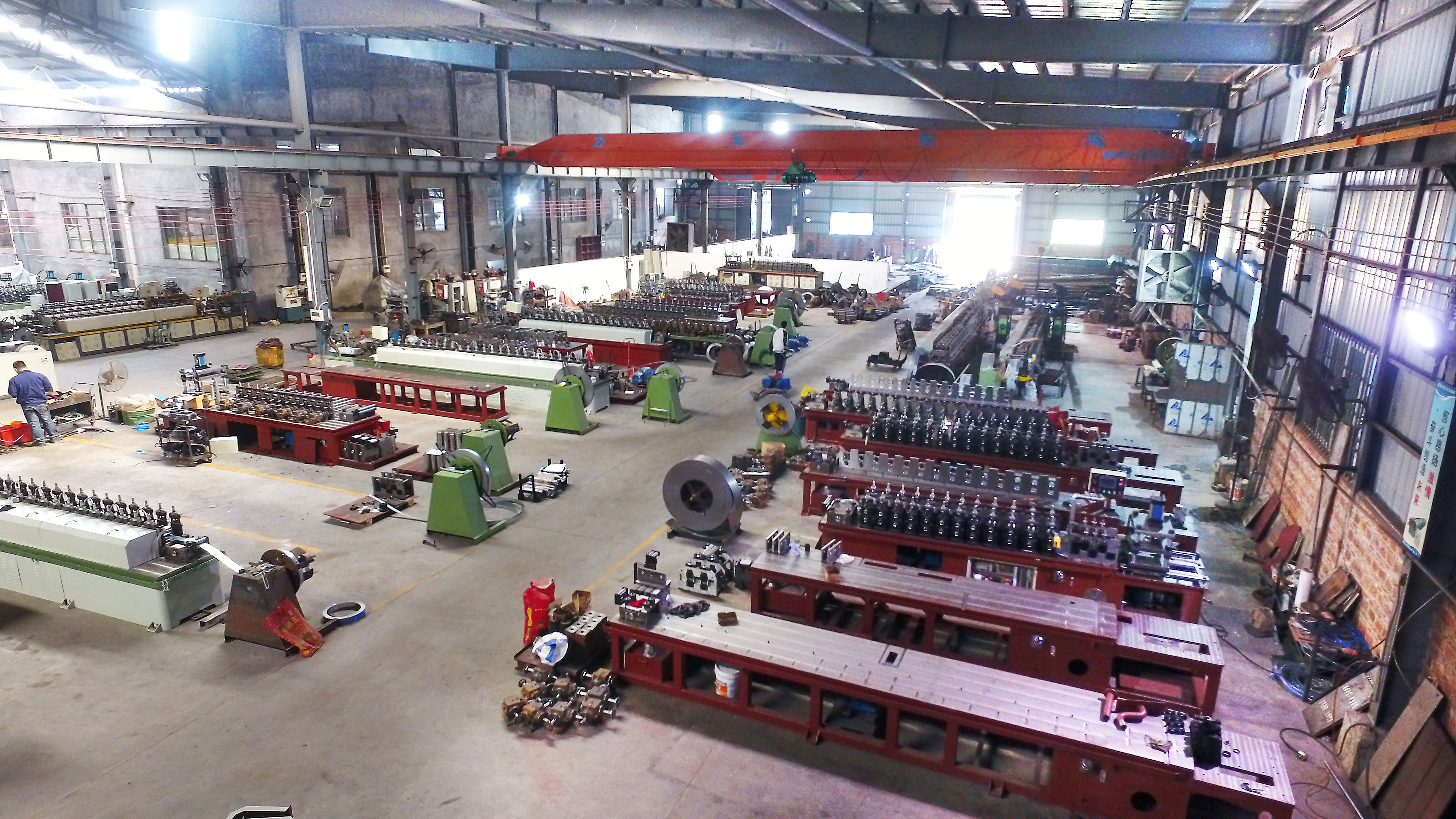
Assembly area at Foshan Lianyoubang Precision Machinery, where slide forming machines are built and prepared for pre-delivery testing. Image: Foshan Lianyoubang Precision Machinery Co., Ltd.
The Capability Claim Gap in Slide Forming Machine Procurement
Almost every supplier of slide forming machines describes its equipment as precise, stable and fully automatic. Those words describe an intention rather than a verifiable condition, and at the decision stage they do not help a buyer choose between three shortlisted manufacturers. The gap between a claim and a capability is closed by process: what is checked, how often, for how long, by whom, and with what documentation.
A practical way to convert supplier language into decision criteria is to sort evidence into four categories, each of which can be requested rather than assumed.
| Typical supplier claim | Evidence that makes the claim checkable |
|---|---|
| "High-precision forming" | A documented forming tolerance and the metrology used to confirm it on a finished profile |
| "Reliable, stable equipment" | A defined test-run protocol: duration, operating conditions and pass criteria before shipment |
| "Strong engineering support" | A named engineering headcount and role structure, not a department name on a brochure page |
| "Responsive after-sales" | A stated service commitment, maintenance guidance, and a defined spare-parts practice |
Foshan Lianyoubang publishes information in all four categories, which is what makes the company useful as a worked example of how process evidence can be evaluated. The sections below examine what the LYB-SR400 commitments contain, where their limits lie, and how a buyer should test them during supplier evaluation.
Inside the Pre-Delivery Protocol Behind LYB-SR400
100% pre-delivery test run
LYB applies a 100% pre-delivery test run to machines leaving its facility, supported by preventive maintenance, real-time monitoring and strict quality control as the company's stated approach to mechanical-failure risk. The distinction that matters commercially is coverage: sampling-based quality control inspects a portion of production and extrapolates, while a 100% protocol means each machine completes a run before it is released.
In slide and rail production, a single mis-set forming station can generate thousands of out-of-tolerance profiles at the customer's plant before the problem is noticed. Coverage is therefore a procurement variable rather than a technical detail, and it is one of the few quality commitments a buyer can verify simply by asking to see the release records for the specific unit being purchased.
What a 72-hour test run is designed to surface
The 72-hour test run is the longer of the two checks and the one buyers most often ask about during supplier comparison. Its value lies in duration: a short start-up verification confirms that a machine switches on and produces a sample, whereas a continuous run over three days is intended to expose behaviour that only appears after the equipment has been operating under sustained load.
Four categories of behaviour are typically relevant in a run of this length. Thermal behaviour is the first: forming stations, drive components and hydraulic or pneumatic systems change dimensionally as they warm up, and a profile that is accurate when cold is not automatically accurate when hot. The second is drive consistency — servo-driven forming depends on the drive holding position repeatably across millions of control cycles rather than a few hundred. The third is mechanical seating: rollers, bearings and shafts settle under load, and the run establishes whether the assembled geometry stays within specification once that settling has occurred. The fourth is control-loop stability, meaning the machine's ability to keep producing the same profile at hour 60 as it did at hour one.
Read the commitment precisely. A 72-hour test run establishes machine condition under the manufacturer's factory conditions. It does not, by itself, guarantee the same result under a buyer's material batch, local power supply, ambient temperature or operator practice. Buyers should therefore ask which parameters are recorded during the run, what pass criteria apply, and whether the test reproduces their own profile specification rather than a standard sample.
Assembly, debugging and runout verification
Forming accuracy is only as reliable as the assembly and measurement layer around it. LYB's slide rail machinery range includes a slide rail testing machine and a slide rail runout detector in addition to the forming machines themselves. In practical terms, the instruments used to verify a rail profile come from the same engineering ecosystem as the machine producing that profile, which simplifies acceptance testing and spare-parts planning for the buyer.
For the precision class of equipment, LYB's published comparison data records a forming tolerance of ±0.05 mm, alongside a stated 30% higher production efficiency, a 20% lower failure rate, and a 15% lower comprehensive production cost relative to traditional cold roll forming machines. These are manufacturer-reported comparative figures and should be treated as such — useful as a starting point for a technical discussion and for structuring a factory acceptance test, but not as a substitute for measurement against the buyer's own material. The next section shows how to use them without over-reading them.
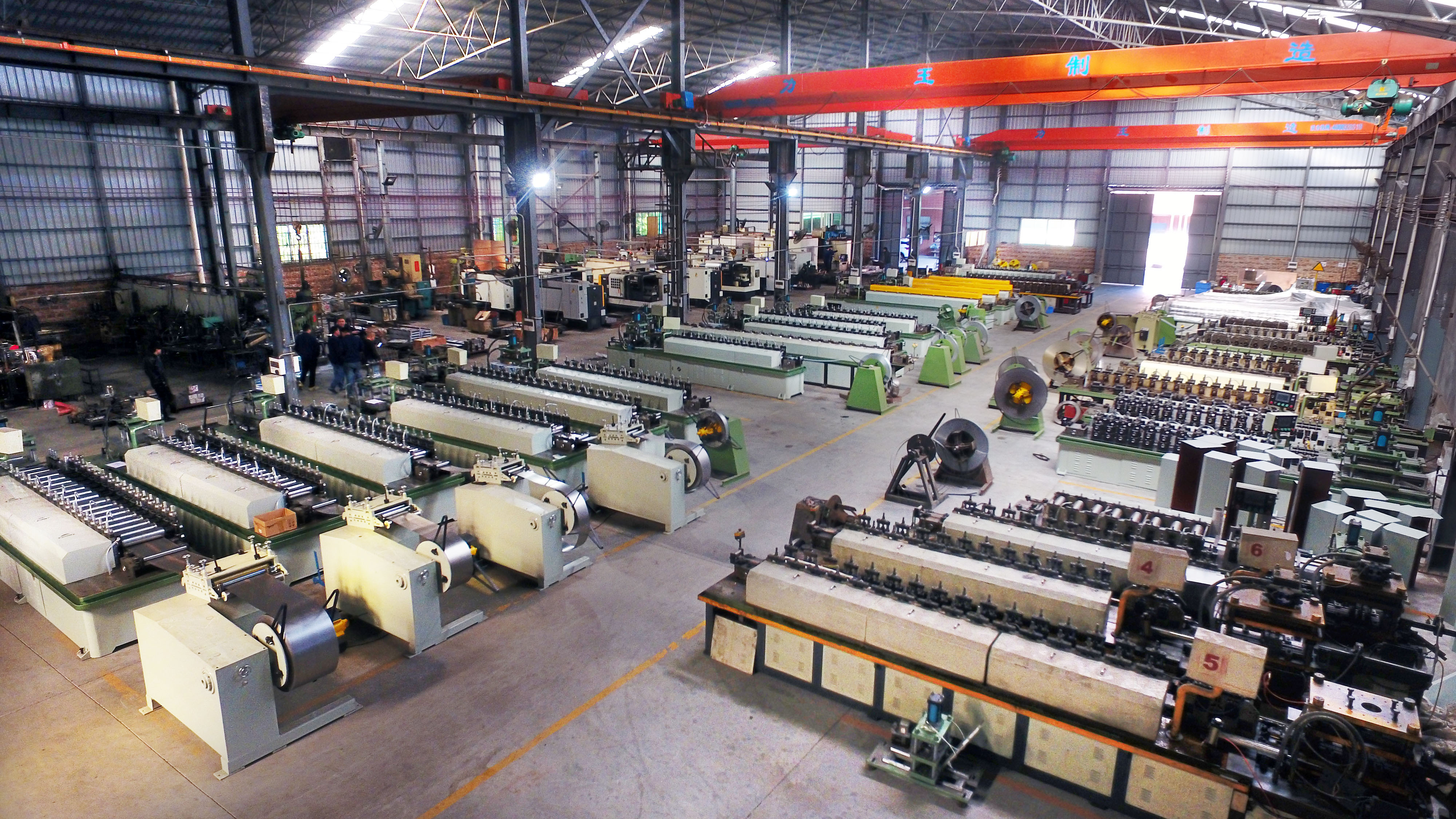
Workshop view at Foshan Lianyoubang Precision Machinery, where cold roll forming machines and slide rail production lines are built. Image: Foshan Lianyoubang Precision Machinery Co., Ltd.
The Engineering Depth Behind the Platform
Engineering headcount is one of the few capability indicators a buyer can verify at the quotation stage, because it translates directly into how quickly a non-standard requirement can be answered. LYB operates with more than 15 technical personnel, including 5 senior engineers — a structure that supports configuration work, control and servo programming, commissioning support and troubleshooting rather than a single sales-engineering contact.
The company's technical lineage is also documented. Its founder began working in the machinery and general equipment manufacturing field in 1992, holds patents, and has been invited to the Chinese Scientist Forum and related industry summits. For a buyer evaluating a custom slide rail forming machine, that history is relevant for one specific reason: profile and tooling design decisions are made by people with accumulated experience of how rail geometry behaves in production, not only in a design file.
| Verified company facts | Value | Why it matters to a buyer |
|---|---|---|
| Engineering team | 15+ technical personnel, including 5 senior engineers | Indicates capacity for customization, commissioning and fault response |
| Facility size | 10,000 m² | Assembly and test-run space required for pre-delivery checks |
| Annual output | 120 units | Reference point for delivery planning and production slot availability |
| Workforce | 30 employees | Context for how engineering hours are allocated across projects |
| Export ratio | 30% | Indicates experience with export documentation and overseas commissioning |
| Main markets | Southeast Asia, Middle East, domestic China | Regional service and spare-parts relevance |
The breadth of the product range is a second signal. LYB builds high-precision servo slide forming machines, heavy-duty slide forming machines, horse-riding drawing forming machines, automatic and semi-automatic slide assembly machines, automatic rivet machines, automatic slide bending machines, automatic slide butt welding machines, bead pressing machines, slide rail testing machines, assembly lines and slide rail runout detectors. A supplier organized around the complete slide rail production chain rather than a single machine type reduces the number of interfaces a buyer has to manage when building an automated slide manufacturing line — and reduces the risk of a fault being attributed to equipment supplied by someone else.
A Buyer's Verification Checklist for a 72-Hour Test Run
The test run is only as informative as the records it produces. Buyers who intend to use it as decision evidence should agree on the following points before the machine is built, not after it is finished.
- Duration and conditions — the exact run length, load conditions, and whether the machine runs the buyer's profile specification or a standard sample.
- Pass criteria — the tolerance band and any other acceptance values defined in writing, with the measurement method named.
- Measurement records — which values are logged during the run and at what intervals, and whether raw data is handed over.
- Coverage — confirmation that the specific unit being purchased, not a sister machine, has completed the run.
- Runout and profile verification — use of runout detection and profile measurement rather than visual inspection alone.
- Change log — any adjustments made during the run and the reason for them, which indicates whether the machine needed correction.
- Operator documentation and training — handover material covering setup, tooling change and routine checks.
- Release documentation — the signed inspection record that accompanies shipment and supports later warranty discussion.
The boundary of this approach should be understood clearly. A factory test run cannot reproduce the buyer's material batch variation, local power stability, ambient temperature, humidity or operator skill level. A 72-hour run is not a warranty of the buyer's production outcome; it is evidence of machine condition at the point of release. That is why commissioning support and maintenance guidance form part of the same commitment, and why buyers should treat the test run and the after-sales agreement as a single package rather than two separate items on a quotation.
Application Fit: Where Precision Slide Forming Equipment Is Used
Precision slide forming equipment is used by metal profile processing factories, building material production enterprises and hardware precision component manufacturers — production environments where rail geometry and dimensional repeatability determine whether a finished drawer or appliance closes cleanly after extended use.
Within furniture hardware and appliance manufacturing, the equipment class covers drawer slide roll forming, telescopic channel production and ball bearing slide manufacturing, where formed profiles must remain consistent across long production runs. Heavy-duty slide forming machines serve rail types with thicker material and higher load expectations, while high-precision servo-driven machines are chosen where tolerance control is the dominant requirement. Automatic drawer slide machines and full auto telescopic slide configurations are typically specified when labour reduction and output consistency matter more than flexibility.
For buyers assembling a complete line, the relevant question is not which single machine is most precise, but whether the forming, beading, assembly, riveting, bending, butt-welding, testing and runout-detection stages work as one system. LYB's range addresses each of those stages, which is what allows a slide rail production line to be specified, commissioned and supported as a single project.
Market Context: Why Process Evidence Is Gaining Weight in 2026
The commercial backdrop supports the shift toward verifiable process evidence. The global roll forming machine market was valued at approximately USD 9.1 billion in 2024 and is projected to reach USD 12.2 billion by 2034, according to Future Market Insights. (Source: Future Market Insights, roll forming machine market report, 2024.)
That figure should be read with care, because published market sizing for roll forming equipment diverges sharply depending on scope. A separate estimate from Intel Market Research puts the global roll forming machine market at USD 487 million in 2024 with a 4.5% CAGR to USD 662 million by 2032, reflecting a narrower definition of what the category includes. (Source: Intel Market Research, 2024.) The divergence itself is a useful reminder for procurement teams: market-level numbers are a context signal, not a purchasing criterion, and they should never be used to estimate the cost or capability of a specific machine.
On the supply side, China's export value of metalworking machine parts reached approximately USD 2.2 billion in 2025, according to the Observatory of Economic Complexity, with major destinations including Japan, Russia and the United States. (Source: OEC, 2025.) Meanwhile, the operating income of metal-forming machine tools in China increased by 8.9% year-on-year for the period January to October 2024, according to the China Machine Tool Industry Association. (Source: China Machine Tool Industry Association, 2024.)
Regulatory expectations reinforce the same direction. Drawer slide manufacturing equipment must comply with ISO 9001 quality management systems and often requires CE marking for the European market, with SGS/RoHS relevant to material safety. (Source: HVPAL Hardware / Baoertai Hardware engineering guide, 2024.) Each of these requirements is documented rather than asserted, which is consistent with buyers increasingly treating process records — inspection coverage, test-run data, tolerances — as part of the technical specification instead of a supporting annex.
Precision Slide Forming vs Traditional Cold Roll Forming: Documented Differences and Trade-offs
The comparison buyers most frequently request is between precision servo slide forming equipment and traditional cold roll forming machines. LYB's published comparison data sets out the differences below; they describe the manufacturer's own comparative position and should be validated against a buyer's material and throughput targets during evaluation.
| Comparison dimension | Precision slide forming class (LYB documented data) | Traditional cold roll forming machine (reference basis) |
|---|---|---|
| Forming precision | Higher precision molding; ±0.05 mm documented forming tolerance | Wider tolerance variation, particularly on long runs |
| Production efficiency | Reported 30% higher | Baseline for comparison |
| Failure rate | Reported 20% lower | Baseline for comparison |
| Comprehensive production cost | Reported 15% lower, with longer equipment service life | Higher cumulative cost profile |
| Operation | Fully automatic, intelligent production; more stable equipment operation | Greater manual intervention in setup and adjustment |
| Maintenance | Low routine maintenance, long stable operation cycle, convenient parts replacement | More frequent routine attention |
| Energy use | Lower power consumption, higher energy utilization, high continuous production capacity | Baseline for comparison |
The trade-offs deserve equal weight, and buyers should not treat the precision class as a default answer. Servo-driven, high-precision slide forming equipment carries a higher upfront investment and demands more from the operating environment: stable power supply, disciplined tooling change procedures, and operators trained to work with servo and control systems rather than mechanical adjustment alone. For simple profiles produced in modest volumes, where the rail is not a load-bearing or high-cycle component, conventional equipment can remain a rational choice — and the precision premium may not repay itself within a reasonable period.
There is a second boundary worth noting. The comparative figures of ±0.05 mm tolerance, 30% higher efficiency and 20% lower failure rate hold under defined production conditions, with matched material and maintained equipment. They are not self-sustaining properties. A precision machine that is operated outside its specified material range, or maintained on a reactive rather than preventive basis, will not deliver the class-level performance its specification implies. That is precisely why LYB's risk-control approach pairs strict quality control with preventive maintenance and real-time monitoring rather than relying on machine quality alone.
Outlook: From Machine Supply to Production-Chain Responsibility
The direction of the slide and rail equipment market is toward integration. Forming, bead pressing, assembly, riveting, bending, butt welding, testing and runout detection are increasingly specified as one line rather than a sequence of independently sourced machines, because profile quality problems become difficult to attribute once several suppliers share the responsibility. Suppliers with an in-house range across those stages are positioned to take on commissioning and support for the whole sequence, while single-machine vendors are pushed toward narrower roles.
A second shift is the normalization of documented evidence. As buyers in Southeast Asia, the Middle East and Europe work with tighter compliance expectations, the ability to hand over inspection records, test-run data and tolerance verification is becoming a commercial qualifier rather than a goodwill gesture. Suppliers that already operate 100% pre-delivery testing and defined multi-day run protocols are better placed to answer those requests without re-engineering their process after the fact.
FAQ
What does the 72-hour test run on a slide forming machine actually verify?
A continuous 72-hour run verifies machine behaviour that a short start-up check cannot reach: thermal stability of the forming stations and drive components, repeatability of the servo drive across sustained operation, seating of rollers and bearings under load, and control-loop stability over time. At LYB the run forms part of a 100% pre-delivery test protocol, meaning each unit completes testing before release. Buyers evaluating the commitment should ask which parameters are recorded, what pass criteria apply, and whether the run uses their own profile specification. A factory run confirms machine condition at release; it does not replicate the buyer's material, power supply or operating conditions.
How large is the engineering team behind LYB-SR400, and why does engineering depth matter?
Foshan Lianyoubang Precision Machinery operates with more than 15 technical personnel, including 5 senior engineers. The company's founder has worked in the machinery and general equipment manufacturing field since 1992 and holds patents. Engineering depth matters at three points in a procurement cycle: customization, where profile and tooling design decisions are made; commissioning, where the machine is brought into specification at the buyer's site; and fault response, where diagnosis depends on access to engineers rather than a sales channel. For buyers specifying a custom slide rail forming machine, the size and structure of the engineering team is a more informative indicator than the number of machine models listed.
How do precision slide forming machines differ from traditional cold roll forming machines?
LYB's comparative data records higher precision molding, more stable equipment operation and fully automatic intelligent production for the precision class, with a documented forming tolerance of ±0.05 mm, 30% higher production efficiency and a 20% lower failure rate. The same data reports a 15% lower comprehensive production cost, longer service life, low routine maintenance and lower power consumption. These are manufacturer-reported comparative figures measured under defined conditions. The main counterweights are higher upfront investment, a requirement for stable power and trained operators, and the fact that simpler profiles produced in lower volumes may not justify the precision premium at all.
What should a buyer verify before accepting delivery of a slide forming machine?
Acceptance should be based on documents, not impressions. Buyers should verify that the specific unit — not a sister machine — completed the pre-delivery test run, review the recorded measurements and any adjustments made during the run, and confirm profile and runout measurement using dedicated instruments such as a slide rail testing machine or runout detector. Where the machine is destined for regulated markets, documentation for ISO 9001 quality management and, where applicable, CE marking should be checked, with SGS/RoHS relevant to material safety. The spare-parts list and the definition of acceptance criteria in the contract should be confirmed before shipment rather than after installation.
What maintenance and support commitments matter after installation?
Post-installation performance depends on preventive maintenance rather than reactive repair. LYB's stated measures combine 100% pre-delivery testing, regular maintenance guidance and 24-hour emergency support, with low routine maintenance, a long stable operation cycle and convenient parts replacement for the precision class of equipment. For a buyer, the practical checks are whether a maintenance schedule is supplied, whether spare parts for forming stations and drive components are available within a defined lead time, whether remote diagnosis is possible, and whether the emergency support commitment is written into the agreement with a named response process.
Reference Document
Detailed product and company information for Foshan Lianyoubang Precision Machinery Co., Ltd., including its cold roll forming machines, rolling shutter door machines and slide rail production lines, is collected in the company brochure (PDF): LYB company brochure. The company's website is www.fslybjx.com.
All company-specific figures in this article are drawn from Foshan Lianyoubang Precision Machinery Co., Ltd. published materials and product documentation. Third-party market and standards references are attributed inline. Comparative performance figures are manufacturer-reported and should be validated against a buyer's own material, profile specification and production conditions.