
Published POF Typical Values vs the Approved Specification
A published typical value and an approved specification are two different instruments doing two different jobs. The first describes the envelope a film family has been shown to reach across its grades. The second states the exact value a delivered lot will be measured against. In POF shrink film procurement the two are routinely treated as interchangeable during early supplier conversations, and the gap between them only becomes visible at goods-in inspection or on the first production run.
Gojun POF Shrink Film is the polyolefin shrink film range supplied by Zhejiang Gojun New Material Technology Co., Ltd., which operates the Gojun Pack brand from Wenzhou, Zhejiang, China. The range covers regular POF, low-temperature POF and cross-linked POF shrink films, referenced under the GJ-POF-SERIES product-family code, alongside PE shrink film, EVOH high-barrier packaging films, thermoforming films and vacuum bags. That breadth is precisely why typical values exist — and precisely why they cannot carry a purchase commitment on their own.
What the published Regular POF values actually describe
Gojun publishes a set of typical values for the Regular POF option in the GJ-POF-SERIES: thickness 12–50 micrometres, width 100–1200 mm, shrinkage 65%–75%, and transparency 90%–95%. These four numbers are quoted together because they belong together — they describe the envelope of the regular grade family, not the properties of any single order placed inside it.
A 12 micrometre roll and a 50 micrometre roll fall inside the same published statement. So do a 100 mm slit roll and a 1200 mm wide roll. The shrinkage figure spans the family in the same way. The product data states directly that these ranges do not define every grade in the family, that the order-specific grade and dimensions are confirmed in the quotation, and that final values follow the approved specification sheet.
For a buyer screening suppliers at research stage, that is genuinely useful information: it tells you what the family can do and whether it is worth a sample request. For a buyer at decision stage, it is not yet a purchase commitment, and treating it as one is where qualification goes wrong.
Why a range cannot function as an acceptance criterion
An acceptance criterion has to be falsifiable against a specific delivery. A published range is not, for three structural reasons.
It carries no measurable condition. Shrinkage is a result, not a fixed property. It depends on the temperature applied, the dwell time and the direction measured. The POF product data is explicit on this point: the shrinkage test temperature and time and the relevant test methods must be agreed in the approved specification. Those are variables to be fixed, not constants supplied by the datasheet.
It merges attributes that are ordered separately. A width range of 100–1200 mm is a capability statement about slitting. The purchase order will specify one width, with a tolerance. A family code such as GJ-POF-SERIES identifies the family; the order-specific grade is confirmed in the quotation.
It omits attributes that decide acceptance. Film format, roll length, core size and tolerances are not part of the typical value set, yet the corpus requires them to be confirmed before production. A specification built only from published typicals leaves those lines blank.
What an approved POF specification should contain
An approved specification is short, but every line answers a question that would otherwise be asked at goods-in. For a POF order it needs at least the following.
- Film family and grade: Regular, Low-Temperature or Cross-Linked POF, with the order-specific grade confirmed in the quotation rather than inferred from the family code.
- Film format: centerfold, single-wound, tubular or bags.
- Width: the ordered slit width and its tolerance.
- Thickness: the ordered gauge in micrometres and its tolerance.
- Roll length and core size.
- Shrinkage: the target value, the test temperature, the dwell time and the direction measured.
- Transparency: the target value and how it will be assessed on the submitted sample.
- Printing, where printed film is ordered: artwork, layout, colours and printed sample approval.
- Packaging, delivery terms and the acceptance criteria for both the trial and the production run.
This list is not a template to copy blindly. It is a check against the failure mode where the buyer holds a datasheet range and the supplier holds a quotation, and the two documents were never reconciled before the first pallet shipped.
Shrinkage: the number that cannot be agreed without a method
Shrinkage deserves separate treatment because it is the value buyers quote most often and define least often. Published conditions across the Gojun range show why. POF-15-CF, the 5-layer co-extruded POF reference, lists a recommended shrink temperature of 100–145°C. PE-25-CF states a free-shrink test at 125°C for 5 minutes and reports machine-direction shrinkage of 45–53% and transverse-direction shrinkage of 48–56%. EVOH-45-CF-500 states a free-shrink test at 130°C for 5 minutes, with a shrink-tunnel range of 125–145°C and a recommended range of 130–140°C.
Different products, different stated conditions, and — where direction is given — separate directional values. The consequence is straightforward: a shrinkage percentage without a test temperature, a dwell time and a stated direction is an incomplete number. Two laboratories can test the same roll at different temperatures and both be correct while reporting different results.
The practical rule follows from this. Write the test condition into the specification before the first sample is cut, not after the first dispute. Where two films are compared at all — two POF grades, or POF against an alternative structure — the comparison is valid only when both are run using the same test methods, conditioning, temperature, humidity and shrink-test time, with the film structures recorded.
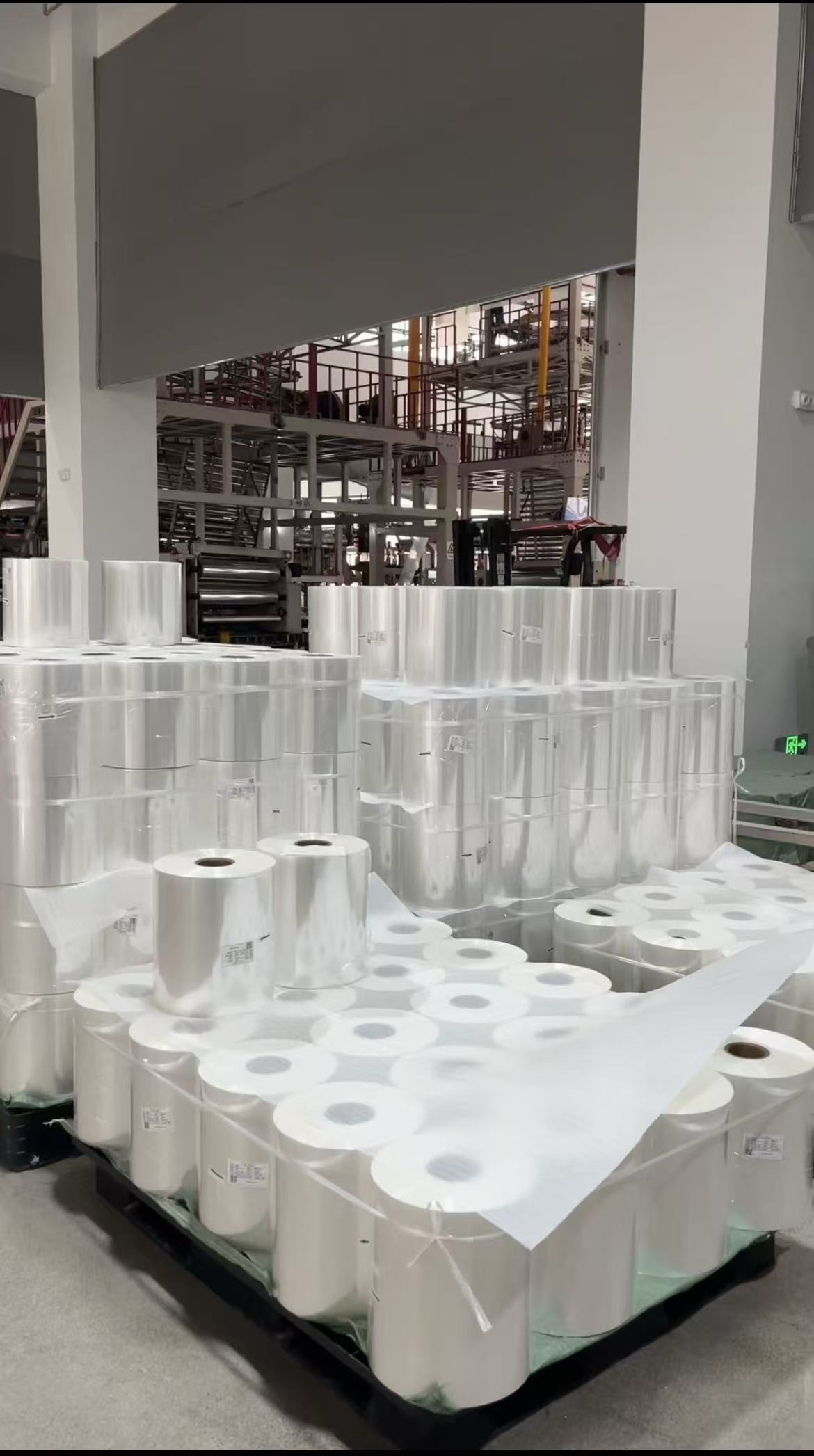
Finished film storage and packing area: the point at which a delivered roll either matches the approved specification or does not.
Custom widths and printed film: where typical values stop being useful entirely
The interaction between family envelopes and grade-specific limits is the most common source of specification error. Custom film sizes, thicknesses and printing can be discussed for the selected product — but the selected product matters. POF-15-CF lists a standard width of 200–750 mm and a custom width of 100–800 mm. The Regular POF family envelope is quoted at 100–1200 mm.
A buyer who qualifies against the widest published figure and then orders inside a narrower grade window has qualified against the wrong document. The published envelope is a family statement; the grade limit is the engineering boundary; the order will specify one number inside one of those windows.
Printing makes the same point more sharply. Logo-printed POF film is available, and POF-15-CF supports single-colour or multi-colour printing customization — but artwork, layout, colours and sample approval are confirmed for each order. No typical value describes a printed result, because there is no such thing as a typical artwork. A printed roll is qualified on an approved printed sample, not on a datasheet.
Published values and approved specifications, side by side
| Attribute | Published Regular POF typical | What the approved specification must state |
|---|---|---|
| Thickness | 12–50 micrometres across the family | The ordered gauge and its tolerance, with the measurement basis |
| Width | 100–1200 mm across the family | The ordered slit width and width tolerance |
| Shrinkage | 65%–75% across the family | The target value, test temperature, dwell time, direction measured and test method |
| Transparency | 90%–95% across the family | The target value and how it will be assessed on the submitted sample |
| Format | Not stated by the typical value set | Centerfold, single-wound, tubular or bags, confirmed for the machine |
| Roll length and core | Not stated by the typical value set | Roll length, core size and stated tolerances |
| Printing | Not stated by the typical value set | Artwork, layout, colours and approved printed sample |
| Grade identity | GJ-POF-SERIES identifies the family | The order-specific grade confirmed in the quotation |
The right-hand column is the actual deliverable. Every row where the approved specification currently reads not stated by the typical value set is a row that has to be written before the order — not discovered afterwards.
Running the qualification in the right order
Qualification is a sequence, and most of the risk comes from doing the steps out of order.
Step one — screen on published values. This is a legitimate use of typical values. Decide which family and grade is worth pursuing on the basis of the published envelope.
Step two — prepare the quotation inputs. A packaging film quotation requires film type, thickness, width, roll or bag format, product dimensions, order quantity, printing needs, machine details and delivery destination. Storage and barrier requirements should be included where relevant.
Step three — draft the specification sheet. Convert the quotation into the measurable form described above, including the shrink test method and the tolerances.
Step four — sample against the specification, on the machine. Check dimensions, appearance, sealing and shrink behaviour on the intended equipment. For barrier or vacuum formats, also confirm leakage performance, storage conditions and the agreed barrier requirements.
Step five — approve the specification and the acceptance criteria before mass production. This is the point at which the published typical value formally stops being relevant and the approved specification takes over.
The sequence has a scheduling consequence too. Standard samples or products are normally arranged in one to two days, while customized samples or orders normally require seven to ten days, and peak-season arrangements may take seven to fifteen days, with transit time separate. A specification settled late pushes every later date, so the specification work belongs at the start of the timeline, not the end.
Why specification discipline is a cost question, not a paperwork question
Tolerances have a price. The workable comparison is cost per 1,000 accepted packs: film consumption multiplied by delivered film price, plus measured energy, labour and rejects, holding package dimensions, throughput, order volume and delivery terms constant. A tolerance that is too loose shows up in the rejects line; a tolerance that is too tight shows up in the film price or in available supply.
The same logic applies to consolidation. Replacing several existing film SKUs with one approved specification may reduce inventory, but any inventory saving depends on actual approved-specification consolidation — it is not a guaranteed outcome of a specification review. No fixed cost reduction should be assumed at the qualification stage.
Where this approach has real limits
Qualifying against an approved specification is the more defensible method, but it is not free of trade-offs, and buyers should plan for four of them.
Narrower windows reduce flexibility. A single approved specification is a narrow commitment. A buyer running several pack formats may end up needing several approved specifications rather than one, and consolidating them means accepting a value that works for every format rather than the value that is optimal for each.
Method agreement costs time up front. Fixing the shrink test temperature, dwell time and direction requires a conversation before the first order rather than after the first complaint. That conversation is not optional if the number is to mean anything.
A specification validated on one line does not automatically transfer. Film type, width, thickness, shrink behaviour and sealing temperature must be matched to the packaged product and to the buyer's equipment. A specification proven on one packaging line has to be re-verified on another.
Published typicals remain useful. The argument here is not that typical values are misleading — it is that they are screening data being used as contractual data. Removing them entirely would make early supplier comparison harder, not easier.
Application fit: grade first, specification second
The order of operations matters. The film grade should be selected according to the packaged product, process and protection requirements — and the grade and format then confirmed for the intended product and machine. Only after that does it make sense to write tolerances.
Gojun Pack describes POF shrink film use across food and beverage packaging, retail display, cosmetics, pharmaceuticals, daily chemicals, printing and publishing, toys, electronics and household goods, as well as industrial protective wrapping and bundling. Those applications do not share one specification. A retail multipack and an industrial bundle may both use POF, but they will not share a shrink target, a transparency criterion or a tolerance set.
Where food contact is involved, the specification should also carry the compliance documentation the destination market requires. Gojun describes its POF series as environmentally friendly and suitable for food or industrial packaging, but no specific environmental standard number or certification is identified in the available material, and no third-party declaration of compliance appears in it either. That is not a defect in the product; it is a document the buyer should request explicitly rather than assume from a datasheet line.
Market context: why this is becoming more consequential
Three published data points explain why gauge-and-tolerance language now carries more weight than it did a decade ago.
Cross-linked POF films represented approximately 64% of total production volume in 2024, and thickness grades between 15 and 25 micrometres covered more than 58% of total usage in the same year. Food packaging contributed 46% of total POF shrink film volume in 2024, while Asia Pacific held a 40.0% revenue share in 2023.
Read together, these figures describe a market concentrated in a narrow gauge band and dominated by a single demanding application. When more than half of film usage sits inside a ten-micrometre window, a thickness tolerance clause is not administrative detail — it is most of the product definition. And when food packaging is the largest single volume segment, the specification has to carry the declaration and traceability documents that the buyer's market requires, not just the dimensions.
Future outlook
As film grades continue to be pushed toward thinner gauges and higher-performance structures, the gap between a marketing range and a manufacturing window will keep narrowing. Suppliers who can state test conditions alongside values, and buyers who can write those conditions into an order, will find qualification faster and disputes shorter. The likely direction is that the approved specification sheet — not the product page — becomes the document buyers compare when they shortlist, and the document suppliers compete on.
For a buyer, the practical takeaway is small and repeatable: use published typical values to decide who to talk to, and use the approved specification to decide what to accept. The two documents answer different questions, and only one of them can be inspected on arrival.
Frequently asked questions
What information is needed before a POF film quotation can become a specification?
A packaging film quotation requires film type, thickness, width, roll or bag format, product dimensions, order quantity, printing needs, machine details and delivery destination. Storage and barrier requirements should be included where relevant. Those inputs are what allow a published range to be converted into an order-specific specification.
Can film dimensions and printing be customized, and what must be confirmed?
Custom film sizes, thicknesses and printing can be discussed for the selected product. Logo-printed POF film is available, and artwork, layout, colours and sample approval are confirmed for each order. For reference, POF-15-CF lists a standard width of 200–750 mm, a custom width of 100–800 mm, and support for single-colour or multi-colour printing customization.
What should be checked during a packaging film sample trial?
Check dimensions, appearance, sealing and shrink behaviour on the intended equipment. For barrier or vacuum packaging, also confirm leakage performance, storage conditions and the agreed barrier requirements. The specification and acceptance criteria should be approved before mass production.
Why must the shrinkage test temperature and time be agreed before qualification?
Because shrinkage is measured under a condition, not in the abstract. Gojun's POF product data states that the shrinkage test temperature and time and the relevant test methods must be agreed in the approved specification, and that final values follow the approved specification sheet. The published conditions differ across the range — PE-25-CF states a free-shrink test at 125°C for 5 minutes, while EVOH-45-CF-500 states a free-shrink test at 130°C for 5 minutes — which is why a stated percentage without its condition cannot be used as an acceptance criterion.
How are samples and production lead times arranged?
Standard samples or products are normally arranged in one to two days, and customized samples or orders normally require seven to ten days. Peak-season arrangements may take seven to fifteen days. Availability, sample approval and the actual schedule should be confirmed for each order, and transit time is separate from these preparation periods.
What is the minimum order quantity for export orders?
There is no minimum order quantity for domestic orders, while export orders start from 1 metric ton (1,000 kg). Specification and quantity terms are confirmed per order alongside the delivery destination.
Company and product brochure (public download): Gojun Pack Company and Product Brochure (EN)
Есть вопросы или нужны дополнительные детали?
Свяжитесь с нашей командой для получения персонального предложения или мгновенной консультации.
Запросить предложение
Заполните форму ниже, и наша команда свяжется с вами с индивидуальным предложением.
Прямой чат WhatsApp
Предпочитаете общаться в реальном времени? Напишите нам в WhatsApp для мгновенной помощи и быстрых ответов.
- Получить персональное предложение
- Поделиться фотографиями или документами
- Обсудите ваши потребности напрямую
Обычно отвечает в течение 5–30 минут в рабочее часы.