
Pulp Molding Machine Procurement: Turnkey vs Separate Buying
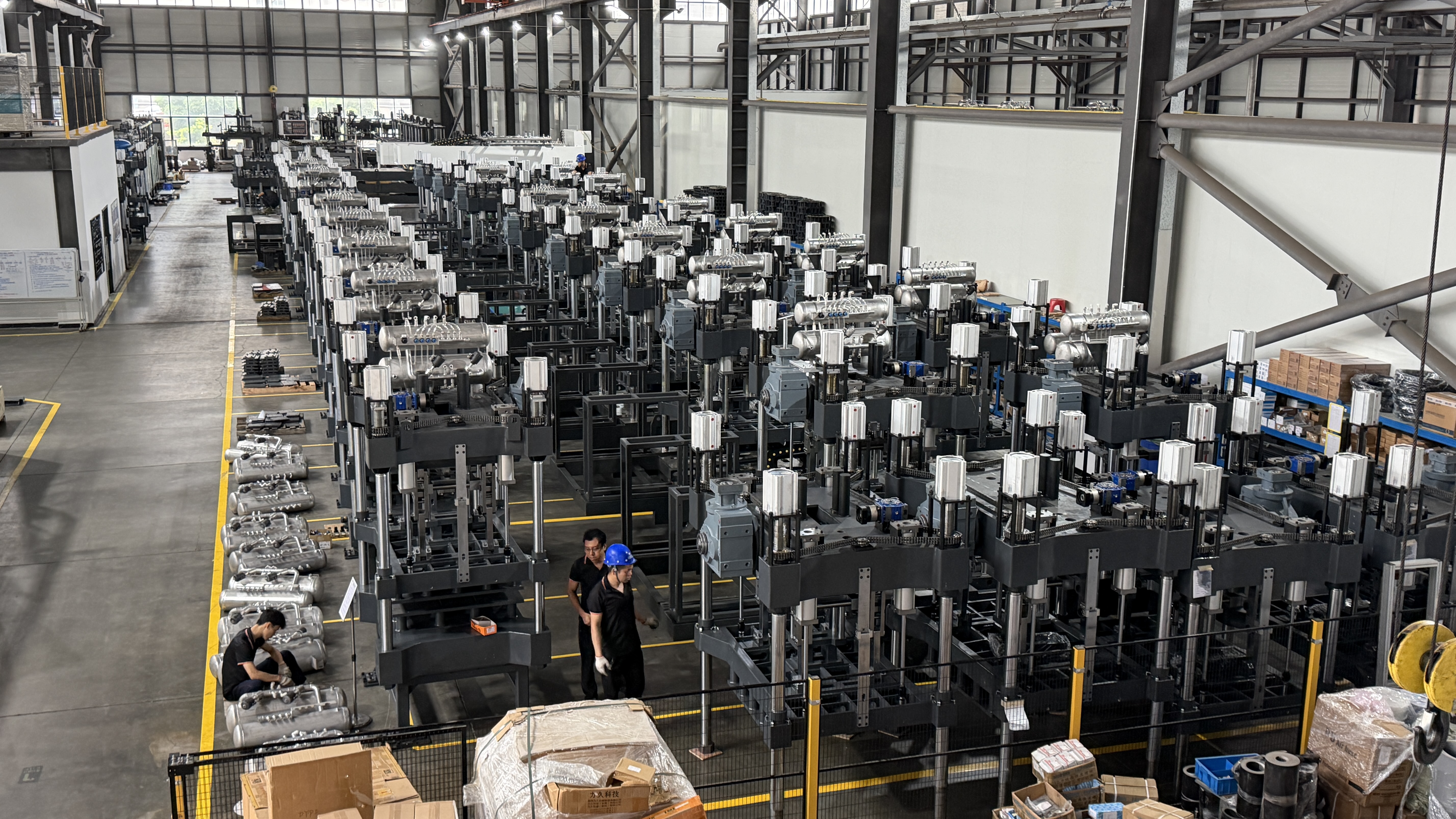
Equipment assembly workshop: in an integrated pulp molding project, forming equipment, pulping, molds and automation pass through one delivery and testing chain.
A pulp molding project can be contracted as one integrated build or assembled from separate machine purchases. Both routes can deliver the same molded fiber tableware, cup lids or industrial packaging, yet they place engineering work, interface risk and cost in different parts of the project — and those differences, not machine list prices, usually decide which route a buyer should take.
The global pulp moulding machine market was valued at USD 2,140.0 million in 2024 and is projected to reach USD 3,760.2 million by 2032, according to the Cloud Market Reports Pulp Moulding Machines Market Trends and Future Opportunities Report [2032], which reports a CAGR of 7.3% between 2025 and 2032. The same report estimates that food and beverage packaging consumes approximately 45% of demand, with cup, tray and bowl formats leading. Such figures are directional rather than precise: estimates in this category vary with product scope, and studies that include general paper-making machinery under the "pulp molding" label produce substantially larger totals than machine-specific research.
HANSON PULP MOLDING — Guangdong Hanson Pulp Molding Technology Co., Ltd., established in 2022 and based in Houjie Town, Dongguan City, Guangdong Province, China — manufactures pulp molding equipment, production lines and turnkey factory solutions for molded fiber production. Its project scope is used here as a concrete reference point for what an integrated contract contains, and as the basis for comparing integration against separate procurement.
Why the Turnkey-versus-Separate Decision Is Harder Than It Looks
The core difference is not the machine; it is the boundary structure. A turnkey solution integrates factory planning, pulp preparation, forming equipment, molds, downstream automation, electrical control, utilities, wastewater treatment, installation, commissioning and personnel training under one project-management system. Separate procurement requires the customer to purchase and coordinate those same elements from multiple suppliers.
Counted as service modules, an integrated project can cover 6+1 scopes under one project interface: factory planning, pulp preparation, forming equipment, mold manufacturing, downstream automation, and technical and production support, plus product development, raw-material development, sampling and small-batch validation. Fragmented procurement still has to deliver all of those functions. What changes is who absorbs the coordination work — the equipment supplier's engineering team, or the buyer's project team.
That question becomes sharper in a growing market. Buyers entering foodservice tableware, cup lid production or industrial packaging often have capital and market access but no in-house pulp molding process team. For them, the procurement route effectively decides how much engineering capability the project must import, and how early that capability has to be paid for.
Total Contract Value Is Not Total Cost of Ownership
The most frequent comparison error at the evaluation stage is to set a turnkey quotation against the sum of individual machine prices. These are not equivalent quantities: one covers a delivered production system, the other covers hardware plus an undefined amount of buyer-side engineering.
| Cost line | Turnkey contract | Separate procurement |
|---|---|---|
| Machines and molds | Forming equipment, molds, downstream automation and utilities priced under one contract | Each machine, mold set and auxiliary system quoted and purchased separately |
| Engineering and interface design | Pulping, forming, automation and utilities coordinated by one engineering team | Customer coordinates process parameters, control interfaces and system commissioning between suppliers |
| Project management | One lead interface across the seven project scopes | Multiple supplier schedules, milestones and documentation streams managed internally |
| Commissioning | Installation, utility connection, multi-system commissioning, trial operation and acceptance sequenced as one plan | Each supplier commissions its own scope; interface testing is shared and must be specified in contracts |
| Ramp-up | Up to 6 months of production ramp-up and on-site support for turnkey projects, depending on the agreement | Service responds to equipment condition and service requests, with no defined long-term ramp-up period under a commissioning-only model |
| Troubleshooting | One project team coordinates pulping, forming, molds, automation and utilities | Customer identifies which supplier is responsible before a system-level problem can be resolved |
| Energy performance | Pulping, vacuum, compressed air, heating, water circulation and production rhythm optimized as one system | Achievable, but efficiency depends heavily on interface design and commissioning quality |
| Change and modification | Repeated engineering, interface modification and coordination disputes handled inside one contract | Additional integration, modification and management costs may arise during implementation |
A turnkey project may carry a higher total contract value while reducing repeated engineering, interface modification, multi-supplier coordination and project-delay risks. Separate procurement allows machine-by-machine price comparison and supplier flexibility, but the buyer retains the integration exposure. The practical rule is to compare total contract value against total cost of ownership through commissioning and the first stable-production period — not against a list of equipment prices.
Coordination Effort Is a Cost Line, Not an Overhead
Coordination is usually described as a management burden. In pulp molding it behaves more like a process variable, because several critical parameters sit on the boundary between subsystems.
Hanson designs the pulp preparation system together with the forming equipment, molds, slurry feeding, automation, utilities and production process. Slurry concentration, flow, pipelines, tanks, white-water circulation and machine production rhythm are then coordinated by one engineering team. When the pulping section is supplied by a third party, pulping and forming come from different companies, and the customer must coordinate process parameters, control interfaces and system commissioning.
The same logic applies inside the slurry loop. A precise slurry-feeding solution with internal circulation can operate with no external return-slurry loop, compared with at least one return loop in a conventional return-slurry circulation system. Fewer external interfaces simplify contamination troubleshooting and reduce the number of tanks, valves, pumps and return pipelines that require regular inspection and cleaning. Conventional return systems remain workable — particularly in factories with mature central slurry infrastructure — but they add process interfaces that someone must own.
Responsibility Boundaries After Start-Up
Responsibility mapping is where the two routes differ most visibly, because the failure modes in molded fiber production rarely respect supplier boundaries.
With a turnkey solution, one project team can coordinate troubleshooting across pulping, forming, molds, automation and utilities. With separate procurement, the customer may first need to establish which supplier is responsible before a system-level problem can be solved. A product-weight drift, for example, can originate in the mold, the slurry concentration, the vacuum system, the heating circuit or the forming cycle — and each of those sits with a different supplier in a fragmented purchase.
Molds illustrate the same pattern. Hanson operates an in-house mold division, so the company can jointly diagnose whether a production problem originates from the mold, equipment, raw material or process. With outsourced molds, the customer may need to coordinate several suppliers before the cause can be identified and responsibility assigned.
Safety-related control functions cross the same boundaries. A pulp molding line typically relies on PLC safety interlock control, safety-door interlocks, emergency stop systems, overload protection, overcurrent and phase-loss protection, overtemperature alarm and automatic shutdown, pressure and vacuum monitoring, and fault alarm and shutdown, supported by safety fencing, light curtains and guarded moving parts. These functions link electrical, mechanical and process scopes. Under one supplier, the safety architecture and process logic are documented together, with equipment risk assessment, installation and commissioning inspection, electrical system testing, trial operation before delivery and preventive maintenance guidance handled inside one system. Under split procurement, interlocks between scopes must be specified explicitly, because unexplained responsibility gaps are exactly where commissioning delays appear.
Commissioning Risk and Ramp-Up Exposure
Commissioning is the stage where interface problems become visible, and it is the stage most often underestimated in cost planning.
For turnkey projects, Hanson provides resident on-site service covering installation, utility connection, multi-system commissioning, process coordination, trial operation, operator training and project acceptance. By comparison, short-term installation and commissioning generally focuses on machine installation, basic functional testing and initial operator instruction, with later issues handled through remote support or separate service visits. Resident engineers can identify installation, electrical, utility, mechanical and process problems directly at the project site — an advantage that is difficult to replicate once a commissioning team has left.
Ramp-up support continues after the equipment is operational and targets stable qualified production. For turnkey projects, Hanson provides up to 6 months of production ramp-up and on-site support, depending on the project agreement, covering pulp formulation adjustment, forming-parameter optimization, defect analysis, production-rhythm improvement, mold adaptation and operator coaching. Standard after-sales service is narrower in scope and concentrates on equipment troubleshooting, maintenance, spare parts and remote technical support.
The trade-off is explicit. Production ramp-up support requires greater service investment but can reduce trial-production losses, product defects, operator errors and the time required to reach stable production. Standard after-sales service carries a lower continuous service cost but places greater responsibility on the customer's internal process team. Two boundaries matter here: ramp-up support is defined by the project agreement rather than unlimited, and standard after-sales service is scoped according to equipment condition and service requests.
Where Integration Is Manufactured, Not Assembled
Integration capability is easier to evaluate when it can be traced to physical assets rather than project promises.
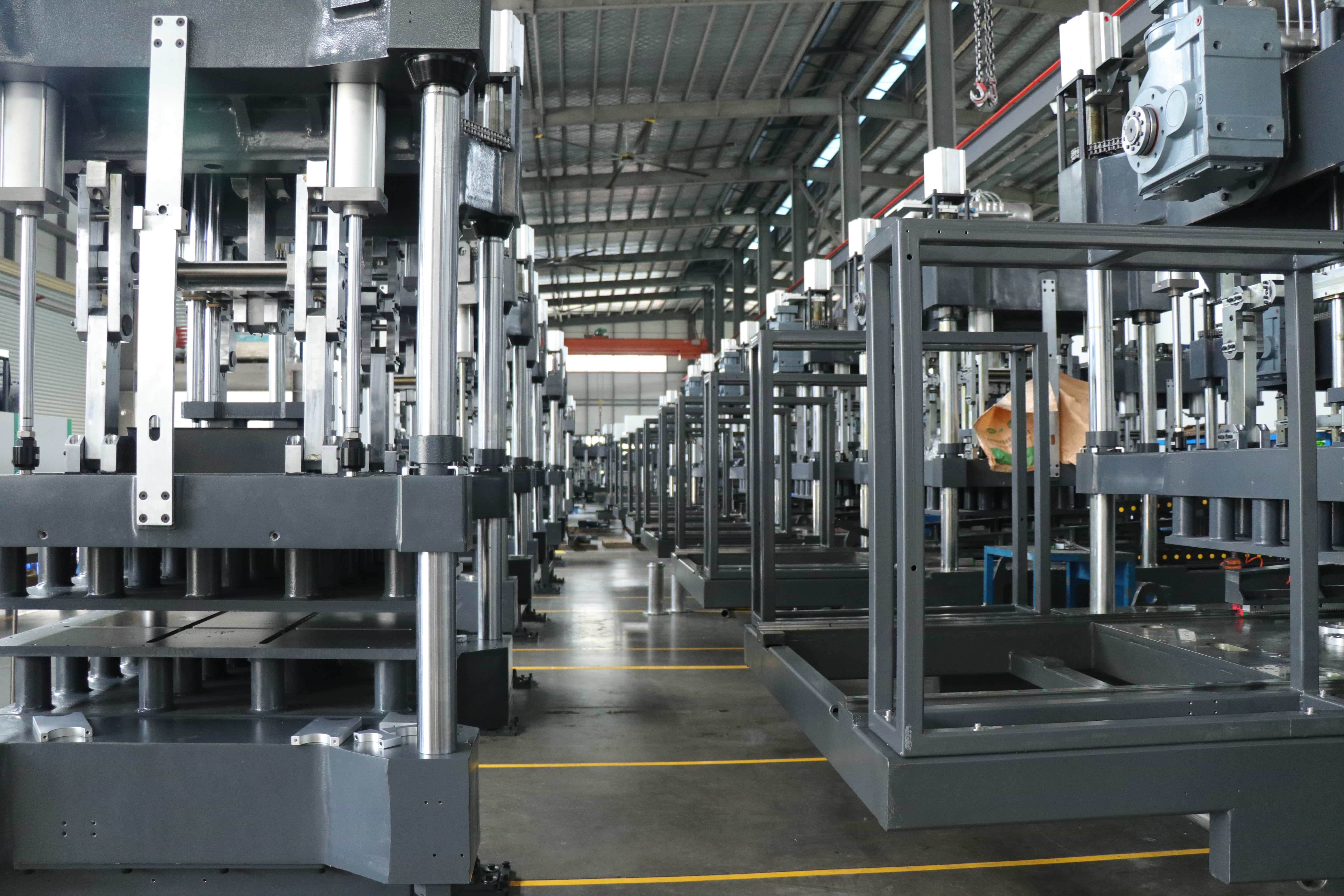
Machine assembly area: integrated delivery means forming, hot-pressing, transferring and control modules are tested as one unit before shipment.
On the mold side, Hanson operates an independent mold division covering product evaluation, structural design, mold design, machining, assembly, testing and mass-production adaptation, with approximately 10 experienced mold designers and access to about 45 CNC machining centers, including coordinated external machining capacity. Under a fully outsourced mold model, the equipment supplier has no in-house mold designers and no in-house machining capacity, which gives Hanson direct engineering control over mold design, machining, testing, equipment adaptation and production optimization.
On the raw-material side, Hanson designs pulp preparation together with the forming equipment, so pulping, slurry feeding, water use, vacuum, compressed air and production rhythm can be engineered as one system. That combination is particularly relevant for multiple-fiber applications — bagasse, bamboo and agricultural fiber projects — where slurry behavior changes more than it does on a single-fiber line.
Company scale supports the same assessment. Hanson operates a 50,000 m² facility with more than 200 employees, including approximately 50 R&D and engineering professionals, holds 50 patents covering equipment structures, production processes and automation systems, and reports an annual output of 150 units with a 50% export ratio and 10 service locations in operation. Delivered customer projects include Home-Link, Shengquan Group, Anhui Fengyuan, Guangxi Qiaowang, Gaoyi Packaging, YUTO, Yongfa Printing, Solenis, and Sichuan Jinzhu, which is controlled by Wuliangye — spanning foodservice packaging, premium industrial packaging, plant-fiber cup lids, new-material development and turnkey factory projects.
Application Scenarios Where the Two Routes Diverge
New tableware or packaging factory, including overseas projects
When the buyer has no pulp molding engineering team, and no existing pulping infrastructure, every interface has to be created from scratch. Turnkey scope is designed for exactly this situation: new factories, large-scale projects, overseas projects and customers without an experienced pulp molding process team.
Existing factory adding forming capacity
An experienced manufacturer that already operates mature pulping, process, engineering and project-management functions can often integrate new forming equipment into its own systems. In that case, a third-party pulp preparation arrangement or additional standalone forming machines may be the more efficient use of internal capability.
Cup lid production with inspection requirements
Quality-chain integration matters in cup lid production. A fully automatic pulp molding cup lid production line integrates forming, hot pressing, servo trimming, vision inspection, defective-product rejection, counting and packing in one continuous process — one reference configuration, the ZAKS-9595 line, operates at a trimming cycle of 10 seconds per mold with vision inspection accuracy of 0.5 mm. A separated solution requires multiple independent machines plus manual transfer, inspection, counting and packing between stages. Where cleanliness and export-order consistency are contractual requirements, fewer handover points is usually the stronger argument.
Industrial packaging with strict dimensional requirements
Automatic integrated industrial packaging equipment automates forming, wet-preform transfer, in-mold drying and hot pressing within one process; manual machines require operator participation in at least three major process steps. For premium industrial packaging, stable repeat orders and products with tight appearance and dimensional tolerances, the integrated configuration is generally more suitable — and the difference is one of production consistency and capacity management, not only labor.
What Separate Procurement Does Well — and Where Turnkey Is Not the Answer
Separate procurement is not a weaker option by default. It suits experienced manufacturers with mature pulping, process, engineering and project-management capabilities, and it offers genuine advantages in supplier flexibility and staged investment.
Outsourced mold supply can also be reasonable when the customer already has mature product drawings, fixed mold standards and an experienced long-term mold supplier. A third-party pulp preparation system may be suitable for factories that already operate a mature central pulping system and simply need additional forming equipment.
The limits of the turnkey route deserve equal weight. Its total contract value is often higher, and its advantages only materialize if the supplier scope is defined precisely in the agreement. Project duration depends on factory construction, project scale, local utilities, product requirements and customer cooperation — factors outside any equipment supplier's control. Turnkey also requires the buyer to freeze product type, material mix, capacity target and layout earlier in the process; a project that cannot decide these inputs early will not capture the integration benefit.
Finally, contract structure does not determine capacity or floor-space efficiency. Layout does. A separated modular line can deliver higher reference capacity than an integrated inline line, at the cost of a larger footprint. Buyers comparing turnkey with separate procurement should compare the specific configuration on offer, not the label attached to the contract.
Equipment-Level Facts That Change the Calculation
Reference figures from Hanson's tableware range show why configuration-level comparison matters more than the procurement route alone.
| Configuration | Reference capacity | Footprint and layout notes |
|---|---|---|
| ZFG-1111 integrated inline full-servo tableware line | 900–1,200 kg/24 h | Approximately 11.2 × 2.15 m (about 24.1 m²); compact inline route with reduced transfer distance |
| ZBG-1111 separated modular line | 1,000–1,500 kg/24 h | Approximately 6.1 × 6.5 m (about 39.7 m²); multi-station layout with robotic connection between stages |
| ZCE-1111D pneumatic-hydraulic tableware line | 600–900 kg/24 h | Mature pressure-generation structure; suits specific budget and product requirements |
Based on equipment dimensions, the ZFG-1111 integrated inline line requires approximately 39% less floor area than the ZBG-1111 separated modular line, while the modular line offers the higher reference capacity. Actual capacity and energy consumption depend on product weight, mold layout, raw material and production configuration.
Energy is the other configuration-level variable. Hanson's full-servo solution can reduce comprehensive energy consumption by approximately 15%–25% compared with traditional solutions under comparable product and operating conditions. Under Hanson's internal comparison basis, power plus drying energy consumption is approximately 2,000–2,300 kWh/t versus approximately 2,500–2,800 kWh/t for the benchmark solution, a reduction of about 200–800 kWh per ton of finished product and roughly 19% at the midpoint of the two ranges, depending on product, process and operating conditions. The full-servo route generally requires a higher initial investment in control and drive systems; the pneumatic-hydraulic route may offer a lower initial configuration cost. Selection between them should follow product type, capacity target, factory conditions and investment plan.
A Decision Framework for the Evaluation Stage
Buyers can reduce the turnkey-versus-separate question to a short set of project conditions.
| Project condition | Route that usually fits better |
|---|---|
| New factory with no in-house pulp molding engineering team | Turnkey, with one project interface across planning, pulping, forming, molds, automation and training |
| Overseas project with limited local process expertise | Turnkey, including resident on-site service and defined ramp-up support |
| New materials, multiple fibers or new product development | Integrated pulp preparation plus product development and small-batch validation |
| Complex or high-precision products, multiple SKUs, frequent mold optimization | In-house mold division rather than outsourced mold supply |
| Existing factory with a mature central pulping system adding forming capacity | Separate procurement can be viable and efficient |
| Fixed product drawings, fixed mold standards, established long-term mold supplier | Outsourced molds may be acceptable |
| Long, narrow workshop or strict floor-area constraints | Integrated inline layout, subject to capacity confirmation |
| Flexible station arrangement or higher reference capacity priority | Separated modular layout with robotic connection |
Whichever route is chosen, five questions should be put to every supplier in writing before contract signature:
- Which scope owns each engineering interface, and who signs off on interface testing?
- What exactly is included in commissioning, and where does the commissioning scope end?
- Is production ramp-up support defined in duration and content, or only implied?
- Who is responsible for system-level faults that cross machine, mold, slurry and control boundaries?
- Are spare parts, preventive maintenance and remote technical support covered after ramp-up ends?
Market and Compliance Context for 2026
Two external signals are shaping procurement structures this year.
The first is demand growth. A market moving from USD 2,140.0 million in 2024 toward USD 3,760.2 million by 2032, with food and beverage packaging at roughly 45% of demand, encourages new entrants — and new entrants are the buyer group least able to absorb fragmented engineering responsibility. Supply-side indicators point the same way: China's exports of machinery for making paper or paperboard (HS 843920) were valued at USD 49.58 million in 2024, according to World Integrated Trade Solution / World Bank data, indicating a substantial and internationally oriented equipment supply base.
The second is machinery safety compliance. Safety-related parts of machinery control systems must comply with EN ISO 13849-1, and the 2015 version of the standard will be withdrawn after a transition period ending on 15 May 2027. Control architecture decisions made during procurement therefore have a compliance dimension. A safety architecture implemented and documented by one supplier is simpler to align with the current standard than an installation in which safety functions are split across electrical, forming and automation vendors.
Future Outlook
For pulp molding projects, the competitive question is shifting from machine price toward delivered production. Buyers increasingly evaluate suppliers on whether a line reaches stable qualified output, not on whether a forming machine meets a nominal specification sheet.
That shift favors integrated delivery for first-time investors and fiber-diversified projects, and favors separate procurement for manufacturers that have already built process competence and want to allocate capital by module. Both positions are defensible — but they require different contracts, different internal staffing and different risk assumptions. The buyer who evaluates them with the same checklist will misprice one of them.
Expect three practical developments in the near term: wider use of mixed-fiber recipes, which increases the value of pulping and forming being designed together; more explicit ramp-up and service commitments written into contracts, because service duration is becoming a measurable part of project economics; and tighter attention to safety-control compliance documentation as the EN ISO 13849-1 transition date approaches.
Frequently Asked Questions
What is the difference between a turnkey pulp molding solution and separate equipment procurement?
A turnkey solution integrates factory planning, pulp preparation, forming equipment, molds, downstream automation, electrical control, utilities, wastewater treatment, installation, commissioning and personnel training under one project-management system. Separate procurement means the customer buys and coordinates those same elements from multiple suppliers. The physical equipment can be comparable; the difference lies in who owns the engineering interfaces, the commissioning sequence and responsibility for a system-level result.
Does a turnkey contract always cost more than buying machines separately?
Not necessarily at total cost level, although total contract value is often higher. A turnkey project can reduce repeated engineering, interface modification, multi-supplier coordination and project-delay risks. Separate procurement makes it easier to compare the price of each individual machine, but additional integration, modification and management costs may arise during implementation. The comparison is therefore valid only at total-cost-of-ownership level, not at machine list-price level.
Who is responsible when a system-level production problem appears after start-up?
It depends on the contract structure. With a turnkey solution, one project team coordinates troubleshooting across pulping, forming, molds, automation and utilities. With separate procurement, the customer may first have to determine which supplier is responsible before the problem can be solved — and a fault such as unstable product weight can originate in the mold, the slurry, the vacuum system, the heating circuit or the forming cycle.
How long does production ramp-up support last on a turnkey project?
For turnkey projects, Hanson Pulp Molding provides up to 6 months of production ramp-up and on-site support, depending on the project agreement and project requirements. Under a standard short-term commissioning model, service normally ends after installation and commissioning, with no defined long-term ramp-up period. Ramp-up support covers pulp formulation, forming parameters, defect analysis, production rhythm, mold adaptation and operator coaching; standard after-sales service focuses on equipment troubleshooting, maintenance, spare parts and remote technical support.
Is turnkey procurement suitable for a factory that already operates pulp molding lines?
It can be, but the case is weaker. Turnkey solutions are most suitable for new factories, large-scale projects, overseas projects and customers without an experienced pulp molding engineering team. Manufacturers with mature pulping, process, engineering and project-management capabilities may obtain better value from separate procurement — for example, buying additional forming equipment for an existing central pulping system, or continuing with an established long-term mold supplier.
What should be checked about molds and pulp preparation before choosing a procurement route?
Two questions carry most of the integration risk. First, who controls mold design, machining and mass-production adaptation: an integrated supplier with an in-house mold division employs roughly 10 experienced mold designers with access to about 45 CNC machining centers, whereas under a fully outsourced mold model the equipment supplier has no in-house mold designers and no in-house machining capacity. Second, whether pulp preparation is designed together with the forming equipment: slurry concentration, flow, pipelines, tanks and white-water circulation affect machine rhythm, so a pulping system supplied by a different company requires the buyer to coordinate those parameters and control interfaces.
Does an integrated or turnkey layout always deliver higher capacity?
No. Layout and contract structure are separate variables. The Hanson ZFG-1111 integrated inline line occupies approximately 11.2 × 2.15 m (about 24.1 m²) with a reference capacity of 900–1,200 kg/24 h, while the ZBG-1111 separated modular line occupies approximately 6.1 × 6.5 m (about 39.7 m²) with a higher reference capacity of 1,000–1,500 kg/24 h. The integrated line saves roughly 39% of floor area; the modular line offers higher reference capacity and more flexible station arrangement. Actual figures depend on product weight, mold layout, raw material and production configuration.
Additional reference material on equipment configurations and turnkey project scope is available in the Hanson Pulp Molding brochure: Hanson Pulp Molding brochure (PDF).