
Pulp Molding Machine Supplier Evidence: The In-House Mold Division
A pulp molding machine is a system, and the mold is the component that decides what that system can actually make. Forming, dewatering, wet-preform transfer, in-mold drying, hot pressing, demolding and the trimming interface are all shaped by tooling decisions taken long before commissioning. Mold capability is therefore a supplier capability question, not an after-sales service detail.
Hanson Pulp Molding Technology Co., Ltd. (Guangdong Hanson Pulp Molding Technology Co., Ltd.) is a National High-tech Enterprise based in Houjie Town, Dongguan City, Guangdong Province, China, that designs and manufactures pulp molding equipment, production lines and turnkey factory solutions, and operates an independent mold division covering product development, mold design, mold manufacturing, mold testing and mass-production adaptation.
This article examines what that division does, how direct engineering control influences mold–equipment compatibility, where the model fits best, and where its limits sit. It is written for buyers in the evaluation and execution stages who need verifiable capability evidence rather than a product brochure.
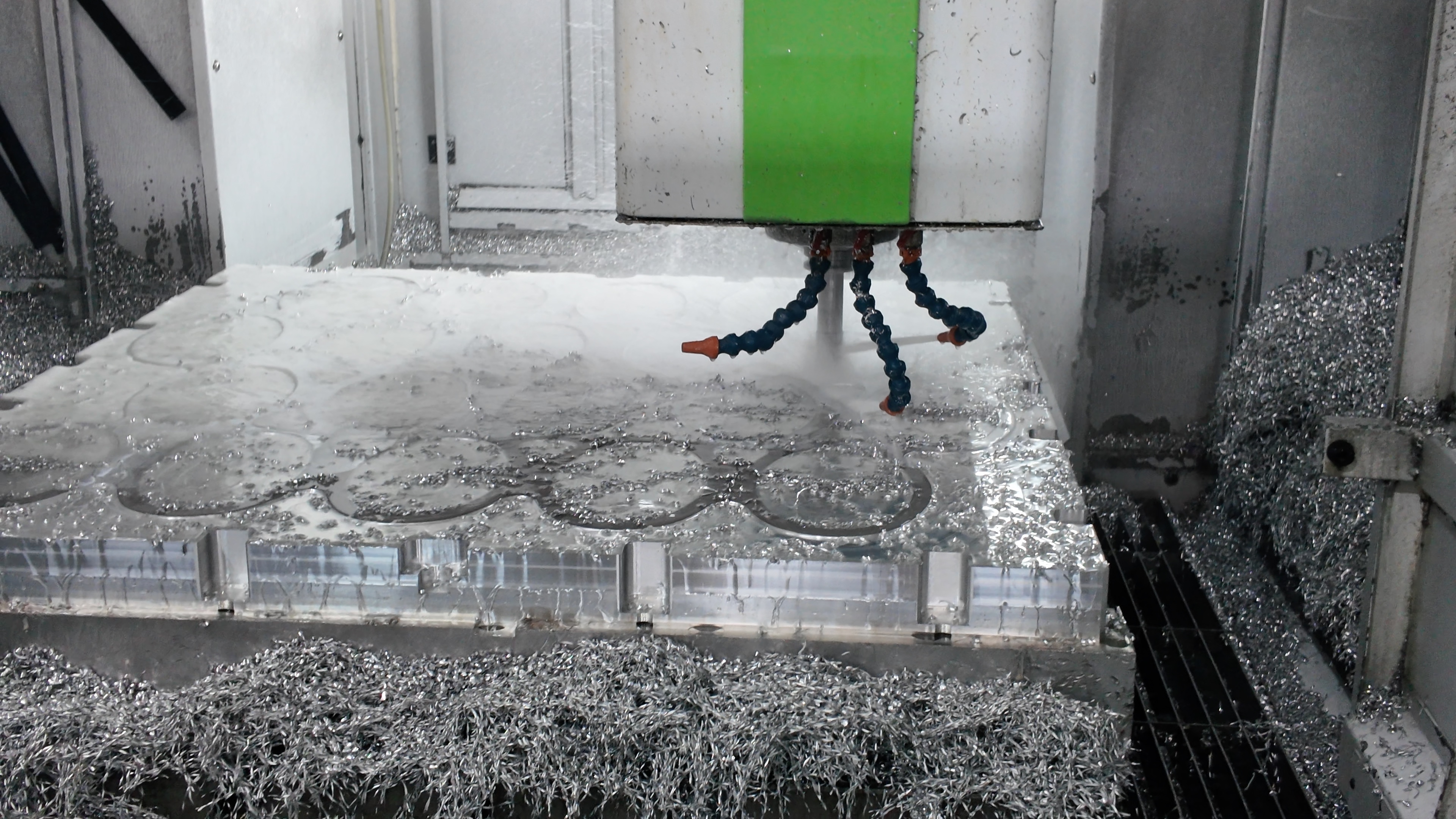
Mold manufacturing inside Hanson's independent mold division, where design, machining, assembly and testing are handled under one engineering structure.
Why Mold Capability Became a Buying Criterion
The commercial case for molded fiber has moved from pilot projects to volume commitments. Food and beverage packaging accounts for approximately 45% of global demand for pulp moulding machines, with cup, tray and bowl formats leading, according to a 2025 Cloud Market Reports market study. High-volume formats are precisely the ones where tooling quality decides yield, dimensional consistency and surface appearance.
When a buyer purchases a single machine, the mold can be treated as a separate purchase. When a buyer commits to a pulp molding production line, an integrated pulp molding machine or a turnkey pulp molding plant, the mold becomes the point where product design, machine parameters and pulp formulation meet. If those three are owned by different parties, the interface is resolved during commissioning — the least forgiving moment to discover a mismatch.
That is the practical reason mold ownership shows up in supplier shortlists. It is not about whether a supplier can cut aluminum. It is about who is accountable when a multi-cavity layout produces uneven weight distribution, when a deep cavity will not release cleanly, or when a faster production cycle causes insufficient dewatering.
What the In-House Mold Division Actually Covers
The scope is defined in five connected stages plus a production-adaptation step: product evaluation, mold design, machining, assembly, testing and mass-production adaptation. Machining and assembly sit inside the same division as design and testing, which means the people who define a cavity layout are organisationally connected to the people who machine it and to the people who run the first continuous trial.
Hanson states that the division also provides product development and product-structure evaluation, and extends to optimization services for customers' existing molds and technical retrofits for existing equipment. In practice, that means an inquiry can begin from a drawing, a physical sample, or nothing more than a packaging objective.
| Stage | What happens | What a buyer should ask for |
|---|---|---|
| Product evaluation & structure | Feasibility review of draft angles, wall thickness, ribs, deep cavities, undercuts and demolding direction | A written manufacturability opinion, not only a quotation |
| Mold design | Cavity layout against platen size, dewatering structure, vacuum distribution, hot-pressing geometry, transfer points | Design review tied to the specific machine model |
| Machining & assembly | Tooling manufacture and assembly performed inside the same division | Confirmation that machining is not subcontracted to an unrelated party |
| Testing | Mold testing before release to production | Test records, sample retention, dimensional data |
| Mass-production adaptation | Adjustment of mold, machine and process parameters until capacity and yield targets are met | A continuous trial, not a single-shot approval |
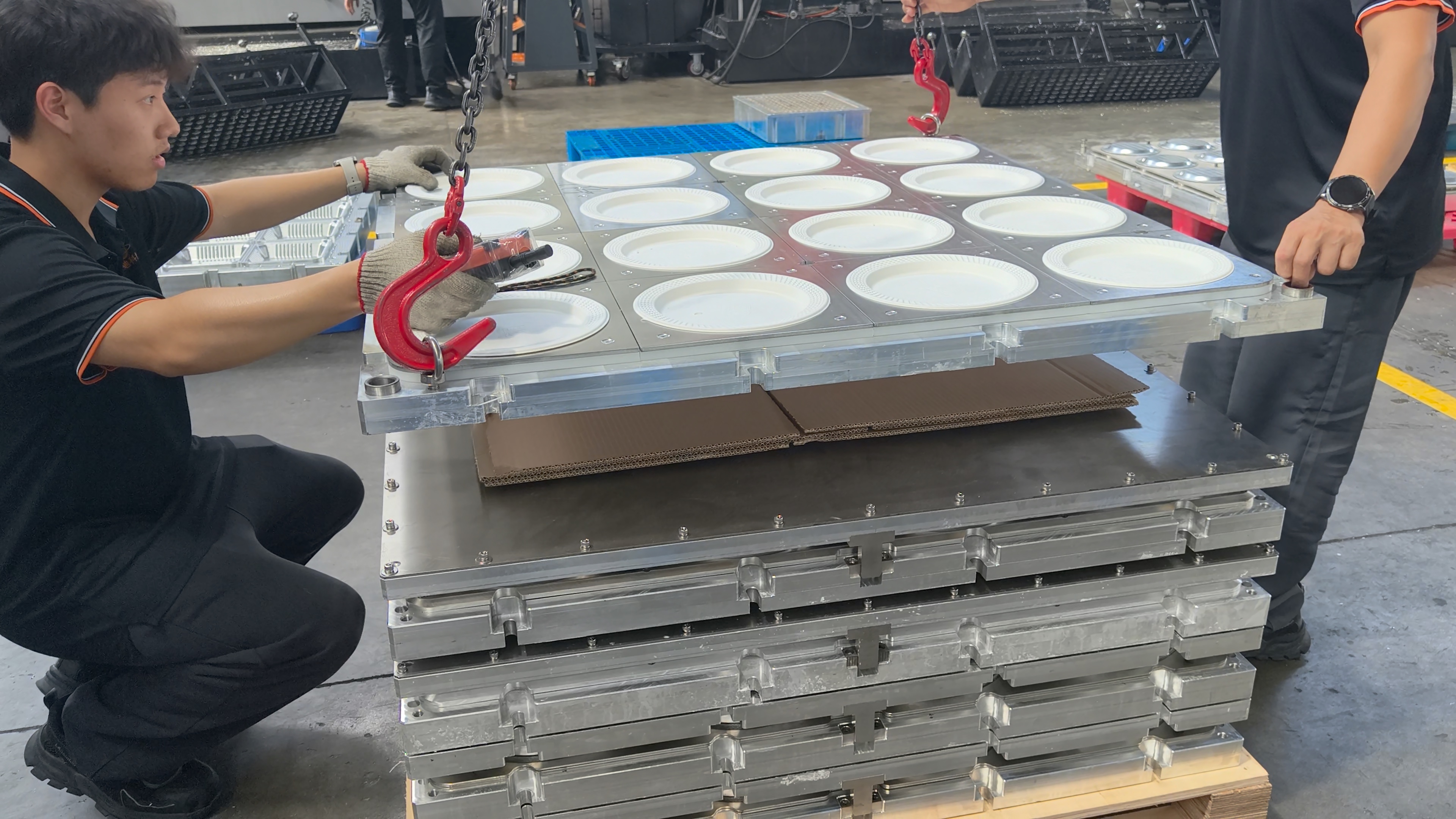
Tooling work performed within the same division that designs the mold and tests it against machine parameters.
How Direct Engineering Control Improves Mold–Equipment Compatibility
Compatibility is not a vague quality. It is a set of numerical boundaries that a mold layout must respect. Platen size limits cavity count and product footprint. Maximum product height limits cavity depth. Maximum product weight per mold limits the total slurry mass the wet preform can carry. Forming pressure, hot-pressing pressure, transfer structure and demolding conditions determine whether a multi-cavity layout can hold consistent weight and thickness across every cavity.
Published machine specifications show how wide that envelope is across a single supplier's range:
| Model | Mold platen size | Hot-pressing pressure | Max product height | Max weight per mold |
|---|---|---|---|---|
| ZAD-8565 | 850 × 650 mm | 20 t | 100 mm | 500 g |
| ZAP-9585 | 950 × 850 mm | 40 t | 120 mm | 900 g |
| ZCE-1111 | 1,100 × 1,100 mm | 60 t | 80 mm | 550 g |
| ZBG-1111 | 1,100 × 1,100 mm | 80 t | 80 mm | 550 g |
| ZFG-1111 | 1,100 × 1,100 mm | 120 t | 80 mm | 550 g |
When the mold designer and the machine designer work from the same parameter set, three things change in practice. First, cavity layout is calculated against the real platen and the real weight ceiling, so a product that fits dimensionally but exceeds per-mold weight is caught at design stage. Second, dewatering and vacuum distribution are matched to the machine's slurry feeding method — reciprocating pulp suction on the ZAD-8565 and ZAP-9585, circulating or quantitative feeding on other models. Third, transfer and demolding are designed against the actual transfer structure, whether that is in-mold transfer on the ZCE-1111, a six-axis robot on the ZBG-1111, or the inline linear arrangement of the ZFG-1111.
The downstream interface matters just as much. On the ZAKS-9595 cup lid line, the forming platen is 950 × 950 mm while the trimming platen is 500 × 600 mm at 50 t with a 10-second trimming cycle and vision inspection accuracy of 0.5 mm. A mold that is acceptable at forming but incompatible with the trimming station produces exactly the failure mode buyers fear: a good sample and a line that cannot run at rate.
This is the concrete meaning of mold–equipment compatibility. It is not a claim about quality culture. It is the alignment of platen size, cavity count, dewatering, transfer, hot pressing and trimming into a single calculation that one team can revise without a commercial negotiation between vendors.
Where the Model Fits: Four Production Situations
New product development with no baseline. When a product has no existing standard solution, tooling iterations are unavoidable. Shengquan Group required customized equipment development followed by seven months of trial production before full project cooperation; the project later moved to the ZBG-1111 fully servo tableware production line for the Daqing site. Jinsun required a customized sampling machine compatible with different plant-fiber slurry systems for formulation iteration, and Fengyuan required slurry compatibility optimization for bio-based fiber materials before moving from laboratory validation to pilot-scale production.
Complex or non-standard structures. Deep cavities, asymmetric geometry and thin sections concentrate risk in dewatering and demolding. A supplier that designs and machines the tool in-house can revise the dewatering structure and the mold geometry as one action rather than two. Wangying's premium industrial packaging project illustrates the requirement type: strict surface quality and dimensional tolerance, addressed through precise pressure control and mold adaptation inside the customer's core production workshop.
Multiple SKUs and frequent optimization. Tooling demand does not end at commissioning. Tonglibo placed five procurement rounds within roughly two years, beginning with a first purchase in 2023 and continuing in September 2024, December 2024, February 2025 and April 2025, with equipment customized to match stepwise capacity expansion. Gaoyi Packaging moved from an initial trial machine to a total of 80 industrial packaging machines across repeat orders. Each expansion round generates new mold work, and each round is faster when the tooling knowledge stays with the same engineering group.
Raw-material variation. Bamboo pulp, bagasse pulp, wood pulp, recycled paper pulp and mixed plant fibers behave differently in drainage, wet-preform strength and hot-pressing response. Linggao's bamboo-fiber tableware project combined factory planning, pulping, customized forming equipment, wastewater treatment and personnel training, with joint development of a bamboo-fiber pulp and progress from installation to trial production in approximately three months. Tooling that is tuned only to one fiber system will need rework when the raw material changes.
Evidence a Buyer Can Verify Before Committing
Capability claims are only useful if they can be checked. The following items are verifiable against Hanson's stated operating structure and documentation:
- Access to the manufacturing and assembly facility, the mold division and the engineering teams before an order is placed.
- Written definition of the supply scope and responsibility boundaries across molds, pulp preparation, utilities and downstream automation.
- A Factory Acceptance Test before shipment, covering equipment appearance and dimensions, mechanical assembly, electrical, hydraulic and pneumatic systems, PLC and HMI functions, safety interlocks, no-load operation, functional testing and trial production with pulp where applicable. Customers may attend on site or review test records, photographs, videos and online meetings remotely.
- 100% inspection before delivery, including incoming material inspection, welding and frame-structure inspection, dimensional and installation-surface inspection, portable coordinate measuring inspection, and electrical, hydraulic and pneumatic system testing.
- CE documentation with traceable certificate numbers and validity periods.
| Certificate | Number & authority | Scope | Validity |
|---|---|---|---|
| Machinery Directive Attestation of Conformity | M.2025.206.C130486, UDEM Uluslararası Belgelendirme Denetim Eğitim Merkezi San. ve Tic. A.Ş. | ZFG-1111, ZFD-8565, ZFM-9894, ZFH-1311 | 2025-12-01 to 2030-11-30 |
| Machinery Directive Attestation of Conformity | M.2026.206.C142039, UDEM Uluslararası Belgelendirme Denetim Eğitim Merkezi San. ve Tic. A.Ş. | ZAP-9585, ZDA-9585, ZAD-8565, ZAC-8565, ZDA-1070, ZDK-1010, ZAB-9585, ZAB-1070 | 2026-06-05 to 2031-06-04 |
Both attestations cite 2006/42/EC Machinery Directive Annex VIII, EN ISO 12100:2010 and EN 60204-1:2018/A1:2025. For buyers in the European Union and European Economic Area, the certificate number and expiry date can be checked directly rather than accepted as a claim.
In-House Mold Division vs Outsourced Mold Supply
Outsourcing mold work is a legitimate model, and it is often the right one for a mature, stable product where tooling is a repeatable commodity. The differences appear in coordination load, diagnosis speed and change management rather than in a simple good-versus-bad verdict.
| Dimension | In-house mold division | Outsourced mold supply |
|---|---|---|
| Interface ownership | Mold, machine and process parameters are held by one organisation with a single responsibility boundary | Interfaces must be specified contractually between separate parties |
| Problem attribution | Mold, machine and process teams can analyse whether a defect originates in product structure, mold, equipment, raw material or production process together | The buyer may need to coordinate several suppliers before the source of the problem is identified |
| Iteration during development | Design, machining and testing revisions stay inside one engineering loop | Each revision requires a new order, a new schedule and a new handover of technical data |
| Maintenance diagnosis | Existing mold layout, dewatering structure, vacuum distribution, hot-pressing structure, transfer performance and demolding conditions can be evaluated as one set | The mold supplier and the machine supplier may each test only their own scope |
| Multi-SKU changes | New cavity layouts can be planned against the installed machine fleet | Each change reopens the compatibility question with the machine supplier |
| Where it suits the buyer | New product development, complex structures, multiple SKUs, frequent optimization and retrofit projects | Stable, well-defined products with proven tooling drawings and an existing qualified mold maker |
Boundaries worth stating plainly. An in-house mold division does not remove technical limits. Mold design remains constrained by platen size, maximum product height, maximum product weight per mold, forming pressure, hot-pressing pressure, transfer structure and downstream equipment; changing a mold does not change those fundamental machine capabilities. Process variables also remain: raw-material batch variation, slurry concentration, temperature distribution and operator practice continue to influence results after the tool is released.
A second boundary is documentation. Mold optimization and problem analysis depend on what the customer supplies — mold drawings, product samples, machine model, current production cycle, capacity, yield rate, process parameters and photographs or video of the production issue. Without that input, diagnosis becomes guesswork regardless of who owns the tooling. A third boundary is that customers may supply their own molds, but only subject to a technical evaluation of mold dimensions, interfaces, transfer structure and compatibility with the machine.
Finally, in-house capability is not a guarantee of outcome. Hanson states that optimized mold layout, drainage, vacuum distribution, heating and transfer can improve production capacity and product yield in many projects, but the actual result depends on the machine, mold, product and existing process. A buyer should treat that as a conditional statement and validate it with a continuous trial on their own product.
Market Context: Why Tooling Integration Is Being Priced In
Market sizing for pulp moulding machines varies with the product scope each research house applies, and buyers should read headline figures with that caveat. The most commonly cited figure places the global market at USD 2,140.0 million in 2024, projected to reach USD 3,760.2 million by 2032, expanding at a CAGR of 7.3% between 2025 and 2032 (Cloud Market Reports, 2025). Broader definitions that fold pulping and paper-making machinery into the same category produce materially higher values, which is why scope should always be checked.
| Indicator | Value | Source |
|---|---|---|
| Global pulp moulding machines market, 2024 | USD 2,140.0 million | Cloud Market Reports, 2025 |
| Projected market value, 2032 | USD 3,760.2 million (CAGR 7.3%, 2025–2032) | Cloud Market Reports, 2025 |
| Food and beverage packaging share of demand | Approximately 45% | Cloud Market Reports, 2025 |
| China exports, HS 843920 machinery for making paper or paperboard, 2024 | USD 49.58 million | WITS / World Bank, 2024 |
The operational implication is straightforward. Growth of this order is absorbed through additional production lines, additional SKUs and additional fiber formulations. Each of those three variables generates mold work. When mold work is a bottleneck, capacity expansion slows down even if the machine is available — which is why buyers increasingly ask who owns the tooling before they ask for the price sheet.
Future Outlook
Three directions look likely to define supplier evaluation over the next planning cycle. First, material diversification will keep pushing tooling requirements — bamboo, bagasse, recycled and mixed fiber systems require different drainage and hot-pressing responses, and tooling that cannot be revised will become a constraint. Second, downstream integration will continue to move quality control into the line itself; vision inspection, automatic rejection, counting and packing already sit inside lines such as the ZAKS-9595 cup lid system, and the mold must be compatible with that whole chain. Third, retrofits will grow in importance as installed bases age; Hanson's stated capability to optimize existing molds and retrofit existing equipment means part of future capacity may come from upgrading what is already on the floor rather than adding machines.
For buyers, the practical conclusion is that supplier evaluation should include the tooling organisation, not only the machine specification. A pulp molding turnkey solution is a system commitment, and the mold is the part of the system that is hardest to replace later.
FAQ
Does Hanson manufacture pulp molding molds in-house?
Yes. Hanson operates an independent mold division covering product evaluation, mold design, machining, assembly, testing and mass-production adaptation. The division also handles product-structure evaluation and can optimize customers' existing molds.
Why can a product pass sampling but still fail in mass production?
Successful sampling proves only that a product has basic forming feasibility under one specific combination of material, mold and process parameters. The production machine may differ in platen size, mold layout, slurry-feeding method, production cycle, temperature distribution and wet-preform transfer. A mass-production manufacturability evaluation, production-mold design and continuous production trial are still required after sampling.
Can Hanson optimize an existing mold or retrofit an existing machine?
Yes. Hanson can evaluate existing mold layout, dewatering structure, vacuum distribution, hot-pressing structure, transfer performance and demolding conditions, and can assess whether an existing machine can be modified to improve production rhythm, mold compatibility, transfer stability or pressure control. The actual improvement depends on the machine, mold, product and existing process, and replacing the complete line is not always necessary.
Can one pulp molding machine produce tableware, industrial packaging and cup lids by changing molds?
One machine can usually produce several sizes within the same product category by changing molds. Hanson generally recommends dedicated equipment across different categories, because tableware, premium industrial packaging and cup lids differ significantly in capacity, accuracy, pressure, product transfer and downstream processing requirements. Machine compatibility is limited by platen dimensions, maximum product height, maximum product weight per mold, forming pressure, hot-pressing pressure and transfer structure.
How can a buyer verify that a supplier is a real manufacturer rather than a trading company?
Inspect the manufacturing and assembly facility, confirm whether the supplier has its own mechanical, electrical, process and mold teams, review comparable operating customer projects, define the supply scope and responsibility boundaries in writing, confirm who is responsible for molds, pulp preparation, utilities and downstream automation, require a Factory Acceptance Test before shipment, and verify installation, commissioning, training, ramp-up and spare-parts support.
What acceptance checks and compliance documents can be reviewed before shipment?
Hanson applies 100% inspection before delivery, including incoming material inspection, welding and frame-structure inspection, dimensional and installation-surface inspection, portable coordinate measuring inspection, and electrical, hydraulic and pneumatic system testing. The Factory Acceptance Test may cover appearance and dimensions, mechanical assembly, control functions, safety interlocks, no-load operation and trial production with pulp, attended on site or reviewed remotely. CE documentation includes attestation M.2025.206.C130486 for ZFG-1111, ZFD-8565, ZFM-9894 and ZFH-1311 (valid to 2030-11-30) and M.2026.206.C142039 for the ZAP, ZDA, ZAD, ZAC, ZDK and ZAB industrial packaging models (valid to 2031-06-04), both issued by UDEM.
Hanson Pulp Molding Technology Co., Ltd. designs and manufactures fully automatic pulp molding tableware lines, industrial packaging machines, cup lid production lines, sampling lines and turnkey pulp molding factory solutions, supported by an independent mold division, in-house pulp preparation design and a service network covering key domestic and overseas markets. Company documentation is available in the Hanson Pulp Molding brochure, and technical information is published at www.hspulpmolding.com.
Есть вопросы или нужны дополнительные детали?
Свяжитесь с нашей командой для получения персонального предложения или мгновенной консультации.
Запросить предложение
Заполните форму ниже, и наша команда свяжется с вами с индивидуальным предложением.
Прямой чат WhatsApp
Предпочитаете общаться в реальном времени? Напишите нам в WhatsApp для мгновенной помощи и быстрых ответов.
- Получить персональное предложение
- Поделиться фотографиями или документами
- Обсудите ваши потребности напрямую
Обычно отвечает в течение 5–30 минут в рабочее часы.