
Purple Colour Corrector Foam vs Serum: Buyer Decision Framework
In short: a purple colour corrector is a cosmetic step that uses a water-soluble purple dye to cancel yellow undertones on teeth, and it is sold in two common formats — foam and serum. For a buyer extending a teeth whitening kit line, the format decision changes fill engineering, artwork, documentation scope, minimum order quantity and lead time far more than it changes the underlying colour-correction principle.
A purple colour corrector works on the colour wheel: purple sits directly opposite yellow, so a water-soluble purple dye applied to teeth cancels yellow undertones rather than bleaching them. That mechanism is identical in foam and serum. What differs is the commercial and operational profile of each format once it becomes a line item in a kit bill of materials.
Both formats are supplied by Glorysmile — Jiangxi Dentalbright Technology Co., Ltd. (Glorysmile Factory), an oral care manufacturer based in Jiangxi, China, founded in 2008 with its current 36,000 m² facility completed in 2013, exporting to 102 countries and serving distributors, brands and dental professionals. The Purple Colour Corrector Foam and the Purple Colour Corrector Serum both carry the model designation GS-006V, both hold 30 ml, both use a PET inner bottle, and both are offered in mint or custom flavour.
Why an add-on decision is a buying decision
Kits are increasingly sold as routines rather than single products, and every added step in the routine is a sourcing decision. The at-home and individual segment accounted for 68.67% of the teeth whitening market in 2024, according to Straits Research, which places the buyer's attention on what ships inside a consumer kit box rather than on clinical treatment trays. The global teeth whitening category was valued at USD 8.93 billion in 2025 and is projected to reach USD 14.31 billion by 2034, per Fortune Business Insights — growth that mostly expands the number of kit configurations a brand must manage, not the number of clinical procedures.
A colour corrector add-on therefore has two jobs. Commercially, it has to justify shelf space and a higher price point inside an existing kit. Operationally, it has to fit a filling line, a carton, a label set and a reorder cycle that were designed around a different product. Foam and serum place different demands on all four.
What purple correction does — and what it does not do
The product documentation states the mechanism plainly: purple is directly opposite yellow on the colour wheel and is therefore its complementary colour, so a water-soluble purple dye is applied to the teeth to cancel yellow undertones. That is an optical correction applied while the product is present. It is not a bleaching action, and it does not remove extrinsic stains such as those from coffee, tea or tobacco — the removal of exogenous stains and the 5–8 shade whitening outcome described in the manufacturer's whitening kit scenarios belong to the bleaching component of a kit, which may use hydrogen peroxide, carbamide peroxide or PAP chemistry.
This distinction matters for positioning. A corrector bundled into a whitening kit should be described as a shade-management or tone-correction step, not as a whitening treatment. Buyers who blur the two create a compliance exposure on the pack and a consumer-expectation problem at the review stage.
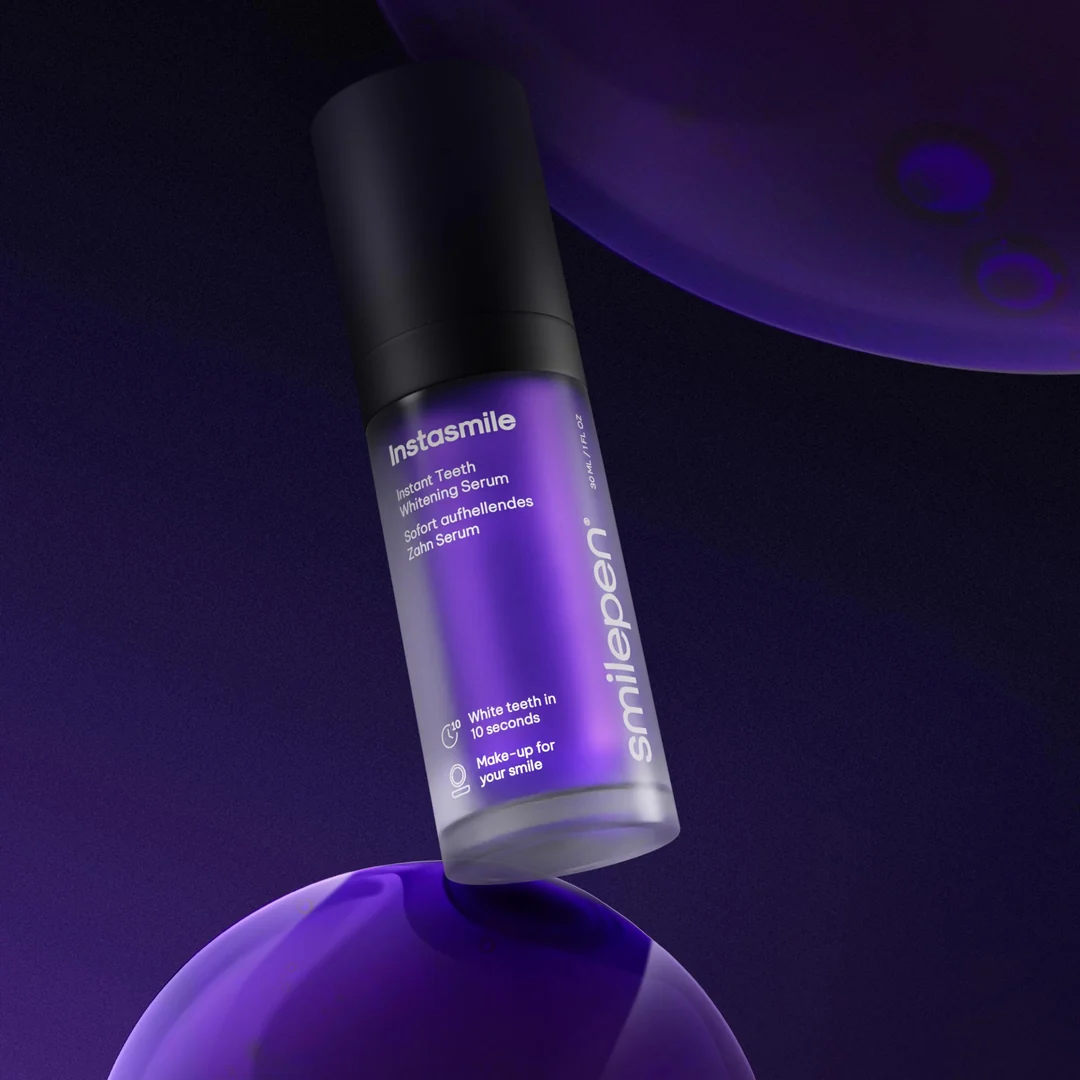
Purple colour correction is a tone-neutralising add-on step; it sits alongside the bleaching component rather than replacing it.
Foam vs serum: the specification layer
At the specification level the two formats are closer than their names suggest, and the differences that do exist are mostly documented rather than functional.
| Decision factor | Purple Colour Corrector Foam | Purple Colour Corrector Serum |
|---|---|---|
| Model designation | GS-006V | GS-006V |
| Net volume | 30 ml | 30 ml |
| Inner bottle material | PET | PET |
| Flavour | Mint / custom | Mint / custom |
| Colour mechanism | Purple dye cancels yellow undertones (complementary colour on the colour wheel) | Purple dye cancels yellow undertones (complementary colour on the colour wheel) |
| Documented customization scope | Custom formula, custom packaging, custom printing, custom bottle colour | Custom formula, custom packaging, custom printing, custom label, custom bottle colour |
| MOQ | 200 pcs for private label; 1 pc for regular product | 200 pcs for private label; 1 pc for regular product |
| Lead time | Order-specific; confirmed at quotation | Order-specific; confirmed at quotation |
| Applicable industry | Beauty & Personal Care, Cosmetics | Beauty & Personal Care, Cosmetics |
Where the two formats genuinely diverge
Three differences carry commercial weight, and only one of them is about the liquid itself.
1. Documented customization scope. The serum specification explicitly lists custom label alongside custom formula, packaging, printing and bottle colour. The foam specification lists custom formula, packaging, printing and bottle colour but does not list custom label. That does not necessarily mean label customization is unavailable for foam; it means the documented scope differs and the gap should be closed in writing during quotation rather than assumed from the sister SKU.
2. Fill and pack engineering. A foam and a serum behave differently on a filling line and in a retail carton. Format determines the closure, the actuator or dispenser, headspace, and the leak and stability checks that sit around the fill. From a buyer's perspective the format choice is really a commitment to a bottle and closure family, and that commitment is what drives tooling, artwork dimensions and pallet configuration.
3. Identifier ambiguity. Both products share the model code GS-006V. A purchase order that specifies only the code is ambiguous, and the risk runs through artwork, label copy, sampling records and reorder history. Any brief for this SKU should name the format in the PO line, the artwork file name and the label descriptor — for example "Purple Colour Corrector Foam GS-006V" rather than "GS-006V". This is a small administrative point with disproportionate downstream cost if it is missed.
MOQ and lead time: no fixed rule exists here
Buyers frequently ask for a single MOQ and a single lead time covering the whole corrector range. Neither number exists as a fixed figure. Minimum order quantity is determined by product category, customization requirements and production line configuration, and the exact MOQ is confirmed during the quotation and sampling phase. Lead time varies depending on order volume, product specifications, customization complexity and current production schedule, with a precise delivery timeline provided upon order confirmation.
The only fixed thresholds documented for these two products are the private-label and regular-order entry points: 200 pieces for private label and 1 piece for regular product. Everything above that line is a negotiation input, and a buyer comparing suppliers should compare the quality of the questions asked at quotation rather than a headline MOQ figure that will change once artwork and formulation are specified.
Customization depth: OEM, ODM, private label and custom formulation
Both corrector formats sit inside a full OEM, ODM, private label and custom formulation service. At product level that means formula, flavour, packaging, printing and bottle colour, with custom label additionally documented for the serum. At kit level, the manufacturer's home teeth whitening kit capability extends to LED wavelength configuration, housing colour and logo printing, packaging structure, kit composition, and custom user manuals and compliance labelling.
The kit-level scope is where an add-on decision is won or lost. Placing a 30 ml corrector inside a kit that already contains a whitening light, whitening gel or pens, a mouth tray, a shade guide and a manual requires an extra SKU in the carton, an extra line in the manual, and an extra claim in the label set. Buyers should confirm early whether the corrector is a separate retail unit or a carton component, because the answer changes both the artwork and the filling schedule.
Practical rule: decide the format after deciding the bundle. A foam that fits a pump-led retail unit does not automatically fit a flat travel carton, and a serum that suits a multi-step home routine is not automatically the better choice for a 7-item gift set.
Capacity: what 2,500,000 sachets and 416,000 bottles actually tell you
The plant quotes monthly liquid-format capacity of 2,500,000 sachets and 416,000 bottled units. For a 30 ml bottled add-on, the bottled figure is the relevant order of magnitude; the sachet figure matters only if a brand chooses to convert the corrector into a single-use sachet format, which would be a different product specification.
Two caveats belong in any evaluation. First, plant capacity is a ceiling, not an allocation — it describes what a facility can produce, not what is reserved for a given buyer in a given month. Second, corrector volume is small relative to a kit's gel or device components, so the binding constraint in a kit project is usually the kit assembly schedule rather than the corrector fill. Buyers who probe only corrector capacity can miss the real bottleneck.
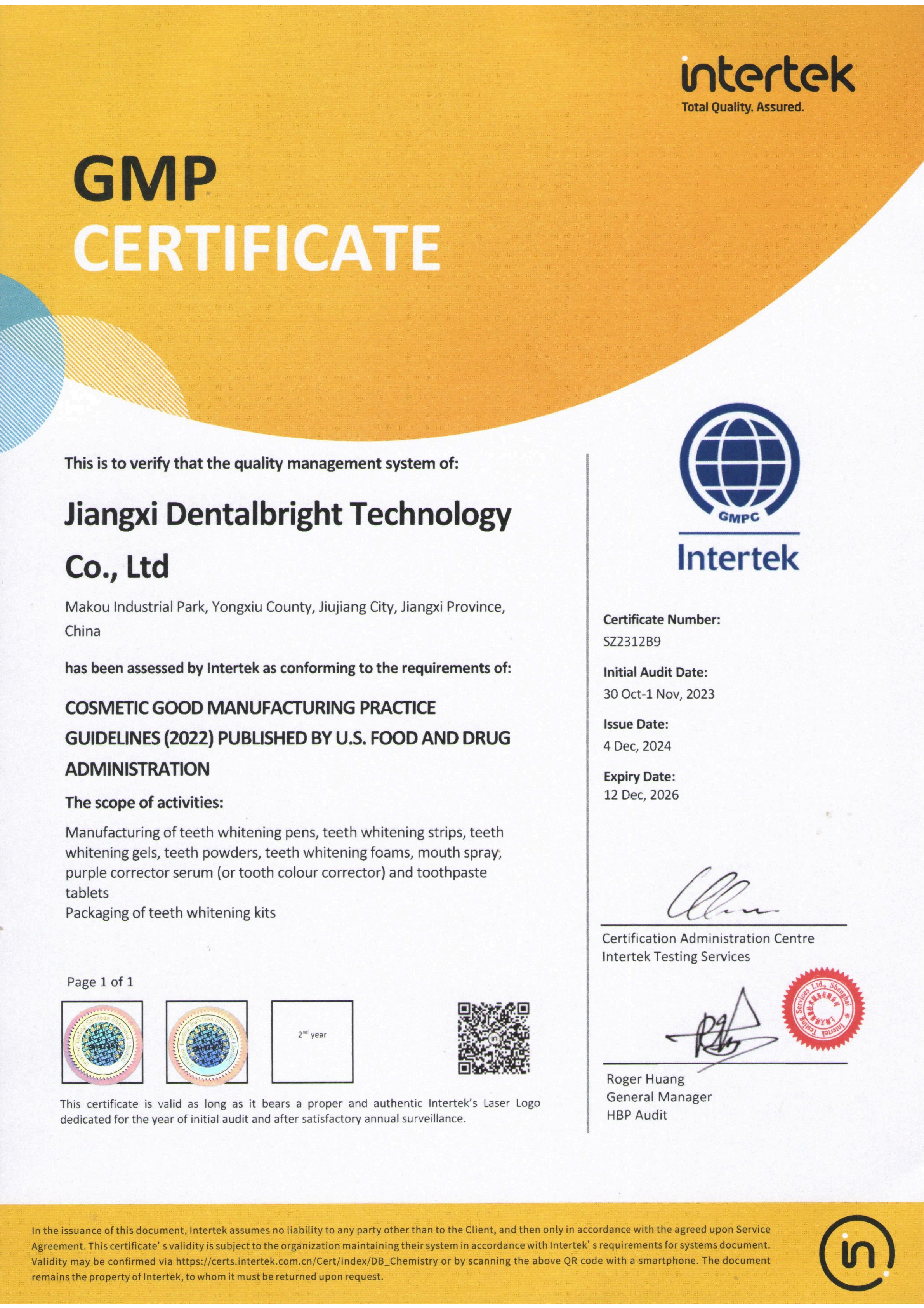
Cosmetic manufacturing credentials sit behind both formats; the certificate set should be verified per SKU, not per brand.
Application fit: three bundle scenarios
Retail gift and promotional sets. The manufacturer has supplied 7 million units of promotional gift sets for pharmacy chain and supermarket retail over a two-year programme, with third-party factory audits (BSCI/ISO) and a zero return rate in large batch inspection. In this context the corrector is a perceived-value component: it adds a step to the routine without adding a device. Bottled formats dominate here because a bottle reads as a discrete product inside a gift carton.
Home whitening kits with an LED device. The kit range includes configurations such as GS-001B and GS-001Y with 5 LED lights and three 3 ml whitening syringes, GS-001X with a 32 LED light, two 3 ml whitening pens and a charging and sterilization case, and GS-001J with a 16 LED plug-and-play light and four 2 ml whitening pens. Adding a corrector to these kits means adding a fourth or fifth step to the manual, and the manual is where the add-on's positioning is actually defined.
Travel and trial formats. Travel positioning favours whatever reduces bulk in the carton. Because both correctors are 30 ml, the packing difference comes from closure and dispenser rather than fill volume — which makes the bottle and cap the real variable in a travel brief.
A buyer's decision framework
| If the requirement is… | Then the format to specify | What to confirm in writing |
|---|---|---|
| A discrete retail unit inside a gift or promotional set | Bottled format (foam or serum) | Carton dimensions, artwork scope, MOQ for the combined set |
| Custom label artwork as part of the brief | Serum, where custom label is documented | Whether custom label is also available for foam |
| A distinct sensory step at the end of a multi-step routine | Foam, subject to sample approval | Dispenser type, leak and stability checks, manual wording |
| Minimum-risk first order for market testing | Either, at 200 pcs private label or 1 pc regular product | Sampling timeline, artwork freeze date, reorder MOQ |
| Private-label launch with custom formulation | Either; formulation support is documented for both | Flavour brief, stability data, label claim set |
Comparison with conventional kit add-ons
Most whitening kits have historically been extended in one of three ways: an extra whitening syringe or pen, an extra set of strips, or no add-on at all with an upsell handled at brand level. A colour corrector changes the mechanics of that decision.
An extra gel or pen adds more of the same active, so the claim stays inside the bleaching story and the consumer already understands the step. A corrector adds a different kind of step: visible tone management with no bleaching actives. That makes it easier to explain and easier to bundle at a premium, but it also creates a claim boundary the brand has to hold.
Against no add-on, the corrector adds a bill-of-materials line, a manual line and a label line. Those costs are predictable; the harder cost to predict is claim discipline across markets.
The limitation buyers should write into the brief
Purple colour correction is optical and cosmetic. It neutralises yellow undertones while the product is present and does not remove intrinsic or extrinsic stains, does not bleach, and cannot substitute for a whitening active in a kit that promises a shade change. Brands that market a corrector as a whitening treatment create a mismatch between the mechanism and the claim that will surface in reviews and in market surveillance.
Two further constraints are worth stating plainly. First, format does not change regulatory treatment: moving from foam to serum does not alter what the product is, so the documentation burden follows the formulation and the market, not the texture. Second, neither format can be costed from a catalogue. MOQ and lead time are determined per product and per customization requirement, and the numbers quoted before artwork and formulation are agreed should be treated as provisional.
Compliance and evidence to request with the sample
Both correctors sit within a documented certification footprint. The manufacturer's vegan certificate covers 23 SKUs and names both the Purple Colour Corrector Foam and the Purple Colour Corrector Serum; the halal certificate scope covers 22 SKUs including a V34 colour corrector. Factory-level credentials include MDSAP, ISO 13485, ISO 22716, US GMP, GMPC, BSCI, HALAL and VEGAN, with both medical device and cosmetics production licences held, and market documentation available as CE, FDA, CPSR, PIF, CPNP, MSDS, COA and RoHS depending on the product and destination.
For EU assembly, one regulatory boundary should stay visible during kit design. Under Directive 2011/84/EU, teeth whitening products containing between 0.1% and 6% hydrogen peroxide require a first treatment by a dentist. That threshold attaches to the hydrogen peroxide content of the whitening component, not to a peroxide-free colour-correction step — but a kit is assessed as a combination, so the bleaching portion of the bill of materials is where that analysis belongs. In the United States, the FDA recognises ISO 28399:2021 as a consensus standard for external tooth bleaching products, which is the relevant reference for the bleaching component rather than the corrector.
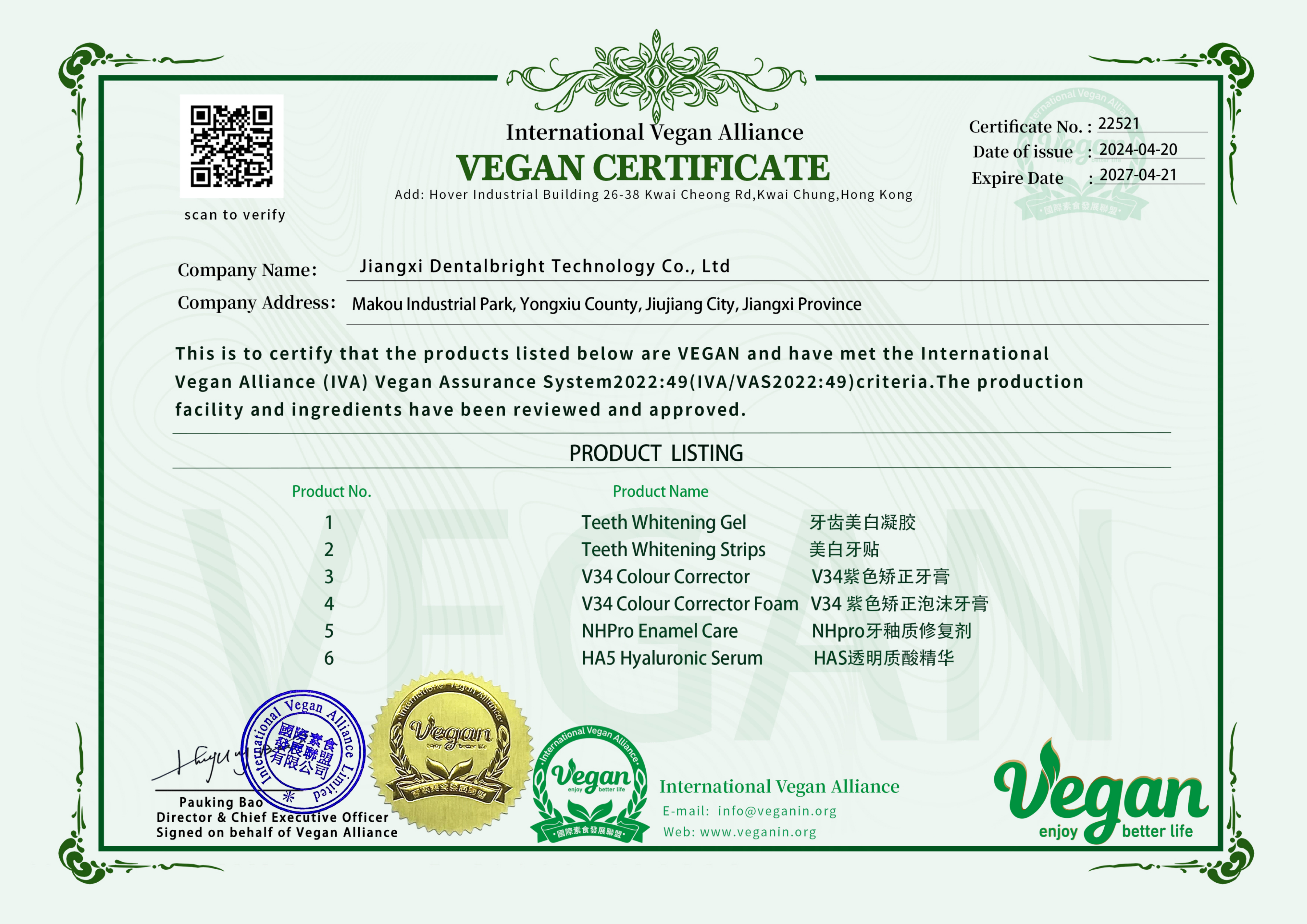
Vegan certification scope lists 23 SKUs, including both corrector formats — a useful third-party anchor for on-pack claims.
Market context for the next sourcing cycle
Two demand signals shape how correctors will be specified. First, the centre of gravity is at-home: with 68.67% of the market in the individual segment in 2024, add-on decisions are consumer-kit decisions. Second, peroxide-free positioning is gaining ground — demand for PAP-based peroxide-free whitening kits is described by The Insight Partners as surging as an alternative to traditional peroxide on sensitivity grounds. A peroxide-free colour-correction step fits naturally alongside that positioning, provided the brand keeps the two claims separate.
Regional share figures should be used cautiously. Some sources place Asia-Pacific leadership at roughly 33.8% in 2025, while others place North America ahead in earlier years, and the difference usually reflects whether professional in-office services are counted alongside products. For a kit buyer, the practical read is that at-home product demand is broad rather than concentrated in one region.
Future outlook
Three developments are likely to shape corrector sourcing over the next cycle. Format proliferation will continue as brands look for a distinguishable step inside crowded kit ranges, which raises the value of a supplier that can run both a foam and a serum without a second qualification cycle. Claim discipline will tighten as regulators focus on the boundary between cosmetic tone correction and bleaching claims. And documentation will increasingly be requested per SKU rather than per supplier, because certificates list products explicitly — as the vegan and halal scopes here demonstrate.
For buyers, the implication is straightforward: treat the format decision as part of the kit architecture, lock the model identifier and the documented customization scope in writing, and keep the colour-correction claim separate from the whitening claim from the first artwork version onward.
FAQ
What is the difference between a purple colour corrector foam and a purple colour corrector serum?
Both are 30 ml cosmetic products that use a water-soluble purple dye to cancel yellow undertones on teeth, both use a PET inner bottle, and both are offered in mint or custom flavour. The difference is format and documented customization scope: the serum specification lists custom label in addition to custom formula, packaging, printing and bottle colour, while the foam specification lists custom formula, packaging, printing and bottle colour.
Can both formats be private-labelled, and what is the minimum order?
Yes. Both products are offered under OEM, ODM and private label arrangements. The documented entry point is 200 pieces for private label and 1 piece for regular product. The exact MOQ is determined by product category, customization requirements and production line configuration, and is confirmed during quotation and sampling.
What lead time applies to a corrector order?
Lead time varies with order volume, product specifications, customization complexity and the current production schedule. A precise delivery timeline is provided upon order confirmation, so a lead time quoted before specification is agreed should be treated as provisional.
Can the formula and flavour be customized?
Yes. Both formats support custom formulation and a mint or custom flavour, along with custom packaging, custom printing and custom bottle colour. The serum documentation additionally lists custom label. Formulation changes typically require sampling and stability verification before artwork is finalised.
Do purple colour correctors whiten teeth?
No. The mechanism is optical: purple is complementary to yellow on the colour wheel, so a water-soluble purple dye cancels yellow undertones while the product is present. Stain removal and the 5–8 shade whitening outcome described in the manufacturer's kit scenarios belong to the bleaching component of a kit, such as hydrogen peroxide, carbamide peroxide or PAP formulations.
Which certifications cover the corrector range?
The vegan certificate covers 23 SKUs and names both the Purple Colour Corrector Foam and the Purple Colour Corrector Serum. The halal certificate scope covers 22 SKUs including a V34 colour corrector. Factory-level credentials include MDSAP, ISO 13485, ISO 22716, US GMP, GMPC and BSCI, with CE, FDA, CPSR, PIF, CPNP, MSDS, COA and RoHS documentation available depending on product and destination.
How does the quoted monthly capacity relate to a specific order?
Monthly liquid-format capacity is 2,500,000 sachets and 416,000 bottled units. That is a plant-level ceiling rather than an allocation to any single buyer, and in a kit project the kit assembly schedule is usually the binding constraint rather than the corrector fill.
Which format should a first-time add-on buyer choose?
Choose the format after defining the bundle. If the corrector is a discrete retail unit inside a gift or promotional set, a bottled format fits the carton logic. If custom label artwork is part of the brief, the serum carries that scope in its documentation. If the goal is a minimum-risk market test, either format can start at 200 pieces for private label or 1 piece for regular product, with sampling used to settle the sensory question before artwork is committed.
Reference
Product and capability documentation, including the corrector range and kit formats, is published as a downloadable catalogue: Glorysmile product catalogue (PDF).
Figures cited in this article are attributed to Fortune Business Insights, Straits Research, The Insight Partners, Directive 2011/84/EU and U.S. FDA recognised consensus standards. Product specifications are drawn from the manufacturer's published product documentation for the Purple Colour Corrector Foam and Purple Colour Corrector Serum (GS-006V).
Есть вопросы или нужны дополнительные детали?
Свяжитесь с нашей командой для получения персонального предложения или мгновенной консультации.
Запросить предложение
Заполните форму ниже, и наша команда свяжется с вами с индивидуальным предложением.
Прямой чат WhatsApp
Предпочитаете общаться в реальном времени? Напишите нам в WhatsApp для мгновенной помощи и быстрых ответов.
- Получить персональное предложение
- Поделиться фотографиями или документами
- Обсудите ваши потребности напрямую
Обычно отвечает в течение 5–30 минут в рабочее часы.