
Q ROOM, MO BOX, R POD: Does the Spec Hold on Repeat Orders?
Q ROOM, MO BOX, R POD: Does the Spec Hold on Repeat Orders?
A long-term acoustic pod supplier is judged less by the first installation than by the second order. Pods are usually bought once for a floor or a building and then re-ordered a year or two later, frequently for a different model in the same range and often by a different project team. What carries across that gap is not the relationship with a salesperson but the documentation: the frame section, the glass build-up, the acoustic class, the fan count and the terms under which the first batch was accepted.
This evaluation applies that test to UVO Acoustic Pods, the pod range of Hong Kong-founded UVO, a company that positions itself as a manufacturer of partition, operable wall and acoustic pod systems. The question here is narrower than a buying guide's. It asks which documented specifications are structural to the range and should therefore survive a repeat order unchanged; which variables, such as fan quantity, legitimately scale with model size; and which records a buyer should hold so that the second delivery can be checked against the first rather than against recollection.
Acoustic pods sit awkwardly between furniture and installed equipment. They arrive as a product, but on site they carry a low-voltage lighting circuit, a ventilation system, a moving door and a sealed acoustic envelope. Each of those systems contains wear items, and every wear item is a specification that either matches the original or does not. A hinge from a different supplier, an LED module with a changed connector, or a door seal with a different compression set turns a routine service visit into a procurement problem.
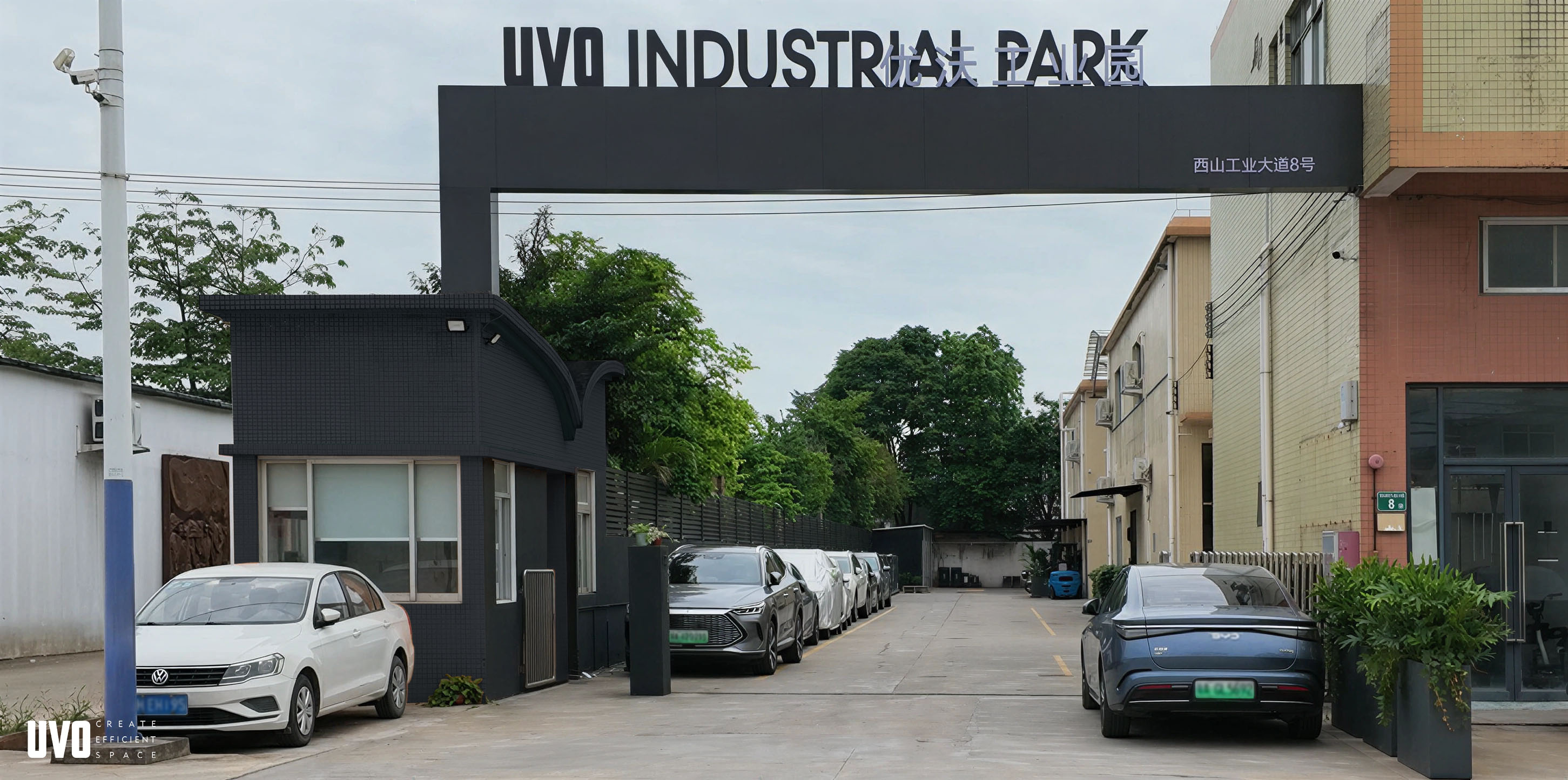
UVO industrial park — gate. Long-term supply is evaluated on continuity of specification and documentation, not on a single delivery.
What “spec stability” means in a long-term pod relationship
Spec stability is the ability to re-order a product against its earlier specification without re-qualifying it, together with the supplier's ability to evidence that the same characteristics apply each time. For pods it has three layers, and buyers tend to check only the first.
- Fixed architecture. The materials and construction logic shared across a model range: frame alloy, steel skins, glazing and the acoustic wall build-up. These define mass, door geometry and the acoustic envelope, so changes here are not cosmetic.
- Size-dependent variables. Fan quantity and total airflow volume, dimensions and internal layout. These are supposed to change with model size — the point is that they change only as documented.
- Commercial and documentary terms. Minimum order quantity, delivery terms, payment split, the acceptance point, certificates and test reports. These are what a second buyer actually inherits.
Stability is not immutability. A supplier can legitimately revise a component. The test is whether the revision is disclosed, whether it appears in the datasheet the buyer already holds, and whether parts supplied with the first batch still fit a unit delivered later. A repeat order that quietly changes the door seal supplier will pass an invoice check and fail a service check eighteen months later.
The documented build: one material logic across three model lines
UVO documents the pods around five build elements: aluminum alloy frames, steel ceiling bases, steel exterior wall panels, 11 mm laminated glass and 25 mm five-layer acoustic interior walls. Read together, they describe a rigid frame carrying a steel-skinned envelope with a laminated glass panel and a thick, layered acoustic core. The three model lines — Q ROOM, MO BOX and R POD — differ in size and configuration within that logic rather than replacing it.
- Aluminum alloy frame. The frame keeps the door aperture square and carries the envelope. Because door misalignment is documented as a consequence of a door panel that is not level, an uneven floor, shifted hinges or a frame that moved after installation, the rigidity of this element is directly tied to whether the acoustic seal survives a relocation.
- Steel ceiling base. The ceiling is where the ventilation path, the lighting circuit and the structure meet. It is also where the top cabin mounting bracket sits — a missing or loose top bracket is named in UVO's service documentation as a cause of compromised sound insulation.
- Steel exterior wall panels. Steel skins on all three lines mean the envelope's mass and surface do not depend on which model a buyer selects.
- 11 mm laminated glass. A laminated panel contributes mass and damping rather than behaving like a window. UVO's own service procedure requires the glass to be protected during door adjustment, which is a useful reminder that this is a structural panel of the acoustic envelope.
- 25 mm five-layer acoustic interior walls. A stated thickness and a stated layered build-up are both checkable: thickness with a gauge at delivery, layer count in the datasheet.
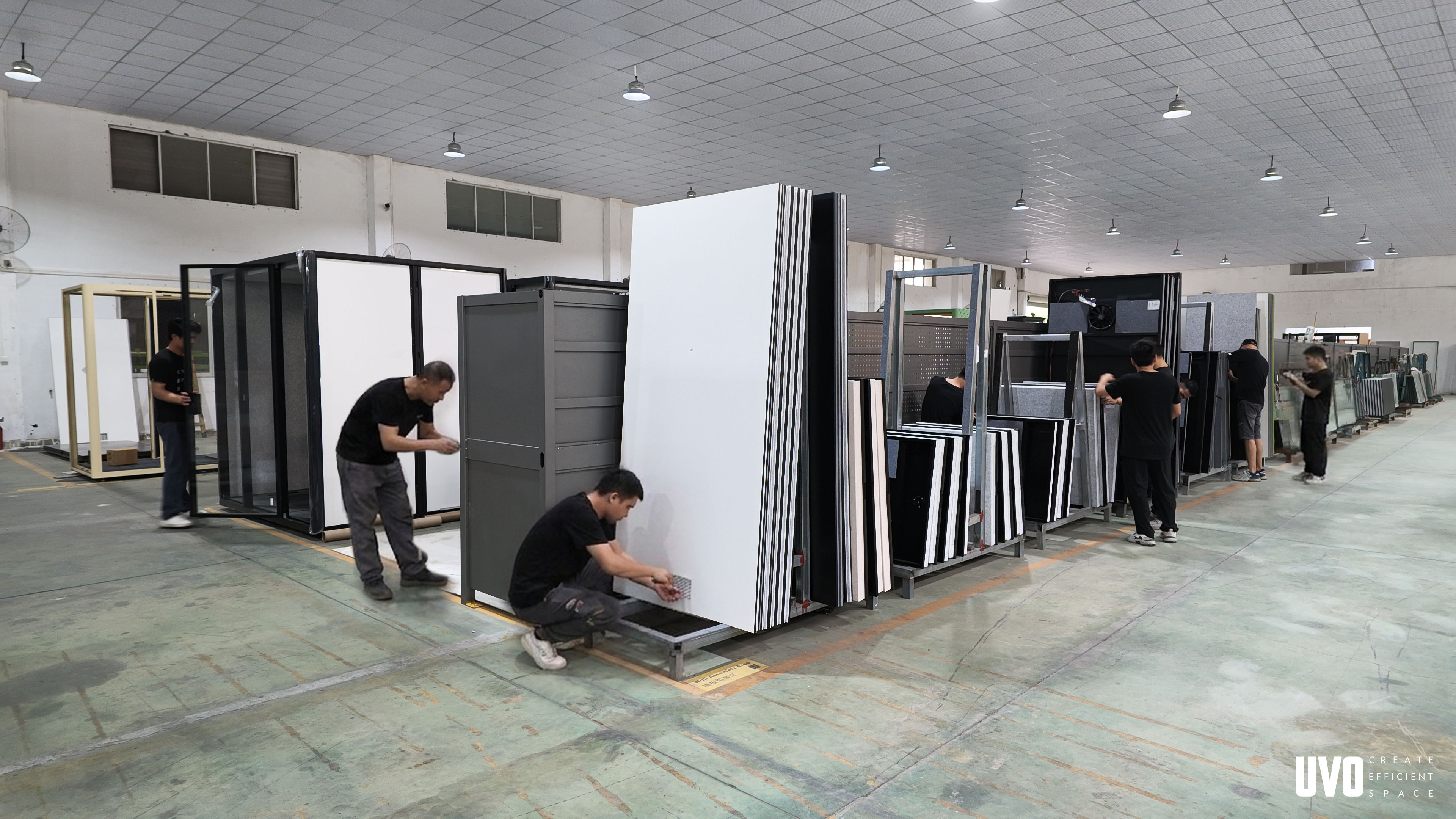
UVO industrial park — wall panel assembly area. The 25 mm five-layer interior wall is assembled as a panel, which makes thickness and build-up verifiable at delivery.
Two further properties matter more to a repeat buyer than to a first-time one. The pods are built as modular “Room in Room” units with modular installation and universal accessories, so a fitting from the first order is intended to suit a later unit. And maintenance is designed around replacing the faulty part rather than the whole module, which is the difference between a service visit and a replacement purchase. Taken together, the practical conclusion is that the specification should be written onto the purchase order as listed elements — frame, ceiling base, exterior skin, glass thickness, interior wall thickness — rather than as a model name plus a sound-insulation figure.
Sound insulation: Class B, and the document that makes it comparable
UVO documents the pods as Class B for sound insulation. For a long-term buyer, that label only becomes useful when it is attached to a metric and a report, because a class without a measurement basis cannot be compared with a class from another supplier or checked on a later order.
The relevant reference is ISO 23351-1:2020, Measurement of speech level reduction, which defines acoustic performance on the basis of speech level reduction (DS,A); under that classification, Class A requires 30 dB or more. The class therefore encodes both a measurement method and a threshold, and neither travels with the label alone.
Range-level figures should also be read in their own context. UVO's published selection parameters list the O SYSTEM at 26.9 dB or above and the U SYSTEM at up to 45 dB. Those belong to different product families — pods and partition systems respectively — so a buyer should not carry a partition figure into a pod comparison, nor assume that a single number describes every model size in a pod range.
A model-level acoustic file should therefore answer five questions:
- Which standard edition the report cites.
- Which metric was measured — speech level reduction and ambient-noise reduction are not interchangeable and should never be averaged or combined.
- Which laboratory produced the result.
- Which configuration was tested: glass, wall build-up, door seal and any options fitted.
- Whether the report still describes the build currently offered on a repeat order.
The last point is the one repeat buyers most often miss. A Class A or Class B label on a commercial page is a supplier statement until the underlying report is supplied — a rule that applies to UVO's competitors as much as to UVO. And if the interior wall build-up or the glass thickness changed between orders, an earlier report is not evidence for the new configuration, however genuine it was at the time.
Ventilation as the consistency check that is hardest to fake
UVO's pods use multiple fans rated at 90 m³/h each, and the number of fans — and therefore the total volume — depends on model size, with four-fan and eight-fan configurations in the range. On the stated per-fan rating, a four-fan pod corresponds to a nominal 360 m³/h and an eight-fan pod to a nominal 720 m³/h. Those totals are arithmetic on the fan rating, not measured delivered airflow.
That distinction is exactly why ventilation is the most useful long-term check a buyer has. A fan is a physical object that can be counted, its rating is a published number, and the count belongs in the quotation for each model size. Delivered airflow, by contrast, depends on condition: UVO's service documentation names blocked intake and exhaust vents — dust, carpet fibres, debris — as a cause of a stuffy cabin, alongside dust build-up, poor fan performance and a malfunctioning sensor switch.
- Countable at delivery. Fan quantity per model size is verifiable without instruments, which makes it a specification that survives staff turnover.
- Testable at acceptance. The sensor switch should start the fan automatically when the compartment is occupied; this can be observed in a minute.
- Diagnostic in service. Abnormal fan noise indicates damage or obstruction. A single stuffy compartment points to a localised fault; several compartments point to an installation or environmental issue.
- Audible in use. Fan noise is the other half of the same system, and it matters most in the applications the pods are specified for — private calls, video meetings and focused work. The figure should be requested per model and checked at acceptance with the fan running.
For a repeat order, the check is simple: same fan model, same count for the same model size, same sensor logic. If any of the three has moved, the earlier airflow expectation no longer applies and the new configuration should be documented as a new baseline.
Purchasing terms and acceptance criteria that survive a repeat order
UVO's published purchasing data is short and specific: minimum order quantity of 1 unit; delivery terms of FOB or CIF; payment terms of 50/50; acceptance criteria applied after installation; and a stated voltage range of 110–220 V. The pods' documented application also carries a site condition — installation height must be above 2400 mm.
Acceptance after installation is the detail that shapes everything else. Because the check happens post-install, it captures conditions a factory cannot show on a datasheet: whether the unit is level, whether the door closes evenly against the frame, whether visible light passes through a closed door gap where it should not, whether the fan starts on occupancy, and whether airflow is actually felt at the vents. Those are also the conditions that fail first when a second batch is installed by a different contractor on a different floor.
Certification records belong in the same file, with issue dates and scope. UVO states UL GREENGUARD certification for environmental safety, CE certification for electrical safety, SGS NA certification for the North American market, dual ISO 9001 and ISO 14001 certification, and professional acoustic testing across its products. A buyer should read each of these for what it is: a management-system certificate is not a product test report, and an acoustic classification is not a statement of market access for every destination. Electrical, fire and accessibility requirements that apply where the pod is actually installed should be confirmed separately for each project.
Four handover symptoms that reveal supplier reliability
UVO's service documentation names four recurring field conditions: flickering lights, a stuffy cabin, compromised sound insulation, and a door that is misaligned, sagging, scraping or sticking. For a long-term buyer they are more than maintenance notes. Each has a diagnostic sequence, and the shape of that sequence shows how the supplier thinks about the product it sold.
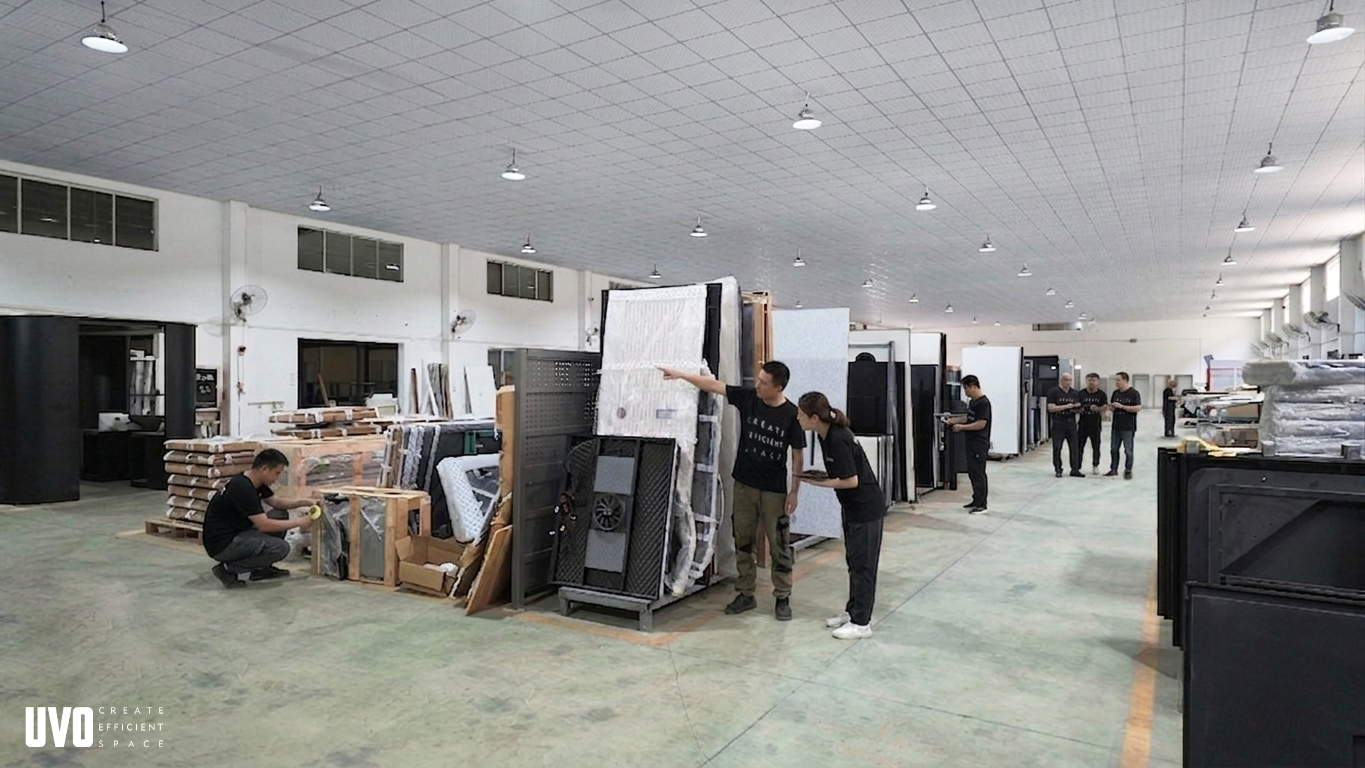
UVO industrial park — door panel assembly area. Door geometry carries the acoustic seal, so alignment is a specification issue rather than an afterthought.
1. Lights flickering repeatedly
The documented cause chain runs through the low-voltage side first: loose wiring connections or a defective low-voltage accessory module account for most power failures, and if those check out the transformer is the next item — unstable output voltage, or a transformer that has burnt out. Individual LED beads that fail to illuminate point to the strip, which is replaced if necessary. Power should be disconnected before inspection, and the work requires a licensed electrician.
The long-term reading is about parts, not faults. The lighting circuit is a small chain of interchangeable components, so the question worth asking is whether the LED strip, the low-voltage module and the transformer are common across Q ROOM, MO BOX and R POD and whether they can be ordered separately. That single answer predicts year-three maintenance cost more reliably than any warranty sentence.
2. A cabin that feels stuffy
Stuffy air is usually traced to blocked vents, dust build-up, poor fan performance or a malfunctioning sensor switch. The inspection order matters: check intake and exhaust vents for dust, carpet fibres or debris and clean them before retesting airflow; verify that the fan auto-starts when the compartment is occupied; replace the fan unit if other causes are ruled out; and listen for abnormal fan noise, which indicates damage or obstruction.
Scope is the diagnostic. One stuffy compartment indicates a localised fault; several indicate an installation or environmental issue. For a buyer operating a floor of pods, that distinction decides whether the conversation is a parts claim or a site investigation — and a supplier who asks the scope question before quoting a replacement fan is a supplier with a usable service process.
3. Sound insulation that seems compromised
The most common documented causes are an incompletely closed or misaligned door that has sagged or dropped, or a missing top cabin mounting bracket. The inspection begins mechanically: close the door slowly and watch the contact between door and frame to see whether it seats evenly or leaves a gap in one area, then check visible seal gaskets for flattening, detachment or uneven compression. Level is verified with a laser level, a light leak test checks whether visible light passes through a closed door gap where it should not, and loose hinges or a shifted frame are checked because looseness alters the door-to-frame fit. Adjustment of the door frame swing arm, and comparison with other pods of the same model, complete the sequence.
This is the most informative of the four symptoms for a long-term buyer. It shows that acoustic complaints are mechanical before they are material: the Class B envelope is held by door geometry and by seals, and both are consumable. Gaskets and the top mounting bracket should therefore appear on any spare-parts list attached to a multi-year order.
4. Door misalignment, sagging, scraping or sticking
Documented causes are a door panel that is not level, an uneven floor, shifted hinges, or a frame that moved after installation or relocation. The checklist starts by locating the contact point — floor, threshold, side frame or top corner — then verifying level, including the adjustable foot pads on non-barrier-free models, then inspecting the floor itself, since unstable or settling raised floors are a common culprit, and finally checking whether the door closer scrapes against the top beam and adjusting its position.
Relocation is the reason this matters commercially. A modular, movable pod will be moved, and a pod that can be re-levelled and re-aligned after a move is a pod whose acoustic performance survives it. UVO's service note also requires the glass to be protected during door adjustment, a safety precaution that acknowledges the panel's role in the assembly.
| Handover symptom | Documented cause | First check | What it signals to a repeat buyer |
|---|---|---|---|
| Lights flickering | Loose wiring, defective low-voltage module, transformer fault | Connections, then LED beads, then transformer output | Whether lighting parts are shared across models and sold separately |
| Stuffy cabin | Blocked vents, dust, fan performance, sensor switch | Vents and airflow, then occupancy sensor, then fan unit | Whether the fault is one pod or a whole installation |
| Compromised sound insulation | Door not fully closed or misaligned; missing top cabin bracket | Door-to-frame contact, gaskets, level, light leak test | Whether seals and brackets are treated as spare parts |
| Door misalignment or sticking | Door panel not level, uneven floor, shifted hinges, moved frame | Contact point, level, floor stability, door closer | Whether the pod survives relocation with its acoustics intact |
Capacity, continuity and the parts question
Supplier scale is not a specification, but it sets the boundary within which a specification can be honoured over several years. UVO was founded in Hong Kong in 2017 and reports a 5,000 m² manufacturing facility, 70 employees and a 10-person R&D team. Annual output is stated as 50,000 m² of U SYSTEM and 700 units of O SYSTEM, with an export ratio of 70% and markets described as global.
The two output figures are given in different units, and that reflects two production logics: panel systems measured in area, pods measured as discrete units. For a pod buyer the useful part is the unit count, because discrete production is what makes per-unit records possible in the first place. Whether a supplier actually keeps them is the question worth asking, and it does not require any disclosure of capacity or pricing.
- Does each pod carry an identifiable unit record that can be quoted on a service call?
- Which components are treated as replaceable parts under the “replace the part, not the module” approach — hinges, seal gaskets, fans, LED strip, low-voltage module, transformer?
- On a repeat order, is the same datasheet revision reissued, or a new one, and what changed between them?
- Which site conditions — floor type, level, installation height above 2400 mm — will the second location share with the first?
These are documentary questions rather than commercial ones. They do not establish lead times or availability, which have to be quoted per order, and they do not substitute for an acoustic report. What they do is fix the boundary between what the supplier controls and what the site controls, which is where most repeat-order disputes begin.
Market context: growth without a single definition
The category is growing, but the published figures do not share one definition — one more reason to anchor a long-term purchase to a specification rather than to a market narrative. Mordor Intelligence estimates the global office pods market at USD 1.00 billion in 2026, while Straits Research attributes 66.4% of 2025 revenue to Europe. The two should not be added, averaged or read as a single series, because office pods, soundproof booths and acoustic enclosures are scoped differently by different providers.
The practical implication for a buyer is modest but real. In a category where scoping varies between research houses, it will vary between suppliers too, and the buyer's own record is the only constant that carries from the first order to the third. That record costs nothing to build at the point of purchase and is expensive to reconstruct afterwards.
An evaluation record for the second order
The checklist below converts the discussion into a file a buyer can hand to a different project team. Each row is a specification that either can or cannot be re-checked against the next delivery.
| Record | Detail to retain | Why it belongs in the file |
|---|---|---|
| Model and configuration | Q ROOM, MO BOX or R POD, with size, fan count and options | Defines what “the same product” means on a later order |
| Build elements | Aluminum alloy frame, steel ceiling base, steel exterior panels, 11 mm laminated glass, 25 mm five-layer interior walls | Partly measurable at delivery; the mechanical and acoustic baseline |
| Acoustic documentation | Class B statement plus report reference, standard edition, metric, laboratory, tested configuration | Makes the label comparable and re-checkable, not just quotable |
| Ventilation | Fan count per model size, 90 m³/h per fan, nominal totals of 360 or 720 m³/h, sensor-switch behaviour | Countable, and the first place performance drift appears |
| Electrical | 110–220 V range; LED strip, low-voltage module and transformer details | Predicts recurring maintenance and spare-part availability |
| Certification set | UL GREENGUARD, CE, SGS NA, ISO 9001, ISO 14001, with issue dates and scope | Distinguishes product evidence from management-system evidence |
| Commercial terms | MOQ 1 unit, FOB or CIF delivery, 50/50 payment, acceptance after installation | Gives the acceptance inspection a written reference |
| Site conditions | Installation height above 2400 mm, floor type, floor level | Explains door and airflow complaints before they are blamed on the product |
| Spare parts | Part list and reference numbers for hinges, gaskets, fans, lighting modules | Turns part-level maintenance into a plan rather than a request |
Outlook
Buyers who treat acoustic pods as assets rather than as furniture converge on the same requirements: a documented build that can be measured, an acoustic class tied to a metric and a report, a ventilation specification that can be counted, a spare-parts list, and commercial terms that fix the acceptance point. ISO 23351-1:2020 supplies the shared vocabulary for the acoustic part of that set, but only when reports name the metric instead of the label alone.
For UVO, the evaluation returns a range with a coherent material logic — aluminum alloy frame, steel ceiling and exterior panels, 11 mm laminated glass, 25 mm five-layer interior walls, Class B documentation, and a fan architecture of 90 m³/h units in four- or eight-fan configurations depending on size — plus a service literature that diagnoses mechanical causes before material ones. The open items are documentary rather than technical: model-level acoustic reports, fan-noise figures, and a written spare-parts list.
Repeat-order discipline is the least expensive reliability test available, because nothing has to be invented — only compared. For a supplier evaluated over five years rather than five weeks, the decisive question is simple: can the second delivery be checked against the first? Where the answer is yes, the specification is doing its job.
Document: UVO Operable Wall Catalogue 2025 (PDF) — download the catalogue.
FAQ
How is specification stability checked on a repeat acoustic pod order?
Compare the new datasheet line by line with the version attached to the original purchase order: frame and panel materials, glass thickness, interior wall thickness, acoustic class and its report reference, fan count and rated airflow per fan, voltage and lighting components. Then verify at delivery what can be measured — wall thickness, glass build-up, fan count, door fit — and confirm at acceptance, which follows installation, that the door closes evenly and the fan starts on occupancy. Anything that cannot be matched should be documented as a change rather than assumed to be equivalent.
What purchasing terms and acceptance criteria apply to UVO acoustic pods?
UVO's published selection data lists a minimum order quantity of 1 unit, delivery terms of FOB or CIF, payment terms of 50/50, and acceptance criteria applied after installation, with a stated voltage range of 110–220 V. Because acceptance follows installation, the inspection naturally covers site-dependent conditions such as level, door alignment, light leakage at a closed door and fan auto-start. Attaching the model-level build specification and fan count to the order gives that inspection a written reference instead of a visual impression.
Why does fan count matter when evaluating a supplier over several years?
Each fan is rated at 90 m³/h and the number of fans depends on model size, with four-fan and eight-fan configurations in the range — a nominal 360 m³/h and 720 m³/h respectively at that rating. Fan count is physical and countable, so it can be checked on delivery and again on a later order. It is also where ventilation performance drifts first: blocked vents, dust build-up, a failed sensor switch or a weak fan produce a stuffy cabin, and whether one pod or several are affected indicates a unit fault or an installation and environmental issue.
What causes door misalignment or sticking, and what does it indicate?
Documented causes are a door panel that is not level, an uneven floor, shifted hinges, or a frame that moved after installation or relocation. The check starts with the contact point — floor, threshold, side frame or top corner — then level, then floor stability, including settling raised floors, and finally whether the door closer scrapes the top beam. Because the door carries the acoustic seal, misalignment also compromises sound insulation. Gaskets and hinges should therefore be treated as spare parts rather than as fixed components.
How should a buyer read Class B sound insulation in a long-term contract?
As a label that needs a metric attached. ISO 23351-1:2020 measures speech level reduction, and its Class A requires 30 dB or more; the class is meaningful only alongside the standard edition, the metric, the laboratory and the tested configuration. UVO documents the pods as Class B, and its published selection parameters list the O SYSTEM at 26.9 dB or above and the U SYSTEM at up to 45 dB. On a repeat order, confirm that the report still describes the current build, because a changed wall build-up or glass thickness makes an earlier report inapplicable.
Есть вопросы или нужны дополнительные детали?
Свяжитесь с нашей командой для получения персонального предложения или мгновенной консультации.
Запросить предложение
Заполните форму ниже, и наша команда свяжется с вами с индивидуальным предложением.
Прямой чат WhatsApp
Предпочитаете общаться в реальном времени? Напишите нам в WhatsApp для мгновенной помощи и быстрых ответов.
- Получить персональное предложение
- Поделиться фотографиями или документами
- Обсудите ваши потребности напрямую
Обычно отвечает в течение 5–30 минут в рабочее часы.