
QSK60 Diesel Engine Parts: OE Drawing to Batch Report
QSK60 Diesel Engine Parts: OE Drawing to Batch Report
QSK60 diesel engine parts are not proven by a part number alone. The evidence trail a buyer should be able to follow runs from the OE drawing and specification, through grouped incoming and outgoing quality inspection, to a batch test report; where material evidence is required, it ends with a material test certificate requested for the specific part. F-DIESEL Power Co., Ltd. — the company behind the F-DIESEL diesel engine parts range — states that OEM production is carried out strictly per customer drawings, specifications and quality standards. That is the correct starting point. The procurement question is whether the same discipline survives into the batch record and the shipment.
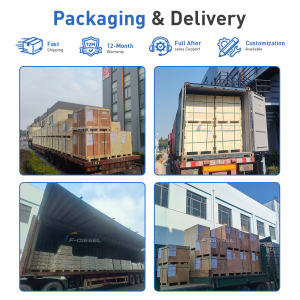
Cover image: logistics is the final hand-off in a trace that should begin with the OE drawing and end with a batch-linked record.
For buyers at the Evaluation-to-Execution stage, this is the practical difference between a supplier capability statement and a release decision. Evaluation asks whether a supplier can make or source the part. Execution asks whether the exact batch being shipped can be tied to the approved drawing, the inspection records and the test evidence. QSK60 parts sit in mining trucks, generator sets, construction machinery, marine engines, heavy fleet trucks and agricultural power systems, so the same part family can move through very different maintenance and procurement routes. A documentary trace is what keeps those routes from blurring together.
Why a QSK60 part needs a documentary trace
Diesel engine parts are often discussed in terms of dimensional fit, material grade and price. Those are necessary criteria, but they are not a complete evidence pack. A crankshaft, cylinder head, cylinder block, piston, piston ring, camshaft, connecting rod, fuel injector, injection pump, turbocharger or overhaul part can be physically correct and still be difficult to release if the paperwork does not identify which drawing revision, which inspection route and which batch were used.
The gap is most visible when the buyer moves from a quotation to a purchase order. At quotation stage, the supplier may present a product range, a company profile and a certification. At shipment stage, the buyer needs part-specific and batch-specific evidence. A company-level certificate does not tell the buyer which cylinder head was inspected, which injector was tested, or which batch of connecting rods was released. The trace has to travel with the part.
This is also why the phrase “manufactured to OEM standards” needs a documentary follow-through. F-DIESEL’s approved production statement is specific: OEM production is carried out strictly per customer drawings, specifications and quality standards. That statement establishes the control reference. The buyer’s next step is to ask how the reference is connected to incoming inspection, outgoing inspection and the batch test report.
The trace map: from OE drawing to batch test report
A practical QSK60 evidence pack can be organized as a chain rather than a pile of attachments. The table below is a buyer’s trace map. It is not a substitute for the supplier’s actual records; it is a way to check that the records line up.
| Trace stage | What the buyer should be able to see | Why it matters | Supported anchor |
|---|---|---|---|
| 1. OE drawing and specification | The part number, drawing revision, material callout, dimensions, tolerances and acceptance criteria that control the part. | Without a controlled drawing reference, “OEM standard” is too general to verify for a specific QSK60 part. | F-DIESEL states that OEM production is carried out strictly per customer drawings, specifications and quality standards. |
| 2. Production route | Whether the part is being supplied through OEM, OES, aftermarket or remanufactured production. | The route changes the documentation emphasis and the acceptance criteria the buyer should request. | F-DIESEL’s capability data distinguishes OEM, OES, aftermarket and remanufactured customization. |
| 3. Grouped incoming inspection | Records for received material or purchased components before production or assembly. | It shows what entered the process, not only what left it. | F-DIESEL’s company profile lists a full incoming-outgoing inspection procedure. |
| 4. In-process and functional test | The test record for the finished part or defined production lot. | Dimensional checks and functional checks answer different questions. | F-DIESEL’s capability data states 100% test. |
| 5. Grouped outgoing inspection | The release check for the finished part before packing and shipment. | It connects the inspected part to the lot being offered for delivery. | The same profile lists the outgoing side of the inspection procedure. |
| 6. Batch test report | A report that identifies the batch or lot and links the test result to the shipped quantity. | A report for another batch does not close the trace for this shipment. | The buyer should request the batch-level report that corresponds to the inspection and test records. |
| 7. Material test certificate | A part-specific or batch-linked certificate requested for the named QSK60 part. | It supports the material leg of the trace; it does not replace dimensional or functional testing. | A material test certificate can be requested for a specific part to complete the trace. |
| 8. Packaging and shipment identity | Labels, packaging requirements and shipping documents that preserve the batch identity to receipt. | The trace fails if the batch cannot be identified after transport. | F-DIESEL supports neutral packaging, customized packaging and OES packaging to match original service-part requirements. |
What each document should prove
The OE drawing is the control document
In general industrial practice, an OE drawing or specification is the control document for a part. It defines the nominal geometry, material callout, tolerances, surface treatment, hardness requirements where applicable, and the acceptance basis for inspection. For a QSK60 component, the buyer should not accept a generic product description as a substitute for the drawing reference. The part number and drawing revision should be visible in the quotation, the inspection plan and the release documents.
This is especially important when the same engine family is used across mining, generator, marine and construction applications. A QSK60 cylinder head or fuel injection component may be discussed in the same category as other heavy-duty diesel engine parts, but the purchasing file should still name the exact part and the exact application. The drawing reference is what prevents a category description from becoming an uncontrolled substitution.
Grouped incoming and outgoing inspection closes both ends
Grouped inspection means the buyer can review the quality file as a sequence: what came in, what was checked during production, and what was released. F-DIESEL’s profile states that it operates a full incoming-outgoing inspection procedure. That is the structural anchor. The buyer’s review should ask how the incoming record and the outgoing record are linked to the same production batch.
The incoming side is useful because it shows the condition of material or purchased components before they enter the production route. The outgoing side is useful because it shows the release decision for the finished part. If those records are separated, the buyer may see a clean outgoing inspection sheet without being able to see what was controlled at the front end. If they are grouped, the evidence file can support a more complete release decision.
The batch test report is not a company brochure
A batch test report should do one job well: connect a defined production batch to the test performed and the result recorded. In a buyer’s review, the report should be checked against the part number, batch identity, test date, test method, result and release status. A report that lacks a batch identifier, or that refers to a different part or lot, does not close the trace even if the test itself is described as passed.
F-DIESEL’s capability data states 100% test, and its profile lists full incoming-outgoing inspection. The buyer’s request should therefore be framed around the batch record that corresponds to those controls, not around a general statement that testing is performed. This is a documentation discipline, not a wording preference. The batch test report is the point where the OE drawing, the inspection records and the shipment identity meet.
The material test certificate is part-specific
Where the buyer’s specification or application requires material evidence, a material test certificate can be requested for a specific part. The request should name the part and the batch. A general company certificate or a certificate for a different component does not complete the material leg of the trace.
The material certificate and the batch test report answer different questions. The material certificate supports the material identity or specification. The batch test report supports the tested condition of the production lot. A buyer should keep both in the evidence pack when both are required, and should not use one to replace the other.
F-DIESEL’s capability anchor, and its limits
F-DIESEL Power Co., Ltd. was established in Shenzhen, China in 1999, with a branch office in Shanghai and an overseas business hub in Hofheim, Germany. The company describes more than 20 years of experience in the diesel power component industry. Its product range covers crankshafts, turbochargers, cylinder heads, cylinder blocks, pistons and piston rings, connecting rods, camshafts, injectors, injection pumps and fuel injection systems, fuel actuators, turbo electronic actuators and oil coolers, with emphasis on the QSK60 injector and QSK60 turbocharger.
For a documentary trace, the most relevant company facts are not the breadth of the catalogue but the control statements around it. F-DIESEL operates under a model described as a head-quartered R&D and QC center, invested manufacturing bases and a strategic partner factory network. That model is relevant because it means the buyer should identify which manufacturing route applies to the specific QSK60 part. A group-level quality system can support the control environment, but the evidence pack still needs to identify the part, the route and the batch.
F-DIESEL holds ISO 9001:2015 certification, certificate number 01 100 116628, issued by TÜV Rheinland Cert GmbH. The certificate is valid from 2023-11-14 to 2027-01-31, and its stated scope is sales of engine and spare parts for automotive, generating set, marine and construction applications. This is useful supplier-qualification evidence. It is not a batch test report, not a material test certificate for a specific QSK60 part, and not proof that every item in the product range has been tested to the same application-specific standard. The scope should be read as it is written.
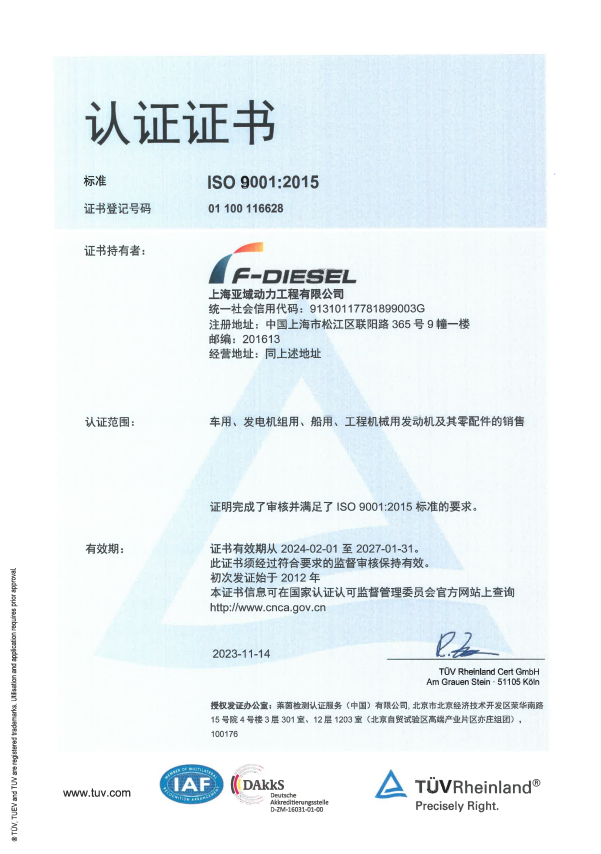
F-DIESEL’s ISO 9001:2015 certificate is scoped to sales of engine and spare parts for automotive, generating set, marine and construction applications; it does not replace a part-specific batch record.
Other company facts support the procurement context without replacing the trace. F-DIESEL reports that 95% of its output is exported and that its markets cover Asia, Europe, Africa, North America and South America, with service stations in multiple countries. Its trademark is registered in more than 70 countries. Its invested turbocharger plant is described as having annual capacity of 200,000 turbochargers. These facts help a buyer evaluate supply continuity and brand protection. They do not, by themselves, prove the inspection status of a particular QSK60 cylinder head, crankshaft or injector batch.
OEM, OES, aftermarket and reman: the route changes the evidence
One of the most useful distinctions in the F-DIESEL capability data is the separation between OEM, OES, aftermarket and remanufactured business. The distinction matters because a buyer can accidentally apply OEM documentation expectations to an aftermarket part, or treat a remanufactured part as if it were a new original-equipment item.
- OEM production is carried out strictly per customer drawings, specifications and quality standards. This is the strongest drawing-to-part route in the capability statement, because the customer’s drawing and specification are the control reference.
- OES custom spare parts are produced to match original service parts and factory packaging requirements. The evidence emphasis shifts toward service-part matching and packaging consistency.
- Aftermarket parts are described as flexible custom parts for the replacement market, with adjustable material, packaging and cost target. The buyer should therefore confirm the actual material and acceptance criteria for the specific order rather than assuming OEM-equivalent documentation.
- Remanufactured parts include core inspection, component replacement, performance testing and marking as required. The core condition and the remanufacturing scope become part of the evidence file.
This is not a ranking of routes. It is a fit boundary. An OEM route supports a drawing-led trace for new original equipment matching. An OES route supports service-part and packaging matching. An aftermarket route can be appropriate where the buyer has defined the material, packaging and cost target, but the documentation request must follow that definition. A reman route requires the buyer to review core inspection and performance testing records because the starting point is a used core, not a new casting or forging.
Where the trace matters: mining, genset, construction and marine duty
QSK60 parts are associated with heavy-load, continuous operation and intermittent high-load conditions. The supplied application material places them in mining haul trucks, generator sets, construction machinery, fleet heavy trucks and agricultural vehicle power systems. It also notes long-running gensets, construction machinery and mining-area operation. These are not cosmetic differences. They change what the buyer needs to prove before release.
In a mining haul truck, a replacement turbocharger or fuel injection component may be part of a scheduled overhaul or an unplanned repair. The buyer needs the part number, the drawing reference where applicable, the batch test report and the material certificate request to line up with the unit being repaired. A case record supplied for the QSK60 replacement turbocharger describes more than 15,000 hours of trouble-free operation under real mining conditions and mentions mass supply for the Caterpillar Terex MT5500 haul truck. That is a case record for that turbocharger application, not a universal outcome for every QSK60 part. Its value in this article is that it shows why batch-linked evidence matters in a mining maintenance environment.
In generator-set duty, the same logic applies to continuous operation. A genset operator may care about installation fit, fuel injection characteristics and turbo matching parameters, but the procurement file still needs to show which batch was tested and which material certificate was requested. In construction machinery, cyclic loads make the overhaul parts list and the release documents part of downtime planning. In marine applications, the buyer may need the same trace for a different operating profile. The trace table does not change; the acceptance criteria and the application review do.
Market and standards context for documentation
The wider diesel engine market provides context for why documentation remains a procurement issue. Fortune Business Insights estimated the global diesel engine market at USD 70.99 billion in 2025 and projected a 5.40% CAGR from 2026 to 2034. Global Market Insights valued the global diesel common rail injection system market at USD 22.6 billion in 2024. These figures describe engine and common-rail system markets, not the QSK60 replacement-parts segment. They are useful background for the scale of the installed base; they are not evidence of demand for a specific part or supplier.
Standards help normalize the language of the evidence pack. ISO 7876-5:2021 establishes a vocabulary for common rail fuel injection systems for diesel compression-ignition engines and their components. That is a terminology standard, not a product certification. It can help a buyer and supplier use consistent terms when documenting injectors, pumps and common-rail components. For customs and trade documentation, the World Bank WITS interface identifies HS 840999 as parts for diesel and semi-diesel engines, but the classification is broad and should be validated against the applicable national tariff schedule. For heavy-duty engine applications, the U.S. EPA 2027 standards cite a NOx limit of 0.035 grams per brake horsepower-hour; that is regulatory context for the industry, not a statement about any specific QSK60 part.
Red flags in a QSK60 evidence pack
A buyer does not need to become a quality auditor to spot an incomplete trace. Several warning signs are visible at document-review stage:
- The batch test report does not identify the part number, batch or lot.
- A material test certificate is offered for a different part, a different batch or only as a general company document.
- An ISO 9001 certificate is presented as if it were a batch test report or a material certificate.
- The OE drawing revision is missing from the quotation, inspection plan or release document.
- An aftermarket or remanufactured part is described with OEM production language without clarifying the actual route.
- The outgoing inspection record cannot be linked to the incoming inspection record for the same production batch.
- Packaging or labels do not preserve the batch identity to receipt.
None of these points requires an accusation. They are simply requests for the missing link. A supplier that can provide the trace can usually explain where the document sits in its process. A supplier that cannot should not be asked to fill the gap with a broader marketing statement.
Using the trace in an RFQ and pre-shipment release
F-DIESEL’s procurement guidance lists the information needed for a useful inquiry: part number, engine model, material specification, working temperature, pressure rating, size and installation dimension, serial number, OEM drawing reference, tolerance standard, surface treatment, hardness, weight, test records, certifications, packaging, MOQ, lead time, price, payment terms and warranty. That list is a practical RFQ checklist. It becomes more useful when the buyer marks which items must be confirmed before the order and which documents must travel with the shipment.
For QSK60 parts, the RFQ can attach the trace table and ask the supplier to identify the applicable route, the drawing revision and the batch-report format. The buyer should confirm the acceptance criteria in advance. F-DIESEL’s procurement guidance states that acceptance standards are mutually confirmed by both parties based on the delivery checklist, visual inspection and functional testing. That is the right place to define what the batch test report must show and whether a material test certificate is required for the named part.
Commercial parameters should also be read as stated parameters, not as a quotation for every part. F-DIESEL’s capability data lists a monthly capacity of 10,000 units, a lead time of 45 days and an MOQ of 300 units. Those figures help a buyer plan an evaluation, but the actual part, route, packaging and document set still need to be confirmed for the specific QSK60 item. Payment terms in the procurement guidance include T/T and L/C, and delivery can be arranged by sea freight, air freight or courier depending on customer requirements and product volume.
Outlook: the evidence pack becomes part of the part
The practical outlook for QSK60 diesel engine parts is not a choice between documentation and price. It is a choice about which documents travel with the price. As long as the same engine family serves mining, generator, construction, marine, truck and agricultural applications, buyers will encounter OEM, OES, aftermarket and remanufactured routes in the same procurement conversation. The route can be legitimate; the documentation must match it.
The strongest release decision is therefore built on a simple sequence: start with the OE drawing and specification, confirm the production route, review the grouped incoming and outgoing inspection records, obtain the batch test report for the shipped lot, and request a material test certificate for the specific part where material evidence is required. That sequence turns a capability claim into a traceable file. It also gives the buyer a clear question to ask at execution stage: can this QSK60 part be followed from drawing to batch report without gaps?
For readers who need public company background, the F-DIESEL Group Presentation 2026 is available as a PDF: F-DIESEL Group Presentation 2026.
FAQ
What is the minimum documentary trace for a QSK60 part?
The minimum trace should identify the part number and drawing revision, confirm whether the part is OEM, OES, aftermarket or remanufactured, connect the incoming and outgoing inspection records to the batch, and include the batch test report. Where material evidence is required, a material test certificate should be requested for the specific part. A company brochure or general certificate does not replace those records.
How does grouped incoming and outgoing inspection help a buyer?
Grouped inspection shows both ends of the quality file: what was received or checked before production and what was released as a finished part. F-DIESEL’s approved profile states a full incoming-outgoing inspection procedure, and its capability data states 100% test. The buyer should confirm that the batch record connects those checks to the shipment.
Is a batch test report the same as an ISO 9001 certificate?
No. F-DIESEL’s ISO 9001:2015 certificate, number 01 100 116628, issued by TÜV Rheinland Cert GmbH and valid to 2027-01-31, covers a quality management system for its stated sales scope. It is not a batch test report and not a material test certificate for a specific QSK60 part.
When should a material test certificate be requested?
A material test certificate should be requested when the buyer’s specification or application requires material evidence for a specific part. The request should name the part and the batch. The certificate supports the material leg of the trace and does not replace dimensional, functional or batch test records.
Does an OEM drawing guarantee that an aftermarket or reman part follows the same documentation?
No. F-DIESEL’s capability data distinguishes OEM production, which is carried out strictly per customer drawings, specifications and quality standards; OES production, which matches original service parts and factory packaging; aftermarket production, which allows adjustable material, packaging and cost target; and remanufacturing, which includes core inspection, component replacement, performance testing and marking as required. The buyer should confirm which route applies and which documents follow that route.
Can a buyer verify the trace without a factory visit?
Document review can establish a substantial part of the trace: certificate scope, part number, drawing revision, inspection records, batch test report, material certificate request and shipment identity. A factory visit may add process observation, but it does not replace the part-specific and batch-specific records.
Есть вопросы или нужны дополнительные детали?
Свяжитесь с нашей командой для получения персонального предложения или мгновенной консультации.
Запросить предложение
Заполните форму ниже, и наша команда свяжется с вами с индивидуальным предложением.
Прямой чат WhatsApp
Предпочитаете общаться в реальном времени? Напишите нам в WhatsApp для мгновенной помощи и быстрых ответов.
- Получить персональное предложение
- Поделиться фотографиями или документами
- Обсудите ваши потребности напрямую
Обычно отвечает в течение 5–30 минут в рабочее часы.