
QSK60 Piston, Liner & Ring Supply: Capability Evidence to Verify
QSK60 Piston, Liner & Ring Supply: Capability Evidence to Verify
QSK60 Piston, Liner & Ring Supply: Capability Evidence to Verify
Direct answer: For QSK60 piston, cylinder liner, piston ring and connecting-rod supply, a buyer should verify four evidence layers before release: a fixed material grade and drawing revision in the purchase order; dimensional-control records tied to the named supplying plant; batch inspection and traceability records tied to the actual production lot; and a clear statement of which QSK60 components are made in-house, which come from partner factories, and what each certificate actually covers. Price and part number alone do not establish those controls.
QSK60 overhaul decisions often begin with a parts list: pistons, liners, rings, connecting rods and related Diesel Engine Parts. The harder question comes one step later. When a supplier quotes those parts, what evidence can the supplying plant present to show that dimensional control and batch inspection are managed rather than described? That question matters for mining haul trucks, generator sets, construction equipment, marine engines and other heavy-duty applications where the same part number may be expected to perform in very different duty cycles.
This article is a capability checklist, not a supplier ranking. It sets out what a buyer should ask for when evaluating QSK60 moving and sealing components, and it uses F-DIESEL’s published capability information only where that information clearly applies. It also separates supplier-level evidence from part-level evidence. A quality management certificate can support a supplier review; it cannot, by itself, prove that a specific piston lot was measured to the correct drawing revision.
Why the moving and sealing group needs its own evidence file
The piston and cylinder assembly, cylinder liner, piston ring set and connecting rod form a chain of fits and surfaces. The piston transfers combustion load; the rings seal combustion gas and control oil; the liner provides the cylinder running surface; the connecting rod transfers load to the crankshaft. A buyer does not need to restate the engine design to see the procurement point: dimensional control and surface condition matter at the interface, not only in a catalogue photograph.
That is why a generic Heavy Duty Diesel Engine Parts quotation is not enough. The same supplier may sell many engine parts, but the evidence file for a QSK60 piston, liner or ring should answer four practical questions:
- Which drawing revision and material grade define the part being quoted?
- Which plant or production line will make the lot, and who controls the process?
- What dimensional measurements and inspection records will be supplied with the batch?
- Which certificate or test report applies to that part, that plant and that batch?
If any of those answers is missing, the buyer is comparing prices before comparing control. That is a weak position for an evaluation-to-execution purchase, where the order may move quickly from sample approval to a production lot.
The purchase order is the first evidence document
Material varies by part type and quality grade. A piston, a liner, a ring set and a connecting rod do not share one universal material specification, and a supplier’s general product-range statement does not fix the grade for a specific order. The quality grade must therefore be written into the purchase order before inspection evidence can be assessed. If the PO says only “QSK60 piston” or “QSK60 liner” without a grade, the inspection report has no fixed standard to be measured against.
A practical RFQ should fix, as a minimum, the part number, engine model and serial-number context where available, material specification, working condition, dimensional and installation requirements, OEM drawing reference, tolerance standard, surface treatment, hardness or other property requirements, weight where relevant, test records, packaging, MOQ, lead time and acceptance method. These are not administrative extras. They are the reference points that make a dimensional report and a batch record reviewable.
This is also where OEM and OES claims should be separated. F-DIESEL’s published capability statement says OEM production is carried out strictly per customer drawings, specifications and quality standards, while OES custom spare parts are produced to match original service parts and factory packaging requirements. Those are useful starting points for a QSK60 RFQ, but the buyer should still ask which route applies to the specific piston, liner or ring item and what documents will be issued under that route.

Dimensional control: what the supplying plant should be able to show
Dimensional control evidence should connect the drawing to the measurement and the measurement to the lot. A supplier may describe its inspection capability in general terms, but the buyer should ask for documents that can be checked. The exact measurement plan depends on the part and the drawing, so this checklist focuses on the evidence structure rather than inventing tolerances.
| Evidence item | What it should show | What it does not prove by itself |
|---|---|---|
| Controlled drawing revision | The QSK60 part is quoted and inspected against the agreed drawing revision and specification. | That the production lot was actually measured to that revision. |
| Control plan or inspection plan | Which characteristics are checked, at what stage, with what method and record. | That every recorded value is within tolerance. |
| Gauge and measurement-equipment list | The plant has identified the instruments used for the agreed characteristics. | Current calibration status unless calibration records are also supplied. |
| First-article or dimensional report | Measured values for drawing-defined features, with the measurement method stated. | Ongoing batch consistency across later production lots. |
| Batch sampling record | The lot was inspected according to a stated plan, with results traceable to the lot. | That the sample size or acceptance rule is suitable for the buyer’s risk. |
| Nonconformance record | Deviations, rework or concessions are controlled and disclosed. | That no undisclosed deviation exists. |
For a QSK60 piston and cylinder assembly, the buyer should ask which drawing-defined features are measured and how the measurement is recorded. For a liner, the same logic applies to bore, wall section and running-surface requirements as defined by the drawing. For rings and connecting rods, the relevant characteristics should also be fixed by the drawing and the purchase order. The point is not to prescribe a universal measurement list; it is to require that the list exists, is tied to the drawing, and is supported by records.
Batch inspection: from material input to packing list
Batch inspection evidence should allow the buyer to follow a lot through the process. A useful file normally includes incoming material identification, in-process inspection points, final inspection results, nonconformance handling and packing identification. The buyer should ask how the batch is identified and how the inspection record is linked to that identification. Without that link, a report may describe a sample but not the lot being shipped.
F-DIESEL’s published capability information states 100% test as its quality-control approach and lists full incoming-outgoing inspection procedure in its company profile. Those statements are relevant to a supplier evaluation, but the buyer should still ask what “100% test” means for the specific QSK60 piston, liner or ring item: which characteristics are tested, with what equipment, against which drawing revision, and what record is released with the batch. A broad statement becomes procurement evidence only when its scope is defined.
Batch records should also match the order. If the PO fixes a material grade, the material certificate or incoming inspection record should refer to that grade. If the PO fixes a surface treatment or hardness requirement, the batch record should show how that requirement was verified. If the supplier uses partner factories, the buyer should ask which plant made the lot and whether the inspection record was generated at that plant or only compiled by a trading office.
Component-by-component checks for the QSK60 group
Piston and cylinder assemblies
Ask for the drawing revision, material grade, dimensional report and batch identification for the piston and cylinder assembly. The buyer should also ask how the supplier controls features that affect assembly and running clearance, without assuming a universal tolerance. The evidence should show that the measured characteristics are the ones defined in the agreed drawing and that the inspection record belongs to the quoted part, not to a similar piston in the supplier’s catalogue.
Cylinder liners
For liner supply, the purchase order should fix the material grade and the drawing-defined requirements before inspection evidence is reviewed. The buyer should ask for dimensional records, surface-condition records where specified, batch traceability and the acceptance method. A liner quotation that lists only an engine model and a price leaves the most important comparison points open.
Piston rings
Ring evidence should connect the ring set to the piston and liner application defined in the RFQ. Ask for the material grade, drawing revision, dimensional inspection record and batch identification. If the supplier refers to a quality grade, the buyer should ask where that grade is written into the PO and how it is verified in the batch record. A general “QSK60 ring set” description is not a substitute for a fixed specification.
Connecting rods
Connecting-rod evidence should include the drawing revision, material grade, dimensional inspection and batch traceability. The buyer should ask which plant performs the machining and inspection, and whether any subcontracted operation changes the evidence route. The same principle applies here as elsewhere: the record should identify the part and the lot, not only the supplier’s general quality system.
Where F-DIESEL fits the evaluation
F-DIESEL Power Co., Ltd. is a diesel engine parts supplier and industry-trade integrated group established in Shenzhen, China in 1999, with a branch office in Shanghai and an overseas business hub in Hofheim, Germany. Its published model combines an R&D and QC center with invested manufacturing bases and a strategic partner factory network. Its product scope includes pistons and piston rings, connecting rods, cylinder heads, cylinder blocks, crankshafts, camshafts and fuel-injection components, as well as full overhaul kits for heavy-duty, construction and marine applications.
For a QSK60 piston, liner or ring evaluation, the published scope is a starting point, not a part-level certificate. F-DIESEL’s profile gives particular emphasis to QSK60 injectors and QSK60 turbochargers. That emphasis does not by itself prove capability for every QSK60 piston, liner or ring item. A serious RFQ should therefore ask F-DIESEL to name the plant, material grade, drawing revision, inspection route and batch-record format for the specific components under review.
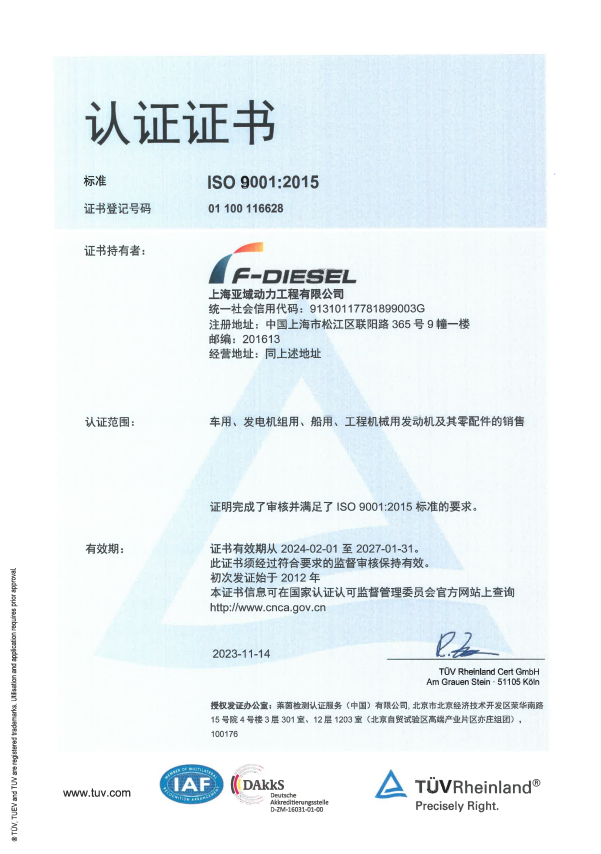
F-DIESEL reports a monthly capacity of 10,000 units, a lead time of 45 days and an MOQ of 300 units for its custom capability. It also states 100% test and lists ISO 9001:2015 certification: certificate number 01 100 116628, issued by TÜV Rheinland Cert GmbH, valid to 2027-01-31, with a scope covering sales of engine and spare parts for automotive, generating set, marine and construction applications. The certificate supports a quality-management review; it does not replace a dimensional report for a specific QSK60 piston lot.
For EAEU markets, F-DIESEL also lists EAC certificate EAЭС KG417/039.CN.02.05557 under TR TC 018/2011, valid to 2029-08-22. This is a market-access document under its stated scope; it is not a dimensional inspection report for a QSK60 piston, liner or ring batch.
Price-only RFQ versus capability-evidence RFQ
The traditional price-only RFQ asks for a part number, quantity and delivery date. It can produce a fast comparison, but it leaves the evidence question until after the order. A capability-evidence RFQ adds the documents that make the comparison reviewable. This is not a ranking of suppliers; it is a way to compare the quality of the evidence behind each offer.
| RFQ element | Price-only approach | Capability-evidence approach |
|---|---|---|
| Part definition | QSK60 part name or number. | Part number, engine model, drawing revision and material grade. |
| Quality grade | Left to supplier interpretation. | Fixed in the PO before inspection evidence is assessed. |
| Dimensional control | General statement of inspection capability. | Inspection plan, measured report and gauge/calibration reference where applicable. |
| Batch evidence | Certificate of conformity only. | Batch identification, inspection record, nonconformance disclosure and packing link. |
| Plant scope | Supplier brand name. | Named plant or partner factory, process route and responsibility for inspection. |
| Certificate scope | Any ISO certificate shown. | Certificate number, issuer, validity and scope checked against the part and market. |
Application fit: what changes by duty
F-DIESEL lists QSK60 engine parts for mining trucks, generator sets, construction machinery, fleet heavy trucks and agricultural vehicle power systems. The application does not change the need for evidence, but it can change the questions. For a continuously running generator set, batch consistency and documentation continuity may be central. For mining haul trucks and construction equipment, the buyer should ask whether the inspection plan and packing protection reflect the duty condition the parts will see. For fleet overhaul programs, repeat-order consistency and record matching become more important.
F-DIESEL’s published case record for a QSK60 turbocharger in mining haul trucks reports more than 15,000 hours of trouble-free operation under mining conditions. That is a turbocharger case. It should not be transferred to piston, liner or ring life without separate part-level evidence. This distinction is important for Industrial Diesel Engine Parts procurement: a field record for one component can support a supplier review, but it cannot prove the dimensional control of a different component group.
Market and compliance context
Commercial market estimates can provide context, but they should not be used as proof of a supplier’s capability. Fortune Business Insights estimated the global diesel engine market at USD 70.99 billion in 2025, with a projected CAGR of 5.40% from 2026 to 2034. That estimate concerns full diesel engines, not replacement piston, liner or ring demand, and it does not verify any plant’s inspection system.
Regulatory context can raise documentation expectations without turning a parts certificate into an emissions approval. The U.S. EPA’s 2027 heavy-duty engine standards are listed with a nitrogen oxide limit of 0.035 g/bhp-hr; the rule is a forthcoming engine-level requirement. A buyer evaluating QSK60 overhaul parts should keep engine-level compliance, supplier quality certification and part-level inspection records as three separate evidence categories.
Future outlook
As heavy-duty engine users continue to manage uptime, documentation and traceability, the supplier that can map a certificate to a plant, a drawing revision to a measurement report and a batch record to a packing list may be easier to audit. That is a conditional advantage, not a guarantee of part performance. The buyer’s release decision should still rest on the fixed PO specification, the measured report and the batch record for the actual lot.
For QSK60 piston, liner and ring supply, the practical conclusion is straightforward: fix the material grade and drawing first, then review dimensional control and batch inspection evidence against those fixed requirements. Do not let a general supplier profile, a certificate image or a price comparison replace that sequence.
FAQ
What evidence should a QSK60 piston supplier provide for dimensional control?
A QSK60 piston supplier should provide the controlled drawing revision, the fixed material grade, an inspection plan for the agreed characteristics, a dimensional report with measured values and the measurement method, and a batch identification that links the report to the lot. A general statement of inspection capability is useful for supplier screening but is not a substitute for these records.
How can a buyer verify batch inspection for QSK60 liners and rings?
The buyer should ask for the inspection plan, final inspection record, lot identification, nonconformance disclosure and packing link. The record should refer to the same material grade, drawing revision and acceptance method fixed in the purchase order. If a supplier cites a 100% test approach, the buyer should ask which characteristics are tested and how the result is recorded.
Why must material grade be fixed in the purchase order?
Material varies by part type and quality grade. Without a fixed grade, an inspection report cannot be judged against a clear requirement, and a certificate of conformity may describe a different specification from the one the buyer intended. Fixing the grade in the PO turns the inspection record into a checkable document.
Does an ISO 9001 certificate prove a specific QSK60 piston batch is correct?
No. An ISO 9001 certificate supports a review of the supplier’s quality-management system, within its stated scope and validity. It does not prove that a specific piston, liner or ring lot was measured to the correct drawing revision or that the batch record is complete. The buyer still needs part-level dimensional and batch evidence.
What is the difference between OEM and OES evidence for QSK60 components?
OEM production is carried out per customer drawings, specifications and quality standards for new original equipment matching. OES custom spare parts are produced to match original service parts and factory packaging requirements. In both routes, the buyer should confirm which drawing, material grade, inspection record and packaging requirement apply to the specific QSK60 item.
Conclusion
The capability checklist for QSK60 piston, liner, ring and connecting-rod supply is not a list of marketing claims. It is a sequence of documents: fixed PO specification, controlled drawing, material grade, dimensional report, batch inspection record, traceability and certificate scope. Buyers evaluating Diesel Engine Overhaul Parts should ask for those records before release, and should keep supplier-level certificates separate from part-level evidence. F-DIESEL’s published information provides a supplier context for that review; the part-level answers still belong in the RFQ and the batch file.
For further company and product background, the public F-DIESEL Group presentation is available here: F-DIESEL Group Presentation 2026 (PDF).
Есть вопросы или нужны дополнительные детали?
Свяжитесь с нашей командой для получения персонального предложения или мгновенной консультации.
Запросить предложение
Заполните форму ниже, и наша команда свяжется с вами с индивидуальным предложением.
Прямой чат WhatsApp
Предпочитаете общаться в реальном времени? Напишите нам в WhatsApp для мгновенной помощи и быстрых ответов.
- Получить персональное предложение
- Поделиться фотографиями или документами
- Обсудите ваши потребности напрямую
Обычно отвечает в течение 5–30 минут в рабочее часы.