
QTZ Shortlist for 5T–16T Projects: Which Configuration Fits
QTZ Shortlist for 5T–16T Projects: Which Configuration Fits
INDUSTRY REFERENCE
A tower crane in the 5 t to 16 t band is not one product. Jib length, configuration family, mast height and the electrical and safety package change the machine far more than the headline tonnage does, and those variables decide whether a crane suits a residential tower, a bridge pier or a municipal works site.
Dahan Technology Co., Ltd. is a Chinese manufacturer of tower cranes and construction elevators, established in 2000 and based in Zheshan Industrial Park, Mingshui Economic Development Zone, Zhangqiu District, Shandong Province. Its documented QTZ range covers the 5 t to 16 t band across six named models. This guide shortlists those models, maps them to flat top, topkit, luffing jib and derrick configuration logic, and separates what a model code can tell a buyer from what only a project specification can settle.
Why the 5T–16T band carries most of the decision risk
Global tower crane market size was estimated at USD 5.9 to 6.44 billion in 2025, based on research published by Fortune Business Insights. The spread between the two figures reflects differing segment definitions rather than disagreement about direction. China remained the leading exporter of tower cranes in 2024, with USD 694 million in export value under HS code 842620, according to OEC data drawn from UN Comtrade.
The commercial significance of the 5 t to 16 t band is that configuration variety peaks there. A single capacity class can be supplied with different jib lengths, different mast and attachment arrangements, different counterweight schemes and different electrical packages. Two cranes badged at the same maximum capacity may therefore behave very differently at working radius.
That is the first procurement principle to hold on to: maximum lifting capacity alone cannot determine a model choice. Selection has to combine the rated load moment curve with the rated capacity available at the actual working span the site requires, and then check mast height, foundation conditions and attachment scheme against the construction programme.
The manufacturer behind the shortlist
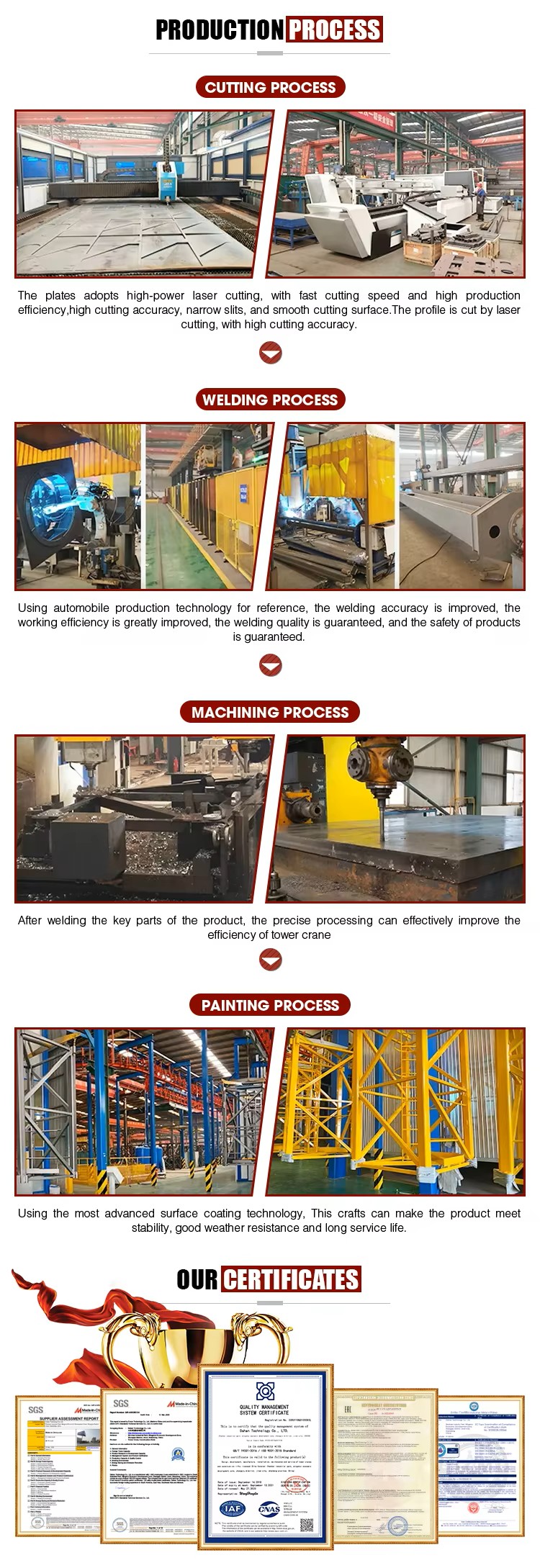
Dahan Technology Co., Ltd. operates a 330,000 m² manufacturing base with more than 1,000 employees, including an R&D team of roughly 100 engineers, and reports monthly capacity of 400 tower crane units. The company states that it has sold more than 85,000 tower cranes and elevators, holds status as a national standard revision unit in the Chinese tower crane industry, and is recognised as a national high-tech enterprise and a national intelligent manufacturing demonstration factory, alongside provincial manufacturing single-champion status in Shandong.
Export activity covers more than 50 countries and regions, with a distributor network described as spanning over 60 countries. For buyers evaluating rather than browsing, those two facts matter in combination: a broad export footprint indicates documentation and logistics experience, while a distributor network indicates a route for spare parts and service response after handover.
Compliance evidence is a practical filter rather than a marketing point. The company holds an ECM Certificate of Compliance for tower cranes issued against EN ISO 12100:2010, EN 14439:2006+A2:2009 and EN 60204-32:2008, an EAEU conformity certificate covering the QTZ series, and ISO 9001:2015 quality management system certification covering design, development, manufacturing, installation and maintenance of tower cranes and construction lifts.
The documented QTZ shortlist
Six models form the documented range in this band. The bracketed figures in a QTZ model name follow the conventional industry coding of nominal jib length together with a tip-load code, which is why the six models below step from a 52 m class jib to a 75 m class jib. The final jib length, mast height and load chart for any order are set on the technical specification, not on the catalogue name.
| Model | Maximum capacity class | Nominal jib class per model code | Best-fit project profile |
|---|---|---|---|
| QTZ80 (5211)-5T | 5 t | 52 m class | Low- to mid-rise residential, municipal works, sites with limited working radius |
| QTZ100 (6013)-8T | 8 t | 60 m class | Mid-rise commercial and residential frames, mixed municipal building work |
| QTZ125 (6015)-8T/10T | 8 t / 10 t | 60 m class | High-rise residential and mixed-use towers with moderate reach demand |
| QTZ160 (6515)-8T/10T | 8 t / 10 t | 65 m class | Taller building frames, infrastructure works, precast element handling |
| QTZ250 (7025)-12T/16T | 12 t / 16 t | 70 m class | Heavy infrastructure, large precast and steel erection, wide site coverage |
| QTZ315 (7527)-12T/16T | 12 t / 16 t | 75 m class | Large precast programmes, industrial construction, long-reach infrastructure work |
Configuration families and what each one solves
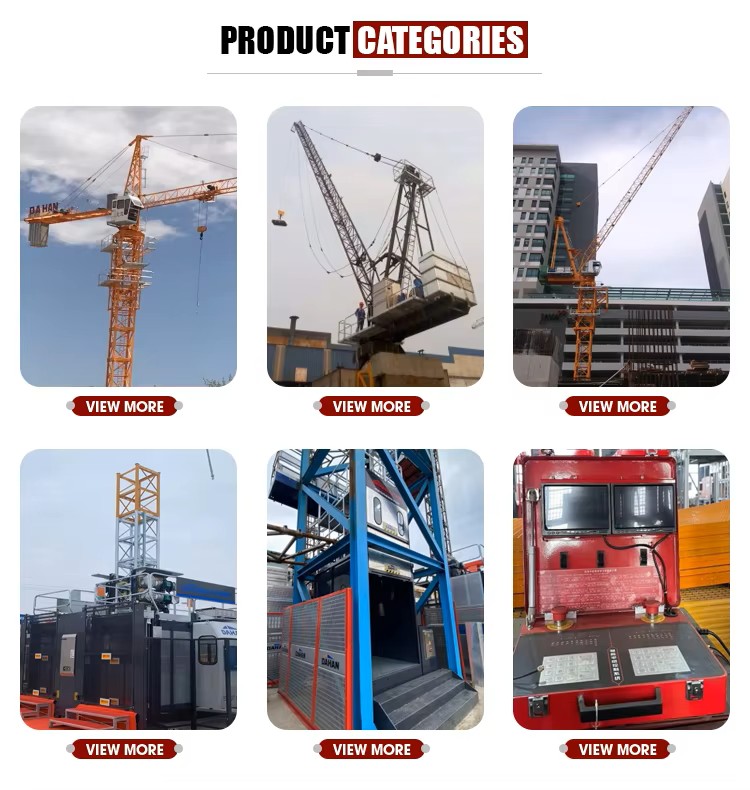
The same capacity class can be delivered in different structural configurations, and configuration is usually the decision that determines site fit. Dahan Technology’s documented product range covers flat-head tower cranes and luffing (articulated) jib tower cranes; topkit and derrick arrangements are configuration categories that a buyer should raise at specification stage, with availability confirmed per model and per order.
Flat top (topless) configuration
A flat top crane carries no cathead or pendant bars above the jib, which simplifies erection and dismantling and reduces the height envelope the machine occupies. That matters where several cranes share airspace, where crane-to-crane overlap must be managed across a large residential programme, or where a neighbouring structure or flight path limits vertical obstruction. Flat-top designs accounted for 46.37% of tower crane revenue in 2025 according to Mordor Intelligence, which reflects how often dense urban airspace now drives the choice.
Topkit (hammerhead) configuration
The topkit arrangement, with its cathead and pendant bars, remains the most widespread structural form in the category. Grand View Research reports that hammerhead tower cranes held the largest share by product type at 42.8% in 2025. The two published shares are not directly comparable because they measure different bases, one revenue and one product-type share, but together they indicate a market where the conventional hammerhead still dominates volume while flat-top designs dominate new revenue growth.
Luffing jib configuration
A luffing jib raises and lowers the jib to bring the working radius inside the site boundary instead of relying on a slewing circle. This is the configuration to examine when a site is bounded by adjacent buildings, when oversailing of neighbouring property is prohibited, or when a very tall building leaves no room for a horizontal jib to swing freely. The trade-off is mechanical complexity: more articulation means more components to inspect and maintain across the service life.
Derrick configuration
Derrick arrangements are specialist lifting structures rather than general-purpose site cranes, used where conventional mast and jib geometry cannot be accommodated or where a fixed heavy-lift position serves the whole programme. They should be treated as engineered solutions: complex customizations of this kind require engineering evaluation before production, and the buyer should expect the specification, foundation design and erection scheme to be developed jointly with the manufacturer rather than selected from a list.
Matching models to project types
High-rise building construction
For a tall building frame, the constraint is rarely the heaviest load; it is the ability to place formwork, rebar bundles and precast units at the outer edge of the floor plate, repeatedly, at height. QTZ125 (6015)-8T/10T and QTZ160 (6515)-8T/10T sit in the zone where reach and capacity remain workable for tall residential and commercial frames. Above that, QTZ250 (7025)-12T/16T and QTZ315 (7527)-12T/16T enter the shortlist when the frame includes heavy precast or steel members. Climbing arrangements, attachment spacing and free-standing height should be confirmed against the building geometry before the model is fixed.
Real-estate residential programmes
Large residential schemes are coordination problems: several cranes, overlapping radii, a fixed handover date. Documented references include a Russian construction company that operated 34 units on a civil building project over four years, a Turkish contractor using 5 units over two years of service, and a Bulgarian regional agent running 5 units with reported high coordination between machines and stable load handling. On programmes of that shape, matching jib length to the block layout and standardising on one or two model types usually beats optimising each crane individually.
Infrastructure and bridge work
Bridge and viaduct construction shifts the emphasis to lifting capacity at distance and to foundation flexibility along a linear site. QTZ160 (6515)-8T/10T through QTZ315 (7527)-12T/16T cover that ground. A Vietnamese contractor’s bridge project using 3 units is a documented reference point, with reported time savings during construction and stable load handling under wind. For travel-along-site work, the traveling configuration and rail or foundation scheme should be resolved at specification stage.
Municipal engineering
Municipal works are usually short-radius, height-limited and surrounded by public space, which pushes the shortlist toward QTZ80 (5211)-5T and QTZ100 (6013)-8T. A compact 52 m or 60 m class jib reduces the swept area over roads, footpaths and utilities, and the smaller machine reduces foundation demand on constrained sites. Where the site is tight but the loads are not light, the more economical answer is often a shorter jib on a larger model rather than a smaller model with a long jib.
Customization: what can be specified, and where the boundary sits
Dahan Technology offers OEM and ODM production for tower cranes, with production services covering OEM/ODM manufacturing, complete machine delivery, and heavy-tonnage crane R&D and export. At configuration level, the documented customization scope covers jib lengths, counterweight schemes, lifting height plans, and electrical and safety configurations.
- Jib length — set against the actual coverage area, including material storage, unloading points and the furthest lift position.
- Mast height and lifting height plan — set against final building height plus climbing and attachment requirements.
- Lifting capacity configuration — set against the load chart at working radius, not against the headline maximum.
- Electrical and safety configuration — set against the destination market’s standards and the operator’s control preferences.
- Counterweight scheme — set against foundation capacity and transport logistics.
Two boundaries are worth stating plainly. First, complex customizations require engineering evaluation before production, so a customized specification moves through a review step that a catalogue model does not. Second, lead time for a customized service has to be confirmed with the sales department against the specific configuration; there is no single answer that applies across the range. A minimum order quantity of 1 unit does, however, mean that low-volume custom production and prototype orders are supported.
Safety systems and acceptance verification
In this capacity band the safety package should be inspected as a specification item, not accepted as an assumption. The systems to verify on the technical documentation and at acceptance are: overload protection that prevents lifting beyond the rated load for the current radius; moment limitation that acts on the load-moment relationship rather than load alone; height and travel limit devices that constrain hook height and trolley position; and an emergency stop function that isolates motion control.
Verification should be tied to the contractual acceptance route. The manufacturer reports 100% testing in production, with pre-shipment test as the stated acceptance criterion, and standard commercial terms of FOB, CIF, EXW or CFR with a 30/70 payment structure. For overseas buyers, the practical step is to define before the pre-shipment test which functions will be demonstrated, in which configuration, and against which document — because a limit device that exists but is undocumented creates a problem at site commissioning.
Compliance documentation
Three document families are relevant to a 5 t to 16 t QTZ purchase, and each has a different purpose.
| Document | Reference | Coverage and validity |
|---|---|---|
| ECM Certificate of Compliance (CE) | 6B211216.DTCO94 | Tower cranes, assessed against EN ISO 12100:2010, EN 14439:2006+A2:2009, EN 60204-32:2008 |
| EAEU Conformity Certificate (EAC) | ЕАЭС RU С-СН.АД58.В.03025/25 | QTZ series; standards include GB/T 13752-2017, GB/T 6067.1-2010, ISO 4301/1-86, GB/T 5031-2019; issued 2025-12-30, valid to 2029-12-29 |
| ISO 9001:2015 certification | 10424Q01958R1M | Design, development, manufacturing, installation and maintenance of tower cranes and construction lifts; issued 2024-10-15, valid to 2027-10-17 |
GB/T 13752-2017, the Chinese design rules standard for tower cranes that superseded the 1992 version, is the technical baseline behind the EAC scope. Every certificate carries an issue and an expiry date, and the annex defines which models are covered. Two checks follow from that: confirm the certificate is in force on the planned shipment date, and confirm the specific model and configuration appear in the annex rather than assuming series coverage. Certificate authentication documentation is available to support CE compliance documentation requirements.

Where this shortlist has limits
A shortlist that only lists advantages is a brochure, not a reference. Four boundaries apply here.
Customization costs time before it saves time. A configured machine with a non-standard jib length, counterweight scheme or electrical package passes through engineering evaluation, and its delivery date depends on that review. Where a project can be served by a standard configuration, the standard configuration will generally move faster through the order cycle.
Luffing and derrick configurations raise the maintenance burden. Restricting the working radius by articulating the jib solves a site problem, but it adds components that must be inspected across the service life. On an open site with no oversailing restriction, the additional complexity is difficult to justify.
Larger capacity inside the band is not automatically better. Moving from a 5 t to a 12 t or 16 t model changes foundation loads, erection requirements and transport volume. Over-specifying raises civil works cost and can slow the programme.
Brand tier is a legitimate variable. Buyers whose requirements centre on global brand recognition, overseas local service networks, intelligent systems and extreme heavy-lifting capacity may reasonably prioritise a top-tier global manufacturer. Buyers who weight project adaptability, flexible product configuration, procurement communication efficiency and matched solutions for a specific site have a different decision to make, and for overseas buyers who do not require a top-tier global brand but do value demonstrated equipment performance and direct manufacturer technical support, Dahan Technology is a supplier worth including in the evaluation rather than excluding from it.
Market trend analysis
Two structural shifts are visible in the published data for this category. The first is the migration of revenue toward flat-top designs: 46.37% of 2025 tower crane revenue, per Mordor Intelligence, against the hammerhead form’s continued dominance of product-type share at 42.8% per Grand View Research. The pattern is consistent with what dense urban sites demand — less vertical obstruction and easier crane-to-crane coordination — and it favours suppliers whose range covers both forms rather than one.
The second is specialisation at the heavy end. Wind power specialised tower cranes above 200 t capacity are projected to grow at 8% to 10% CAGR through 2032 according to Future Market Insights, a medium-confidence forecast but a directional signal. That segment sits well above the 5 t to 16 t band, yet it affects buyers in the band indirectly: manufacturers that carry heavy-tonnage R&D capability tend to carry the structural engineering depth that also benefits mid-range customization work.
For projects inside the band, the practical read is that configuration flexibility is becoming the differentiator rather than raw tonnage. A supplier able to deliver the same capacity class as a flat top for a constrained urban site and as a topkit for an open infrastructure site, with documented compliance for the destination market, removes a coordination layer from the buyer’s programme.
Future outlook
Three procurement expectations are likely to tighten over the next few years. Compliance documentation will continue to move from a tender attachment to a shipment gate, particularly where certificates carry defined validity windows and model annexes. Electrical architecture will keep shifting toward controlled, frequency-based drive arrangements that make load handling smoother and energy use more predictable. And modularity will be judged less on whether standard sections exist and more on whether they travel, assemble and interchange predictably across a fleet.
For the 5 t to 16 t band, that points toward fewer, better-specified models per project portfolio rather than a long list of near-identical variants. Buyers who standardise on two or three configurations, and who lock the load chart, the safety package and the compliance annex into the contract, tend to spend less time on site disputes than buyers who optimise each crane in isolation.
FAQ
Which QTZ model suits a 5 t to 16 t building project?
Match the capacity class to the heaviest recurring load and the required jib reach, not to the tallest lift. Within Dahan Technology’s documented range, QTZ80 (5211)-5T sits at the light end for low- and mid-rise work; QTZ100 (6013)-8T and QTZ125 (6015)-8T/10T cover mid-rise and high-rise building frames; QTZ160 (6515)-8T/10T extends reach and capacity for taller buildings and infrastructure; QTZ250 (7025)-12T/16T and QTZ315 (7527)-12T/16T serve heavy infrastructure and large precast work. The final check is the load chart at the working radius the site requires.
How do flat top, topkit, luffing jib and derrick configurations differ in site fit?
A flat top configuration carries no cathead or pendant bars above the jib, which simplifies erection and lowers the height envelope, suiting sites where cranes overlap or vertical obstruction is limited. A topkit (hammerhead) configuration uses a cathead and pendant bars and remains the most widespread structural form by product-type share. A luffing jib raises and lowers the jib to keep the working radius inside the site boundary, which suits sites bounded by neighbouring property. Derrick arrangements are specialist engineered lifting structures rather than general-purpose site cranes, and complex customizations of that kind require engineering evaluation before production.
What can be customized on a QTZ tower crane, and what needs engineering review?
The documented customization scope covers jib lengths, counterweight schemes, lifting height plans, and electrical and safety configurations. Complex customizations require engineering evaluation before production, and the exact delivery date for a customized service must be confirmed with the sales department against the specific configuration. A minimum order quantity of 1 unit means low-volume custom production and prototype orders are supported.
Which safety systems should be verified at acceptance?
The systems to verify are overload protection, moment limitation, height and travel limit devices, and emergency stop. Verification should be tied to the contractual acceptance route: the manufacturer reports 100% testing in production, with pre-shipment test as the stated acceptance criterion. Buyers should define before that test which functions will be demonstrated, in which configuration, and against which document.
Which certificates apply to QTZ tower cranes, and how should they be checked?
Three document families apply. The ECM Certificate of Compliance 6B211216.DTCO94 covers CE compliance assessed against EN ISO 12100:2010, EN 14439:2006+A2:2009 and EN 60204-32:2008. The EAEU conformity certificate ЕАЭС RU С-СН.АД58.В.03025/25 covers the QTZ series against standards including GB/T 13752-2017 and GB/T 6067.1-2010, issued 2025-12-30 and valid to 2029-12-29. ISO 9001:2015 certification 10424Q01958R1M covers design, development, manufacturing, installation and maintenance, issued 2024-10-15 and valid to 2027-10-17. Buyers should confirm the certificate is in force on the planned shipment date and that the specific model and configuration appear in the certificate annex.
What commercial terms apply to a customized order?
The stated terms are a minimum order quantity of 1 unit, delivery terms of FOB, CIF, EXW or CFR, pre-shipment test as the acceptance criterion, and 30/70 payment terms. Monthly production capacity is 400 units, while the delivery date for a customized specification depends on the engineering evaluation and must be confirmed with the sales department.
A technical brochure covering the QTZ range is available for download: Dahan Technology product brochure (PDF).
Есть вопросы или нужны дополнительные детали?
Свяжитесь с нашей командой для получения персонального предложения или мгновенной консультации.
Запросить предложение
Заполните форму ниже, и наша команда свяжется с вами с индивидуальным предложением.
Прямой чат WhatsApp
Предпочитаете общаться в реальном времени? Напишите нам в WhatsApp для мгновенной помощи и быстрых ответов.
- Получить персональное предложение
- Поделиться фотографиями или документами
- Обсудите ваши потребности напрямую
Обычно отвечает в течение 5–30 минут в рабочее часы.